


Imagine running a hedge fund where you don't need a license, a lawyer, or a bank account. You just write code. That’s the core promise of Enzyme, a decentralized infrastructure protocol that lets anyone create and manage on-chain investment funds. Formerly known as Melon Protocol, this Ethereum-based platform has quietly become one of the most robust tools for serious crypto investors who want professional-grade control without the centralized gatekeepers.
If you’ve ever wondered how people launch their own crypto portfolios or if DAOs can really manage money like traditional firms, Enzyme is the answer. It’s not just another token; it’s an operating system for digital assets. But here’s the catch: it’s complex. The interface isn’t exactly beginner-friendly, and the fee structure has teeth. So, before you buy any MLN tokens, let’s break down what this protocol actually does, how the tech works, and whether it’s worth your attention in 2026.
The Evolution from Melon to Enzyme
To understand where Enzyme is going, you have to look at where it started. Back in 2017, the project launched as Melonport, raising $2.9 million in its ICO. At the time, "DeFi" wasn’t even a common term yet. Most people were still figuring out what a smart contract was. Melonport aimed to bring institutional-grade asset management to the blockchain, but the tech was clunky, and the user experience was rough.
In 2019, after deploying on the Ethereum mainnet, the team rebranded to Enzyme Finance. This wasn’t just a marketing trick. They rebuilt the architecture to be modular and scalable. Today, the project is managed by a DAO called the Melon Council, meaning no single CEO calls the shots. The development team, Avantgarde Finance, continues to build tools, but governance belongs to the community. This shift matters because it aligns incentives: if the protocol succeeds, token holders benefit directly through value accrual and governance rights.
Why should you care about this history? Because it explains why Enzyme feels different from newer, flashier DeFi protocols. It’s battle-tested. While other projects chase hype cycles with high-yield farming, Enzyme focuses on infrastructure reliability. As of 2025, it manages over $150 million in assets, proving that institutions are willing to trust code over bankers.
How Enzyme Actually Works: The Two-Layer Architecture
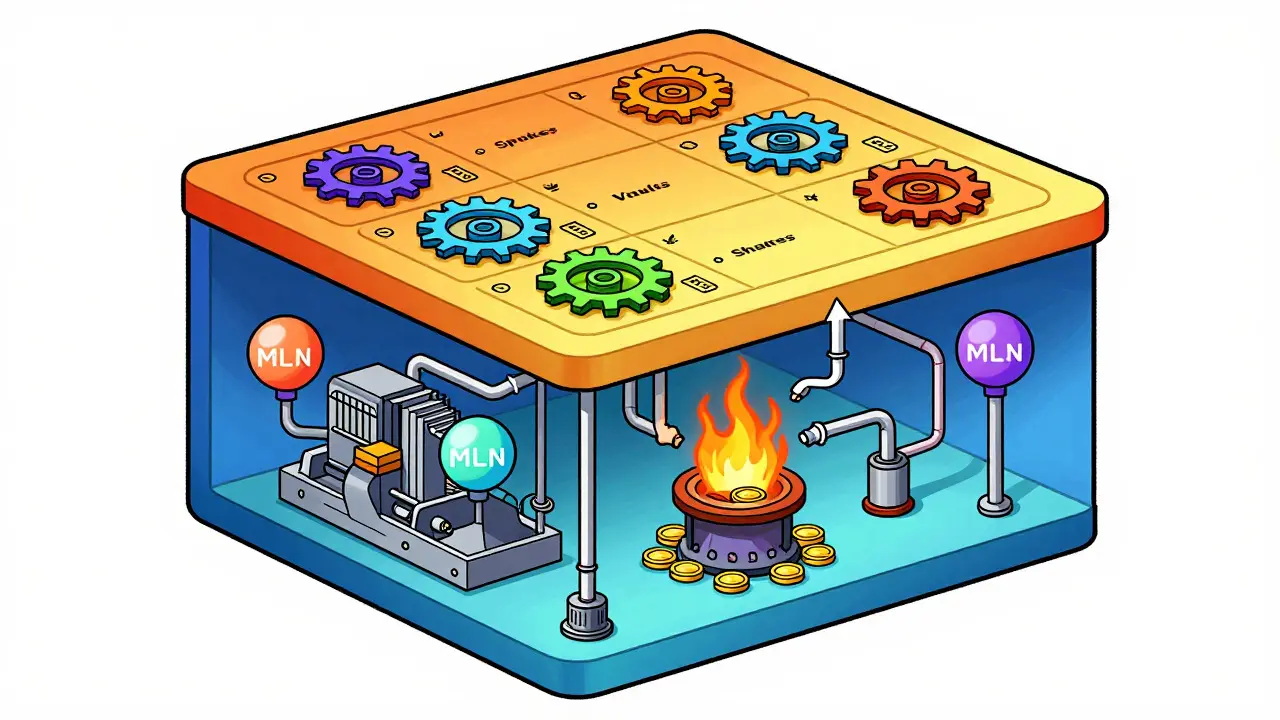
Most crypto tutorials gloss over the technical stack, but with Enzyme, you need to grasp the basics to avoid losing money. The protocol runs on a two-layer system: the Fund Layer and the Infrastructure Layer.
Think of the Fund Layer as your dashboard. This is where you interact with the protocol. It consists of two main parts:
- The Hub: This is your command center. It tracks all components of your fund and provides the tools to set up new strategies.
- The Spokes: These are plug-and-play modules created by fund managers. For example, a "Vault" spoke holds your tokens, while a "Shares" spoke tracks who owns what percentage of the fund. If you want to add a specific trading strategy, you install a Spoke module.
Then there’s the Infrastructure Layer. This is the engine room, controlled by the DAO. It handles the heavy lifting, like connecting to price feeds so the protocol knows what your assets are worth. It also includes the "engine" contract, which automatically buys MLN tokens using ETH to pay for computational costs. This automation is key-it ensures the network stays secure without manual intervention.
For developers, Enzyme offers a JavaScript library that simplifies building front-ends. This means you can create custom interfaces for your fund, making it look and feel like a proprietary app rather than a generic wallet. This flexibility is why many white-label solutions use Enzyme under the hood.
The MLN Token: Utility and Fee Structure
Now, let’s talk about the coin itself. MLN is an ERC-20 utility token, but it’s not just a speculative asset. It’s the fuel that keeps the engine running. Every time a fund operates on Enzyme, fees are paid in MLN. And here’s where it gets interesting: these fees aren’t just collected; they’re burned.
The fee structure is precise. Access fees are calculated at 25 basis points (0.25%) of the total Assets Under Management (AUM). This might sound small, but on a $10 million fund, that’s $25,000 per year. Those MLN tokens are sent to a burn address, effectively removing them from circulation. This creates deflationary pressure, theoretically increasing scarcity over time.
But there’s a penalty mechanism you need to know about. If a fund manager fails to maintain enough MLN to cover fees, their vault shares get diluted by 50 basis points (0.5%). This is a harsh incentive. It forces managers to stay active and funded. For casual users, this can feel punitive. If you forget to top up your MLN balance, you lose ownership stake in your own fund. It’s a strict rule, but it ensures the protocol remains solvent and incentivizes consistent usage.
| Feature | Detail | Impact on User |
|---|---|---|
| Native Token | MLN (ERC-20) | Required for fee payments and governance voting. |
| Fee Model | 25 bps of AUM (Burned) | Deflationary supply; reduces circulating MLN over time. |
| Penalty | 50 bps dilution for missed fees | Strong incentive to maintain token balances. |
| Governance | Melon Council DAO | Community-driven upgrades and parameter changes. |
| Primary Use Case | On-chain fund creation | Allows non-coders to launch structured crypto portfolios. |
Who Uses Enzyme? Institutional vs. Retail
You might think Enzyme is only for whales, but that’s not entirely true. The user base splits into two distinct groups: experienced DeFi participants and institutions.
Retail users who dive into Enzyme usually do so because they want more control than a simple exchange offer. Maybe you want to hold a basket of altcoins that rebalances weekly. Or perhaps you want to lend your ETH while holding a long position in BTC. Enzyme lets you automate these strategies via smart contracts. However, the learning curve is steep. Setting up a fund requires understanding concepts like slippage, oracle prices, and gas optimization. Beginners often struggle with the Hub and Spokes interface, finding it less intuitive than platforms like Uniswap.
On the other hand, institutions love Enzyme. Why? Because of compliance and security. Avantgarde Finance, the core dev team, has undergone rigorous audits. In fact, the UK government has certified their principal developer for security management programs. This level of assurance is rare in DeFi. Tools like Enzyme.Blue offer vault-as-a-service solutions specifically for businesses that want to manage treasury assets on-chain without hiring a full-time blockchain engineer.
There’s also Enzyme.Myso, which focuses on options protocols. This allows sophisticated traders to implement derivative strategies on-chain. If you’re used to traditional finance derivatives, Myso bridges that gap. But again, these tools are designed for pros, not for someone who just wants to swap tokens quickly.

Competitive Landscape: How Does It Stack Up?
Enzyme isn’t alone in the decentralized asset management space. It competes with protocols like Harvest Finance, Ampleforth Governance Token (FORTH), and Bancor. Each has its strengths.
Harvest Finance, for instance, is great for yield farming aggregators. Bancor excels at instant liquidity swaps. But Enzyme’s niche is customization. It doesn’t just give you a pool; it gives you a framework to build your own financial product. This makes it harder to use but far more powerful for tailored strategies.
One area where Enzyme lags is user experience compared to newer competitors. Some newer DeFi apps have slicker interfaces and lower barriers to entry. Enzyme’s performance in recent market cycles has also been mixed. While the broader crypto market saw gains, MLN sometimes underperformed, dropping 3.32% in certain periods while the market rose. This suggests that while the technology is solid, the token price is sensitive to broader sentiment shifts.
Is Enzyme (MLN) a good investment for beginners?
Generally, no. Enzyme is designed for intermediate to advanced users. The interface requires understanding fund mechanics, and the fee penalty system can confuse newcomers. If you’re new to DeFi, start with simpler lending or swapping protocols before trying to launch a fund on Enzyme.
How much does it cost to create a fund on Enzyme?
There is no upfront creation fee, but you must pay ongoing access fees. These are 25 basis points (0.25%) of your Assets Under Management (AUM), paid in MLN tokens. Additionally, you’ll pay standard Ethereum gas fees for transactions. If you fail to maintain sufficient MLN for fees, you face a 50 basis point dilution penalty on your shares.
Can I invest in an existing Enzyme fund?
Yes. Enzyme hosts a marketplace of public funds. You can browse these funds, check their historical performance, and deposit capital. Once you deposit, you receive shares representing your portion of the fund. You can redeem these shares back to the underlying assets at any time, subject to liquidity conditions.
What happens to the MLN tokens collected as fees?
The MLN tokens collected from access fees are permanently burned. This means they are sent to an unspendable address, reducing the total supply of MLN. This deflationary model aims to increase scarcity and potentially drive up the token’s value as the protocol’s usage grows.
Is Enzyme safe to use?
Enzyme’s smart contracts have been audited multiple times by reputable firms. The core development team, Avantgarde Finance, maintains high security standards. However, as with any DeFi protocol, risks include smart contract bugs, oracle failures, and regulatory changes. Always do your own research and never invest more than you can afford to lose.
Final Thoughts: Is Enzyme Worth Your Time?
Enzyme represents a mature phase of DeFi. It’s moved past the wild west of yield farming and into the realm of professional infrastructure. If you’re looking for quick flips or easy passive income, this might not be for you. The complexity is real, and the penalties for negligence are strict.
But if you’re serious about managing digital assets-whether as a DAO, a family office, or a savvy individual investor-Enzyme offers unparalleled control. It turns the blockchain into a customizable bank. The MLN token plays a crucial role in this ecosystem, tying economic incentives to protocol health. Just remember: with great power comes great responsibility. Keep your MLN balances topped up, understand your fund’s strategy, and keep an eye on the evolving regulatory landscape. In 2026, as institutions continue to migrate on-chain, Enzyme stands ready to handle the load.
 Finance