


The big question is whether this platform actually delivers on its promises of high growth and a slick user interface. With reported monthly revenues hitting the $2 million mark and a rapidly growing user base, it looks like a powerhouse on paper. But for the average trader, revenue numbers don't matter as much as slippage, security, and how much of your capital is eaten by fees. Let's break down what this exchange actually offers and where the red flags are hiding.
The Core Trading Experience and Interface
First impressions matter. Project-X focuses heavily on UI/UX, aiming to bridge the gap between the complex feel of a decentralized exchange and the polished experience of a centralized one like Binance. When you first land on the dashboard, the layout is intuitive. You aren't greeted by a wall of confusing charts and jargon; instead, the navigation is streamlined to get you from deposit to trade in just a few clicks.
The platform operates primarily as a Hyperliquid DEX. For those who aren't deep in the weeds of DeFi, a decentralized exchange means you aren't handing your money over to a corporate entity. You trade via smart contracts. This removes the "exchange risk" where a CEO disappears with the funds, but it places the responsibility of security squarely on your shoulders.
One of the standout features is the speed of execution. In the world of perp trading, a one-second delay can be the difference between a win and a liquidation. Project-X manages to keep latency low, providing a responsive environment that feels native to your browser without requiring a heavy desktop application.
Fees and the Points Program Incentive
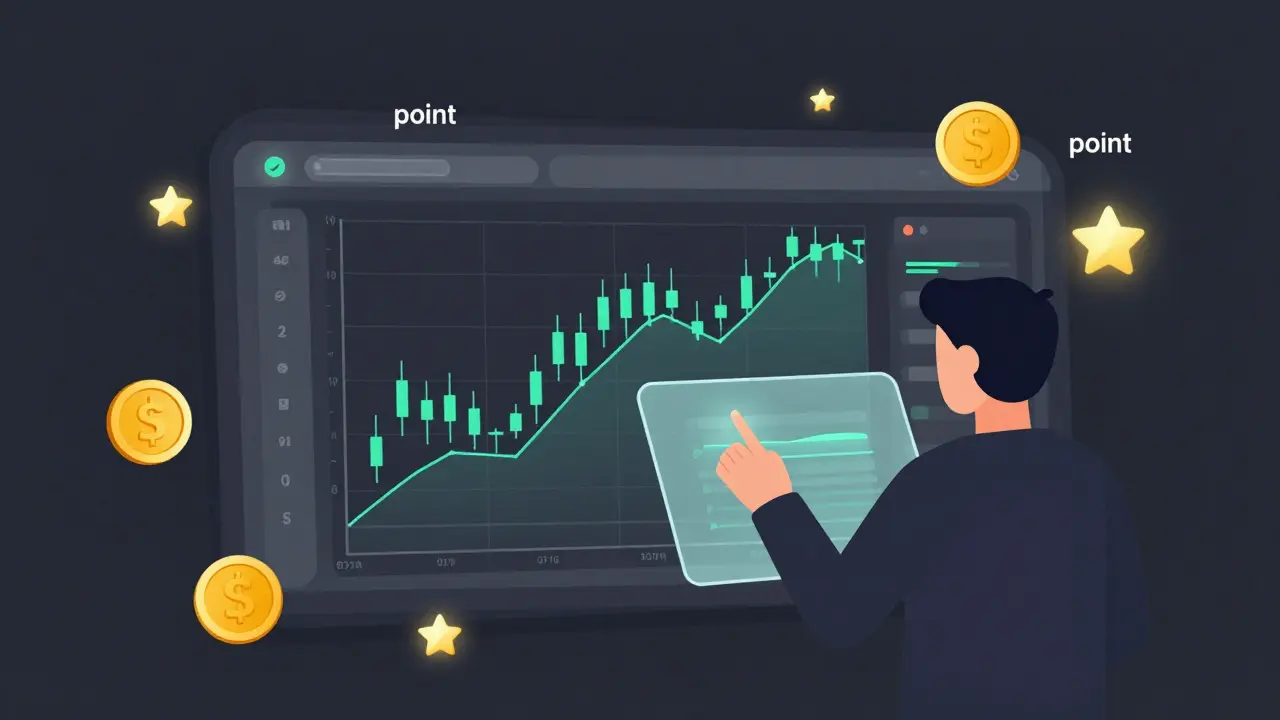
Trading isn't free, and the fee structure here is designed to attract high-volume traders. While they don't publish a static pricing table in the way old-school brokers do, the costs are competitive within the DEX landscape. The real draw, however, is the Points Program, which is an early-stage incentive system used to reward active users.
How does this work in the real world? Imagine you're trading a volatile pair like ETH/USDC. Not only are you speculating on the price, but every trade you make earns you "points." In the crypto world, these points are usually a precursor to an Airdrop-a distribution of new tokens to early adopters. It's a clever way to bootstrap liquidity and keep users from jumping to the next shiny new platform.
However, be careful. The "Points' game" can tempt you into over-trading just to climb a leaderboard. If you're trading more than your strategy dictates just to earn points, you're essentially paying the exchange in losses to get a potential reward later. It's a psychological trap that many beginners fall into.
| Feature | Project-X (DEX) | Standard CEX |
|---|---|---|
| Custody | Self-custody (Your keys) | Exchange-held (Their keys) |
| KYC Requirements | Minimal to None | Strict Identity Verification |
| Incentives | Points & Airdrop potential | Referral bonuses/Staking |
| Execution Speed | Fast (Blockchain dependent) | Instant (Internal Database) |
Security and Potential Pitfalls
Here is where we need to get serious. In the crypto space, "above-average growth" is often a double-edged sword. Rapid growth attracts hackers. Project-X relies on the security of the underlying Smart Contracts. Unlike a bank, there is no one to call if you send funds to the wrong address or if a bug in the code allows a drain.
A major red flag for some users is the lack of transparent founder information. In the early 2010s, anonymous founders were the norm. In 2026, the industry has shifted. While decentralization is the goal, having a known team with a track record of successful projects provides a layer of accountability. When the leadership is a mystery, you're trusting the code alone.
Furthermore, since this is a DEX, you are exposed to Slippage. If you're trading a low-liquidity coin, the price you see on the screen might not be the price you actually get when the trade executes. For small retail trades, this is negligible. For whales moving millions, it's a critical cost factor.

Who is this platform actually for?
Project-X isn't for everyone. If you are someone who wants a "set it and forget it" experience with a customer support chat that can reset your password, stay away. This is a tool for the crypto-native user who understands how to use a hardware wallet and isn't afraid of the risks associated with DeFi.
It's an excellent choice for those who are:
- Hunting for early-stage airdrops through the points system.
- Prioritizing privacy and avoiding the invasive KYC processes of major exchanges.
- Comfortable with the technical side of blockchain and managing their own seed phrases.
- Looking for a high-performance interface that doesn't require an app installation.
On the flip side, if you're a complete novice who just bought your first fraction of a coin on a regulated app, the learning curve here might be too steep. The risk of losing funds due to a simple user error is much higher in a decentralized environment.
Final Verdict: Worth the Risk?
Project-X is clearly riding a wave of momentum. The combination of a high-quality interface and an aggressive incentive program has created a virtuous cycle of growth. The $2 million monthly revenue proves there is a real demand for their specific implementation of the Hyperliquid stack.
Is it the safest place for your life savings? No. No DEX is. But as a tool for active trading and farming potential rewards, it's one of the more polished options available right now. Just remember the golden rule of crypto: never deposit more than you are willing to lose in a single airdrop-hunting venture. Treat the points program as a bonus, not a guarantee, and keep your primary assets in cold storage.
Is Project-X a centralized or decentralized exchange?
Project-X is a decentralized exchange (DEX), specifically leveraging the Hyperliquid infrastructure. This means users maintain control of their private keys and trade via smart contracts rather than trusting a central authority with their funds.
What is the Project-X Points Program?
The Points Program is an incentive system designed to reward early and active users. Traders earn points based on their trading volume and activity, which typically suggests a future distribution of tokens (an airdrop) to those who helped grow the platform.
How does Project-X differ from the prop-firm futures platform?
There is a separate entity called ProjectX that provides futures trading for proprietary trading firms using a TradingView interface. That is a traditional finance tool for funded accounts. The crypto exchange version is a blockchain-based DEX for trading digital assets.
Are there any KYC requirements for using Project-X?
Generally, as a DEX, Project-X does not require the extensive Know Your Customer (KYC) documentation that centralized exchanges like Coinbase or Binance demand, allowing for greater user privacy.
Is my money safe on Project-X?
Safety in a DEX depends on the security of the smart contracts and your own key management. While you avoid the risk of a central entity stealing funds, you are exposed to potential contract bugs and the risk of losing your own private keys.
 Finance


Sara Ellis
April 24, 2026 AT 17:28money is just energy flowing around anyway
Kathleen Bergin
April 25, 2026 AT 13:17Everyone knows that Hyperliquid is the actual engine here and Project-X is just a frontend wrapper. It's not exactly a new innovation, just a better coat of paint on existing tech.
Gary Lingrel
April 26, 2026 AT 11:14typical crypto shill post talking about growth and revenue while ignoring the moral bankruptcy of these airdrop schemes :P just a way to lure in the naive before the rug pull happens im sure
Jennifer Taylor
April 27, 2026 AT 20:46The lack of founder info is a huge sign. They are probably hiding who they really are because they work for the central banks trying to trick us into a digital cage. Wake up people, no one is actually anonymous in 2026
Benjamin Forg
April 27, 2026 AT 23:05imagine trusting smart contracts when the whole system is rigged by the elites who write the code and leave the backdoors open for themselves it is all a game of control and you are just a pawn in their digital chessboard stop being so naive
Caiaphas Konkol
April 28, 2026 AT 01:14The intellectual dishonesty of promoting a platform based on
Caiaphas Konkol
April 29, 2026 AT 06:59The intellectual dishonesty of promoting a platform based on a 'points system' is staggering. It is essentially a gamified psychological operation designed to keep retail traders trapped in a cycle of churn, creating artificial volume that benefits only the liquidity providers and the developers. To suggest that this is a viable 'incentive' rather than a predatory mechanism is a failure of critical analysis. One must wonder if the 'slick interface' is simply a veil to distract us from the void of transparency regarding the team's identity. In an era of systemic fragility, the absence of a verified track record isn't just a 'red flag,' it is a flashing siren of imminent collapse. We are witnessing the commodification of hope, where the promise of a future token is used to subsidize current operational costs. It is truly an exercise in mediocrity masked as innovation.
Alex Wan
April 30, 2026 AT 16:19I absolutelee agree that caution is paramout!! However, the potential for inclusive growth in DeFi is simply magnifcent if we support each other through the learning curve! Let us all try to be patient with the newcommers who may struggle with seed phrases!
Charlie Queen
May 1, 2026 AT 19:02Love the vibe of this analysis! 🌟 It's always great to see tools that make the blockchain more accessible to everyone regardless of where they are from! 🚀
Tony Gurley-Ward
May 2, 2026 AT 13:07Calling it a 'psychological trap' is a bit dramatic, isn't it? It's more like a digital carrot on a stick. A whimsical dance of greed and hope! I'll take my chances with the mysterious founders; the mystery adds a certain spicy flavor to the risk.
Candace Sherrard
May 3, 2026 AT 15:21It is interesting to consider how the shift toward self-custody represents a larger philosophical movement toward individual sovereignty, though one must wonder if the technical burden of managing private keys creates a new kind of dependency on the tools we use to manage them, effectively replacing a corporate master with a technical one that is equally unforgiving in its nature.
Kyle Bush
May 4, 2026 AT 00:57USA SHOULD BE LEADING THE DEX REVOLUTION! 🇺🇸 Why are we letting these mystery teams run the show? Get some real American transparency in here! 🦅💥
Jagdish Sutar
May 4, 2026 AT 10:30For those of you in different regions, checking the local regulations on DEXs is a good first step. It's wonderful to see how these platforms bridge global gaps in financial access.
Keith Garcia
May 5, 2026 AT 22:38The prose in this review is pedestrian at best, though the point about slippage is marginally useful. 🙄 Truly, the obsession with 'points' is a testament to the intellectual decay of the modern investor. 💅
Paige Raulerson
May 6, 2026 AT 09:00I can't believe people actually care about the UI. If you can't handle a bit of clunkiness for the sake of decentralization, you're just a CEX tourist.
Larry Yang
May 6, 2026 AT 11:59Imagine actually thinking a 'slick interface' means security lol. The logic is flawwed. Just another layer of abstraction to hide the fact that the liquidity is probably thin as paper.
Greg Reynolds
May 8, 2026 AT 05:10The assertion that Project-X is for the 'crypto-native' is a misnomer. Most of the people using points programs are simply arbitrageurs and bot farmers, not actual believers in the decentralized ethos.
Ellie Drews
May 9, 2026 AT 10:30I appreciate the warning about over-trading. It's so easy to lose sight of the big picture when there's a leaderboard involved. Be kind to yourselves and your portfolios!