

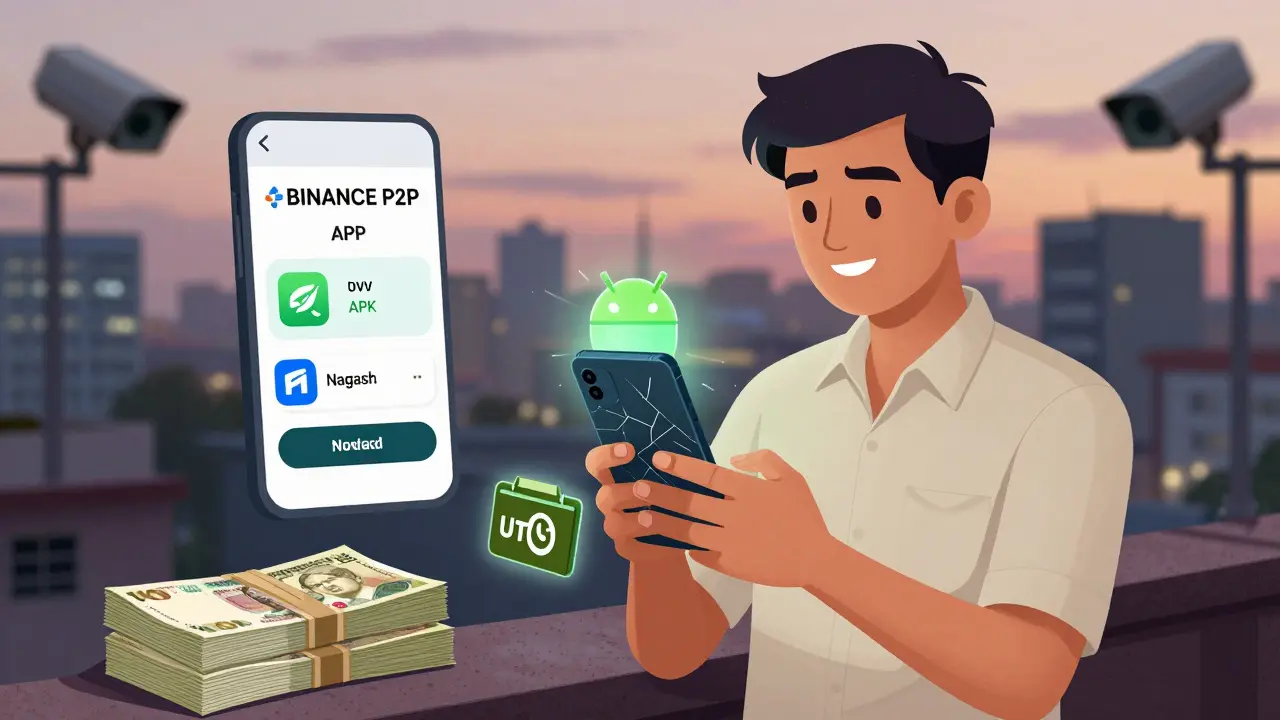
It’s 2025, and you can’t legally buy Bitcoin in Bangladesh. The central bank says it’s illegal. Banks block transactions. Mobile apps like bKash and Nagad warn users not to send money for crypto. Yet, over 3.5 million people in Bangladesh are trading crypto anyway - mostly through peer-to-peer (P2P) methods. How? Because the need is real. People are sending money home to families overseas, and traditional remittance services charge up to 8% in fees. With P2P crypto, they pay less than 2%.
How P2P Crypto Trading Actually Works in Bangladesh
There’s no official crypto exchange in Bangladesh. No licensed platform. No government approval. So traders use international apps like Binance, Bybit, and KuCoin - all of which are technically blocked by the Bangladesh Telecommunication Regulatory Commission (BTRC). But people still get in. They use VPNs. They download APK files. They use older Android phones with Android 7 or even 6. It works.
The real magic happens on Binance’s P2P platform. It’s used by about 68% of Bangladeshi crypto traders. Here’s how it works: You find a seller offering USDT (Tether) for BDT (Bangladeshi Taka). You pay them via bKash or Nagad. The money hits their mobile wallet. Then, after they confirm receipt, Binance releases the crypto from escrow to your wallet. It’s fast. It’s automated. And it’s the only way most people can buy crypto without touching a bank.
Transactions are small - usually between ৳5,000 and ৳500,000 ($46-$460). Most trades happen in under 10 minutes. But the system isn’t perfect. Sometimes, sellers disappear after you pay. Or a bKash payment gets reversed. That’s why 98% of traders use two-factor authentication. Only 37% use multi-signature wallets - too complicated for most.
The Three Main Ways People Trade Crypto in Bangladesh
There are three clear paths:
- Exchange-based P2P (Binance, Bybit) - This is the most popular. Binance alone handles 73% of all exchange-based trades. You pay with bKash (61% of transactions), Nagad (29%), or bank transfer (10%). Spreads are low - usually 1.2% to 3.5% above market price. Escrow protection means you’re not entirely at the mercy of the other person.
- Informal agent networks - These are local dealers, often mobile money agents or shop owners. They buy and sell crypto in cash. No app. No KYC. Just hand over ৳50,000 and get BTC in your wallet. But spreads are high - 4% to 8%. And there’s zero protection. In 2023, over 12,000 such agents were active in Dhaka alone. Many have been arrested. Many have vanished with people’s money.
- Decentralized exchanges (DEX) - A small group - about 8% - use MetaMask and PancakeSwap. They trade directly on the Binance Smart Chain. No middleman. No KYC. But it’s technical. You need to understand gas fees, wallet addresses, and network switches. A single mistake can cost you everything. Still, for those who know how, it’s the most private way to trade.
Bybit is popular for people who want to trade with leverage - up to 50x. KuCoin offers more altcoins than Binance. But none of them let you withdraw BDT directly. You always need to use bKash or Nagad to get your money out.
Why People Risk It: The Remittance Problem
Bangladesh received $21.5 billion in remittances in 2022. Most of it came from workers in the Middle East, the UK, and the US. Sending $5,000 through Western Union or MoneyGram costs $400. That’s 8%. With crypto, you pay $100 - or less. A trader in Chittagong told Reddit he saved $217 on a $5,000 transfer to Dubai. That’s not a small thing. That’s rent. That’s school fees. That’s food.
Most users are young - 68% are under 35. Most live in cities - Dhaka, Chittagong, Sylhet. Many are overseas workers themselves. They don’t trust banks. They’ve seen relatives lose money to fraud. Crypto feels safer because it’s not tied to a bank account. It’s in a phone. It’s digital. It’s theirs.
The Hidden Dangers: Fraud, Arrests, and Scams
But here’s the catch: You have no legal protection.
In 2022, 17 people in Dhaka were arrested under Section 411 of the Penal Code - for “possessing stolen property.” Their crime? Owning Bitcoin. No one was charged with trading. Just owning it.
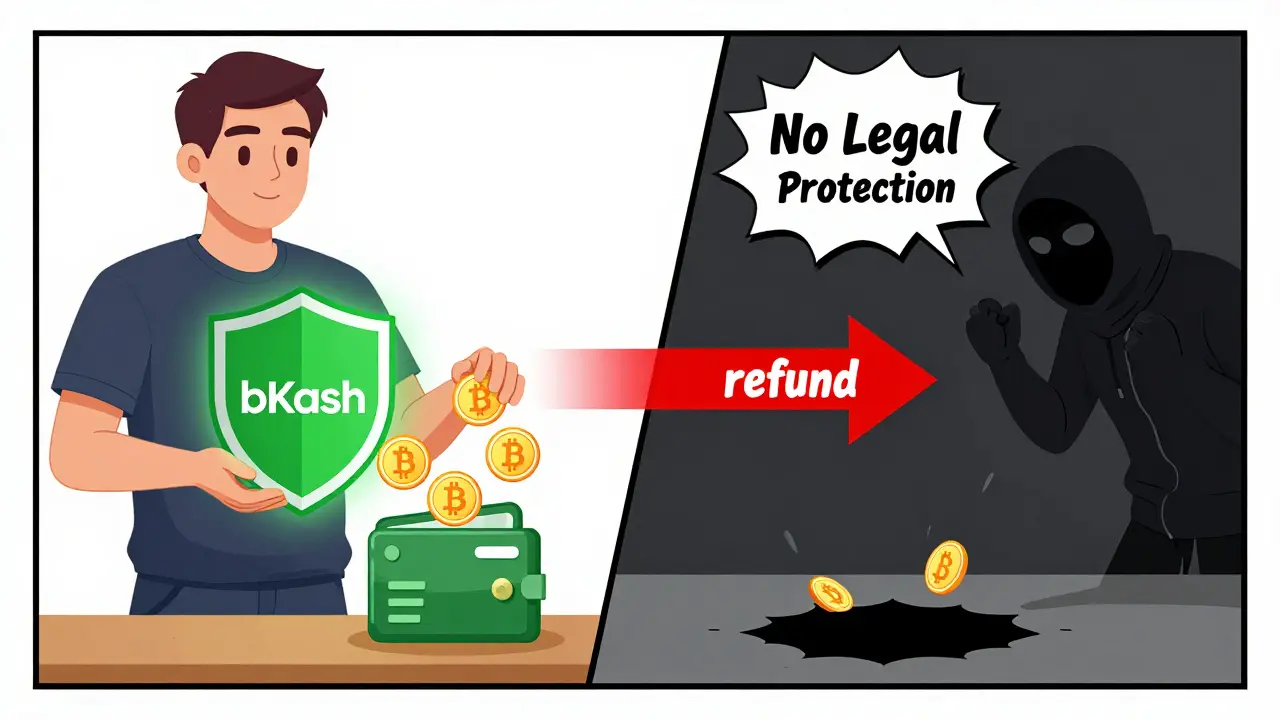
Scams are common. A trader on Trustpilot lost ৳250,000 ($2,300) when an agent reversed the bKash payment after receiving crypto. bKash doesn’t reverse payments for crypto - but scammers trick users into using “cash in” instead of “send money,” then claim the transaction failed. The buyer gets the crypto. The seller gets the money. Then the seller calls bKash and says, “I didn’t authorize this.” The money is refunded. The crypto is gone.
Even Binance’s escrow system isn’t foolproof. If a seller lies about receiving payment, you have to wait 14 hours for support to step in. During Eid holidays, mobile banking systems crash. Transactions that normally take 8 minutes can take 47. People lose money because they’re rushed. They’re tired. They’re sending money to family on the other side of the world.
How to Get Started - If You Decide To
If you’re thinking of trying this, here’s what you need to do:
- Download Binance. Use a VPN if the app won’t open. Install the APK if needed.
- Complete KYC. You’ll need your national ID. Transactions over $1,000 require this.
- Link your bKash or Nagad account. Verification takes about 2.3 hours on average.
- Start small. First trade? ৳7,500. Enough to learn without losing everything.
- Use only trusted sellers. Check their history. Look for “Top Trader” badges. Avoid new accounts.
- Never use “cash in” on bKash. Always use “send money.”
Most beginners take about 17.5 hours to get comfortable. Many need help from friends or Telegram groups. The “Crypto BD Guide” Telegram channel has 47,000 members. They keep a live list of banned agents. It’s the closest thing to a safety net.
The Future: Will It Be Legal?
Bangladesh Bank is working on a digital currency - a central bank digital currency (CBDC). They’ve been testing it since 2022. If it works, they might finally accept digital money - but only if they control it.
In February 2025, the government formed a 12-member Crypto Asset Task Force. Their job? Decide what to do by December 2025. Will they ban it? Regulate it? Tax it? No one knows.
Right now, the government is cracking down. Between October 2024 and January 2025, police raided 87 crypto trading hubs. They seized equipment worth ৳32 million. Banks froze 1,842 accounts linked to mobile financial services.
But adoption keeps growing. P2P volume hit $417 million in Q1 2025 - up 38% from last year. Experts predict it could hit $1.2 billion by 2026. But if the government moves fast, it could collapse in weeks.
For now, it’s a game of cat and mouse. People trade. The government watches. And the system keeps working - because the need is too strong to stop.
 Finance
Janet Combs
December 20, 2025 AT 01:25Wow. I had no idea people were doing this kind of thing in Bangladesh. It’s wild how tech just finds a way, you know? Like, the government says no, but people still send money to their moms and pay for school. That’s real life right there.
vaibhav pushilkar
December 20, 2025 AT 04:16Good breakdown. The bKash reversal scam is the biggest trap. Always use ‘send money’ - never ‘cash in’. Seen too many people lose everything because they didn’t know the difference.
Sheila Ayu
December 21, 2025 AT 06:56Wait… so you’re telling me people are risking jail time… just to save 6% on remittances? And you think that’s smart? What about the fact that crypto is unregulated? That’s not freedom-that’s financial chaos! And don’t even get me started on the fact that they’re using Android 6 phones?!?!?!?!?!?
Ashley Lewis
December 22, 2025 AT 21:22This is irresponsible. People should use legal channels. If the government bans it, there’s a reason. End of story.
Zavier McGuire
December 23, 2025 AT 15:32So people are using VPNs and APKs and bKash to trade crypto because banks are greedy? Cool. I guess that’s just capitalism working. No need to overthink it.
Sybille Wernheim
December 24, 2025 AT 04:09This made me cry a little. Imagine sending your last savings to your sister in Dubai and knowing you saved enough for her to buy medicine instead of paying a fee. That’s not crypto-that’s love with a blockchain.
Shubham Singh
December 24, 2025 AT 08:07How can you possibly consider this a success story? The fact that 98% use 2FA but only 37% use multisig is not innovation-it’s negligence. You cannot build a financial system on desperation and poor security. This is not resilience. It is vulnerability dressed up as ingenuity.
Lloyd Yang
December 25, 2025 AT 04:20Let me tell you something-I’ve talked to guys in Dhaka who trade crypto while waiting for their kids to finish school. They use their lunch break to check bKash confirmations. They’re not gamblers. They’re parents. They’re nurses. They’re drivers. They’re not trying to get rich-they’re trying to keep their families alive. The government’s crackdown? It’s not about regulation. It’s about control. And control doesn’t feed a child. Crypto does. I’ve seen it. The Binance P2P system isn’t perfect, but it’s the only thing standing between a mother and starvation. And yeah, some people get scammed. But the ones who survive? They teach the next person. That’s how real communities build safety nets-no bureaucracy, no forms, just trust and shared knowledge. That Telegram group with 47k members? That’s not a forum. That’s a lifeline. And if the CBDC comes next year? Let’s hope it’s built by people who’ve actually been on the ground, not by bureaucrats in air-conditioned offices who’ve never paid for a meal with a phone.
Jacob Lawrenson
December 26, 2025 AT 14:32THIS IS AMAZING!!! 🚀🔥 I’m so proud of the Bangladeshi crypto community!!! They’re out here building a parallel economy with old phones and bKash!!! YESSSSSS!!!
Vyas Koduvayur
December 27, 2025 AT 07:03Okay, let’s be real. The whole thing is a house of cards. Binance’s escrow system is only as good as their support team, and support takes 14 hours during Eid? That’s not a feature-that’s a bug with a marketing label. And the fact that 12,000 agents were active in Dhaka alone? That’s not a market-it’s a mafia. And you think the government doesn’t know? They do. They’re just waiting for the right moment to swoop in and seize everything. The $417 million in Q1? That’s not growth. That’s a bubble fueled by desperation. And when it pops? The people who lose everything won’t be the ones writing the articles. They’ll be the ones sitting in a Dhaka jail cell, holding a phone with a crypto wallet and no legal recourse. This isn’t innovation. It’s a slow-motion disaster with a nice infographic.
Craig Fraser
December 29, 2025 AT 00:19Why do people think they’re entitled to bypass national laws because they dislike fees? This isn’t civil disobedience-it’s financial recklessness. And the fact that you’re glorifying it is disturbing.
Jake Mepham
December 30, 2025 AT 16:29Just saw a video from Chittagong-guy’s using a Nokia 3310 with a Bluetooth dongle to receive USDT. No screen. Just a beep when the transaction hits. He’s sending money to his daughter in Canada. She’s studying nursing. He doesn’t even know what a blockchain is. He just knows his money doesn’t disappear into some bank’s ‘processing fee.’ That’s the real tech here. Not the app. Not the VPN. The human will to not let poverty win.
SHEFFIN ANTONY
December 30, 2025 AT 18:13Everyone’s acting like this is some heroic underground movement. Bro. It’s a scam magnet. 87 raided hubs? 1,842 frozen accounts? That’s not a revolution. That’s a crime scene. And you’re all just cheering like it’s a TikTok trend. Wake up. This isn’t freedom-it’s fraud waiting to happen. And the next time someone loses ৳500,000 because they used ‘cash in’ instead of ‘send money,’ don’t come crying to Reddit. You were warned.