

What is Perpetual Protocol?
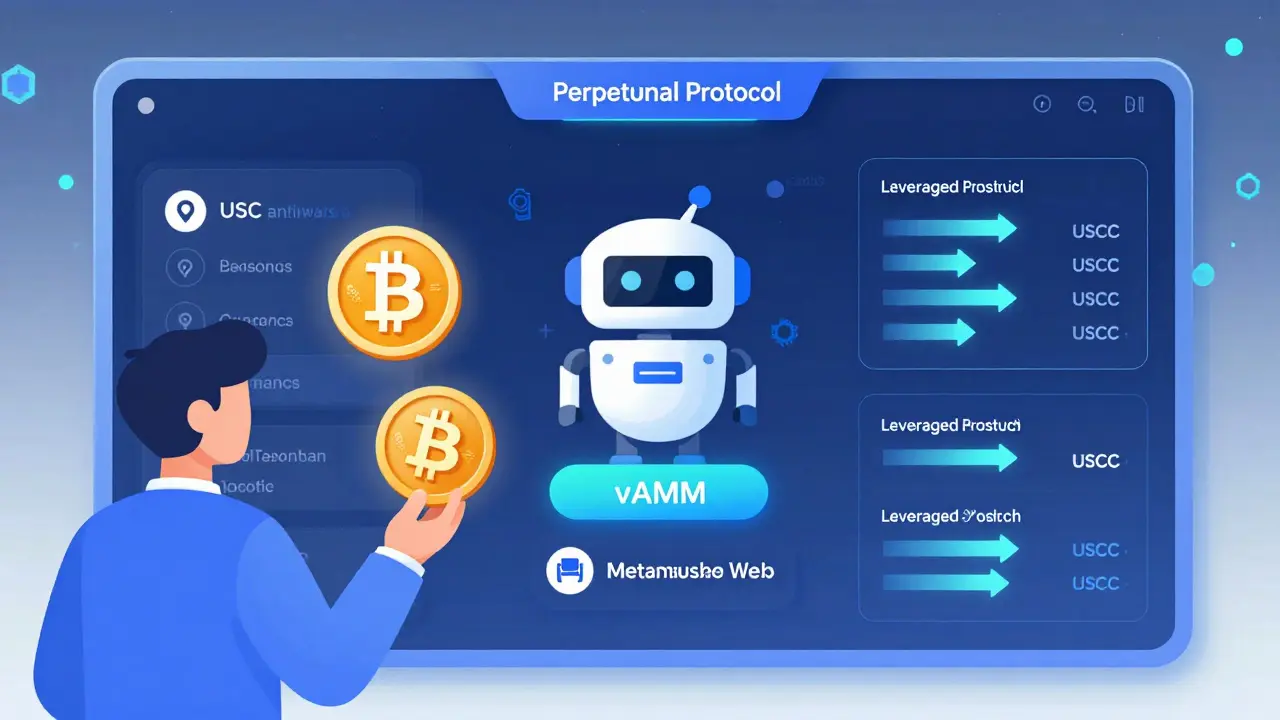
Perpetual Protocol is a decentralized exchange (DEX) built specifically for trading perpetual futures contracts in crypto. Unlike centralized platforms like Binance or Coinbase, it doesn’t hold your money. You trade directly from your wallet-no KYC, no custody, no middleman. It launched in 2020 and has since evolved into a serious player in DeFi derivatives, especially after its v2 upgrade in late 2024.
The core idea is simple: trade leveraged crypto positions without needing someone on the other side of the trade. That’s thanks to its virtual AMM (vAMM) system. Instead of matching buyers and sellers, it uses a mathematical formula to set prices and absorb trades. Think of it like a robot market maker that never sleeps and never gets tired.
How Perpetual Protocol Works
Here’s how it actually works when you open a trade. First, you connect a wallet-MetaMask, Coinbase Wallet, or any EVM-compatible one. Then you deposit USDC as collateral. You can now trade perpetual contracts on assets like BTC, ETH, SOL, and more, with up to 10x leverage.
Every trade happens on-chain. That means every order, every liquidation, every profit or loss is recorded on Ethereum or another supported blockchain. No off-chain matching. No hidden fees. No surprise stop-losses. You see the price, you click, and it executes. The vAMM adjusts the price based on demand, using a constant product formula similar to Uniswap, but optimized for derivatives.
What’s different from centralized exchanges? No counterparty risk. No exchange gets hacked and loses your funds because the exchange doesn’t hold them. If the smart contract fails, you might lose access-but that’s a system-wide risk, not an exchange-specific one.
Perpetual Protocol v2: Major Upgrades
The big shift came with v2, released in late 2024. Before that, you could only use USDC as collateral. Now, you can use other assets like WETH, WBTC, and even DAI. That’s huge. It means you don’t have to convert your holdings just to trade perps.
Another major upgrade: cross-margin. Before, each position had its own isolated margin. Now, your entire collateral pool supports all your trades. If one position starts losing money, it can draw from your other assets instead of getting liquidated immediately. This makes trading less fragile and more like what you’d find on centralized platforms.
And then there’s permissionless market creation. Anyone can propose a new trading pair-say, ARB/USDC or AVAX/USDC-and if it gets enough community support, it goes live. That’s innovation you won’t find on most centralized exchanges, which are slow to add new assets.
Fees and Costs
Perpetual Protocol charges a flat 0.10% fee on every trade, whether you’re the maker or the taker. That’s lower than most centralized exchanges, which often charge 0.04% for makers and 0.07% for takers-plus hidden costs like funding rates that swing wildly.
On Perpetual Protocol, funding rates are built into the vAMM price. They’re predictable and rarely spike. You won’t get hit with a 5% overnight funding fee like you might on some other DeFi platforms. This makes holding positions longer less risky.
Gas fees are the real cost. Since everything is on-chain, you pay Ethereum (or Layer 2) network fees. On Ethereum mainnet, that can be $5-$20 per trade during congestion. But if you use Arbitrum or Optimism, you’re looking at under $0.50 per trade. Most users now trade on Layer 2 to keep costs low.
Performance and Liquidity: The Real Problem
Here’s the hard truth: Perpetual Protocol doesn’t have the liquidity of its competitors. As of September 2025, the entire perpetual DEX market hit $96.9 billion in daily volume. Hyperliquid alone did $15.6 billion. Perpetual Protocol? It’s in the hundreds of millions.
Why does this matter? Slippage. If you try to trade a $10,000 position on a low-liquidity pair, your entry price might be 1-2% worse than what you saw on the screen. That’s money lost before you even open the trade.
The Binance delisting in November 2025 didn’t help. Binance pulled PERP spot and futures trading, citing low liquidity and compliance reviews. That sent a signal to retail traders: if even a giant like Binance doesn’t see enough volume, maybe this isn’t the place to be.
Compare that to Hyperliquid, which processes over 200,000 orders per second with 0.2-second latency. Perpetual Protocol doesn’t publish its own metrics, but user reports suggest it’s slower and less reliable under pressure.
Security and Risks
No custody means no exchange hacks. That’s a win. But smart contract risk? That’s real. If there’s a bug in the vAMM logic, or if the oracle feeding price data gets compromised, your positions could be liquidated incorrectly-or worse, not at all.
There’s also the risk of protocol upgrades. v2 was a big step, but upgrades can introduce new vulnerabilities. The team has audited the code with multiple firms, including CertiK and OpenZeppelin, but audits don’t guarantee safety. Just because it’s been audited doesn’t mean it’s bulletproof.
Wallet security is on you. If you lose your private key, your funds are gone. No customer support can recover them. Use a hardware wallet like Ledger or Trezor. Never use a browser wallet on a public computer.
Who Is This For?
Perpetual Protocol isn’t for beginners. If you’ve never used a crypto wallet, don’t know what leverage means, or get nervous when you see ‘funding rate,’ you should stick to centralized exchanges like Bybit or OKX.
It’s for experienced DeFi users who want:
- Full control over their assets
- Transparency in pricing and fees
- Access to permissionless trading pairs
- Lower funding rate volatility than other DEXs
If you’re a trader who values decentralization over speed and liquidity, this is one of the few places where you can trade perps without trusting a company.
Price of PERP Token: Bullish or Bearish?
The PERP token is used for governance and fee discounts. It’s not required to trade, but holding it gives you a 20% fee reduction.
As of January 2026, PERP is trading around $0.22. That’s down over 80% from its all-time high of $2.80 in early 2022.
Some analysts are optimistic. Changelly says PERP could hit $2.49 by end of 2026. Others, like 3Commas, predict it might dip below $0.17. The divergence is huge because the token’s value is tied to adoption-and adoption is stuck.
The 30-day price increase of 15.29% you see in some reports? That’s noise. It’s a bounce after a long slump. The long-term trend is still down. Until trading volume picks up, the token will struggle.
Alternatives to Consider
If you want decentralization but better performance, look at:
- Hyperliquid: Faster, deeper liquidity, institutional-grade infrastructure. Still decentralized, but built for speed.
- Aster: Easier for beginners. Supports no-bridge deposits from centralized exchanges. Great if you’re new to DeFi.
- Apex: Built on Arbitrum. Low fees, clean UI, good liquidity on major pairs.
Perpetual Protocol isn’t the best in speed or volume. But it’s one of the oldest and most battle-tested. If you believe in true decentralization, it’s still worth keeping an eye on.
Final Verdict: Worth It in 2026?
Perpetual Protocol is a solid technical experiment. The v2 upgrade fixed major flaws. The fee structure is fair. The architecture is elegant.
But the market doesn’t care about elegance if it’s slow and thin.
If you’re a DeFi purist who wants to trade without trusting anyone, and you’re okay with slower execution and occasional slippage, then yes-use it. Use it for small positions. Use it to learn. Use it to support decentralization.
If you’re trading for profit, chasing returns, or want to move large amounts quickly? Go to Hyperliquid or a centralized exchange. Don’t waste your time fighting liquidity issues on a platform that’s still trying to catch up.
Perpetual Protocol isn’t dead. But it’s not winning either. It’s surviving. And in crypto, surviving is sometimes enough.
Can I trade Perpetual Protocol without a wallet?
No. Perpetual Protocol is a fully decentralized exchange. You must connect a Web3 wallet like MetaMask, Coinbase Wallet, or Phantom to trade. There is no sign-up or email login. If you don’t control your private keys, you can’t trade here.
Is Perpetual Protocol safe to use?
It’s safer than centralized exchanges because your funds never leave your wallet. But it’s not risk-free. Smart contract bugs, oracle failures, or failed upgrades could lead to losses. Always use a hardware wallet, start with small amounts, and never invest more than you can afford to lose.
Why did Binance delist PERP?
Binance cited two reasons: low trading volume and compliance reviews. Low volume means not enough users were trading PERP to justify the listing. Compliance reviews suggest regulators may have flagged the token for unclear legal status. The delisting hurt confidence and reduced liquidity further.
What’s the difference between vAMM and traditional order books?
Traditional exchanges match buyers and sellers using an order book. vAMM uses a mathematical formula to set prices and absorb trades automatically. There are no real counterparties. This eliminates the need for liquidity providers but can lead to wider spreads and less price accuracy during high volatility.
Can I use other coins besides USDC as collateral?
Yes. Since the v2 upgrade, you can use WETH, WBTC, DAI, and other major assets as collateral. This makes it easier to trade without converting your holdings first. But USDC is still the most stable and widely used option.
How do I get started with Perpetual Protocol?
First, get a Web3 wallet and fund it with USDC or another supported asset. Go to perpetual.protocol, connect your wallet, deposit collateral, choose a trading pair (like BTC/USDC), set your leverage (up to 10x), and place your order. Always test with a small amount first.
 Finance



CHISOM UCHE
January 16, 2026 AT 14:50Also, why is no one talking about the oracle risk? If Chainlink or Pyth feeds get manipulated during a flash crash, the vAMM could liquidate 20% of positions incorrectly. Audits don't mitigate oracle failure. This isn't just a liquidity problem-it's a systemic risk architecture flaw.
Sarah Baker
January 17, 2026 AT 22:48Perpetual Protocol is the quiet builder. No hype, no VC cash grabs, just clean code and real decentralization. If you believe in the vision-true ownership, no middlemen, permissionless markets-then this is the place to be. Not for quick flips. For long-term believers.
Keep supporting it. The tide turns when the faithful show up.
Pramod Sharma
January 19, 2026 AT 06:25Christina Shrader
January 20, 2026 AT 08:54Andre Suico
January 21, 2026 AT 19:37For institutional traders: Hyperliquid. For libertarians and DeFi purists: Perpetual.
Bill Sloan
January 23, 2026 AT 16:46Slippage was 0.8% on BTC/USDC-acceptable for a DEX.
PERP token is a steal at $0.22. 20% fee discount + governance rights = long-term play. The market will catch up. Trust the stack.
ASHISH SINGH
January 24, 2026 AT 13:19They're draining liquidity slowly. Watch the PERP burns. They're fake. The real tokens are just being moved to Binance custody. They want you to think it's dead so they can buy the bottom.
Don't be the sucker who buys the dip. This is a pump disguised as a protocol.
Callan Burdett
January 25, 2026 AT 16:57But... I still love it. It's like driving a manual car in a world of Teslas. Annoying? Yes. Rewarding? Also yes. I'm not going back to Binance. Not after they froze my funds last year.
Anthony Ventresque
January 26, 2026 AT 07:03Nishakar Rath
January 28, 2026 AT 01:49Jason Zhang
January 28, 2026 AT 20:07Katherine Melgarejo
January 29, 2026 AT 20:22Wow. I didn't know I was paying for a philosophy class.
Patricia Chakeres
January 31, 2026 AT 10:22Anna Gringhuis
February 1, 2026 AT 09:26I use Perpetual for small, experimental trades. I don't sleep with all my funds in it. I keep my main portfolio on centralized platforms. That's not hypocrisy. It's risk management.
Michael Jones
February 2, 2026 AT 01:32Lauren Bontje
February 3, 2026 AT 12:32Stephanie BASILIEN
February 4, 2026 AT 07:37And yet, in this uncertainty, we find the sublime: the human desire to transact without intermediaries, even when the system is imperfect.
Deb Svanefelt
February 4, 2026 AT 17:07Yes, liquidity is low. But look at the community. No shills. No influencers. Just traders helping each other on Discord. That’s rare.
I don’t trade big here. But I hold PERP because I believe in the people behind it. Not the price. The people.
Telleen Anderson-Lozano
February 5, 2026 AT 23:52It’s slow. It’s clunky. It’s expensive sometimes. But it’s honest.
And in a world where every exchange has a backdoor, a hidden fee, a team wallet, or a rug-pull escape hatch… honesty is the rarest commodity of all.