

OI Coin Value Calculator
O Intelligence Coin (OI) is unique - there's only one coin in existence, divisible into 100 million O units. As of December 2025, one OI coin trades between $9.6M and $15.3M.
O Intelligence Coin (OI) isn’t just another cryptocurrency. It’s a one-of-a-kind digital asset with exactly one coin in existence - and that coin can be split into 100 million smaller parts called O units. Launched in February 2025 on the Solana blockchain, OI was built not for everyday spending, but as the backbone of a decentralized artificial intelligence system called Sovereign Super Intelligence. This isn’t about speculation. It’s about creating an AI ecosystem that no single company or government can control.
How OI Works: One Coin, 100 Million Units
Most cryptocurrencies have millions or billions of tokens. Bitcoin has 21 million. Ethereum has no hard cap. OI breaks every rule. There’s only one OI coin ever created. That’s it. No more. No less. But you don’t need to buy the whole thing. The coin is divisible into 100,000,000 O units. Think of it like a dollar divided into pennies. You can own 500,000 O units - that’s 5% of the coin - without paying $10 million. This design makes participation possible while keeping the total supply fixed.The OI token runs on Solana, which means transactions are fast and cheap. It uses the SPL standard, the same one used by most tokens on Solana. But unlike other tokens, OI isn’t meant to be traded like a stock. It’s the fuel for an AI network.
The O.XYZ Ecosystem: AI That Runs Itself
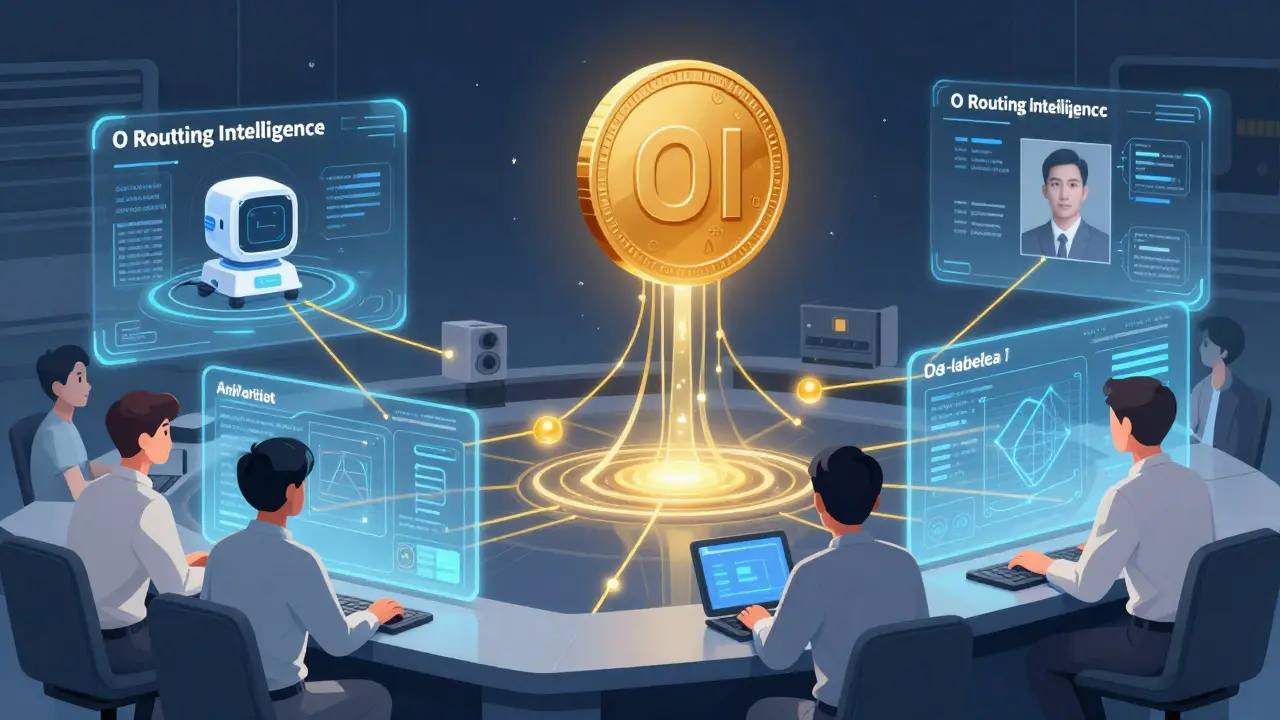
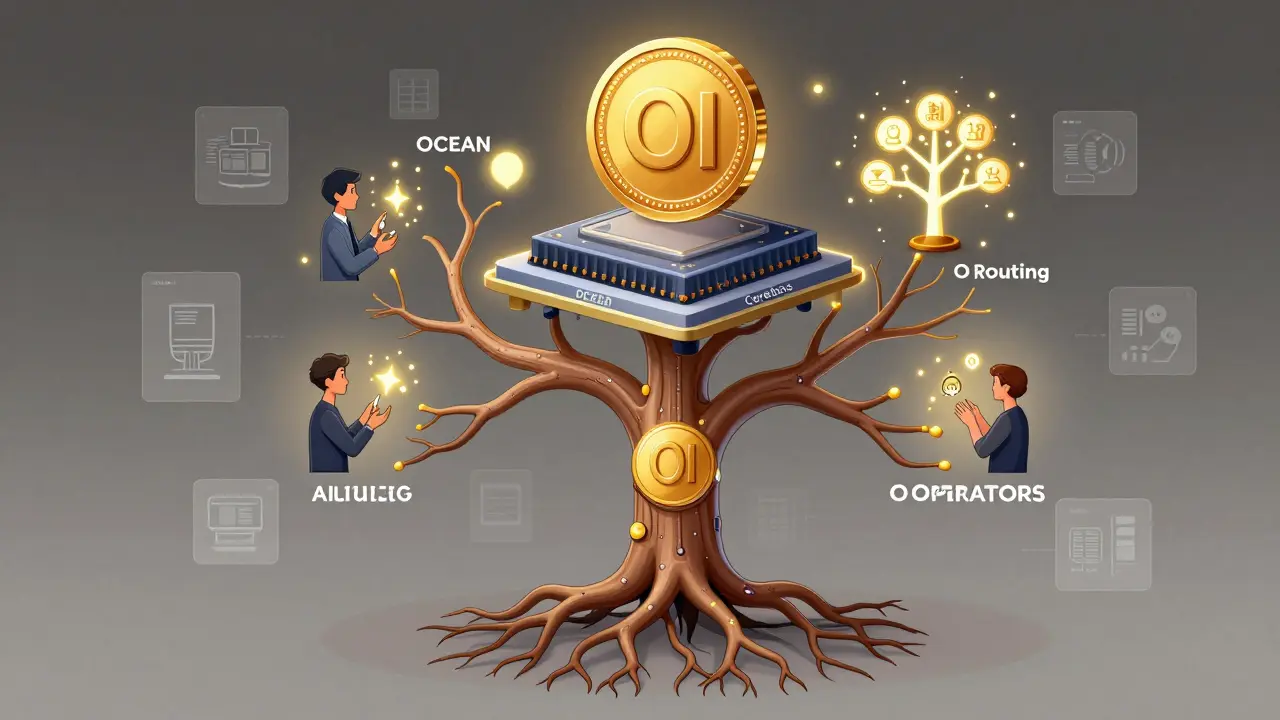
OI isn’t just a token. It’s the heart of the O.XYZ ecosystem, a group of tools designed to build AI without central control. Here’s how it works:- O Routing Intelligence - This system picks the best AI model for each task. Need a translation? It grabs the most accurate one from HuggingFace. Need image analysis? It picks the right model. No human picks. The network decides.
- OCEAN - A decentralized AI assistant powered by Cerebras chips, which are designed for massive AI workloads. This isn’t ChatGPT. It’s an open-source AI that anyone can use, contribute to, or improve.
- OPERATORS - A platform where humans and AI work together. People get paid in O units to label data, test models, or fix errors. AI learns from real human feedback, and humans earn from the system they help build.
Every action inside this ecosystem - whether it’s running a model, submitting data, or voting on upgrades - requires O units. That’s why the coin exists. It’s not a currency. It’s a utility key.
Why Does One Coin Matter?
Most crypto projects talk about scarcity. OI is scarcity. Having only one coin total is symbolic. It’s meant to represent unity - the idea that everyone in the ecosystem is working toward the same goal: building AI that belongs to no one and everyone at once.This model has real consequences. For one, the price is insane. As of December 2025, one OI coin trades between $9.6 million and $15.3 million. That’s more than most houses. You can’t buy it on Coinbase or Binance. You need to use decentralized exchanges like Jupiter or Raydium, and even then, liquidity is thin. The 24-hour trading volume is only around $12,310 - meaning if someone tries to sell even 1% of the coin, the price could swing wildly.
That’s why most people don’t own OI. They own O units. And that’s fine. The system is designed for developers, researchers, and AI engineers - not retail investors. The O.XYZ team says the goal isn’t to make millionaires. It’s to build something that lasts.
Who Uses OI? And Who’s Buying It?
As of December 2025, only about 1,842 wallet addresses hold O units. Most of them belong to early contributors, AI labs, and institutional players. There are no retail investors on Trustpilot or Reddit talking about their OI gains. Why? Because they can’t afford it. One trader on r/solana summed it up: “OI is more of a psychological play than a functional token - its value comes from the narrative, not utility.”That’s not entirely fair. The utility is real - if you’re building AI tools on Solana. But for most people, it’s invisible. You won’t see OI in your wallet unless you’re coding AI agents or running decentralized models. It’s a tool for builders, not buyers.
How Does OI Compare to Other AI Coins?
There are other AI tokens like Fetch.ai ($FET), SingularityNET ($AGIX), and Ocean Protocol ($OCEAN). But they all work differently:| Token | Supply | Blockchain | Primary Use | Accessibility |
|---|---|---|---|---|
| O Intelligence Coin (OI) | 1 coin (100M units) | Solana | Core ecosystem utility | Very low (requires technical skills) |
| Fetch.ai ($FET) | 1.15 billion | Fetch.ai Chain | Autonomous AI agents | High (on major exchanges) |
| SingularityNET ($AGIX) | 1.9 billion | BNB Chain | AI marketplace | High |
| Ocean Protocol ($OCEAN) | 1.4 billion | Ethereum | Data sharing and AI training | High |
OI doesn’t compete on volume or ease of access. It competes on uniqueness. While others build marketplaces, OI builds a single, unified foundation. It’s like comparing a highway system (FET, AGIX) to a single, ultra-precise nerve center (OI).
Is OI Safe? What Are the Risks?
The biggest risk isn’t hacking. It’s meaning. If the O.XYZ ecosystem fails to deliver real AI tools, OI becomes a novelty. A one-coin token with no real-world use is just a meme with a blockchain.There’s also regulatory risk. In December 2025, the U.S. SEC released a new framework for token classification. It asked: Can a token with a single supply and no clear utility be considered a security? The answer isn’t clear yet. If regulators decide OI is a security, trading it could become illegal for most people.
Price volatility is another issue. OI hit an all-time high of $31.5 million in June 2025. By December, it had dropped over 50%. That’s not normal market behavior. It’s the result of a tiny market with huge price swings. One large trade can move the needle by millions.
And then there’s the technical barrier. To use OI properly, you need to know Rust, Solana’s SDK, and how to integrate AI models. Most people don’t. That’s not a bug - it’s a feature. OI isn’t for everyone. It’s for those building the future.
What’s Next for OI?
The O.XYZ team has a roadmap. By Q1 2026, they plan to integrate 47 new AI models from HuggingFace into O Routing Intelligence. They’re also working on cross-chain AI requests - meaning OI could one day connect AI tools on Ethereum, Solana, and beyond.Their goal? To make OI the default unit of value for decentralized AI. Not because it’s cheap. Not because it’s popular. But because it’s the only token designed to represent a truly open, community-owned AI future.
Whether that works depends on one thing: Can they build tools so useful that people are willing to pay millions in O units to use them? So far, the answer is still open.
Is O Intelligence Coin (OI) a good investment?
OI isn’t an investment in the traditional sense. It’s not designed to be bought and held for profit. Its value comes from its role in the O.XYZ ecosystem. If you’re not a developer or researcher building AI tools on Solana, OI offers no practical benefit. The extreme price and low liquidity make it risky and inaccessible for most people. Treat it as a speculative experiment, not a portfolio asset.
Can I buy a full OI coin?
Technically, yes - but you’d need over $10 million. As of December 2025, one OI coin trades between $9.6 million and $15.3 million. Very few individuals have the capital to buy a whole coin. Most participants own O units - fractions of the coin - which are used to access AI services in the ecosystem.
Where can I trade OI?
OI trades only on decentralized exchanges (DEXs) that support Solana tokens, such as Jupiter, Raydium, and Orca. It is not listed on centralized exchanges like Coinbase or Binance. You’ll need a Solana wallet (like Phantom or Backpack) and SOL to swap for O units. Be cautious - low liquidity means prices can change rapidly with small trades.
Do I need to be a developer to use OI?
Yes, to fully interact with OI’s core features. Accessing O Routing Intelligence, deploying AI agents, or contributing to OPERATORS requires knowledge of Rust, Solana SDK, and AI model integration. However, you can hold O units without coding - but you won’t be able to use them for their intended purpose unless you’re building on the ecosystem.
Is OI regulated by the SEC?
As of December 2025, the U.S. SEC has not taken any action against OI. However, its single-supply model and lack of clear utility for the general public raise questions under the SEC’s new token classification framework. Regulators may classify it as a security if they determine it functions more like an investment contract than a utility token. Always assume regulatory risk with any novel crypto project.
What’s the difference between OI and O units?
OI is the single, indivisible token representing the whole ecosystem. O units are the smallest divisible parts - 100 million of them make up one OI coin. You don’t buy OI. You buy O units. Think of OI as the entire pie, and O units as the slices. Most users hold and transact in O units, not the full coin.
 Finance

Chris Mitchell
December 6, 2025 AT 11:57Real innovation doesn't need hype. It needs utility.
nicholas forbes
December 7, 2025 AT 16:47Regina Jestrow
December 8, 2025 AT 14:58Martin Hansen
December 9, 2025 AT 22:44Meanwhile, actual AI engineers are building stuff that works. Not memes with a supply cap.
Lore Vanvliet
December 11, 2025 AT 06:31They're using 'AI' to hide the fact that they're creating a one-world currency controlled by Big Tech and the Fed. You think you're owning a piece of the future? You're signing a contract for digital serfdom. #WakeUp
They're already tracking your wallet. You're not anonymous. You're a data point.
Scott Sơn
December 12, 2025 AT 10:08It’s like buying a Van Gogh and then locking it in a vault so no one else can see it. The beauty is in the impossibility.
Frank Cronin
December 14, 2025 AT 05:07Go buy Dogecoin. Your wallet will thank you.
Stanley Wong
December 14, 2025 AT 20:31Cristal Consulting
December 16, 2025 AT 00:39But if you're learning Rust or building AI agents? This is your playground. Start small. Get O units. Play. Build. You'll thank yourself later.
Tom Van bergen
December 17, 2025 AT 12:18Sandra Lee Beagan
December 18, 2025 AT 20:52It’s not flashy. It doesn’t need to be. The real builders? They don’t tweet. They code. And they’re already using this. I’ve seen it in open repos. It’s real. You just have to know where to look.
Ben VanDyk
December 19, 2025 AT 16:42Chris Jenny
December 20, 2025 AT 18:03THEY SAID 'NO GOVERNMENT CONTROL'... BUT WHO CONTROLS THE NODES? WHO OWN THE CEREBRAS CHIPS? WHO'S BEHIND O.XYZ? HIDDEN CORPORATE BACKERS. I KNOW IT. I'VE SEEN THE PATENTS. THEY'RE ALL CONNECTED TO THE SAME 3 COMPANIES IN SILICON VALLEY. THIS IS A SCAM.
THEY WANT YOU TO THINK YOU'RE PART OF THE FUTURE. YOU'RE JUST A NODE IN THEIR MATRIX.
Thomas Downey
December 22, 2025 AT 04:38Krista Hewes
December 22, 2025 AT 18:44what if the whole thing is just code and no one actually knows how it works? like what if its just a really fancy calculator that thinks its a god?
ronald dayrit
December 23, 2025 AT 13:50Doreen Ochodo
December 24, 2025 AT 07:35Yzak victor
December 26, 2025 AT 02:08Holly Cute
December 27, 2025 AT 18:32Josh Rivera
December 29, 2025 AT 06:32Pathetic.
Neal Schechter
December 31, 2025 AT 02:56Madison Agado
December 31, 2025 AT 18:26Tisha Berg
January 2, 2026 AT 13:19jonathan dunlow
January 3, 2026 AT 00:22Chris Mitchell
January 4, 2026 AT 16:50