

The WAGMI (Metis) crypto exchange isn’t another Uniswap clone. It doesn’t have thousands of tokens, massive liquidity, or a polished user experience like the big names. But if you’re already deep into the Metis ecosystem - trading METIS, USDC.e, or other Metis-native assets - this exchange might be the quiet workhorse you didn’t know you needed. Here’s the real deal: what it does well, where it fails, and who should actually use it in 2026.
What Is WAGMI (Metis)?
WAGMI (Metis) is a decentralized exchange (DEX) built directly on the Metis Layer 2 network. Unlike centralized exchanges like Binance or Coinbase, it doesn’t hold your crypto. You trade directly from your wallet using smart contracts. This means no KYC, no account freezes, and no middleman. The catch? It only works with assets on the Metis chain. If you’re not already using Metis, you’ll need to bridge your ETH or USDC over first.
It launched in 2023 and has stayed small on purpose. While Uniswap moves billions daily, WAGMI handles about $1.2 million. That’s not a bug - it’s a feature. It’s designed for users who want ultra-low fees and fast trades within the Metis ecosystem, not for traders looking to move $50,000 in a single click.
How It Works: Simple, But Limited
Setting up WAGMI takes less than 10 minutes if you’ve used MetaMask before. Just connect your wallet, switch your network to Metis (chain ID 1088), and you’re in. No downloads. No sign-ups. No email verification.
The interface is clean. You pick a token, pick the one you want to swap it for, and hit swap. There are no limit orders, no stop-losses, no margin trading. Just spot trades. That’s it. If you need advanced tools, look elsewhere. But if you just want to swap METIS for USDC.e without paying $5 in gas fees? This is one of the few places where that’s possible.
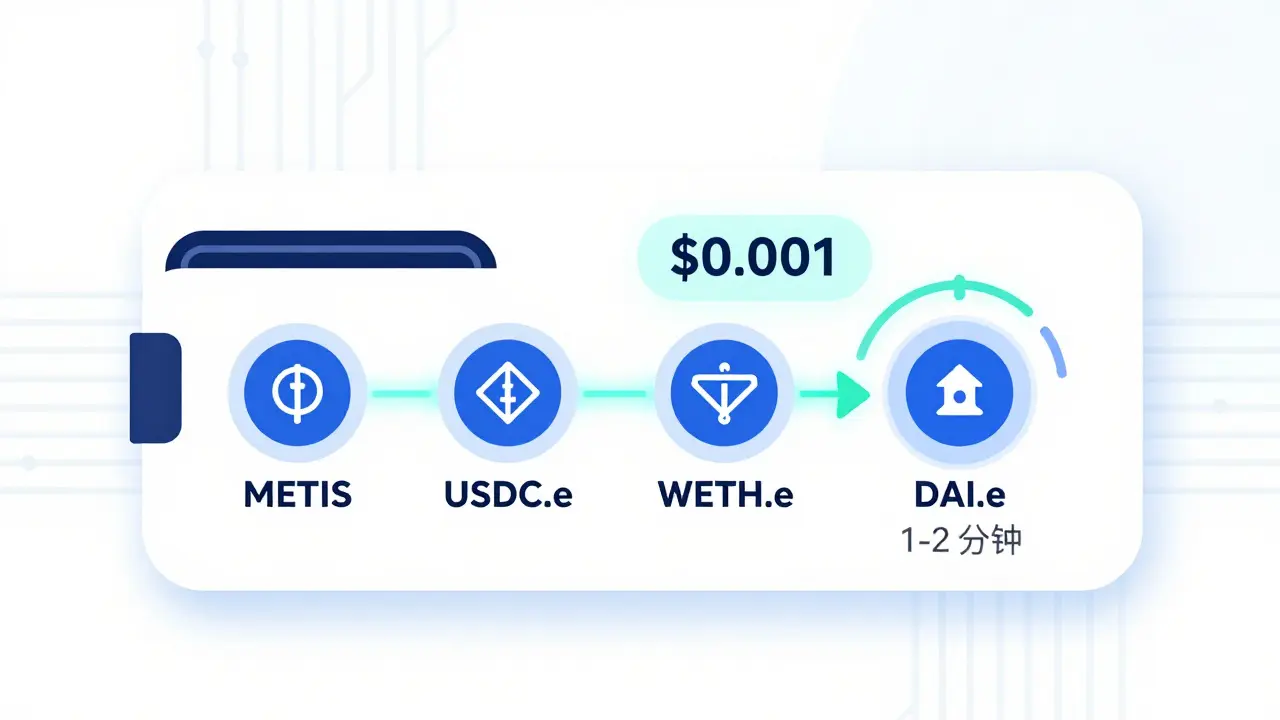
It supports only four tokens: METIS, USDC.e, WETH.e, and DAI.e. That’s it. And only eight trading pairs. So if you’re trying to trade some obscure altcoin from a new Metis project? You’re out of luck. But for stablecoin swaps and core Metis trades? It works.
Fees and Speed: Where It Shines
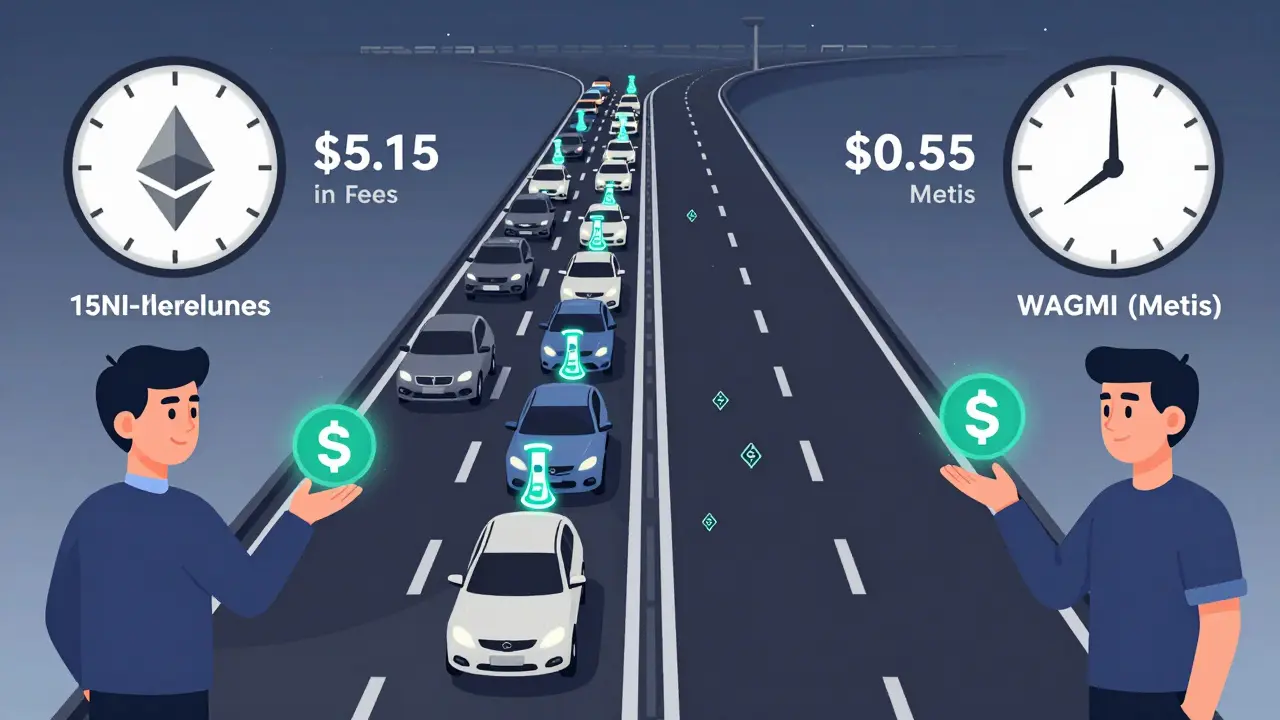
Gas fees on Ethereum can hit $10-$30 during peak times. On WAGMI (Metis)? They average $0.001 per transaction. That’s not a typo. You’re paying one-thousandth of a dollar to swap tokens. Even with the 0.05%-1% trading fee (based on volume), you’re still saving 95%+ compared to Ethereum-based DEXs.
Transaction finality is 1-2 minutes. On Ethereum, that’s 15 minutes. On Solana, it’s fast too - but Solana has its own problems. Metis uses optimistic rollups to bundle hundreds of transactions into one Ethereum proof. That’s why it’s so cheap and fast. WAGMI rides that infrastructure perfectly.
Compare that to Uniswap on Ethereum: 0.3% fee + $5 gas = $5.15 to swap $1,000. On WAGMI: 0.05% fee + $0.001 gas = $0.55. That’s a 90% cost saving. For small traders, that adds up fast.
Liquidity: The Big Problem
This is where WAGMI falls apart for anyone serious about trading.
Its total liquidity is around $8.3 million. That’s down 22% from earlier in 2025. Compare that to Netswap on Metis, which holds $28.7 million. Or to Uniswap, which has $24 billion across all chains.
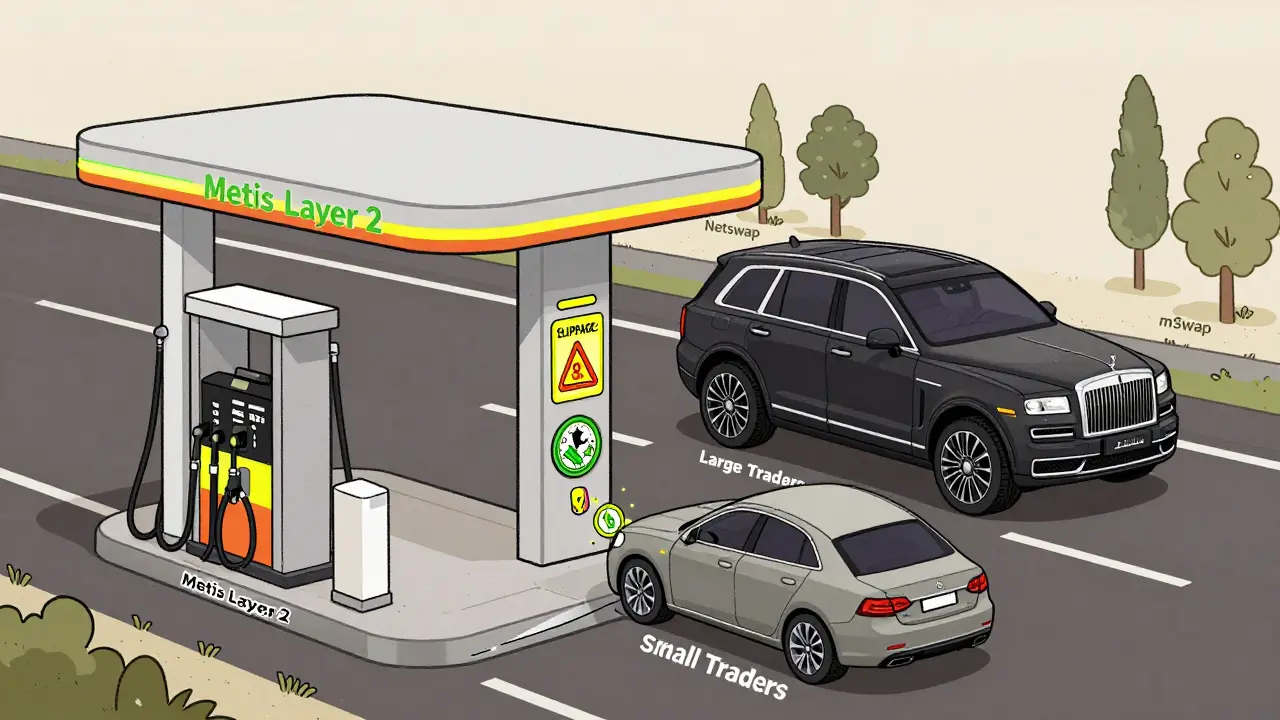
What does that mean in practice? Slippage. If you try to trade more than $2,000 in one go, your price can shift by 5-8%. One Reddit user reported an 8.2% slippage on a $10,000 swap. That’s $820 lost just because the pool was too shallow.
Order book depth? WAGMI ranks in the 29th percentile among DEXs. That means 71% of decentralized exchanges have deeper liquidity. If you’re trading large amounts, you’ll get ripped off. Even $5,000 trades often see 2.3% slippage - way above the industry standard of 0.5%.
For small trades under $1,000? Fine. For anything bigger? Avoid it.
Security and Trust
WAGMI’s smart contracts were audited by CertiK (Report #METIS-WAGMI-2024-087). That’s good. No exploits. No rug pulls. The code is clean.
But security isn’t just about code. It’s about what happens if things go wrong. There’s no insurance fund. No compensation pool. If a bug slips through or a liquidity pool drains, you’re out of luck. Compare that to Aave or Curve, which have $100 million+ in safety reserves. WAGMI has zero.
Also, no KYC. That’s great for privacy, but it means no recourse if you get scammed or send funds to the wrong address. You’re fully responsible. That’s fine for experienced users. Not so great for beginners.
Who Is This For? (And Who Should Avoid It)
Use WAGMI (Metis) if:
- You’re already using the Metis network
- You trade small amounts - under $1,000 per swap
- You care more about gas fees than token variety
- You want to avoid KYC and centralized exchanges
Avoid WAGMI if:
- You want to trade more than $2,000 at once
- You need limit orders, stop-losses, or margin trading
- You’re looking for a wide selection of coins
- You’re new to crypto and want customer support
It’s not a replacement for Binance or Uniswap. It’s a specialized tool - like a chainsaw instead of a Swiss Army knife. If you don’t need the chainsaw, don’t carry it.
Support and Usability
There’s no live chat. No phone number. No help center with FAQs. Support comes through a Telegram group (1,247 members) and an email address. Response time? Around 32 hours. That’s normal for a small DEX, but frustrating if you’re stuck with a failed transaction.
The interface works well on mobile and desktop. The design is simple, no clutter. But the documentation? Barebones. There are only 9 pages of guides. Uniswap has 47. You’ll need to Google how to bridge from Ethereum to Metis. That’s not hard if you’ve done it before. For newcomers? It’s a barrier.
What’s Next? The Roadmap
WAGMI isn’t standing still. In Q1 2026, it’s adding Chainlink’s CCIP protocol. That means it could start supporting assets from Bitcoin, Solana, and other chains - not just Metis. That’s huge. If it works, it could double its user base.
By March 2026, it plans to add 12 new trading pairs. And it’s testing concentrated liquidity pools - the same tech Uniswap v3 uses - to make liquidity more efficient. If they pull this off, slippage could drop from 2.3% to under 0.8%.
But here’s the problem: the Metis ecosystem is consolidating. Netswap and mSwap are growing fast. New DEXs like MetiSwap are stealing volume. WAGMI’s market share of Metis DEX volume dropped from 15% to 12.3% in 2025. If it doesn’t deliver on its roadmap, it could vanish by 2027.
Final Verdict: Niche, Not Universal
WAGMI (Metis) isn’t the best DEX. It’s not even close to the top 10. But it’s the best DEX for one specific job: swapping small amounts of Metis-native tokens at near-zero cost.
For users deep in the Metis ecosystem - developers, stakers, early adopters - it’s a no-brainer. Low fees, fast trades, no KYC. Perfect for daily swaps.
For everyone else? Stick with Uniswap, PancakeSwap, or a centralized exchange. The liquidity, features, and safety aren’t even close.
Think of it this way: WAGMI isn’t trying to beat Binance. It’s trying to be the most efficient gas station on the Metis highway. If you’re driving that highway, it’s the only place that matters. If you’re not? Keep driving.
Is WAGMI (Metis) a centralized exchange?
No, WAGMI (Metis) is a decentralized exchange (DEX). It doesn’t hold your funds or require KYC. You trade directly from your wallet using smart contracts on the Metis Layer 2 blockchain. This means full control over your assets, but also full responsibility for your trades.
Can I deposit fiat money into WAGMI (Metis)?
No, WAGMI (Metis) does not support fiat deposits. You cannot use credit cards, bank transfers, or PayPal. You must first buy crypto on a centralized exchange like Binance or Coinbase, then bridge it to the Metis network using a bridge like Metis Bridge or LayerSwap before using WAGMI.
What tokens can I trade on WAGMI (Metis)?
As of 2026, WAGMI (Metis) supports only four tokens: METIS, USDC.e, WETH.e, and DAI.e. There are eight trading pairs total - all centered around these four. No altcoins, no new projects. It’s built for stablecoin swaps and core Metis ecosystem trades.
Is WAGMI (Metis) safe to use?
Its smart contracts have been audited by CertiK, so the code is secure. But safety goes beyond code. There’s no insurance fund, no customer support team, and no recourse if you lose funds. It’s safe for small trades if you know what you’re doing. Not safe for large trades or beginners.
Why is slippage so high on WAGMI (Metis)?
Slippage is high because the exchange has very low liquidity - only $8.3 million in total value locked. When you trade more than $2,000, you’re moving a large portion of the available pool, which shifts the price. This is normal for small DEXs but dangerous for anyone trading large amounts.
How does WAGMI (Metis) compare to Uniswap?
Uniswap has 1,200+ tokens, $24 billion in liquidity, and advanced features like limit orders. WAGMI has 4 tokens, $8.3 million in liquidity, and no advanced tools. WAGMI wins on cost and speed for Metis-native trades. Uniswap wins on everything else. They serve completely different users.
Does WAGMI (Metis) have a mobile app?
No, WAGMI (Metis) doesn’t have a standalone mobile app. It works through your wallet’s browser - like MetaMask or WalletConnect - on your phone. The interface is responsive and works fine on mobile, but you’re still using a web-based DEX, not a native app.
What’s the trading fee on WAGMI (Metis)?
WAGMI uses a tiered fee structure: 0.05% for low-volume users, 0.15% for medium, 0.3% for high-volume, and 1% for large traders. Most users pay 0.05%-0.3%. Gas fees on Metis are $0.001 per transaction. Combined, a $1,000 trade costs about $0.55 - far cheaper than Ethereum-based DEXs.
Can I use WAGMI (Metis) without bridging to Metis?
No. WAGMI only operates on the Metis Layer 2 network. If your crypto is on Ethereum, Solana, or BNB Chain, you must first bridge it to Metis using a bridge service. You cannot connect your Ethereum wallet directly and trade on WAGMI without switching networks and bridging assets.
Is WAGMI (Metis) regulated?
WAGMI is incorporated in the UAE and falls under Dubai’s VARA (Virtual Assets Regulatory Authority) framework. However, it currently operates without KYC, even for trades over $1,000 - which violates VARA’s 2025 requirements. This puts it in a legal gray zone. Regulators could shut it down or force KYC at any time.
 Finance


jack carr
March 7, 2026 AT 10:47Jane Darrah
March 8, 2026 AT 13:38Olivia Parsons
March 10, 2026 AT 07:15Bryanna Barnett
March 12, 2026 AT 04:16Jonathan Chretien
March 13, 2026 AT 01:19Ian Thomas
March 13, 2026 AT 20:06Josh Moorcroft-Jones
March 15, 2026 AT 02:04Jeffrey Dean
March 16, 2026 AT 18:25Austin King
March 17, 2026 AT 06:06Denise Folituu
March 19, 2026 AT 03:00Issack Vaid
March 20, 2026 AT 16:28Datta Yadav
March 21, 2026 AT 19:18Brian T
March 23, 2026 AT 12:30Nancy Jewer
March 24, 2026 AT 08:07Jesse VanDerPol
March 25, 2026 AT 03:08jonathan swift
March 26, 2026 AT 22:10jay baravkar
March 27, 2026 AT 05:49Bill Pommier
March 29, 2026 AT 03:59Steven Lefebvre
March 30, 2026 AT 18:02Nash Tree Service
March 31, 2026 AT 21:18Lydia Meier
April 1, 2026 AT 15:37Jackson Dambz
April 2, 2026 AT 03:33Shawn Warren
April 3, 2026 AT 08:13