
Have you ever wished for a weather forecast that told you exactly when the price of Bitcoin or your favorite memecoin would spike? That is the promise behind Dither AI, a project building what it calls the world's most powerful AI time-series models for trading. The ticker symbol is DITH, and it lives on the Solana blockchain. But before you rush to buy, you need to understand what this token actually does, how it works, and why the data surrounding it looks a bit messy right now.
Dither AI isn't just another coin hoping to go viral. It positions itself as an experiment in combining artificial intelligence with cryptocurrency markets. Specifically, it aims to create a "ChatGPT moment" for financial forecasting. Instead of predicting text, their AI predicts price and volume movements. Think of it as a continuous weather report for financial information, designed to help traders make smarter decisions. However, like many early-stage projects, there is a gap between the ambitious marketing and the current reality of its market presence.
The Core Idea: AI Meets Crypto Markets
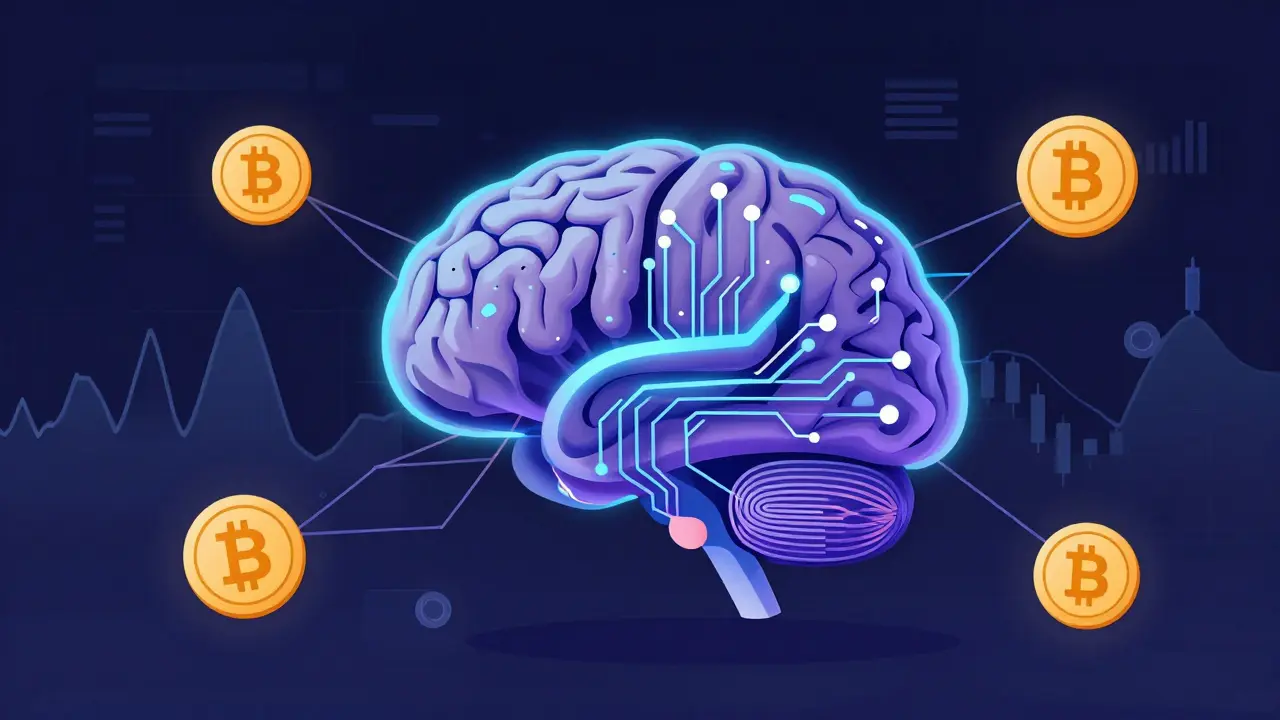
To understand Dither AI, you have to look at the problem it tries to solve. Trading cryptocurrencies is chaotic. Prices swing wildly based on news, social media trends, and whale activity. Traditional analysis often lags behind these changes. Dither AI claims to bridge this gap by using transformer-based models-the same type of architecture that powers large language models-to analyze time-series data.
Time-series data is just a fancy term for data points collected over time, like hourly price charts or daily volume stats. By training its AI on vast amounts of blockchain data, specifically focusing on memecoin markets, Dither AI attempts to spot patterns that humans might miss. The goal is to provide probabilistic forecasts. They don't claim to predict the future with certainty; instead, they offer likelihoods, similar to how a meteorologist says there is a 70% chance of rain.
This approach targets both professional quantitative traders and retail investors who want an edge. The project’s website, dith.ai, emphasizes making this high-level analysis accessible to everyone. The idea is that if you can access institutional-grade AI insights, you stand a better chance of navigating the volatile crypto landscape. But does the technology live up to the hype? That depends on whether you trust the underlying model, which remains largely opaque to the public.
How Does the DITH Token Work?
So, what is the role of the DITH token in all this? In many crypto projects, the token is simply a currency used to pay for services. With Dither AI, the tokenomics are tied directly to the project's experimental nature. The official description states that DITH is an "experimental token which uses a dither bot to incentivize stable value."
This "dither bot" is a key component. While detailed technical specifications aren't publicly available, the concept suggests an automated system that interacts with the market to dampen volatility or reward stability. Essentially, the bot might buy or sell tokens to keep the price within a certain range or to incentivize holders during turbulent times. This mechanism is supposed to align the interests of the community with the long-term health of the project.
However, it is crucial to note that this is still an experiment. There are no published audits or third-party verifications of how this bot operates. You are trusting the developers' code and their stated intentions. In the world of decentralized finance, that trust is earned over time through transparency and consistent performance, neither of which Dither AI has fully established yet.
Market Data and Supply Confusion
If you look up Dither AI on different exchanges, you will notice something strange: the numbers don't match. This inconsistency is a red flag for any investor and highlights the nascent stage of the project. Let's break down what major platforms are saying as of mid-2026.
| Platform | Circulating Supply | Total Supply | Market Cap | Ranking |
|---|---|---|---|---|
| Bitget | 0 DITH | 99,999,802 DITH | $0.00 | #5273 |
| CoinGecko | 100,000,000 DITH | Not specified | ~8.72 BTC | Not specified |
| Crypto.com | Not specified | Not specified | Not specified | Not specified |
Look at that table. Bitget lists a circulating supply of zero and a market cap of $0.00, despite listing a total supply of nearly 100 million tokens. CoinGecko, on the other hand, reports a full 100 million tokens in circulation and a market cap denominated in Bitcoin. Why the discrepancy?
It likely comes down to how each platform defines "circulating supply." Bitget may not have integrated the token into its main order book, meaning it sees no active trading volume on its central exchange. CoinGecko aggregates data from decentralized exchanges (DEXs) and on-chain sources, where some trading is happening. The fact that these major aggregators disagree means the data is unreliable. For an investor, this lack of clarity makes it impossible to accurately assess the true market size or liquidity of the token.
Trading Volume and Liquidity Risks
Liquidity is king in crypto. If you can't sell your tokens easily without crashing the price, you're holding a risky asset. Dither AI currently suffers from very low liquidity. CoinGecko reported a 24-hour trading volume of just $1,761.42 in one snapshot. That is tiny. Compare that to top AI tokens or even popular memecoins, which see millions in daily volume.
Low volume means two things. First, it is hard to enter or exit large positions. If you try to sell a significant amount of DITH, you might not find enough buyers, causing the price to drop sharply-a phenomenon known as slippage. Second, low volume makes the price highly susceptible to manipulation. A single whale buying or selling a few thousand dollars worth of tokens could cause massive percentage swings, creating false signals for traders relying on chart analysis.
The price itself hovers around the $0.01 mark. Bitget listed it at $0.01085, while Crypto.com rounded it to $0.01. At this price point, the fully diluted valuation (FDV)-what the market cap would be if all tokens were in circulation-is roughly $1.08 million. This places Dither AI firmly in the microcap category. Microcaps offer high potential rewards but come with extreme risk. Most fail to gain traction and eventually fade into obscurity.
Where Can You Buy DITH?
If you decide to take the plunge, how do you actually get your hands on DITH? Since it is a Solana-based token, you won't find it on every centralized exchange. Here is the general path:
- Set Up a Web3 Wallet: You need a wallet that supports Solana, such as Phantom, Solflare, or the Binance Web3 Wallet. Make sure you secure your seed phrase properly.
- Fund Your Wallet: Buy Solana (SOL) on a major exchange like Coinbase or Binance and transfer it to your Web3 wallet. You will need SOL to pay for transaction fees and to swap for DITH.
- Use a Decentralized Exchange (DEX): Connect your wallet to a Solana DEX like Raydium or Jupiter. Search for the DITH contract address. Always double-check the address to avoid scams, as fake tokens with similar names are common.
- Swap for DITH: Execute the swap from SOL to DITH. Be aware of the slippage tolerance settings; you may need to increase them due to low liquidity.
Some platforms like Bitget offer a "Buy for $1" widget, which simplifies the process for small purchases. However, this often routes through less liquid pools, so check the final rate carefully. Coinbase provides conversion rates and swap utilities but does not list DITH on its main spot trading page, reinforcing its status as a niche asset.

Risks You Cannot Ignore
Let's be real. Investing in Dither AI is speculative. Here are the specific risks you face:
- No Independent Audits: There are no public security audits of the smart contracts or the AI models. You are trusting the developers' word.
- Opaque Team: The creators do not list individual founder names or company registration details on their main site. They claim experience in AI and crypto, but anonymity increases counterparty risk.
- Unproven Technology: The claim of being a "ChatGPT moment" for trading is marketing speak. There are no published backtests, Sharpe ratios, or accuracy metrics to prove the AI actually works better than random chance.
- Data Inconsistency: As shown earlier, basic metrics like supply and market cap vary wildly across platforms, indicating poor data infrastructure or early-stage chaos.
- Memecoin Volatility: Since the AI trains on memecoin data, it is exposed to the most irrational and volatile segment of the crypto market. This can lead to erratic behavior in both the token price and the AI's predictions.
These aren't minor footnotes. They are fundamental issues that define the risk profile of the asset. If you invest, assume you could lose 100% of your capital. Only put in money you can afford to burn.
Future Outlook and What to Watch
So, is Dither AI a diamond in the rough or a flash in the pan? Right now, it is too early to tell. The project sits in the "experimental" phase. To move from a curiosity to a credible tool, several things need to happen.
First, the team needs to release transparent performance data. Show us the forecasts vs. actual outcomes. Prove that the AI adds value beyond simple trend lines. Second, they need to clarify the tokenomics. Resolve the supply discrepancies and publish a clear distribution schedule. Third, they should undergo independent security audits to build trust in the smart contracts and the dither bot.
Watch for updates on their X (Twitter) account, @Dither_Solana. Community sentiment and development activity will be your best indicators of progress. If you see regular technical updates, partnerships with reputable DeFi protocols, and growing trading volume, that's a good sign. If the silence continues and the volume stays flat, the project may be losing momentum.
In the broader context of AI crypto tokens, Dither AI is trying to carve out a unique niche by focusing on time-series forecasting rather than just compute power or data storage. This is a promising direction, but execution is everything. Until then, treat DITH as a high-risk bet on a novel idea, not a proven investment.
Is Dither AI (DITH) a scam?
There is no definitive proof that Dither AI is a scam, but it carries high risk. The anonymous team, lack of audits, and inconsistent market data are warning signs. It is classified as an experimental project, meaning its success is not guaranteed. Always do your own research and never invest more than you can afford to lose.
What blockchain is DITH built on?
Dither AI (DITH) is built on the Solana blockchain. This means it uses Solana's fast transaction speeds and low fees, and it is traded primarily on Solana-based decentralized exchanges (DEXs).
Why do different sites show different prices and supplies for DITH?
The discrepancies arise because Dither AI is a new, low-liquidity token. Some platforms like Bitget may not have integrated it into their main trading pairs, showing zero circulating supply. Others like CoinGecko aggregate on-chain data from DEXs, showing actual trading activity. This inconsistency is common for microcap tokens in early stages.
How does the "dither bot" work?
The exact mechanics are not publicly disclosed in detail. However, the project describes it as a tool to "incentivize stable value." This likely means the bot automatically trades the token to reduce volatility or reward holders, aiming to stabilize the price. Without an audit or whitepaper, the specific strategy remains unknown.
Can I use Dither AI's forecasting tools for free?
The project aims to make AI analysis accessible, but there is no clear public documentation on pricing or access methods for the forecasting tools. Currently, the primary way to interact with the project is by holding or trading the DITH token. Check their official website and social channels for updates on tool availability.
What is the total supply of DITH?
Bitget lists the total supply as approximately 99,999,802 DITH. CoinGecko references a circulating supply of 100,000,000 DITH. The max supply is not formally capped in some listings, suggesting the total number of tokens may be fixed near the 100 million mark.
 Finance