

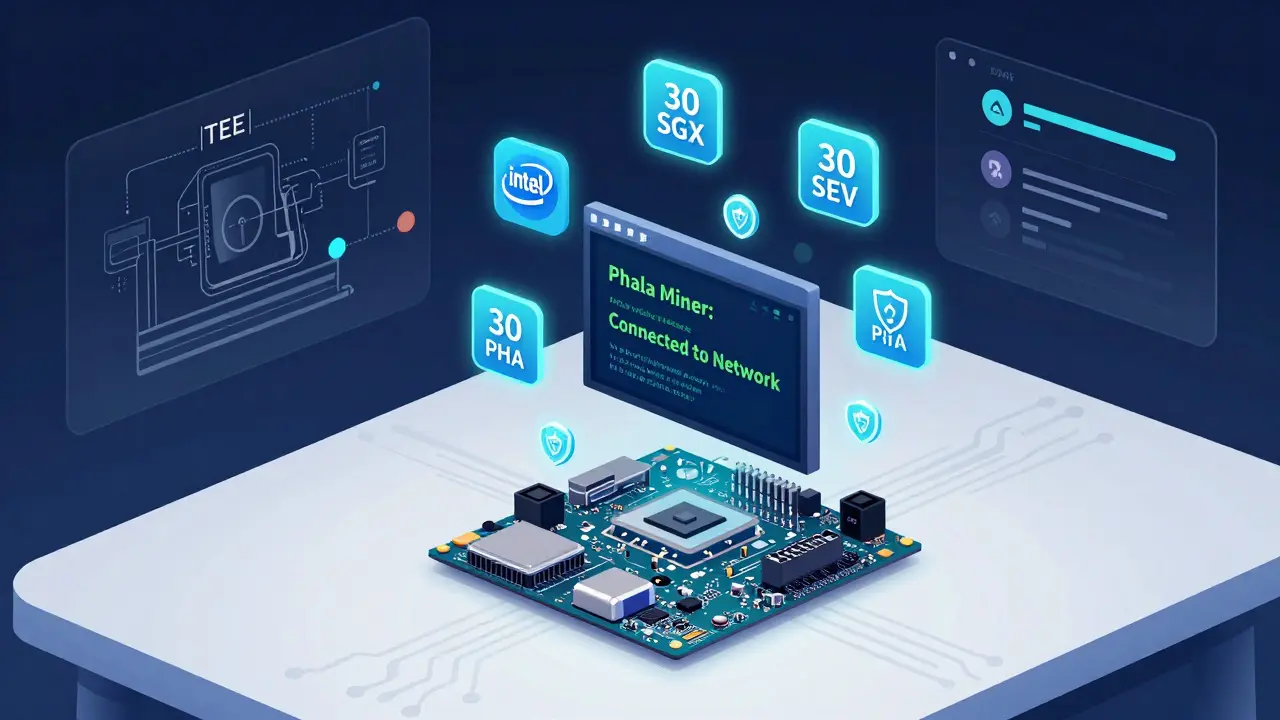
If you’ve heard about the PHA airdrop from Phala Network, you’re not alone. Thousands of crypto users are trying to figure out if it’s worth the effort. Unlike simple airdrops that ask you to tweet or connect your wallet, this one demands real work. You need to run a miner node. You need compatible hardware. And you need patience. But if you’re tech-savvy and believe in privacy-first blockchains, this could be one of the more valuable airdrops you’ve seen in 2025.
What Is the PHA Airdrop?
The PHA airdrop is Phala Network’s way of rewarding early contributors who help secure its privacy-focused blockchain. For completing the setup and running a miner node, participants receive exactly 30 PHA tokens. At current prices (around $0.1029 per PHA), that’s roughly $3.09. It’s not a life-changing sum, but it’s not peanuts either-especially when you consider you’re not just signing up, you’re actively contributing to the network’s security. This isn’t a giveaway for social media followers. It’s a test. Phala wants people who understand blockchain infrastructure, not just those chasing free tokens. That’s why the barrier to entry is higher than most airdrops. You’re not just claiming a reward-you’re becoming part of the network’s backbone.How Does the PHA Airdrop Work?
Here’s the step-by-step process:- Download the official Phala miner software from the Phala Network website. Make sure you’re on the correct version-there are fake versions floating around.
- Check your hardware. You need a CPU that supports Intel SGX or AMD SEV (Trusted Execution Environment). Most modern Intel i5/i7 or AMD Ryzen processors from the last 5 years support this, but you must enable it in your BIOS. If you’re unsure, tools like
sgx_checkcan verify compatibility. - Install the software and run the setup command. This usually involves opening a terminal and typing a few lines of code. No GUI here-you’re working in the command line.
- Once your node is running, you’ll see logs confirming it’s connected to the network. Keep it running for at least 24 hours.
- Take a screenshot of your terminal showing the node status and submit it via the official airdrop portal.
Why Is This Airdrop Different?
Most airdrops are easy. You sign up, you get tokens. Phala’s is different because it’s built on Trusted Execution Environment (TEE) technology. This means your data stays private-even from the network itself. When you run a Phala miner, you’re helping execute smart contracts in a secure, encrypted environment. That’s rare. Most blockchains can’t do this without sacrificing speed or decentralization. Phala’s approach filters out casual participants. Only people who understand hardware, security, and blockchain infrastructure will complete the setup. That’s intentional. Phala wants miners who care about the network’s long-term health, not just quick profits. Compare this to other privacy projects like Oasis (ROSE) or Akash (AKT). They also offer airdrops, but few require you to run actual mining hardware. Phala’s model is closer to early Bitcoin mining-work now, get rewarded later.When Will You Get Your PHA Tokens?
This is the big question-and the biggest source of frustration. The airdrop rewards are tied to the launch of the “Darth Vader” pre-mainnet version. That’s the internal codename for the next major upgrade. As of December 2025, there’s no official date for this launch. The Phala team has been quiet. Community members are guessing, but no one knows for sure. Some participants have been waiting since mid-2024. Others got their tokens within weeks. It’s unpredictable. And that’s the risk. You’re investing time now, with no guaranteed payout date. The network’s upcoming shift from Polkadot to Ethereum Layer 2 (scheduled for November 2025) has added more uncertainty. Will the airdrop rewards be transferred to the new chain? Will the tokenomics change? The team hasn’t confirmed.
Hardware Requirements: Can Your PC Handle It?
This is where many people get stuck. You can’t run a Phala miner on a basic laptop or a cheap VPS. You need:- Intel CPU with SGX support (i5-6xxx or newer, or i7/i9)
- AMD CPU with SEV support (Ryzen 2000 series or newer)
- At least 8GB RAM (16GB recommended)
- Trusted Execution Environment (TEE) enabled in BIOS
Is the PHA Token Worth It?
PHA is trading at $0.1029 as of late December 2025. That’s down from its all-time high of $0.85 in early 2022. But trading volume is strong-over $16 million daily. That means liquidity isn’t an issue. You can sell if you need to. Price predictions vary. Some models suggest PHA could hit $0.117 by 2030. Others say it’ll stay flat unless Phala gains real adoption on Ethereum Layer 2. The network’s $76.98 million market cap puts it in the bottom half of privacy coins. It’s not Solana-level, but it’s not a dead project either. The real value isn’t in the token price-it’s in the utility. If Phala’s privacy smart contracts get used by enterprises, developers, or DeFi protocols on Ethereum, PHA could surge. Right now, it’s mostly used by miners. That’s a narrow base.What’s Next for Phala Network?
Phala is making a major pivot. Its Polkadot parachain slot expires on November 20, 2025. Instead of renewing, the community voted to move fully to Ethereum Layer 2. A new rollup is already live as of January 2025. This is a big deal. Moving from a niche parachain to Ethereum means access to millions of users, thousands of dApps, and deeper liquidity. But it also means competing with established privacy tools like Tornado Cash (which is under regulatory pressure) and newer Layer 2 privacy protocols. If Phala succeeds here, it could become a key privacy layer for Ethereum. If it fails, PHA might just become another forgotten token.
Who Should Try the PHA Airdrop?
You should try this if:- You have a decent desktop or server with Intel/AMD TEE support
- You’re comfortable with terminal commands and basic Linux
- You’re okay waiting months for rewards
- You believe privacy-preserving blockchains have a future
- You’re on a laptop without TEE support
- You don’t want to spend 2-4 hours setting it up
- You need immediate returns
- You’re skeptical about privacy tech being adopted at scale
Common Problems and Fixes
Most issues come down to hardware or setup:- “My node won’t start.” Check if TEE is enabled in BIOS. Reboot and re-enter BIOS settings.
- “I submitted my screenshot but got no response.” Wait 7-10 days. The team processes submissions in batches.
- “The software crashes on my PC.” Try running it on Ubuntu 22.04 LTS. It’s the most stable OS for Phala miners.
- “I can’t find the official site.” Only use phala.network. Any other domain is a scam.
Final Thoughts
The PHA airdrop isn’t for everyone. But if you’ve got the right hardware and the patience to wait, it’s one of the few airdrops in 2025 that actually rewards real contribution. You’re not just collecting tokens-you’re helping build a privacy layer for the next generation of blockchain apps. The risks are real: no payout date, uncertain future, technical hurdles. But so are the rewards. If Phala’s Ethereum migration works, you could look back on this as the moment you got in early.Is the PHA airdrop still active in 2025?
Yes, the PHA airdrop is still active as of December 2025. You can still run a miner node and submit your proof to claim 30 PHA tokens. However, rewards are not yet distributed and depend on the launch of the ‘Darth Vader’ pre-mainnet upgrade, which has no confirmed date.
Do I need to invest money to join the PHA airdrop?
No, you don’t need to buy anything. The airdrop is free to join. However, you need compatible hardware (Intel/AMD with TEE support), which you likely already have if you own a modern desktop. You may need to spend time enabling SGX/SEV in your BIOS, but there’s no financial cost.
Can I run a Phala miner on my laptop?
Maybe. Most laptops don’t have TEE enabled by default, and some manufacturers disable Intel SGX or AMD SEV entirely. Check your BIOS settings. If you don’t see an option for SGX or SEV, your laptop likely won’t work. A desktop with a modern Intel i5/i7 or AMD Ryzen is much more reliable.
What happens after the Polkadot parachain expires?
Phala Network is fully migrating to Ethereum Layer 2. The Polkadot parachain slot expires on November 20, 2025, and all operations will shift to the new Ethereum rollup. Your PHA tokens will remain valid, and the airdrop rewards will be distributed on the new chain. The transition is complete as of early 2025, but the network is still stabilizing.
Is PHA a good long-term investment?
It depends. PHA’s value is tied to whether privacy-preserving smart contracts gain real adoption on Ethereum. Right now, it’s speculative. If Phala becomes the go-to privacy layer for DeFi or enterprise apps, PHA could rise. If it stays niche, it may stagnate. The token’s current price of $0.1029 reflects this uncertainty. Only invest what you can afford to lose.
Where can I buy PHA tokens if I miss the airdrop?
You can buy PHA on major exchanges like Gate.io, KuCoin, and MEXC. It’s also listed on decentralized exchanges like Uniswap via the Ethereum Layer 2 version. Always verify the contract address before trading-scam tokens with similar names are common.
 Finance

Daniel Verreault
December 29, 2025 AT 12:52Elisabeth Rigo Andrews
December 29, 2025 AT 19:57Mandy McDonald Hodge
December 30, 2025 AT 17:17Alexandra Wright
December 30, 2025 AT 18:42Jordan Fowles
January 1, 2026 AT 14:32Monty Burn
January 3, 2026 AT 03:28Kevin Gilchrist
January 5, 2026 AT 02:02Steve Williams
January 6, 2026 AT 04:57Prateek Chitransh
January 6, 2026 AT 09:22Andrew Prince
January 7, 2026 AT 12:26Kenneth Mclaren
January 8, 2026 AT 23:11Jack and Christine Smith
January 9, 2026 AT 07:16Raja Oleholeh
January 10, 2026 AT 12:02Bruce Morrison
January 12, 2026 AT 07:01Jacky Baltes
January 14, 2026 AT 05:57Jackson Storm
January 15, 2026 AT 22:25Adam Hull
January 16, 2026 AT 18:09Bianca Martins
January 17, 2026 AT 11:55surendra meena
January 18, 2026 AT 19:22alvin mislang
January 19, 2026 AT 10:25