

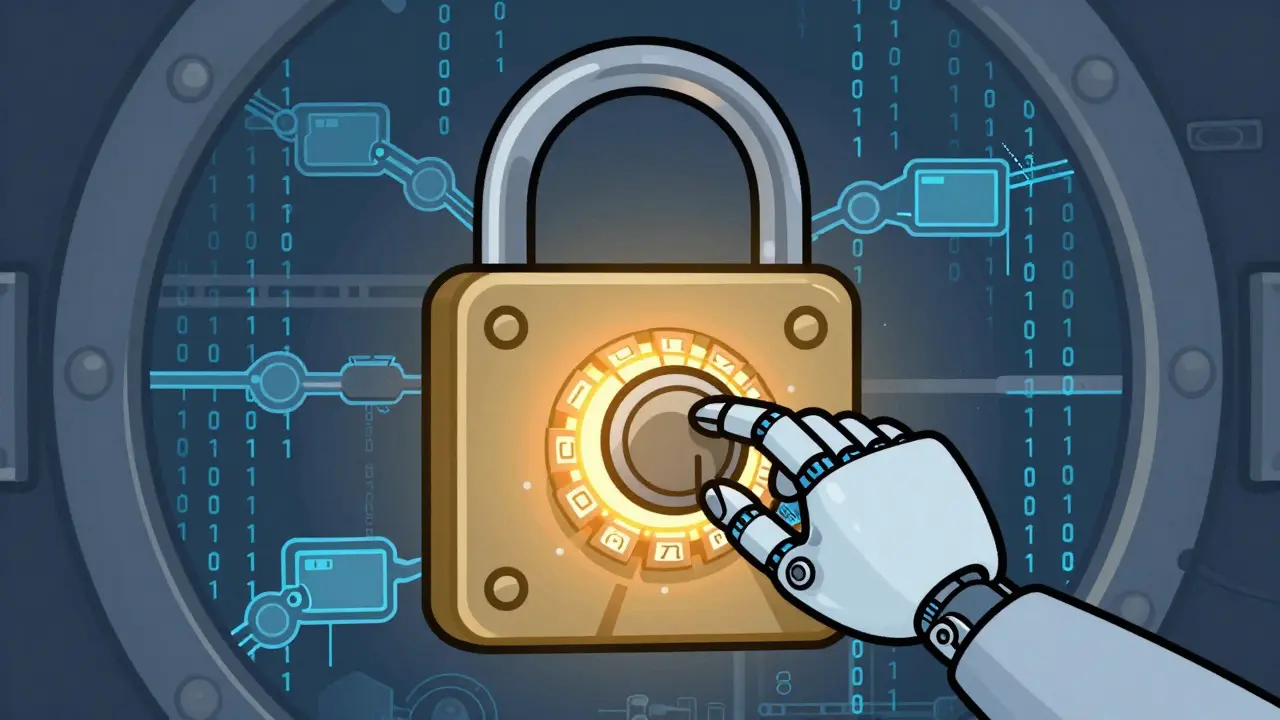
Imagine you are trying to pick a combination lock. You don't know the code, so you try 001, then 002, then 003. You keep turning the dial until it clicks open. In the world of Blockchain, specifically within decentralized digital ledgers secured by cryptography, this random number you change over and over again is called a Nonce. Short for 'number used once,' the nonce is the secret ingredient that makes mining possible and keeps your digital money safe.
If you have ever wondered how Bitcoin miners actually "mine" coins or why blockchain transactions take time to confirm, the answer lies in this small but powerful piece of data. Without nonces, the entire concept of Proof of Work would collapse, and networks like Bitcoin would be vulnerable to attacks. Let’s break down exactly what a nonce is, how it works under the hood, and why it matters for the future of crypto.
The Core Function: What Exactly Is a Nonce?
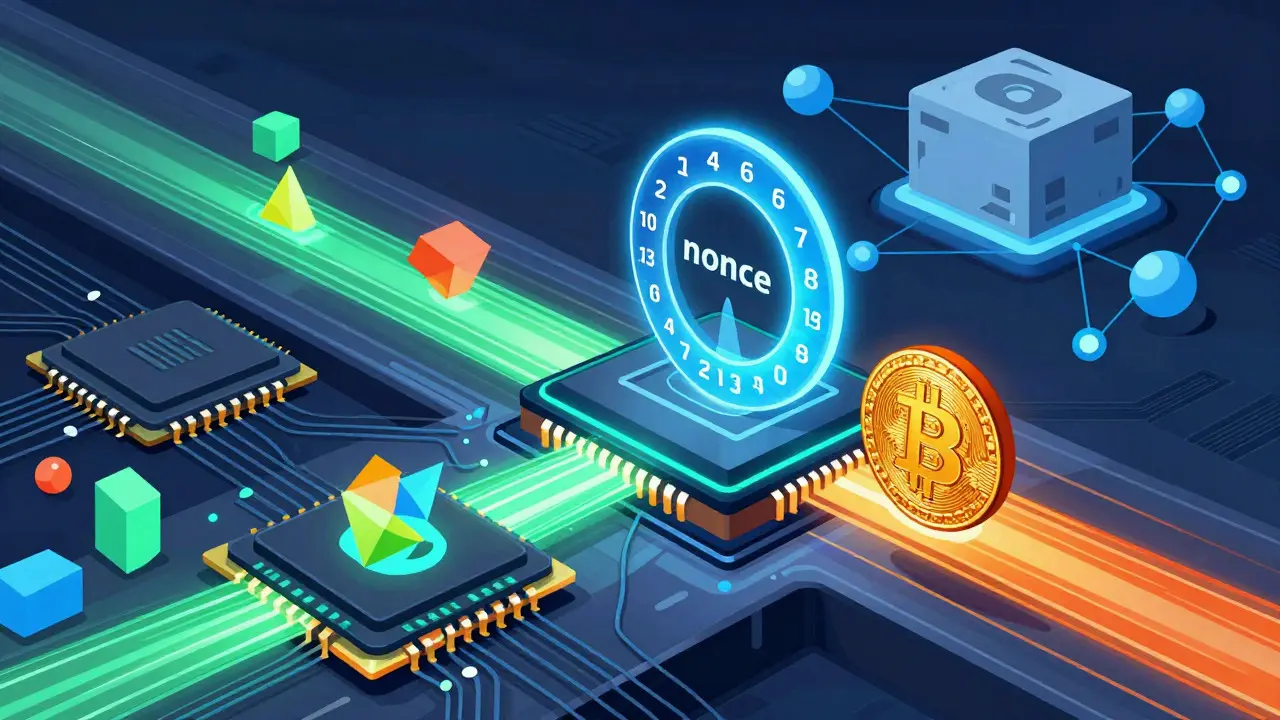
A nonce is essentially a variable number that miners adjust to solve a complex mathematical puzzle. It has no inherent meaning on its own-it’s just a number. However, when combined with other block data, it becomes the key to validating a new block on the chain.
In technical terms, a nonce is a 32-bit integer. This means it can hold values from 0 up to approximately 4.3 billion (specifically 2^32 - 1). When a miner starts working on a new block, they gather all the pending transactions, add a timestamp, reference the previous block's hash, and set the nonce to zero. They then run this data through a cryptographic function.
If the result doesn't meet the network's strict difficulty requirements, the miner increments the nonce to 1, tries again, then 2, then 3, and so on. This process happens millions of times per second. The moment a specific nonce produces a valid output, the block is considered "solved," and the miner broadcasts it to the network. That specific nonce value is now permanently recorded in the block header, ensuring no one can tamper with the block later without redoing the massive amount of work associated with finding that unique number.
How Nonces Drive the Proof of Work Consensus
To understand the nonce, you must understand Proof of Work (PoW). PoW is the consensus mechanism used by Bitcoin and many other cryptocurrencies to agree on the state of the ledger without needing a central authority.
Here is the step-by-step process of how a nonce fits into this:
- Gather Data: Miners collect unconfirmed transactions into a candidate block.
- Create Header: They create a block header containing the Merkle root (a summary of all transactions), the previous block's hash, a timestamp, the current difficulty target, and the nonce (initially set to 0).
- Hash Calculation: The miner runs the entire block header through the SHA-256 algorithm, a cryptographic hash function widely used for security.
- Check Result: The resulting hash is checked against the network's difficulty target. For Bitcoin, this usually means the hash must start with a certain number of leading zeros.
- Adjust Nonce: If the hash is too high (doesn't have enough zeros), the miner changes the nonce and repeats steps 3 and 4.
- Solve & Broadcast: Once a valid hash is found, the miner shares the block and the winning nonce with the network. Other nodes verify the work instantly and accept the block.
This system creates an "unbiased lottery." Because the SHA-256 function is deterministic yet unpredictable, there is no way to calculate which nonce will win. The only way to find it is through trial and error. This ensures that no single entity can predict or control block creation, maintaining the decentralization of the network.
The Role of Hashing and Difficulty Targets
You might ask, "Why do we need leading zeros?" The requirement for leading zeros in the hash output is what creates the computational cost. In mathematics, finding a hash that starts with '0' is roughly twice as hard as finding any random hash. Finding one that starts with '00' is four times harder. As more miners join the network, the protocol automatically adjusts the difficulty-requiring more leading zeros-to ensure that blocks are mined at a steady rate (every 10 minutes for Bitcoin).
As of recent years, the probability of finding a valid Bitcoin block hash on the first try is roughly 1 in 70 trillion attempts. This immense difficulty is why miners use specialized hardware. Standard computers cannot compete. Instead, the industry relies on ASICs (Application-Specific Integrated Circuits). These chips are designed solely to perform SHA-256 calculations billions of times per second, iterating through nonce values faster than humanly possible.
The global Bitcoin network currently processes hundreds of exahashes per second. An exahash is one quintillion hashes. To put that in perspective, if every person on Earth tried to guess a nonce manually, it would still take centuries to match the speed of modern ASIC farms. This computational power secures the network; attacking it would require owning more than 51% of this total processing power, which is economically prohibitive for most attackers.
Nonces vs. Extra Nonces: Solving the Limitation
There is a catch with the standard 32-bit nonce. Since it only goes up to ~4.3 billion, high-powered miners exhaust all possible nonce values in milliseconds. If they haven't found a solution by then, what do they do?
Miners use a technique called "extra nonce" or "nonce rollover." Here is how it works:
- Transaction Malleability: Miners slightly alter the inputs or outputs of transactions within the block (without changing their validity) to generate a new Merkle root.
- Change Block Content: By changing even one bit of transaction data, the entire Merkle root changes. This effectively resets the hashing problem.
- Reset Counter: The miner sets the main nonce back to zero and starts counting up again with this new block structure.
This allows miners to explore a virtually infinite search space. While the visible nonce in the block header is limited, the underlying data manipulation ensures that miners never run out of combinations to try. This optimization is critical for large mining pools that coordinate thousands of machines to share the workload efficiently.
Comparison: Proof of Work vs. Proof of Stake
Not all blockchains use nonces in the same way. The rise of Proof of Stake (PoS) has changed the landscape significantly. Ethereum, the second-largest cryptocurrency, transitioned from Proof of Work to Proof of Stake in September 2022 (an event known as "The Merge").
| Feature | Proof of Work (Bitcoin) | Proof of Stake (Ethereum 2.0+) |
|---|---|---|
| Role of Nonce | Critical: Used to solve hashing puzzles | Minimal/Legacy: No longer used for consensus validation |
| Hardware Required | ASICs (High energy consumption) | Standard servers (Low energy consumption) |
| Security Basis | Computational cost (Energy) | Economic stake (Slashing penalties) |
| Energy Efficiency | Low (High electricity usage) | High (~99.95% reduction in energy) |
| Decentralization Risk | Centralization via expensive hardware | Centralization via wealth accumulation |
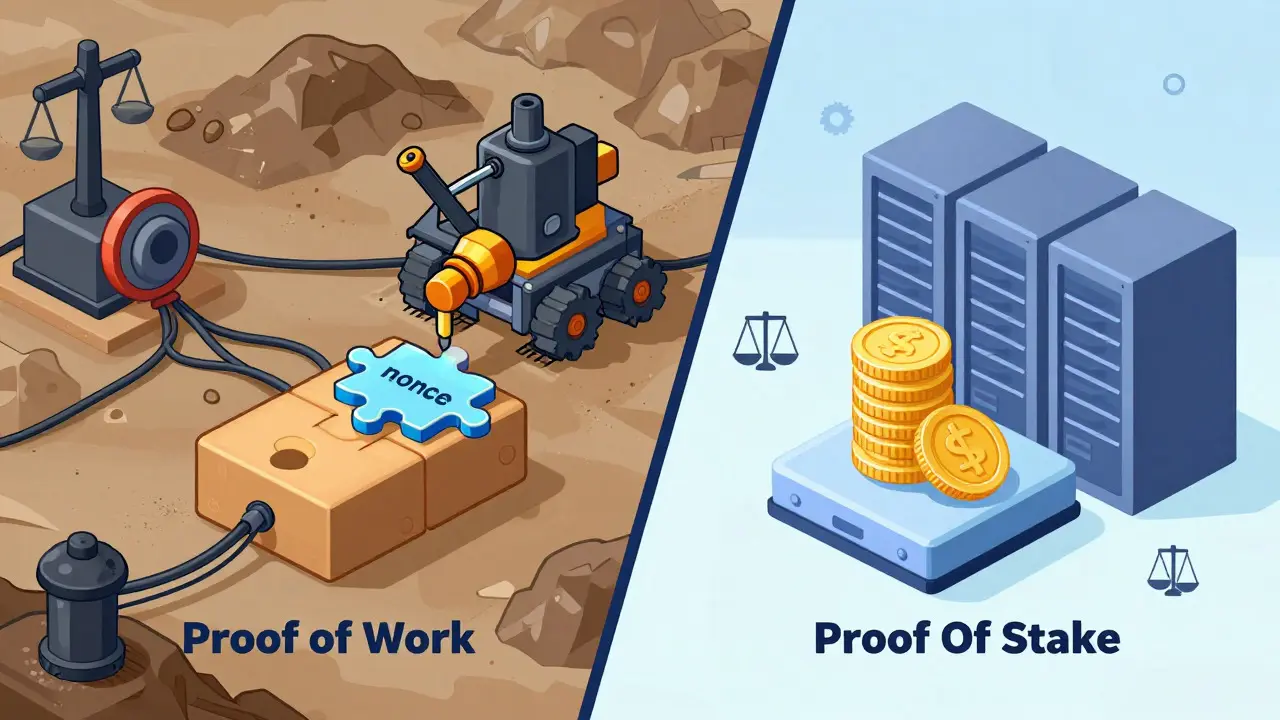
In Proof of Stake, validators are chosen to create blocks based on the amount of cryptocurrency they "stake" as collateral, not their computing power. Therefore, the intense nonce-hunting race disappears. This shift addresses environmental concerns but introduces different economic dynamics. Networks like Litecoin, Dogecoin, and Bitcoin Cash continue to rely on nonce-based Proof of Work, valuing the security provided by physical energy expenditure over pure financial stakes.
Why Nonces Matter for Security
The nonce is not just a tool for miners to earn rewards; it is the backbone of blockchain immutability. Once a block is added to the chain, its nonce is fixed. If a hacker wants to alter a transaction in that block, they must change the block's data. This changes the block's hash. To make the new hash valid, they must find a new nonce that satisfies the difficulty target.
But here is the kicker: changing one block invalidates all subsequent blocks because each block contains the hash of the previous one. So, the hacker must re-mine the altered block AND every block after it, all while competing against the rest of the honest network to stay ahead. This is known as a "51% attack." The nonce makes this attack computationally expensive and practically impossible for well-established networks like Bitcoin.
Experts like Dr. Andreas Antonopoulos often describe the nonce as the element that makes mining fair. It prevents anyone from predicting when a block will be solved. If the system were predictable, wealthy entities could buy the exact computational path to victory, breaking the decentralized nature of the currency. The randomness of the nonce ensures that luck and raw power are the only factors, keeping the door open for new participants.
Future Trends and Challenges
As technology evolves, the role of the nonce faces new challenges. Quantum computing is a theoretical threat to current cryptographic standards, including SHA-256. While quantum computers are not yet capable of breaking Bitcoin's security, researchers are already exploring quantum-resistant hash functions. If these are adopted, the mechanics of nonce discovery might change, potentially requiring larger nonce fields or entirely new algorithms.
Additionally, environmental regulations are pushing some regions to ban energy-intensive mining. China's 2021 mining ban, for example, shifted nearly half of the global hash rate to countries like the United States, Kazakhstan, and Russia. This geographic redistribution highlights the flexibility of nonce-based mining but also raises questions about long-term sustainability. Hybrid consensus models that combine Proof of Work with other methods are being tested to balance security with efficiency.
Despite these shifts, the nonce remains fundamental to Bitcoin's identity. As long as Bitcoin maintains its conservative approach to protocol changes, the nonce will continue to serve as the gatekeeper of the network's integrity. For developers and enthusiasts, understanding the nonce is essential to grasping how trust is established in a trustless environment.
Can a nonce be reused in a blockchain?
Technically, yes, but it is highly unlikely and irrelevant. Each block has a unique combination of transactions, timestamps, and previous hashes. Even if the same numeric nonce value (e.g., 12345) appears in two different blocks, the overall block headers are completely different. The term "used once" refers to its specific context within a single block's mining attempt, not a global uniqueness constraint across the entire history of the blockchain.
Why is the nonce important for Bitcoin security?
The nonce forces miners to expend significant computational effort to validate a block. This cost makes it prohibitively expensive for attackers to rewrite transaction history. To alter a past block, an attacker would need to recalculate the nonce for that block and all subsequent blocks faster than the rest of the network, which requires controlling more than 51% of the total hashing power.
Does Ethereum still use nonces for mining?
No. After transitioning to Proof of Stake in 2022, Ethereum no longer uses mining or nonces for consensus. Validators are selected based on their staked ETH rather than solving cryptographic puzzles. However, the term "nonce" is still used in Ethereum accounts to track the number of transactions sent from a specific address, preventing replay attacks, but this is different from the mining nonce.
What happens when a miner exhausts all nonce values?
When a miner tries all ~4.3 billion nonce values without finding a valid hash, they use an "extra nonce" strategy. They slightly modify the transaction data in the block (such as changing the order or input values) to create a new Merkle root. This resets the hashing problem, allowing them to start the nonce counter over from zero with a new block configuration.
Is the nonce visible to the public?
Yes, the nonce is stored in the block header, which is part of the public blockchain. Anyone can view the nonce value used to mine any specific block using a blockchain explorer. However, knowing the winning nonce does not help you predict future winners, as the relationship between the input data and the hash output is cryptographically random.
 Finance


Joshua Hofford
August 9, 2026 AT 02:24Man, this is actually a really cool way to think about it. The lock picking analogy makes so much sense for something that usually feels like magic or just pure math wizardry. It’s wild how such a simple concept as 'trying numbers until one works' holds up the entire global financial system of Bitcoin. I love how you broke down the extra nonce part too because that was always the confusing bit for me. Why stop at 4 billion tries when you can just tweak the transaction data and start over? Genius honestly.
Marcia Albert
August 9, 2026 AT 08:28I’ve been staring at my mining rig for hours trying to visualize this process and your explanation finally clicked. It’s like watching paint dry but with billions of dollars on the line lol. The idea that we are literally burning electricity to solve a puzzle that has no other purpose than to prove we did the work is both terrifying and beautiful in its own weird way. I guess that’s the beauty of decentralization though. No boss telling you what to do, just the hash rate speaking truth to power.
Ed Mitchell
August 9, 2026 AT 15:03This article ignores the elephant in the room which is the massive environmental destruction caused by these ASIC farms. They claim it secures the network but who really benefits from this energy waste? Probably the same oligarchs controlling the hardware supply chain. The whole 'fair lottery' narrative is a convenient myth sold to retail investors while the real players consolidate power through geographic arbitrage and cheap hydroelectric subsidies. Wake up sheeple.
Ken G
August 11, 2026 AT 12:09typical tech bro propaganda. they want you to believe that burning more energy equals more security but its just a scam to sell expensive chips. the moral decay of society is evident when we value digital tokens over clean air. ken g says stay skeptical
Matt Kay
August 13, 2026 AT 00:11nice post but u missed the point about quantum computing. also typos everywhere in ur comment above lol
Erica Johnson
August 14, 2026 AT 16:36You guys are missing the forest for the trees. The nonce isn't just a number, it's the fundamental unit of trust in a trustless environment. Without it, the blockchain is just a glorified spreadsheet anyone could edit. Also, don't forget that Ethereum still uses nonces for account transactions even if they aren't used for PoW anymore. So it's not dead, just evolved. :)
Carl Michaud
August 16, 2026 AT 04:30The epistemological implications of the nonce are profound yet largely ignored by the crypto-enthusiast herd. By forcing computational expenditure, the nonce creates an ontological anchor for digital scarcity. However, one must question if this physical anchoring is truly secure against state-level actors who control the energy grids themselves. The centralization of hashing power in regions with lax regulations suggests that the 'decentralized' ideal is merely a facade maintained by the illusion of distributed labor. We are witnessing the birth of a new feudalism based on hash rate rather than land ownership.
Lance Jantz
August 16, 2026 AT 20:43Oh wow, Carl, you’re really going deep into the philosophy today! I love that passion. But let’s bring it back to earth for a second. The nonce is basically the heartbeat of the blockchain. It’s rhythmic, predictable in its randomness, and essential for life on the network. Without that little guy ticking away, the whole symphony falls apart. It’s poetic really, how chaos (random numbers) creates order (secure ledger). Keep thinking big!
Dave Kjendal
August 18, 2026 AT 00:03look i dont know much about coding but this sounds like a lot of busywork for nothing. why cant we just have a bank verify the transactions? seems easier than guessing numbers. maybe im just old fashioned but all this tech jargon is exhausting. just tell me if my money is safe or not
Don Fizy
August 18, 2026 AT 16:56Hey Dave! Totally get where you're coming from. It does sound complicated at first glance. Think of it like this: instead of trusting a bank (which can make mistakes or be hacked), you trust math. The nonce is the proof that someone actually did the work to verify your transaction. It’s like a digital fingerprint that says 'I checked this.' Once you see it that way, it’s pretty neat! Let me know if you want me to break down any other parts. :)
Candice Cornett
August 19, 2026 AT 22:56everyone here acting like PoW is the holy grail. meanwhile PoS is eating their lunch with efficiency. the nonce is a relic of a bygone era. cling to your ASICs while the rest of us move on to sustainable consensus mechanisms. it’s not about morality it’s about scalability. wake up
Phil Babb
August 20, 2026 AT 08:17Candice!!! You make some valid points there!! Efficiency IS important!! But remember that security comes at a cost!! The nonce provides a layer of protection that PoS struggles to match in terms of finality without economic slashing penalties!! It’s not black and white!! Both have merits!! We need to embrace the diversity of consensus models!! Don’t dismiss the energy expenditure so quickly!! It serves a purpose!!!
Kat Bennett
August 21, 2026 AT 05:19I’ve been reading up on this for weeks and I’m still amazed by how intricate the whole system is. The fact that miners have to constantly adjust the difficulty target to keep blocks coming every ten minutes shows just how dynamic the network is. It’s like a living organism that breathes and adapts to its environment. I wonder if future generations will look back at this era of brute-force mining as a fascinating historical artifact, similar to how we view steam engines now. There’s something romantic about the idea of people around the world working together, unknowingly, to secure a shared database through sheer computational might. It gives me hope for human cooperation even in digital spaces.
Emma Smith
August 21, 2026 AT 12:55the nonce is just a placeholder for our collective anxiety about digital value right? we project meaning onto random integers because we crave structure in a chaotic market. the sha-256 algorithm is essentially a ritualistic dance performed by silicon priests to appease the god of immutability. but who defines the ritual? the core devs? the miners? or the users who blindly accept the block headers? its a sociological experiment disguised as cryptography. interesting times indeed
Michael Mostyn
August 21, 2026 AT 23:15While the philosophical interpretations are intriguing, it is crucial to maintain focus on the technical mechanics. The nonce’s primary function remains the facilitation of Proof of Work. Its limitation to 32 bits necessitates the use of extra nonces, a detail often overlooked in high-level discussions. This constraint highlights the engineering ingenuity required to scale the network. As we look toward potential quantum threats, the evolution of nonce handling will likely be a critical area of research. Understanding these foundational elements is imperative for anyone seeking to grasp the robustness of decentralized ledgers.