

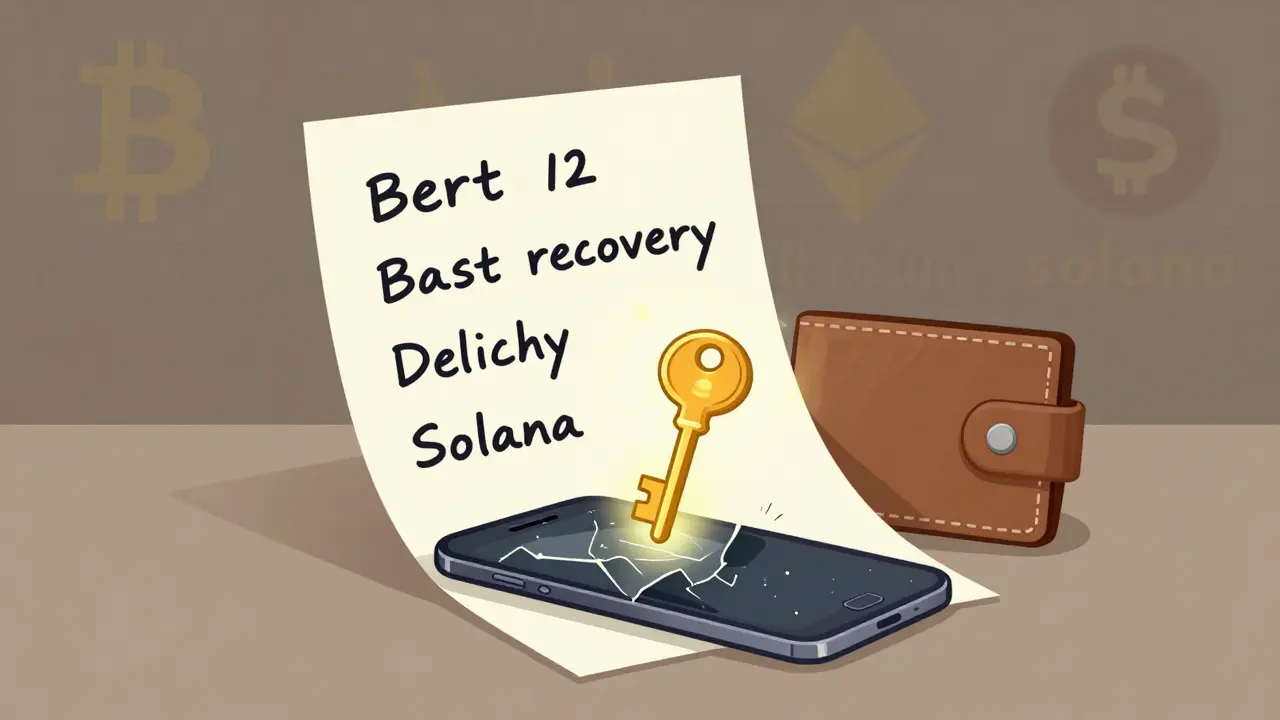
Imagine losing your phone, your wallet, or even your house keys. Now imagine losing access to all your cryptocurrency - not because someone stole it, but because you forgot where you wrote down a 12-word phrase. That’s the reality millions face every year. The solution? BIP39. It’s not flashy. It doesn’t make headlines. But it’s the quiet backbone of every crypto wallet you’ve ever used.
Before BIP39, recovering crypto was a nightmare. Each wallet had its own way of backing up keys. One used a string of random letters and numbers. Another required you to save a file. If you lost it? Gone forever. No refunds. No help. No second chances. BIP39 changed that. It turned impossible-to-remember binary keys into something you can write on a piece of paper: a sequence of 12 or 24 easy-to-recall words. This isn’t magic. It’s math. And it works.
What Exactly Is a BIP39 Seed Phrase?
A BIP39 seed phrase - also called a recovery phrase or mnemonic phrase - is a human-readable list of words that represents the cryptographic key to your cryptocurrency wallet. Think of it as the master password to everything you own on the blockchain. Whether it’s Bitcoin, Ethereum, Solana, or a thousand other coins, if your wallet uses BIP39 (and almost all do), this phrase can restore your entire balance on any compatible wallet app or hardware device.
The standard uses a fixed list of exactly 2,048 words. These aren’t random. Each word was chosen so that the first four letters are unique. That means if you miswrite “banana” as “banan,” you can still guess the right one. If you forget the last word? The system has a built-in checksum to help you spot the error. This is why you can recover your wallet even if your handwriting is messy or the paper got damp.
Most wallets generate either a 12-word or 24-word phrase. A 12-word phrase gives you about 128 bits of security - enough to be considered unbreakable with today’s technology. A 24-word phrase pushes that to 256 bits. For most users, 12 words is more than enough. The extra 12 words are for high-value institutional wallets or users who want maximum paranoia.
How Does It Work Behind the Scenes?
Here’s where it gets technical - but you don’t need to be a coder to understand it. When you create a wallet, the app generates a long string of random numbers (entropy). This isn’t something you see. It’s just bits: 0s and 1s.
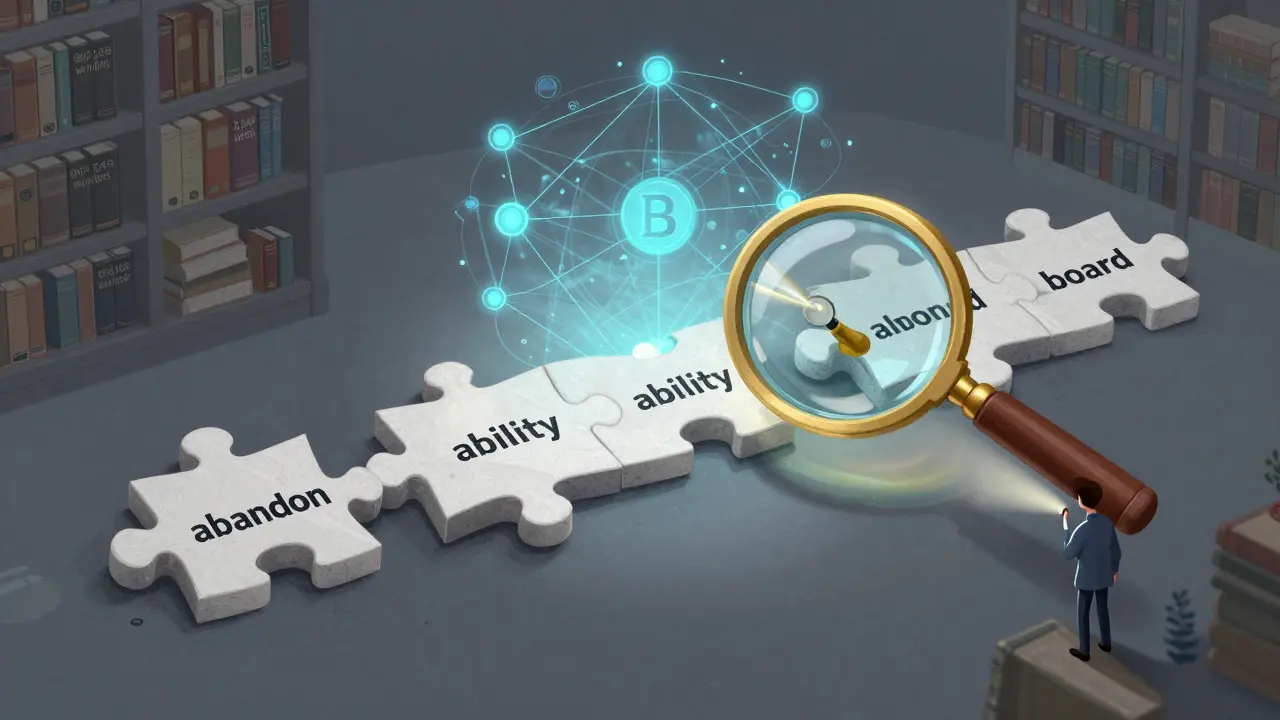
That entropy gets split into chunks of 11 bits each. Each 11-bit chunk becomes a number between 0 and 2047. That number maps directly to one word in the BIP39 wordlist. So if your first chunk equals 127, the first word is “abandon.” The next chunk equals 456? The next word is “ability.” And so on.
Then comes the checksum. A small part of the original entropy is used to create a single extra word. This word acts like a safety net. If you type in the wrong word, or miss one, the wallet software checks the math and tells you: “This doesn’t add up.” That’s why you can’t just make up your own words. The system needs the exact sequence.
Once the phrase is created, it’s converted into a binary seed using a cryptographic function called PBKDF2. That seed then generates all your private keys - for Bitcoin, Ethereum, and any other coin you hold. The phrase is the root. Everything else grows from it.
Why BIP39 Is Everywhere
You might think Bitcoin wallets are the only ones using this. Wrong. Ethereum? Uses BIP39. Solana? BIP39. Cardano? BIP39. Even apps like Trust Wallet, MetaMask, Ledger, and Trezor rely on it. Why? Because it’s the only standard that lets you move your crypto from one wallet to another without losing access.
Before BIP39, if you used Coinbase and then switched to Exodus, you had to send your coins out manually. That meant paying fees, risking mistakes, and waiting days. With BIP39, you just type your 12 words into Exodus, and poof - your whole balance appears. No transfers. No fees. No waiting.
That interoperability is why BIP39 became the universal language of crypto wallets. It’s like USB-C for digital assets. One standard. Works everywhere. No adapters needed.
The Hidden Danger: Passphrases
Here’s where things get tricky. BIP39 has an optional feature: the passphrase. This is a second secret - a password you can add on top of your seed phrase. It’s like having a lock on your safe, and then hiding the key inside a different safe.
Used correctly, a passphrase adds serious security. If someone steals your paper with the 12 words, they still can’t access your wallet without the passphrase. But here’s the catch: if you forget the passphrase, you lose everything. No one can recover it. Not even the wallet maker.
Most wallet apps disable passphrases by default. Why? Because users keep forgetting them. Ledger and Trezor report that nearly 30% of support tickets come from people who added a passphrase and lost it. DataRecovery.com says they see hundreds of cases every month where users swear they wrote down their phrase - but forgot the extra word.
Bottom line: Unless you’re storing millions in crypto, skip the passphrase. Stick to the 12 words. Keep them safe. Don’t overcomplicate it.
Real-World Mistakes People Make
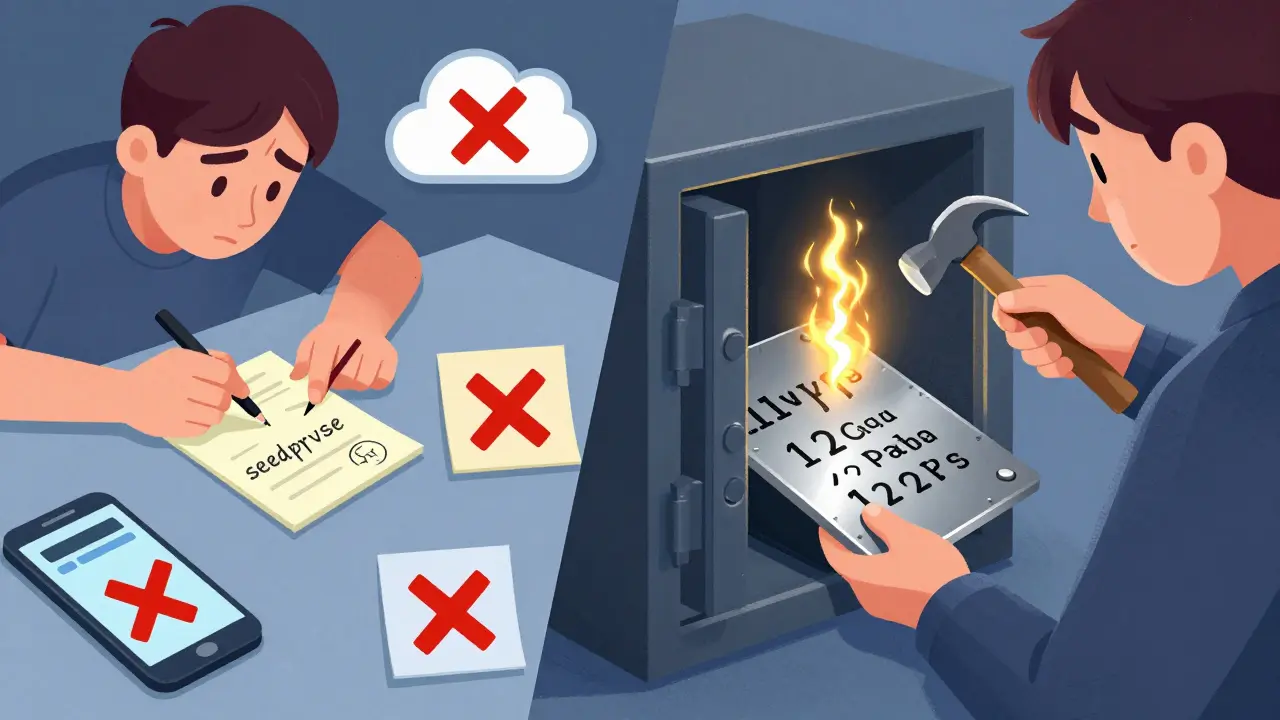
People think they’re being smart. They write their seed phrase on a sticky note. They take a photo of it. They store it in their cloud drive. They even use handwriting recognition apps to scan it into their phone.
Every one of those is a disaster waiting to happen.
Sticky notes? Someone cleans your desk. Photos? Your phone gets hacked. Cloud backups? Your account gets breached. Handwriting apps? They misread “ladder” as “ladder” - wait, no, they misread “ladder” as “ladder.” Oh wait - they got it right. But what if they misread “cliff” as “cliff”? That’s not a word on the list. Your wallet won’t restore. And you’ll never know why.
The safest way? Use a metal backup. Write your 12 words on a steel plate with a hammer and punch. Store it in a fireproof safe. Make two copies. Keep one at home. Keep one with a trusted family member. Don’t digitize it. Don’t email it. Don’t screenshot it.
And if you’re ever unsure? Test it. Send a small amount of crypto - say, $5 worth of Bitcoin - to a new wallet. Write down the phrase. Then restore it on a different device. Make sure it works. Do this before you store any real value.
What If You Lose Part of Your Phrase?
It happens. You spill coffee on your paper. You misremember one word. You think “ocean” was “ocean” - but it was “ocean.”
There are tools out there that can help. Some let you input partial phrases and guess the missing words. But they’re slow. And expensive. DataRecovery.com charges hundreds of dollars to try and recover a phrase. And even then, success isn’t guaranteed.
The best tool? Your memory. Try to remember the context. Where were you when you wrote it? What was the weather like? Did you write it in the morning? Did you use a pencil or pen? Sometimes, the smallest detail triggers the right word.
But honestly? If you lost even one word and don’t have a backup - you’re probably out of luck. That’s why preparation matters more than recovery.
The Bottom Line
BIP39 isn’t perfect. But it’s the best we’ve got. It turned crypto from a technical nightmare into something ordinary people can use. It’s why your grandma can now hold Bitcoin without needing a computer science degree.
But it only works if you treat it like gold. Not like a password you can reset. Not like a PIN you can guess. Your seed phrase is your identity on the blockchain. Lose it, and you lose everything. No one can help you. No one can reverse it. No one can recover it.
Write it down. Keep it safe. Test it once. And never, ever share it.
Is BIP39 the only way to back up a crypto wallet?
No, but it’s the most common. Some wallets use alternative standards like BIP32 (for hierarchical deterministic wallets) or BIP44 (for multi-coin support). However, nearly all consumer wallets today combine BIP39 with these other standards. BIP39 handles the human-readable backup. Other standards handle how keys are organized. So while BIP39 isn’t the whole system, it’s the part you interact with.
Can I use a BIP39 phrase from one wallet in another?
Yes - that’s the whole point. If Wallet A gave you a 12-word BIP39 phrase, you can paste it into Wallet B, Wallet C, or even a hardware wallet like Ledger, and it will restore your exact balance. This works across Bitcoin, Ethereum, Litecoin, and hundreds of other coins. As long as the wallet supports BIP39, it works. That’s why it’s the industry standard.
Why 12 or 24 words? Why not 10 or 18?
It’s about security and usability. 12 words = 128 bits of entropy, which is considered unbreakable with current computing power. 24 words = 256 bits, used for high-security needs. Anything less than 12 reduces security. Anything more than 24 becomes impractical to write, remember, or verify. The 12- and 24-word lengths were chosen as the sweet spot between safety and simplicity.
Can I create my own BIP39 phrase?
Technically, yes. But you shouldn’t. BIP39 requires true randomness. Humans are terrible at generating randomness. If you try to pick words yourself, you’ll likely create a pattern - and that pattern can be cracked. Wallet software uses hardware-based random number generators to ensure each phrase is truly unpredictable. Never manually create a seed phrase. Always let your wallet do it.
Are BIP39 phrases safe from quantum computers?
Not forever. A powerful enough quantum computer could break the cryptographic algorithms behind private keys. But BIP39 itself isn’t the weak link - it’s the underlying cryptography (like ECDSA). Even if quantum computers become viable, BIP39 will still be the standard for generating keys. The industry will likely upgrade the encryption layer while keeping BIP39 as the backup system. So your 12-word phrase will still work - it’ll just unlock a new type of key.
 Finance



Brenda White
March 20, 2026 AT 03:42Lucy de Gruchy
March 22, 2026 AT 01:29Angelica Stovall
March 23, 2026 AT 06:37Konakuze Christopher
March 24, 2026 AT 22:27Bryan Roth
March 25, 2026 AT 19:41Steph Andrews
March 27, 2026 AT 01:16Henrique Lyma
March 28, 2026 AT 15:56Manali Sovani
March 29, 2026 AT 16:08Zachary N
March 30, 2026 AT 05:01Ann Liu
April 1, 2026 AT 00:04Gene Inoue
April 2, 2026 AT 12:36Taylor Holloman.
April 4, 2026 AT 01:45Jerry Panson
April 5, 2026 AT 17:33Tobias Wriedt
April 7, 2026 AT 09:11Sahithi Reddy
April 8, 2026 AT 18:46Anastasia Danavath
April 9, 2026 AT 15:26sai nikhil
April 10, 2026 AT 07:34Elizabeth Kurtz
April 10, 2026 AT 10:26Ernestine La Baronne Orange
April 11, 2026 AT 14:41anshika garg
April 13, 2026 AT 05:18Prakash Patel
April 14, 2026 AT 06:33Ricky Fairlamb
April 15, 2026 AT 07:07john peter
April 15, 2026 AT 07:54George Hutchings
April 15, 2026 AT 11:40S F
April 16, 2026 AT 18:36