

FATF Crypto Rules: What They Mean for Traders and Exchanges
When you hear FATF crypto rules, the global standards set by the Financial Action Task Force to stop money laundering and terrorist financing through digital assets. Also known as FATF guidelines, these rules don’t just sit on paper—they decide whether a crypto exchange can open bank accounts, list certain tokens, or even operate in your country. If a country ends up on the FATF grey list, its exchanges get frozen out of global finance. That’s not a warning—it’s a death sentence for most platforms.
The FATF grey list, a public list of countries with weak anti-money laundering controls that are under increased monitoring is where things get real. Take the UAE—until 2024, it was on that list. Exchanges there couldn’t get banking partners. Investors stayed away. Then they tightened rules, enforced KYC, and got removed. Overnight, crypto trading there went from risky to reputable. That’s the power of FATF. It doesn’t care if you’re trading Bitcoin or a meme coin. If your platform doesn’t track who’s sending money and why, it’s not allowed.
And it’s not just about countries. AML crypto, anti-money laundering practices specifically designed for digital currencies is now baked into every major exchange’s operations. That’s why you see ID checks, transaction limits, and flagged wallets. It’s not paranoia—it’s compliance. The FATF says exchanges must collect and share customer data across borders. If they don’t, banks cut them off. That’s why you’ll never see a legit exchange offering anonymous trading anymore. Even platforms that claim to be "privacy-focused" now walk a tightrope between user anonymity and FATF demands.
What does this mean for you? If you’re trading on a small exchange with no KYC, you’re not getting a secret advantage—you’re risking your funds. The FATF doesn’t just target big players. It targets any platform that could be used to launder money. That’s why you see so many posts here about shady exchanges like BiKing, CEEX, or GCOX—they’re the ones ignoring these rules. And when regulators move, those platforms vanish. Your wallet gets drained. No warning. No refund.
Meanwhile, the cryptocurrency compliance, the set of legal and operational steps exchanges and users must follow to meet global financial regulations is becoming the new baseline. It’s not about slowing innovation—it’s about making sure innovation doesn’t become a tool for crime. That’s why platforms like Minswap or Flamingo Finance still operate—they built compliance into their design from day one. They know the rules. They play by them. And that’s why they’re still here.
Don’t confuse FATF rules with censorship. They’re not banning crypto. They’re banning chaos. The posts below show you exactly how this plays out: from the UAE’s rise after leaving the grey list, to the scams that exploded because they ignored AML crypto rules, to the exchanges that vanished overnight because they didn’t track their users. This isn’t theory. It’s real life. And if you’re trading crypto, you need to know where the line is—before you cross it.
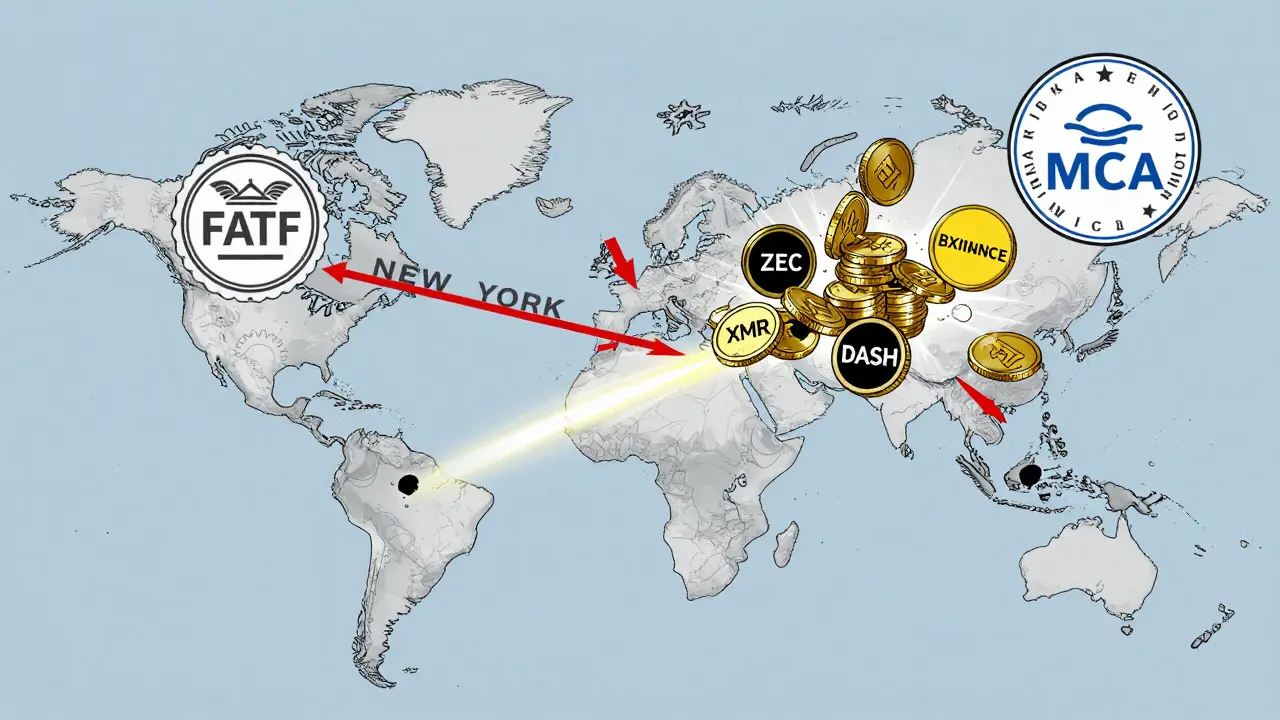
Major crypto exchanges are removing privacy coins like Monero and Zcash due to new global regulations. Here's why it's happening, where you can still trade them, and what it means for your crypto holdings in 2025.
Categories
 Finance
Archives
Recent-posts

Inside ElSalvador’s Chivo Wallet: Bitcoin Adoption, Challenges, and What Comes Next
Aug, 10 2025

ProtoFi Crypto Exchange Review: What You Need to Know Before Trading PROTO
Dec, 16 2025

Homomorphic Encryption for Privacy: How Encrypted Data Can Be Computed Without Being Seen
Feb, 10 2026

Using Multiple Crypto Exchanges to Avoid Restrictions: Risks and Realities
Nov, 6 2025
Uniswap v2 on Arbitrum: In‑Depth Crypto Exchange Review 2025
Nov, 11 2024