

12-Month Crypto Holding: Why Waiting Out Volatility Pays Off
When you buy a crypto asset and hold it for 12-month crypto holding, a simple strategy where you keep your crypto for exactly one year before selling. Also known as long-term crypto holding, it’s one of the few moves that can quietly outperform complex trading — not because it’s smart, but because most people can’t do it. The market throws tantrums every few weeks. Prices crash. Hype explodes. Coins with no real use case spike 500% in a day. But if you hold for a full year, you skip 90% of that noise. You don’t panic-sell when Bitcoin drops 20%. You don’t FOMO-buy the latest meme coin with zero code. You just wait.
Why does this matter? Because the IRS and other tax agencies treat crypto taxes, the rules that determine how much you pay when you sell digital assets. Also known as cryptocurrency capital gains, they change dramatically after 12 months. In the U.S., if you sell before a year, you pay short-term capital gains tax — which can be as high as your regular income tax rate, sometimes over 37%. But if you hold for 12 months? You get long-term rates, often under 15%. That’s not a trick. That’s a free 20%+ discount on your tax bill. And it’s not just the U.S. — countries like Germany, Canada, and Australia all reward long-term holders with lower rates.
Then there’s crypto volatility, how wildly prices swing in short timeframes. Also known as digital asset price fluctuations, it is the reason most people lose money. They buy at the top of a hype wave, panic when it drops 30%, then buy back in higher. But if you hold for 12 months, you’re not reacting to daily charts. You’re riding through the full cycle. Look at Cronos (CRO) — it crashed hard after fake exchanges like Cronus Finance tricked users. But if you held it for a year through the chaos, you likely broke even or made a profit. Same with low-cap tokens like Launchium (LNCHM) or CRODEX (CRX). They’re dead now. But if you bought them early and held through the dust, you avoided the worst of the sell-off. Holding isn’t about picking winners. It’s about avoiding losers.
And don’t forget DeFi liquidity pools, where you lock up crypto to earn rewards. Also known as yield farming, they often require you to hold tokens for months just to unlock rewards. If you pull out early, you lose everything. The smart move? Lock it in. Wait. Let the fees compound. That’s the same mindset as a 12-month hold. It’s not trading. It’s patience. And patience is the only edge most people have left.
Below, you’ll find real reviews of tokens that failed, exchanges that vanished, and airdrops that vanished too. But you’ll also see how holding through the mess — whether it was a scam coin, a broken DEX, or a dead exchange — often meant the difference between losing everything and walking away with something. This isn’t about predicting the future. It’s about surviving the present. And if you’re holding crypto for a year, you’re already ahead of 90% of the crowd.
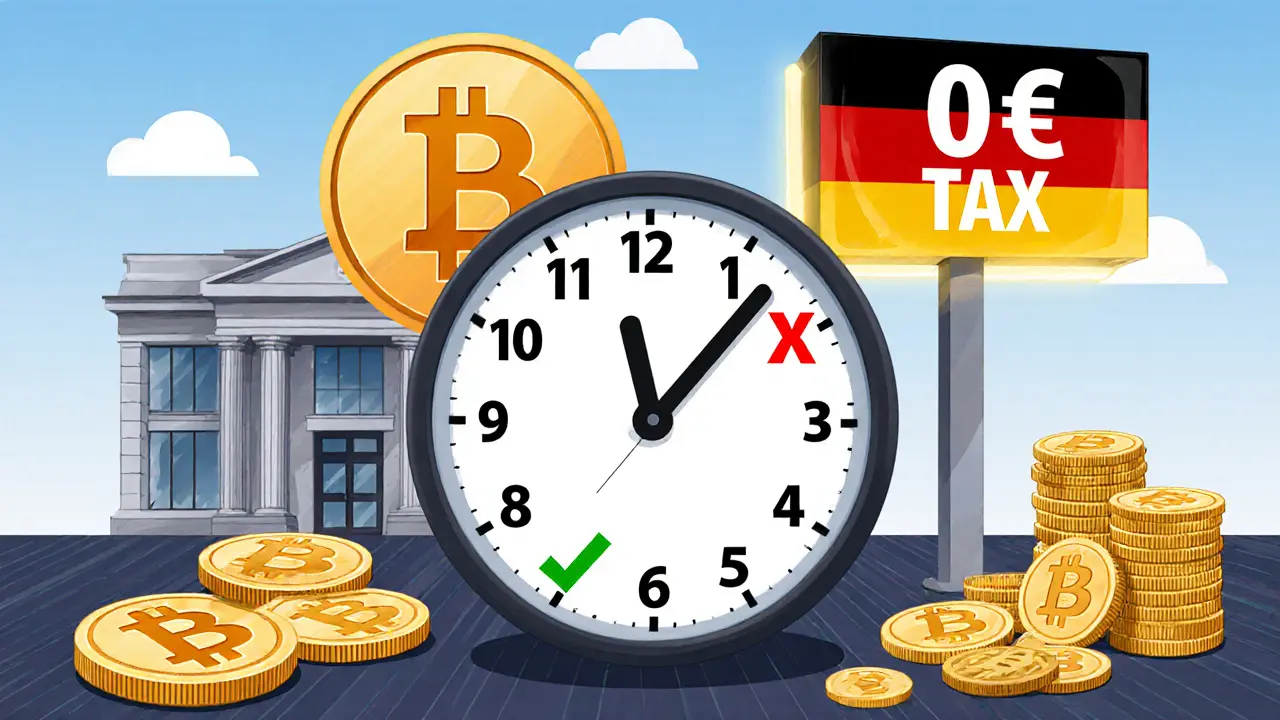
Germany offers a 12-month crypto tax exemption for Bitcoin and other digital assets, making it one of Europe’s most favorable tax environments for long-term holders. Learn how it works, who it benefits, and what risks remain.
Categories
 Finance
Archives
Recent-posts
Shiba Inu TREAT (TREAT) Token Explained - Price, Purpose & Risks
Jul, 17 2025

Caduceus CMP Airdrop Details: How to Claim & What Was Distributed
Feb, 12 2025

How North Korea Converts Stolen Cryptocurrency to Fiat: A Detailed Breakdown
Feb, 6 2026
Blockchain Transparency vs Privacy: How to Balance Both Without Sacrificing Trust
Dec, 4 2025
Uniswap v2 on Arbitrum: In‑Depth Crypto Exchange Review 2025
Nov, 11 2024