

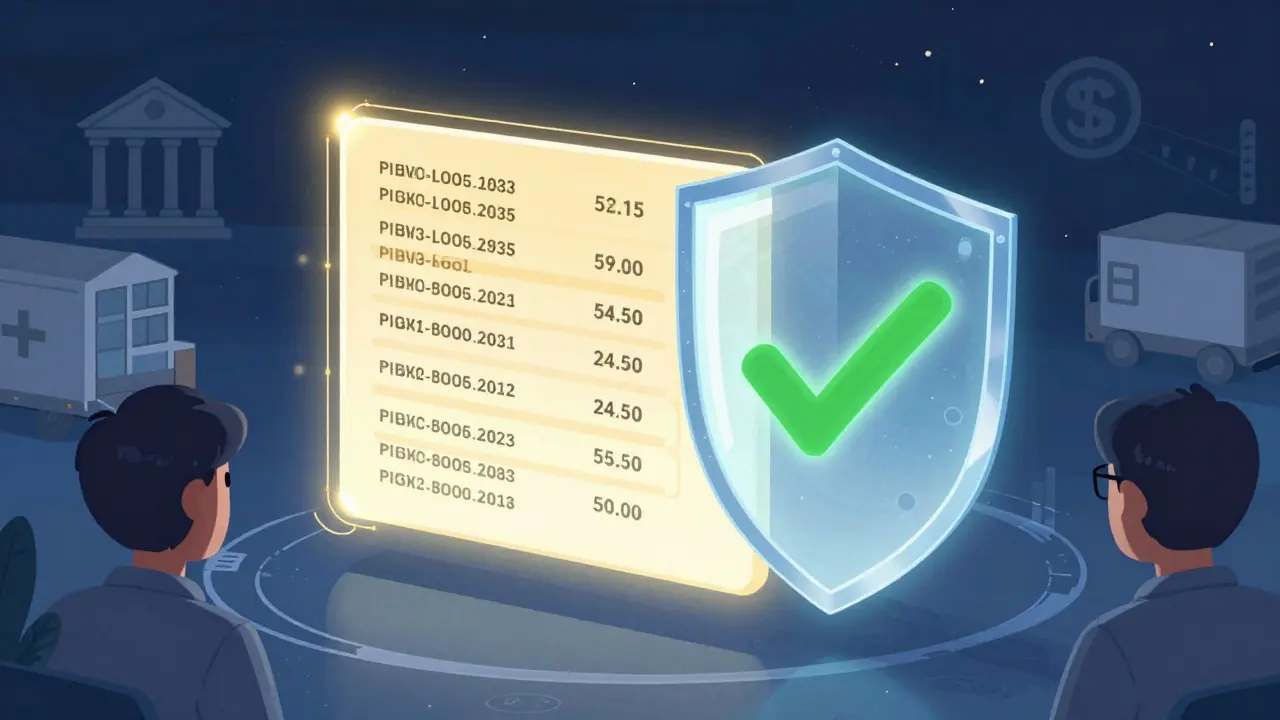
Blockchain Privacy-Transparency Balance Calculator
This tool helps you determine the optimal balance between transparency and privacy for your blockchain implementation based on your specific requirements. Select your parameters below to see the recommended approach and expected trade-offs.
Recommended Approach
Optimal Solution
Blockchain was built to be open. Every transaction, every transfer, every contract - recorded forever, visible to anyone. That’s its power. It’s why we trust it. But what happens when that same openness violates your right to keep your data private? In 2025, this isn’t a theoretical debate. It’s a daily operational headache for banks, hospitals, and supply chains trying to use blockchain without breaking the law.
The Core Conflict: Immutable vs. Forgettable
Blockchain’s biggest strength is also its biggest legal problem. Once data goes on-chain, it can’t be erased. That’s great for auditing fraud or proving ownership. But under GDPR - Europe’s strict privacy law - you have the right to have your personal data deleted. How do you delete something that’s permanently stored across thousands of computers worldwide? The European Data Protection Board put it bluntly in 2025: "How can you exercise your right to be forgotten when every transaction is permanently etched into an immutable ledger?" This isn’t just a technical glitch. It’s a fundamental clash between two pillars of modern society: accountability and privacy.Public Blockchains: Transparent, But Not Private
Bitcoin and Ethereum are the most famous blockchains. They’re public. Anyone can see who sent what to whom. But here’s the catch: those addresses? Like 1A1zP1eP5QGefi2DMPTfTL5SLmv7DivfNa - they’re not your name. They’re random strings. That’s called pseudonymity. It sounds private. But it’s not. In 2023, researchers at IEEE showed they could deanonymize 60-80% of Bitcoin users by mapping transaction patterns. If you ever bought coffee with Bitcoin and later linked that address to your real identity - say, through an exchange - suddenly every past transaction is traceable. That’s not privacy. That’s a digital trail waiting to be followed. For businesses, this is risky. Imagine a supplier using Ethereum to track shipments. If competitors can see how much they’re ordering from which factories, or when they’re running low - that’s a competitive disadvantage. Transparency without control isn’t helpful. It’s dangerous.Private Blockchains: Control, But at a Cost
To fix this, companies turned to private blockchains like Hyperledger Fabric and R3 Corda. These aren’t open to the public. Only approved participants can join. Transactions are hidden from outsiders. Sounds perfect, right? Not quite. Private blockchains sacrifice decentralization - one of blockchain’s core values. Bitcoin has over 15,000 active nodes verifying transactions. A typical Hyperledger network? 15 to 20. That’s more like a private database with blockchain branding. You lose the trust that comes from open verification. And if only a handful of companies control the network, who’s really auditing whom? Plus, compliance gets messy. If your private blockchain stores customer data, and one of your partners gets hacked, GDPR still applies. You’re still responsible. The fact that the ledger isn’t public doesn’t make you immune.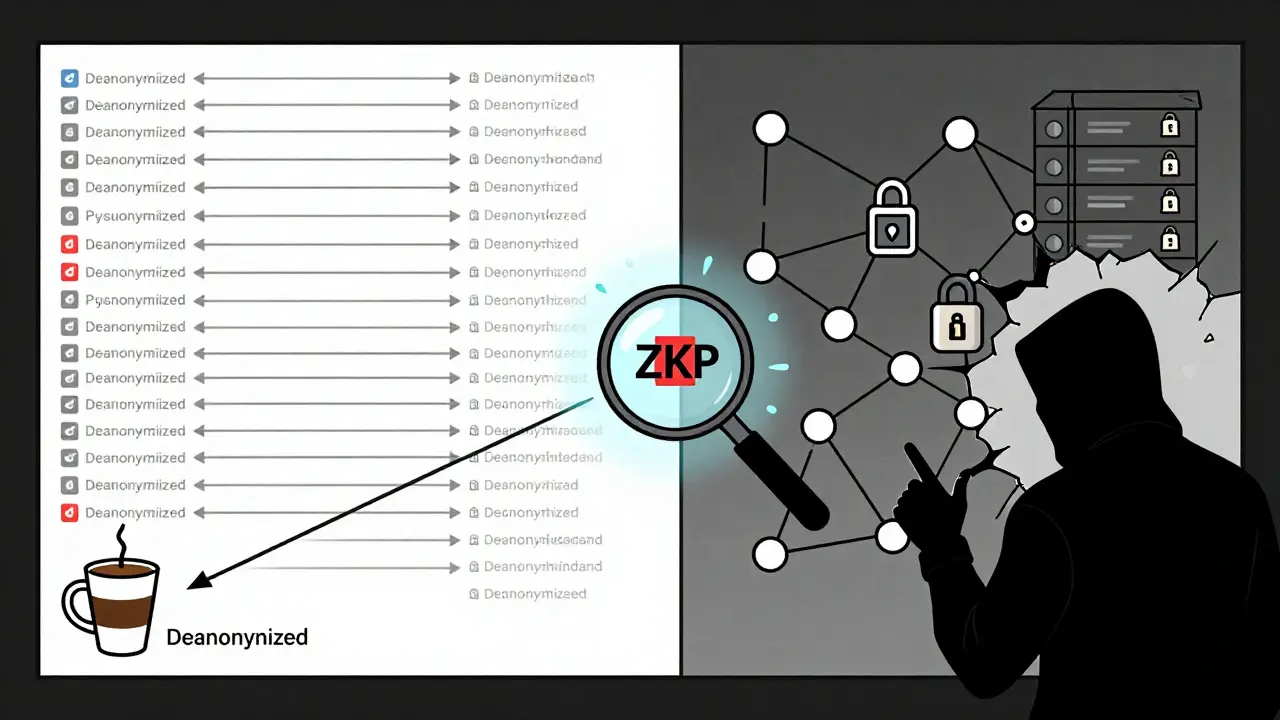
The Game Changer: Zero-Knowledge Proofs
There’s a better way - and it’s not about hiding data. It’s about proving things without showing them. Zero-knowledge proofs (ZKPs), first used in Zcash in 2016, let you prove a transaction is valid - without revealing who sent it, who received it, or how much was transferred. Think of it like showing a bouncer your ID without letting him see your name or age. He just sees: "Yes, you’re over 18. Come in." In 2025, ZKPs are no longer experimental. Zama’s fully homomorphic encryption reduced processing overhead from 1,000x slower than normal to just 150x - making private smart contracts practical. The Midnight Foundation’s 2024 update lets users hide 87% of transaction data while still letting regulators verify compliance. A 2025 study in Nature Scientific Reports showed a blockchain system using ZKPs could achieve 98.7% privacy while keeping 100% auditability. That’s the holy grail: no one sees the details, but everyone can be sure nothing’s fake.Trade-Offs You Can’t Ignore
Nothing comes free. ZKPs make transactions 300-500% larger and take 200-300% longer to verify. That’s a problem for high-volume systems like payment rails. And while off-chain solutions like state channels (e.g., Raiden Network) can process over a million transactions per second, they’ve lost over $12.7 million to exploits in 2023 alone. Encryption helps, but it breaks auditability. PwC’s 2024 audit study found that encrypted blockchains increase compliance verification time by 40-60%. That’s expensive for banks and insurers who need to prove they’re following rules. And then there’s cost. Financial institutions using blockchain for cross-border payments report a 30-45% jump in KYC/AML compliance costs when adding privacy features. Healthcare systems? 68% of blockchain pilot projects failed because patient data couldn’t be kept private under HIPAA.Real-World Use Cases: Where It Works
So where is this balance actually working? - Supply chains: Companies like IBM Food Trust now use selective disclosure. A retailer can see a product’s origin and safety certs, but not the supplier’s pricing or contract terms. - Healthcare: Patient records are stored off-chain. Only a cryptographic hash (a digital fingerprint) goes on-chain to prove the record hasn’t been tampered with. Access is granted via private keys - no one else can see the data. - Public sector: Estonia’s digital ID system uses blockchain to log who accessed citizen records. The data stays private, but the access trail is transparent - perfect for detecting abuse. The key? Don’t put everything on-chain. Put only what needs to be verified. Keep the rest off-chain, encrypted, and accessible only with permission.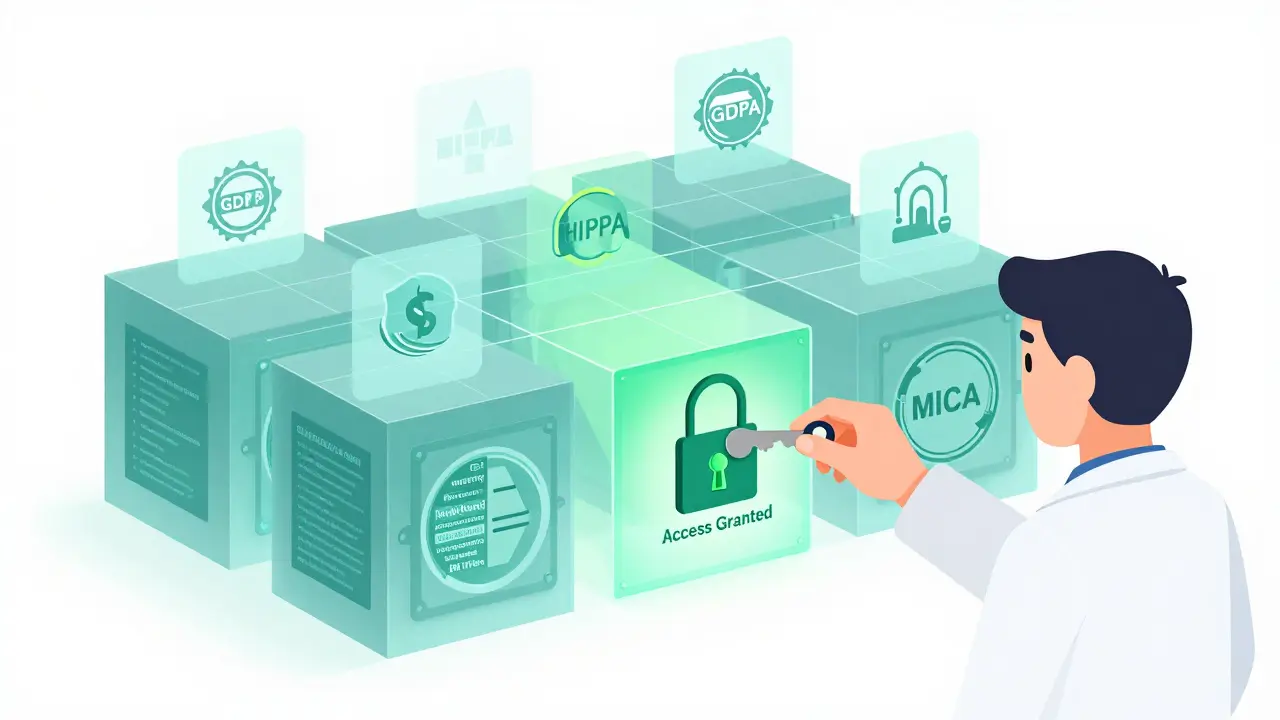
The Future Is Privacy by Design
This isn’t about choosing between transparency and privacy anymore. It’s about building systems that do both - from the start. Dr. Ann Cavoukian, who created the Privacy by Design framework, says it plainly: "The next generation of blockchain platforms must be designed with privacy as a fundamental feature, not a bolted-on afterthought." That’s exactly what’s happening. In Q1 2025, 78% of blockchain developers surveyed by ConsenSys said privacy features were their top priority. Venture capital funding for privacy-focused blockchains hit $4.2 billion - up 28% year-over-year. Regulators are catching up too. The EU’s MiCA regulation, effective since June 2024, acknowledges blockchain’s unique challenges. It doesn’t ban privacy - it demands smart design. The World Economic Forum’s 2025 governance framework now includes "privacy-preserving transparency" as a core standard.What You Need to Do Now
If you’re using or planning to use blockchain:- Don’t assume public = safe. Public blockchains are transparent, but easily deanonymized.
- Don’t assume private = compliant. Private blockchains still store personal data. GDPR still applies.
- Ask: What absolutely needs to be on-chain? Only put hashes, proofs, or audit logs on-chain. Keep raw data off-chain.
- Use ZKPs for verification. They’re mature enough now for enterprise use. Don’t wait for "perfect" - start testing.
- Build in access controls. Even with encryption, who can view what? Define roles clearly.
Frequently Asked Questions
Can blockchain ever be truly private?
Yes - but not the way most people think. You can’t hide the fact that a transaction happened on a blockchain. But you can hide who did it, what was sent, and why. Technologies like zero-knowledge proofs let you prove a transaction is valid without revealing any details. Zcash and the Midnight Foundation already do this at scale. Privacy isn’t about secrecy - it’s about selective disclosure.
Does GDPR make blockchain illegal?
No. GDPR doesn’t ban blockchain. It bans storing personal data on immutable ledgers without a legal basis for deletion. The solution isn’t to avoid blockchain - it’s to avoid putting personal data on it. Store hashes, not names. Store proofs, not records. Use off-chain storage with on-chain verification. Many EU regulators now accept this model as compliant.
Are private blockchains better than public ones?
It depends on your goal. If you need maximum security and control - like a bank or hospital - private blockchains offer more control over who sees what. But if you need trust from outsiders - like a public registry or open marketplace - public blockchains with privacy layers (like ZKPs) are stronger. Private blockchains reduce decentralization, which weakens trust. Public blockchains with privacy tech offer both openness and confidentiality.
Why are zero-knowledge proofs so expensive to use?
They require heavy mathematical computations to prove something is true without revealing it. Early ZKPs were 1,000 times slower than regular transactions. But in 2024, new hardware and algorithms (like those from Zama) brought that down to just 150x slower. That’s now fast enough for most enterprise use cases. Cost is falling fast - and performance is improving faster.
What’s the biggest mistake companies make with blockchain privacy?
They assume privacy is a feature they can add later. It’s not. Privacy needs to be built into the architecture from day one. Trying to bolt on encryption or access controls after the fact creates gaps. The most successful projects - like Estonia’s digital ID or Zcash - started with privacy as a core design principle, not an afterthought.
 Finance



Murray Dejarnette
December 5, 2025 AT 08:11This is the dumbest take I've seen all week. Blockchain isn't about privacy-it's about trustless verification. If you can't handle public ledgers, don't touch crypto. End of story. 😒
Britney Power
December 6, 2025 AT 21:15Let’s be brutally honest: most enterprises deploying blockchain today are just repackaging their legacy databases with buzzword salad. Zero-knowledge proofs? Cute. But when your compliance team can’t even parse the audit trail because it’s encrypted behind 12 layers of cryptographic obfuscation, you’re not solving a problem-you’re creating a regulatory nightmare. And don’t get me started on the energy costs of ZKP verification. This isn’t innovation-it’s performance art for VCs.
Sarah Locke
December 8, 2025 AT 09:40Y’all are overcomplicating this. 🌱 Think of blockchain like a public library. You can read every book (transparency), but you don’t need to know who checked out which one (privacy). ZKPs are the librarian who whispers, ‘Yes, this book is returned on time’-without telling you the title. It’s not magic. It’s just smart design. Start small. Test. Iterate. You got this.
Mani Kumar
December 9, 2025 AT 14:41The notion that private blockchains offer ‘control’ is a fallacy. Centralized trust is an oxymoron in distributed systems. The true value proposition lies in cryptographic verifiability-not access control. ZKPs are not optional; they are the necessary evolution of consensus mechanisms in regulated environments.
Philip Mirchin
December 10, 2025 AT 12:09I work in healthcare IT. We tried a blockchain pilot last year. We put patient hashes on-chain, kept records encrypted off-chain with key rotation. Worked like a charm. No HIPAA violations. Auditors loved it. The trick? Don’t try to store the whole medical record. Store the proof that it hasn’t been tampered with. Simple. Elegant. Real. 🙌
justin allen
December 11, 2025 AT 19:37Why are we even talking about GDPR in the context of blockchain? America doesn’t have that crap. If Europe wants to cripple their own tech industry with nanny-state rules, fine. But don’t drag global innovation down with your bureaucratic whining. Blockchain was built to be free-stop trying to regulate it into oblivion.
Maggie Harrison
December 11, 2025 AT 22:36Zero-knowledge proofs = 🤯 mind blown. Imagine proving you’re over 21 without showing your ID. Or proving you paid your taxes without revealing your salary. This isn’t tech-it’s wizardry. And it’s HERE. We’re living in the future, folks. 🌌✨
Lawal Ayomide
December 13, 2025 AT 18:38Back home in Lagos, we use blockchain for land titles. No middlemen. No bribes. But we don’t put names on-chain. Only hashes. People still know who owns what-because the community knows. Transparency isn’t about visibility. It’s about accountability. Simple.
ashi chopra
December 15, 2025 AT 05:50I really appreciate how this post doesn’t just throw tech jargon around. It actually acknowledges the human side-how banks, hospitals, and everyday people are caught in this mess. It’s not about the tech being right or wrong. It’s about whether it serves people. And honestly? That’s the only metric that matters.
Darlene Johnson
December 15, 2025 AT 14:31Let me guess-this is all just a front for the government to track everything under the guise of ‘compliance.’ ZKPs? Please. If they can verify without seeing, they can still reconstruct everything with AI and metadata. This isn’t privacy. It’s psychological warfare. You think you’re safe? You’re not. They’re already watching.
Ivanna Faith
December 16, 2025 AT 19:25ZKPs are the future but honestly why are we still using blockchain at all if we need to hide everything? Just use a database with encryption. Everyone’s overcomplicating things. I’m just saying...
Akash Kumar Yadav
December 17, 2025 AT 01:34India’s financial infrastructure is 80% paper. You think ZKPs matter here? We need basic digital IDs first. Stop exporting Western tech fantasies to developing economies. Build the foundation before you build the cathedral.
samuel goodge
December 17, 2025 AT 11:56It’s worth noting that the very concept of ‘immutable ledger’ is philosophically incompatible with the legal right to erasure-unless we redefine what ‘immutable’ means. Perhaps we should consider cryptographic obfuscation as a form of ‘logical deletion’-where the data remains, but is rendered functionally inaccessible without a key that can be revoked. This isn’t a loophole-it’s a necessary reinterpretation of digital permanence in a rights-based society.
Mark Stoehr
December 18, 2025 AT 00:08everyone keeps talking about zkp like its magic but the gas fees alone make it unusable for retail. also who the hell is auditing the auditors? nobody checks the code behind the proofs. its all smoke and mirrors
Shari Heglin
December 18, 2025 AT 00:34The assertion that private blockchains are ‘less trustworthy’ is empirically flawed. Trust is not derived from the number of nodes, but from the integrity of the consensus protocol and the enforceability of access controls. A permissioned network with formal verification and audit trails can offer superior assurance in regulated domains than a public chain vulnerable to MEV and frontrunning.
Tatiana Rodriguez
December 18, 2025 AT 13:47I love how this post doesn’t just say ‘use ZKPs’ and call it a day. It actually lays out the trade-offs-cost, speed, complexity-and then gives real examples of where it’s working. That’s rare. So many tech pieces act like innovation is a button you press. Nope. It’s a messy, expensive, iterative process. And honestly? That’s beautiful. We’re not building tools-we’re building culture.
Nelia Mcquiston
December 18, 2025 AT 19:56What if the real question isn’t how to balance transparency and privacy-but whether we should be storing personal data on any blockchain at all? Maybe the answer isn’t better tech, but better boundaries. Maybe some things shouldn’t be digitized. Maybe some trust should remain human.
Reggie Herbert
December 19, 2025 AT 07:07Regulators are finally catching up. The EU’s MiCA framework doesn’t ban privacy-it mandates it. That’s not a restriction. It’s a standard. If you’re still building blockchain systems without privacy-by-design, you’re not a pioneer-you’re a liability. And if your CTO says ‘we’ll add privacy later,’ fire them. Now.