

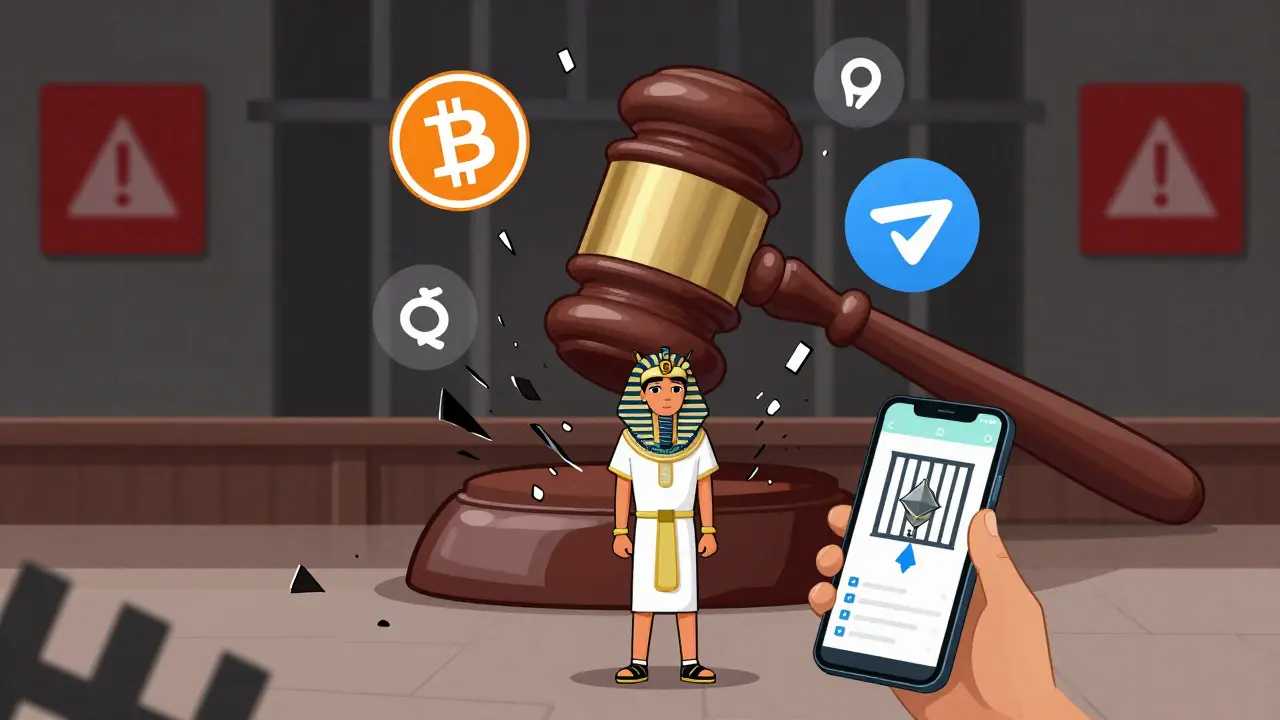
If you're promoting cryptocurrency in Egypt, you could go to jail. Not just a fine. Not just a warning. Actual prison time. And it's not some obscure rule - it's written into law, enforced by the government, and backed by real arrests. As of 2026, Egypt has one of the strictest crypto policies in the world, and the punishment for simply talking about crypto online or helping people invest in it is severe.
What Exactly Is Illegal?
It's not just trading Bitcoin or using Binance. The law targets promotion. That means anything that encourages others to buy, sell, or invest in cryptocurrency. This includes social media posts, YouTube videos, Telegram channels, influencer endorsements, websites offering crypto investment plans, or even a friend telling you "this coin is going to 10x." Under Law No. 194 of 2020, any activity that promotes, trades, or facilitates cryptocurrency use without official approval from Egypt's Central Bank of Egypt (CBE) or the Financial Regulatory Authority (FRA) is a crime. That covers staking, DeFi platforms, NFT marketplaces - if it's tied to financial gain and not licensed, it's banned.The law doesn't care if you're a small-time blogger or a big marketing firm. If you're pushing crypto to the public, you're breaking the law. Even if you're not taking money yourself. Just explaining how to use a wallet or linking to a crypto exchange can be enough to trigger legal action.
The Penalties Are Not a Joke
The punishment is clear: imprisonment, a fine of at least one million Egyptian pounds (about $20,000 USD), or both. The maximum fine? Up to ten million pounds - roughly $516,000 USD. That’s more than the average Egyptian earns in 20 years.There’s no minimum sentence listed, which means judges have wide discretion. Some might give a short jail term. Others might hand down years. Fines can be stacked on top. And if you’re a business? Your assets can be seized. Your website shut down. Your bank accounts frozen.
Why so harsh? The CBE says cryptocurrencies threaten "national security and financial stability." They argue these assets have no government backing, no value regulation, and open the door to fraud, money laundering, and cybercrime. In their view, allowing crypto promotion is like letting unlicensed banks operate - dangerous, unpredictable, and illegal.
Who Enforces This?
The FRA keeps a public "negative list" of unlicensed crypto platforms and companies. They monitor social media, report suspicious accounts, and work with internet service providers to block websites. They also encourage citizens to report anyone promoting crypto - even anonymously.There are reports of people being arrested for running Instagram pages that shared crypto trading tips. Others were detained for hosting Telegram groups that taught people how to buy Bitcoin. In 2023, a local tech startup was raided after promoting a blockchain-based savings app. The founder spent six months in jail before being released on bail.
These aren’t isolated cases. Enforcement has increased every year since 2020. The government doesn’t just want to stop crypto - it wants to scare people away from even thinking about it.

But Millions of Egyptians Use Crypto Anyway
Here’s the contradiction: despite the prison risk, Egypt has one of the highest crypto adoption rates in Africa and the Middle East. A 2022 report by TripleA found over 1.7 million Egyptians owned cryptocurrency. By 2026, estimates suggest that number has jumped to over 3 million - nearly 3% of the population.Why? Because the economy is unstable. Inflation is high. The Egyptian pound has lost value. People turn to crypto not for speculation, but as a lifeline - a way to protect savings, send money home, or pay for goods without relying on a failing banking system.
So while the law says "don’t promote crypto," millions are still using it. And many are quietly helping others use it too. The government can’t arrest everyone. But they can and do arrest the most visible ones - the influencers, the content creators, the platform operators.
What About NFTs, Staking, and DeFi?
Yes, they’re banned too. The CBE explicitly says staking is "inherently linked to cryptocurrency activities" and therefore illegal without a license. NFTs used for investment - even digital art sold for profit - fall under the same ban. DeFi protocols that let users earn interest or lend crypto? Also prohibited.There’s no gray area. If it’s blockchain-based and offers financial returns, it’s treated the same as Bitcoin or Ethereum. The law doesn’t make exceptions. No matter how "innovative" or "decentralized" it sounds.
Is There Any Legal Way to Talk About Crypto?
Technically, yes - but only if you get a license from the CBE. And there’s a catch: no one has been granted one yet. The government hasn’t opened the door for any crypto-related business, not even for educational content.There’s no official application process. No public guidelines. No clear path to compliance. So while the law says "authorized activities are allowed," no one has been authorized. That makes every mention of crypto - even academic or technical - a legal risk.
Some lawyers say you *might* be safe if you’re doing purely educational content - like explaining how blockchain works - without encouraging investment. But even that’s risky. Authorities have broad discretion. And they’ve shown they’ll interpret promotion very broadly.

What Happens If You’re Accused?
If you’re caught, the process is fast and harsh. Authorities can freeze your assets immediately. Your phone and laptop may be seized. You could be detained without bail. Court hearings are often closed. There’s no public defender system for financial crimes like this.Legal representation is expensive. Many people don’t have access to lawyers who understand crypto law. And because the law is so vague, judges often side with the state. Convictions are common. Appeals are rare - and rarely successful.
What Should You Do?
If you’re in Egypt: don’t promote crypto. Don’t post about it on social media. Don’t run a YouTube channel about it. Don’t help someone buy Bitcoin. Even sharing a link to a wallet app could get you in trouble.If you’re outside Egypt but targeting Egyptians: don’t market crypto to them. Don’t run ads in Arabic. Don’t create content aimed at Egyptian audiences. You’re not immune - Egyptian authorities have pursued foreign-based influencers and platforms.
If you’re a blockchain developer or entrepreneur: forget launching a product in Egypt. The legal risk isn’t worth it. The market is huge, but the punishment is too severe. There’s no path to compliance. Not now. Maybe not ever.
Why Does Egypt Care So Much?
It’s not just about money. It’s about control. The government sees cryptocurrency as a challenge to its authority over the national currency. If people start using Bitcoin instead of the pound, it weakens the state’s power to manage the economy. It also opens the door to transactions outside government oversight - something officials fear could fuel corruption or smuggling.They’ve made their position clear: no decentralized money. No unregulated finance. No alternative systems. Only what they control.
For now, the message is simple: promote crypto in Egypt, and you risk your freedom.
Can I get imprisoned for just owning cryptocurrency in Egypt?
No, owning cryptocurrency is not illegal in Egypt. The law only targets promotion, trading, operating exchanges, or facilitating crypto-related financial activities without a license. Simply holding Bitcoin, Ethereum, or other digital assets in a personal wallet is not a crime. However, if authorities find you’ve promoted crypto to others or used it for transactions linked to unlicensed platforms, you could still face charges.
Is there any chance Egypt will legalize crypto in the future?
There are no signs of legalization. The Central Bank of Egypt and the Financial Regulatory Authority have doubled down on their stance since 2020. They continue issuing warnings, increasing enforcement, and blocking websites. Officials have repeatedly called crypto a threat to financial stability. While other countries are creating regulatory frameworks, Egypt is moving in the opposite direction - tightening restrictions, not loosening them.
What if I’m a foreigner promoting crypto to Egyptians online?
You’re still at risk. Egyptian authorities have pursued foreign-based individuals and companies that target Egyptian audiences. If your content is in Arabic, promotes investment, or uses Egyptian payment methods, you could be flagged. While extradition is unlikely, your assets, websites, or payment processors could be blocked. You may also be banned from entering Egypt in the future.
Can I use crypto for remittances or paying bills in Egypt?
Technically, using crypto for personal transactions like sending money to family or paying for goods is not explicitly banned - but it’s risky. The law doesn’t mention personal use, but authorities have cracked down on platforms that enable such transfers. If you use a crypto service that’s not licensed by the CBE, you could be linked to an illegal activity. Even if you’re not promoting it, using unlicensed services makes you a target for investigation.
Are there any legal crypto education resources in Egypt?
No. There are no officially approved educational programs, courses, or institutions in Egypt that teach about cryptocurrency without risking legal consequences. Universities, tech hubs, and online platforms avoid the topic entirely. Even academic research on blockchain technology is done quietly - never mentioning financial applications. Any public discussion of crypto as a financial tool is considered a violation.
 Finance




Amita Pandey
February 25, 2026 AT 01:42It is deeply concerning that a nation would criminalize the mere dissemination of financial knowledge. The state's monopoly on monetary systems is not a moral imperative but a historical artifact. To imprison individuals for discussing decentralized alternatives is to reveal a profound fear of intellectual autonomy. This is not financial regulation-it is epistemic suppression.
Jan Czuchaj
February 25, 2026 AT 14:13There's something fundamentally tragic about a country with such high inflation and currency instability choosing to punish the very tools its people use to survive. Crypto isn't a rebellion-it's a response. A quiet, desperate, rational response to systemic failure. The government isn't protecting stability; it's protecting its own irrelevance.
George Suggs
February 26, 2026 AT 22:41People are using crypto because the system broke. Not because they're into hype. Because their savings vanished. Because they need to feed their kids. The law doesn't care. That's the real story.
Dianna Bethea
February 27, 2026 AT 07:36I’ve seen this pattern before in places where the state fears losing control. The real crime here isn’t crypto-it’s the refusal to adapt. People aren’t breaking laws to be rebels. They’re breaking silence to survive. And that’s not a crime. That’s human.
KingDesigners &Co
February 27, 2026 AT 07:44LMAO. They’re throwing people in jail for talking about Bitcoin? 😂 The fact that this is even a thing says everything about how out of touch these regulators are. You can’t un-invent technology. You just make it underground. And then you lose control completely.
Felicia Eriksson
February 28, 2026 AT 13:31It breaks my heart that people have to risk prison just to protect their money. I hope they find a way to keep helping each other. Quietly. Carefully. But keep going.
Tracy Whetsel
March 1, 2026 AT 22:33Imagine being told you can’t explain how to send money to your sister overseas because it’s done with crypto. That’s not law. That’s cruelty wrapped in bureaucracy. They say they’re protecting stability-but they’re just protecting their own power. And people? They’re just trying to live.
Alyssa Herndon
March 2, 2026 AT 07:06I wonder how many of the people enforcing this law have ever held a Bitcoin. Or tried to send money to a family member with a broken banking system. Maybe if they did, they’d see this isn’t about regulation. It’s about fear.
Ifeanyi Uche
March 2, 2026 AT 20:08Man this is wild. They jail people for talkin bout crypto? That’s like jailin someone for usin a flashlight in a dark room. The pound is trash, people need options. The government ain’t protectin nobody, they just scared of losin control. And guess what? They already lost.
Jeff French
March 4, 2026 AT 16:47The regulatory architecture here reflects a centralized financial ontology that is fundamentally incompatible with decentralized ledger systems. The CBE’s position is predicated on a monolithic control paradigm, which, when confronted with emergent peer-to-peer value networks, triggers institutional panic rather than adaptive governance.
Kenneth Genodiala
March 6, 2026 AT 04:54It’s amusing how the state clings to the illusion of sovereignty over money. Fiat currencies are already digital, fractional, and backed by nothing but faith. Yet somehow, blockchain is the existential threat? The cognitive dissonance is almost poetic.
Michael Rozputniy
March 7, 2026 AT 05:05They’re not banning crypto because it’s dangerous. They’re banning it because the IMF told them to. This is all part of a globalist plan to control every transaction. You think they’re worried about inflation? No. They’re worried about you having a way out. Watch your bank accounts. They’re coming for you next.
Brian Lemke
March 9, 2026 AT 00:44There’s a quiet revolution happening in Egypt-not with guns or protests, but with wallets and seed phrases. People are turning to crypto not because it’s cool, but because it’s the only thing left that still works. This law? It’s not about finance. It’s about dignity. And the people? They’re refusing to give that up.
lori sims
March 10, 2026 AT 08:40It’s wild how the same government that can’t keep the lights on or the currency stable is terrified of people using tech to help themselves. I don’t get it. But I respect the hell out of them for trying anyway.
Reggie Fifty
March 12, 2026 AT 05:07Who gives a damn about Egypt? They’re a third-world country with no economic discipline. If they want to jail their own citizens for using modern finance, that’s their problem. We’ve got real issues here in America. Stop distracting us with this nonsense.
Kristi Emens
March 13, 2026 AT 15:22I’ve worked with financial systems in developing economies. This isn’t unique. But it’s especially tragic here because the need is so clear. The law ignores reality. And reality always wins in the end.
Deborah Robinson
March 15, 2026 AT 13:11My cousin in Cairo uses crypto to send money to her mom. She doesn’t even talk about it. Just quietly sends it. I’m so proud of her. She’s not breaking the law. She’s fixing it.
Michelle Mitchell
March 17, 2026 AT 00:32so like… they jail people for talking about bitcoin? lmao. why even bother. no one listens to them anyway. just another failed gov trying to be in charge.
Kaitlyn Clark
March 17, 2026 AT 14:15They think locking up influencers will stop crypto? Bro. The second someone gets arrested, ten more pop up. People are tired. They’re not gonna stop. This law is just gonna make crypto cooler. And the government? They’ll look even more out of touch.
christopher luke
March 18, 2026 AT 03:12It’s wild how much courage it takes to just explain how to use a wallet these days. I hope the people in Egypt know they’re not alone. We see you. Keep going.
Mary Scott
March 18, 2026 AT 12:14They’re doing this because they’re scared. And scared people do stupid things. This law won’t work. It’ll just make crypto more dangerous. And more popular.
Shannon Holliday
March 20, 2026 AT 01:04Imagine having to whisper about money just to survive. That’s not a law. That’s a prison of silence. And the people? They’re still talking. Just not where they can be caught.
Don B.
March 21, 2026 AT 10:19Ohhh this is so dramatic. Jail for talking about crypto? Who even cares? The whole world’s moving on. Egypt’s just… stuck in a 2009 PowerPoint. 💅
Arya Dev
March 21, 2026 AT 22:00Let me be clear: this is not a financial policy-it is a psychological weapon. The state weaponizes fear to maintain its crumbling authority. The people, however, are not afraid. They are calculating. And they are winning.
Leslie Cox
March 22, 2026 AT 18:52You know what’s funny? They think they’re protecting the economy. But they’re really just protecting their own salaries. Meanwhile, the people are building a new system-one they can’t control. And that? That’s the real threat.