

When you look at the global map of cryptocurrency adoption, the biggest countries don’t always lead the pack. In fact, some of the most sophisticated, clear, and effective crypto policies are coming from small nations. These countries-whether they are island states like Singapore or Switzerland, or emerging markets like Nigeria and Vietnam-are moving faster than their larger counterparts. Why? Because they can pivot quickly. They don’t have the bureaucratic bloat that slows down superpowers.
By 2026, the landscape has shifted dramatically. It’s no longer just about whether a country bans or allows crypto. It’s about how they regulate it to attract business while protecting citizens. Some nations offer zero capital gains tax to lure investors, while others impose strict transaction taxes to fund public services. This overview breaks down how these small players are handling restrictions, taxation, and legal frameworks, giving you a clear picture of where the action is happening.
The Gold Standard: Switzerland’s Regulatory Clarity
If you want to understand what works, look at Switzerland. For years, this small European nation has been the benchmark for crypto-friendly policy. The secret isn’t lack of regulation; it’s clarity. Since implementing the Distributed Ledger Technology (DLT) Act in 2021, Switzerland has provided a comprehensive legal framework that removes the guesswork for businesses.
The Swiss Financial Market Supervisory Authority (FINMA) plays a central role here. Instead of vague warnings, FINMA offers specific guidance for different types of crypto activities. This has turned the canton of Zug into "Crypto Valley," hosting over 1,000 blockchain companies. Major foundations, including those behind Ethereum and Cardano, operate there because they know exactly what the rules are.
For individual investors, the incentives are strong. Long-term holdings of cryptocurrencies are generally exempt from capital gains tax. This contrasts sharply with many other jurisdictions. However, Switzerland isn’t a lawless haven. The Swiss National Bank is actively exploring wholesale Central Bank Digital Currencies (CBDCs) through projects like "Helvetia." Furthermore, to combat tax evasion, the Federal Council approved automatic international exchange of crypto asset information with 74 partner countries, starting in 2027. This shows that small nations can be both pro-innovation and compliant with global standards.
Gulf Ambitions: UAE vs. Saudi Arabia
In the Middle East, we see a fascinating split between two major approaches within small-to-medium sized economies. The United Arab Emirates (UAE) has gone all-in on becoming a global crypto hub. Through the Virtual Asset Regulatory Authority (VARA), the UAE has established clear licensing regimes and created financial free zones specifically for crypto activities. This aggressive strategy aims to capture wealth and talent from across Asia and Europe.
Right next door, Saudi Arabia takes a much more cautious path. Due to Sharia-related restrictions, financial institutions are banned from trading crypto. Yet, despite these official restrictions, Saudi Arabia remains one of the fastest-growing crypto markets in the region. Why? Grassroots adoption. With 63% of the population under the age of 35, there is massive demand for digital assets among the youth. The Saudi Arabian Monetary Authority (SAMA) is promoting blockchain technology for institutional use, attracting giants like Goldman Sachs for tokenization projects, even if retail trading remains restricted.
This contrast highlights a key trend: formal policy doesn’t always match actual usage. Small nations must decide whether to chase the grassroots market with light-touch regulation or build a premium, highly regulated environment for institutional players.
Asia’s Risk-Adjusted Approach: Singapore
Singapore continues to refine its "risk-adjusted" licensing framework. By late 2024, the city-state had expanded its rules to provide greater clarity for both retail and institutional participants. As a small nation with a massive financial footprint, Singapore leverages its reputation for stability to attract crypto firms seeking access to Asian markets.
Their approach is not about being the cheapest or the loosest. It’s about being the safest bet for serious business. Singapore’s Monetary Authority (MAS) ensures that anti-money laundering (AML) and counter-financing of terrorism (CFT) standards are rigorously enforced. This makes it an ideal gateway for Western firms entering Asia and Asian firms going global. The focus is on quality over quantity, ensuring that only well-capitalized and compliant entities operate within its borders.

Taxation Strategies: From Havens to Heavy Levies
Taxation is perhaps the most decisive factor for individuals and businesses choosing where to operate. Small nations are using tax policy as a tool to either attract crypto activity or extract revenue from it. The differences are stark.
| Country | Tax Policy Detail | Reporting Threshold |
|---|---|---|
| Switzerland | No capital gains tax on long-term private holdings | N/A (Private use exemption) |
| Brazil | Standard income tax rates apply to profits | $5,000 annual transactions require reporting |
| Turkey | 7% transaction tax on trades | Annual declaration required for holdings >$10,000 |
| Philippines | 12% VAT on exchange commissions/fees | All taxable transactions |
| Nigeria | 5% VAT on crypto services | Applicable to exchanges and wallet providers |
| Vietnam | Pilot framework: 10% profit tax, 5% withholding | Income-based |
| India | 30% flat tax on profits + 1% TDS | All transactions subject to TDS |
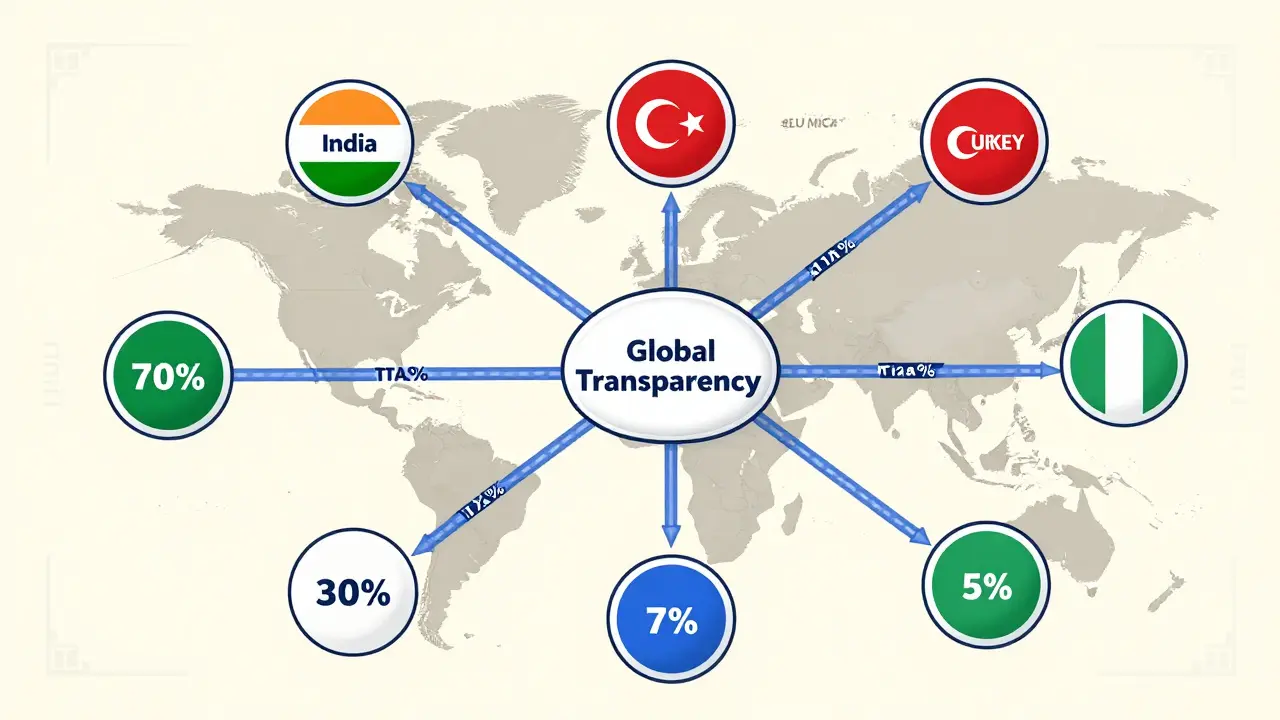
Look at India. While not a "small" nation geographically, its regulatory impact is felt globally due to its massive population. Its 30% tax on crypto profits and 1% Tax Deducted at Source (TDS) on every transaction generated $1.8 billion in FY 2024-2025. This heavy taxation has stifled local innovation but secured significant state revenue. In contrast, Argentina offers unique incentives, such as a 10% tax rebate for exporters using stablecoins for international settlements. This encourages the use of crypto for real-world trade rather than speculative trading.
In Africa, Kenya and Nigeria are taking steps to formalize the sector. Kenya’s 3% Digital Services Tax (DST) on crypto transactions applies to both local and foreign Virtual Asset Service Providers (VASPs). This ensures that even if a service is hosted abroad, the economic activity within Kenya contributes to the national treasury. Nigeria’s 5% VAT on crypto services follows a similar logic, targeting the infrastructure providers rather than just the end-users.
Emerging Markets: Regulation First
Countries like Bahrain and Oman are adopting a "regulation-first" posture. They prioritize compliance, infrastructure, and licensing over rapid adoption. The Central Bank of Bahrain, for instance, has led comprehensive regulatory development, ensuring that any crypto activity within its borders meets high international standards. This approach may slow initial growth, but it builds trust with traditional financial institutions and prevents the kind of scandals that plague less regulated environments.
Mauritius represents a middle ground. The Financial Services Commission considers cryptocurrencies as regulated Digital Assets under the Financial Services Act 2007. This provides legal recognition, which is crucial for business operations, but also warns investors that there are no statutory compensation protections if things go wrong. It’s a balanced approach that acknowledges the reality of crypto without promising safety nets that the government cannot afford.
The Impact of Global Frameworks: MiCA and Beyond
Small nations do not operate in a vacuum. The European Union’s Markets in Crypto-Assets (MiCA) framework, which came into effect in late 2024, has influenced many small European nations to align their regulations accordingly. Even non-EU small nations feel the pressure to harmonize their rules to facilitate cross-border business. If a Swiss firm wants to do business with a German partner, regulatory alignment reduces friction.
This trend toward coordination means that the era of wild west crypto is ending. Small nations are increasingly balancing innovation-friendly policies with international compliance requirements. Switzerland’s participation in international information exchange agreements is a prime example. You can no longer hide assets in a small jurisdiction easily. Transparency is becoming the norm.
Challenges for Small Nations
Implementing these policies is not without challenges. Countries with established financial centers like Switzerland and Singapore can leverage existing expertise and infrastructure. They have lawyers, accountants, and regulators who understand complex financial instruments. Emerging market nations often have to build this capacity from scratch. Training staff, developing technical surveillance tools, and creating legal precedents take time and money.
Additionally, small nations are vulnerable to external shocks. A change in policy by a major economy like the US or China can ripple through the global market, affecting small nations disproportionately. They must remain agile, constantly updating their frameworks to address new technologies like decentralized finance (DeFi) and non-fungible tokens (NFTs).
What This Means for Investors and Businesses
If you are looking to start a crypto business or invest significantly, the choice of jurisdiction matters more than ever. Switzerland remains top-tier for long-term holding and institutional setup due to tax benefits and clarity. The UAE is rapidly becoming the go-to for those wanting access to Middle Eastern and Asian markets with a modern regulatory structure. Singapore offers stability and prestige for Asian operations.
However, beware of the hidden costs. In countries with high transaction taxes like Turkey or India, your operational margins will shrink. In places with ambiguous regulations, the risk of sudden policy shifts remains high. Always consult with local legal experts before committing resources. The goal is to find a jurisdiction that aligns with your business model and risk tolerance.
Why are small nations leading in crypto policy?
Small nations can adapt their regulatory frameworks much faster than large economies. They lack the bureaucratic inertia that slows down legislative processes in bigger countries. This allows them to experiment with innovative approaches, such as Switzerland's DLT Act or the UAE's VARA, providing legal certainty that attracts businesses and investors.
Is it better to live in a country with low crypto taxes?
Not necessarily. While low taxes like Switzerland's zero capital gains tax on long-term holdings are attractive, you must consider the overall regulatory environment. A country with low taxes but unclear laws poses higher legal risks. Additionally, international tax reporting agreements mean that hiding assets in low-tax jurisdictions is becoming increasingly difficult.
How does the EU's MiCA framework affect small non-EU nations?
MiCA sets a high standard for consumer protection and market integrity. Small non-EU nations often align their regulations with MiCA to facilitate easier cross-border business with European partners. Harmonizing rules reduces compliance costs for companies operating in multiple jurisdictions and increases trust among international investors.
What is the difference between the UAE and Saudi Arabia's crypto approach?
The UAE has embraced crypto as a strategic economic pillar, creating dedicated regulatory authorities and free zones to attract businesses. Saudi Arabia, constrained by Sharia interpretations, restricts financial institutions from trading crypto but sees high grassroots adoption among its young population. Saudi Arabia focuses on blockchain infrastructure for institutional use rather than retail trading.
Are small nations safe havens for crypto anonymity?
No, the era of anonymity is largely over. Many small nations, including Switzerland, have joined international agreements for automatic exchange of financial information. This means crypto holdings are reported to partner countries, making it difficult to evade taxes. Regulatory clarity is replacing secrecy as the main selling point for these jurisdictions.
Which small nation is best for crypto startups in 2026?
It depends on your target market. Switzerland is ideal for firms prioritizing regulatory clarity and tax efficiency for long-term holders. The UAE is excellent for accessing Middle Eastern and Asian markets with a robust legal framework. Singapore is the best choice for companies seeking stability and credibility in the broader Asian region.
 Finance