


Can businesses in Iran accept cryptocurrency legally? The short answer is: yes - but only under a system so tightly controlled that it barely resembles free-market adoption. This isn’t El Salvador, where Bitcoin is legal tender. It’s not Nigeria, where businesses can freely accept crypto with basic reporting. Iran’s approach is a high-stakes balancing act: allow just enough crypto activity to ease economic pressure from sanctions, while keeping every transaction under the Central Bank’s watchful eye.
How It Actually Works (Not What You’d Expect)
Forget setting up a crypto payment button on your website. Iranian businesses can’t accept crypto directly from customers like they would a credit card. The system forces all crypto transactions through government-approved exchanges - Nobitex, Wallex.ir, Bitpin.ir - and requires every transaction to be tied to a Foreign Exchange Card (FX Card). This isn’t just a digital wallet. It’s a financial leash. Here’s the real process: A customer pays you in Bitcoin or DAI. That crypto gets instantly converted to Iranian rials through an approved exchange. But here’s the catch - the exchange doesn’t just hand you rials. It credits your FX Card with the equivalent foreign currency value (say, $1,000 USD). You now owe the Central Bank of Iran (CBI) that $1,000 back within one year. You have to physically repatriate foreign currency - cash, wire, or trade goods - to settle the obligation. If you don’t? Penalties, fines, or worse. This system was formalized in January 2025 under Presidential Directive No. 1403/12456. It replaced a chaotic, unregulated period where businesses were freely accepting crypto without oversight. The CBI shut down all direct crypto-to-rial payment gateways in December 2024, then rebuilt the entire system under its control. Now, every transaction flows through a CBI API that logs 55 data points per payment - including customer IP, device ID, and merchant location. The government sees everything.The Hidden Costs: Fees, Delays, and Paperwork
Accepting crypto in Iran isn’t just about technology. It’s a compliance marathon. To even start, a business must apply for a CBI license. The application requires 17 documents: commercial registration, tax ID, energy usage certificates, bank statements, even proof of legal business premises. The average approval time? 23 business days. For small businesses, the rejection rate hits 32%. Many give up before they even begin. Once approved, the operational burden doesn’t end. Each crypto transaction adds 4.7 seconds to checkout time because of the mandatory API checks. Monthly accounting jumps by 8.3 hours - you need separate ledgers for crypto income, foreign exchange obligations, and tax reporting. Form CR-2025/07 must be submitted every month. Missing it means fines. Then there’s the FX Card. Businesses report it adds 1.8% in extra fees and 2-3 days of processing delay per transaction. That’s money lost and customers walking away. And if you’re a restaurant or small e-commerce shop with thin margins? That’s not a cost - it’s a dealbreaker.What You Can’t Do (And Why)
There are hard lines in Iran’s crypto rules:- No direct customer payments. You can’t integrate a Coinbase or MetaMask wallet on your site. All conversions must go through CBI-approved exchanges.
- No advertising. Since February 2025, it’s illegal to promote crypto payments on social media, billboards, or even in-store signs. You can’t tell customers you accept crypto - even if you do.
- No mining. Unauthorized mining was banned after nationwide power outages in December 2024. Businesses caught running mining rigs face fines equal to 200% of their electricity bill - and immediate shutdown.
- No private transactions. The CBI has full, real-time access to all transaction data. There is no anonymity. No off-chain transfers. No private wallets for business use.

Taxes and the New Financial Trap
In August 2025, Iran introduced its first formal crypto tax law: the Law on Taxation of Speculation and Profiteering. It’s not just about income - it’s about profit. If your business makes more than 50 million rials ($1,000 USD at official rates) in crypto trading profits in a year, you owe 25% in capital gains tax. That rate climbs to 35% for profits over 500 million rials. But here’s the trap: the CBI doesn’t just track your crypto sales. It tracks your FX Card obligations. If you bought Bitcoin for 100 million rials and sold it for 200 million rials, you owe tax on the 100 million rial gain - even if you haven’t yet repaid the $1,000 USD foreign currency debt tied to that transaction. You’re taxed on paper profit, not cash flow. Many businesses end up paying taxes on profits they never actually received in cash. That’s why 63% of crypto-accepting businesses now rely on high-interest loans (22.4% APR average) just to cover their FX Card obligations - and then pay taxes on money they borrowed.Who’s Doing It - And Why
Despite the restrictions, crypto use among Iranian businesses is growing. Daily transaction volume hit $22.3 million in mid-2025 - up 11.8% from 2024. Why? Because it’s still better than the alternatives. Iran’s official exchange rate for the dollar is 42,000 rials. The black market rate? Around 550,000 rials. That’s a 1,200% difference. For businesses importing goods, paying suppliers in crypto (converted to rials through the FX Card) is often the only way to access foreign currency at a rate close to reality. The biggest adopters? Small businesses. E-commerce shops (34%), restaurants (22%), and freelance service providers (19%) - all under 50 employees. They’re the ones who need to pay for international tools (Shopify, Canva, AWS), buy inventory from Turkey or China, or send money to family abroad. Digikala, Iran’s largest e-commerce platform, processed $4.2 million in crypto transactions in Q1 2025 - all through the CBI system. No violations. No fines. Just strict compliance. They’re the model others try to copy.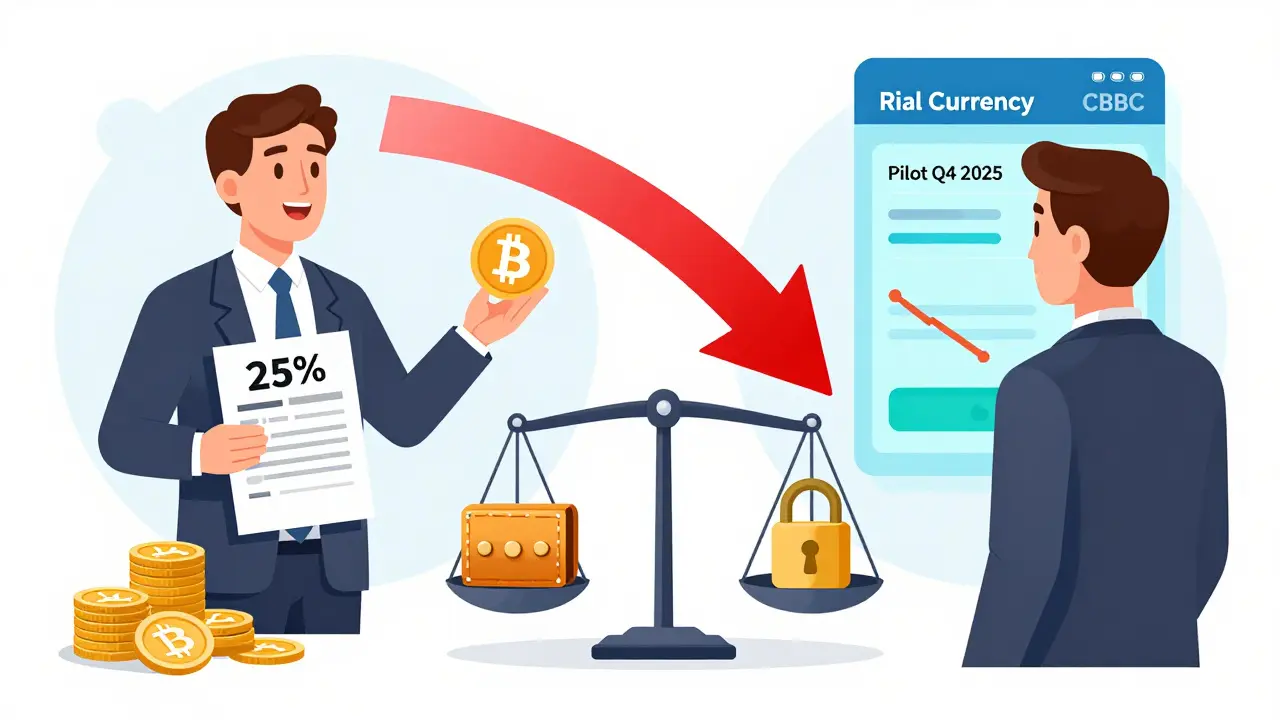
The Bigger Picture: A Controlled Leak
Iran’s crypto policy isn’t about embracing innovation. It’s about survival. Western sanctions have frozen $120 billion in Iranian assets abroad. The banking system is isolated. The rial is collapsing. The government can’t stop people from using crypto - so instead, it controls it. By forcing all transactions through its own system, the CBI captures tax revenue, prevents capital flight, and monitors who’s doing what. It’s what analysts call a “controlled leak.” The government lets a little crypto flow out - just enough to keep businesses alive - but never enough to threaten its control. Every transaction is a data point. Every FX Card is a tracking device. The future may bring more pressure. Tether froze $12.7 million in Iranian-linked addresses in July 2025. The CBI is now pushing businesses toward DAI and other stablecoins on the Polygon network, which are harder to freeze. And by late 2026, 85% of crypto transactions are expected to shift away from Tether entirely. Even more telling: Iran is developing its own central bank digital currency - “Rial Currency” - set for pilot testing in Q4 2025. It won’t be crypto. It won’t be decentralized. It will be rials with a digital wrapper. The government’s endgame isn’t crypto adoption. It’s replacing it with something it fully owns.Is It Worth It for Your Business?
If you’re a small business owner in Iran asking whether to accept crypto, here’s what you need to know:- Pros: Access to real foreign currency when banks won’t help. Lower transaction fees than traditional remittance services. Ability to pay international suppliers. Growing customer base that prefers crypto.
- Cons: 17 documents, 23-day wait, 1.8% fees, 2-3 day delays, 25-35% tax on profits, mandatory foreign currency repayment, no advertising, constant surveillance, risk of license revocation.
Frequently Asked Questions
Can Iranian businesses accept Bitcoin directly from customers?
No. Iranian businesses cannot accept Bitcoin or any cryptocurrency directly from customers. All transactions must go through Central Bank of Iran-approved exchanges like Nobitex or Wallex.ir. The exchange converts the crypto to rials and credits the business’s Foreign Exchange Card with the equivalent foreign currency value. Direct integration with wallets like MetaMask or Coinbase is illegal.
What is the Foreign Exchange Card (FX Card) and why does it matter?
The FX Card is a government-mandated financial tool that links every crypto transaction to a foreign currency obligation. When a business receives crypto, the exchange converts it and credits the FX Card with the USD or EUR equivalent. The business must then repay that exact amount in foreign currency - through bank transfers, trade, or cash - within one year. Failure to repay results in fines, license suspension, or criminal penalties. It’s the core mechanism that lets the government control capital outflow.
Are there taxes on cryptocurrency profits in Iran?
Yes. Since August 2025, Iran imposes a capital gains tax on cryptocurrency trading profits. If a business makes over 50 million rials ($1,000 USD) in profit from crypto transactions in a year, it owes 25% tax. Profits over 500 million rials are taxed at 35%. The tax is calculated on the rial value of the gain, even if the business hasn’t yet repaid its foreign currency obligation to the CBI.
Can I advertise that my business accepts crypto in Iran?
No. Since February 2025, advertising cryptocurrency payment options is illegal. This includes social media posts, website banners, in-store signs, or even mentioning crypto acceptance in customer conversations. The ban is strictly enforced to prevent public awareness and discourage widespread adoption outside the CBI-controlled system.
What happens if I try to bypass the CBI system?
Attempting to bypass the CBI system - such as using unapproved exchanges, private wallets for business, or offshore payment processors - can lead to immediate license revocation, heavy fines (up to 200% of transaction value), and potential criminal charges. In Q1 2025, the CBI revoked 29 licenses from compliance consultants helping businesses circumvent rules. One Tehran e-commerce company was fined $48,000 for routing payments through a foreign intermediary. The system is monitored in real time - evasion is not sustainable.
Is cryptocurrency mining legal for businesses in Iran?
No. Unauthorized cryptocurrency mining was banned nationwide after December 2024 power outages affected 17 provinces. Businesses found operating mining equipment face immediate shutdown and fines equal to 200% of their electricity costs. Even if you have a license to accept crypto, mining is a separate violation. Only state-approved mining operations (if any) are permitted - and none are currently active for private businesses.
Will Iran’s new digital currency replace crypto?
Yes - that’s the goal. Iran is developing a central bank digital currency called “Rial Currency,” set for pilot testing in Q4 2025. Unlike Bitcoin or DAI, it will be fully controlled by the Central Bank, pegged to the physical rial, and designed to replace reliance on global cryptocurrencies. Once launched, businesses will be strongly encouraged - then likely required - to shift all digital payments to the state system. Crypto’s role will shrink further as the government consolidates financial control.
 Finance




Barbara Rousseau-Osborn
January 27, 2026 AT 18:14Jen Allanson
January 29, 2026 AT 11:32Harshal Parmar
January 29, 2026 AT 22:33Darrell Cole
January 30, 2026 AT 11:18Dave Ellender
February 1, 2026 AT 04:44Adam Lewkovitz
February 2, 2026 AT 14:20Clark Dilworth
February 3, 2026 AT 04:36Brenda Platt
February 4, 2026 AT 17:31Arnaud Landry
February 6, 2026 AT 02:01george haris
February 6, 2026 AT 19:54Mark Estareja
February 8, 2026 AT 14:18David Zinger
February 8, 2026 AT 23:28steven sun
February 10, 2026 AT 18:10Sara Delgado Rivero
February 11, 2026 AT 15:15