

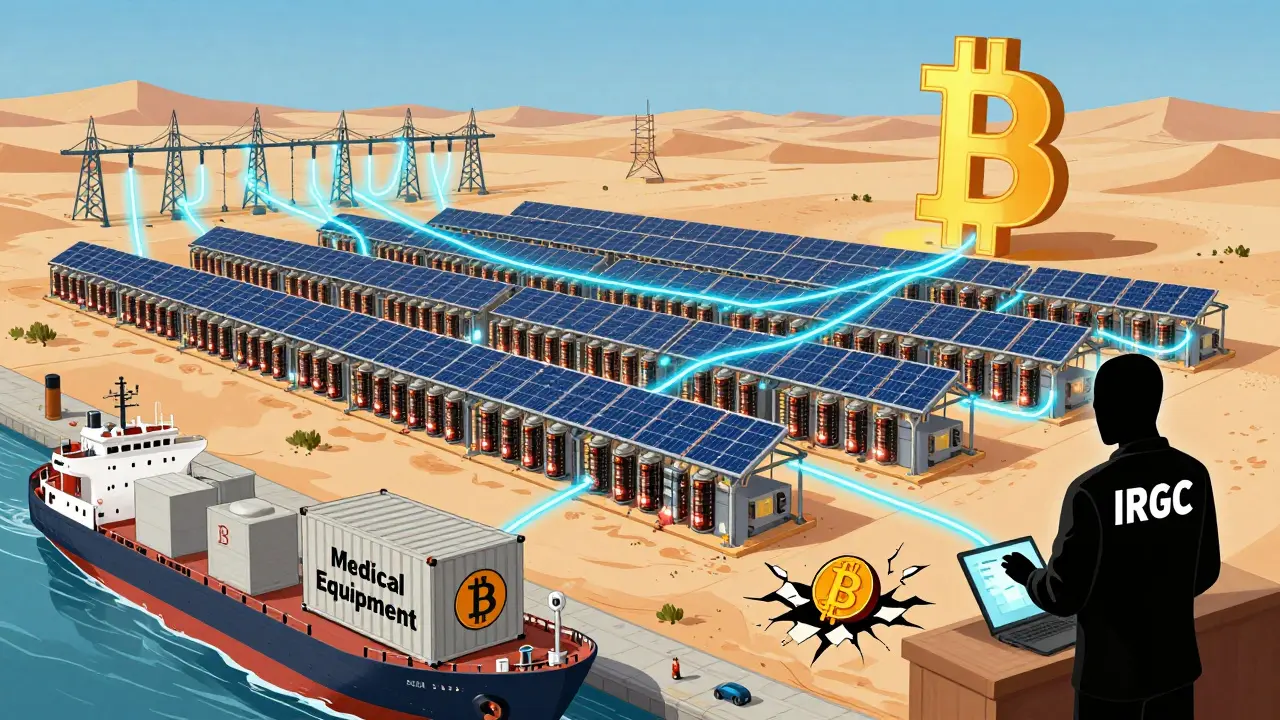
When international sanctions cut Iran off from the global banking system, the country didn’t just sit still. It built a new financial pipeline - not with banks or dollars, but with Bitcoin. Today, Bitcoin isn’t just a speculative asset in Iran. It’s a lifeline for importing essential goods, from medical equipment to industrial machinery. And it’s working - not because it’s perfect, but because there’s no other way.
How Iran Turned Bitcoin Into a Trade Tool
Iran’s official stance on cryptocurrency is confusing. The Central Bank of Iran bans citizens from using Bitcoin to pay for anything locally. You can’t buy a phone or pay your electricity bill with it. But here’s the twist: the government actively encourages mining. In 2018, it legalized Bitcoin mining under special industrial electricity rates. That wasn’t about tech enthusiasm. It was about survival. With U.S. sanctions blocking access to SWIFT and freezing Iranian assets abroad, traditional trade became nearly impossible. Iranian companies couldn’t receive dollars. Foreign suppliers wouldn’t risk processing payments through banks that might get penalized. So Iran turned to Bitcoin - not as a currency for consumers, but as a settlement tool for international trade. The system works like this: Iranian mining farms, often owned or backed by state-linked entities like the Islamic Revolutionary Guard Corps (IRGC), produce Bitcoin using cheap, state-subsidized electricity. They sell that Bitcoin to state-approved exchanges. Those exchanges then convert the Bitcoin into foreign currency - not in Iran, but through offshore accounts. The money is used to pay for imports. It’s a closed loop: energy → Bitcoin → imports. By 2024, over $4.18 billion worth of cryptocurrency had left Iran. That’s a 70% jump from the year before. And it’s not just random transactions. Iran’s first documented crypto import was in August 2023 - a $10 million order for medical supplies. Since then, Iranian firms have moved over $8 billion through Binance alone to bypass sanctions.The Mining Machine Behind the Trade
Iran doesn’t just mine Bitcoin. It runs one of the largest mining operations on the planet. By 2022, the government had issued licenses for more than 10,000 mining farms. Some are small. Others are massive. Take the 175-megawatt facility in Rafsanjan, Kerman province. Built in partnership with Chinese investors, it’s powered by electricity so cheap it’s practically free. That’s because it’s connected directly to power grids controlled by the IRGC. These aren’t hobbyist operations. They’re industrial-scale, 24/7 factories filled with ASIC miners - machines designed to crack Bitcoin’s code faster than any consumer device. Each one consumes as much power as hundreds of homes. And they’re not alone. Investigators say state-backed mining pools, including those linked to religious foundations like Astan Quds Razavi, have formed what experts call a “crypto cartel.” They divert electricity meant for homes and factories, leaving entire cities without power for hours at a time. The government claims these operations are legal. But the reality is messier. Miners must register with the Ministry of Industry and get electricity quotas from the Iran Power Generation Company. They’re supposed to follow AML and KYC rules. But enforcement is selective. Illegal miners using household power were arrested in 2021 - but only the small ones. The big ones? They operate with armed guards and political protection.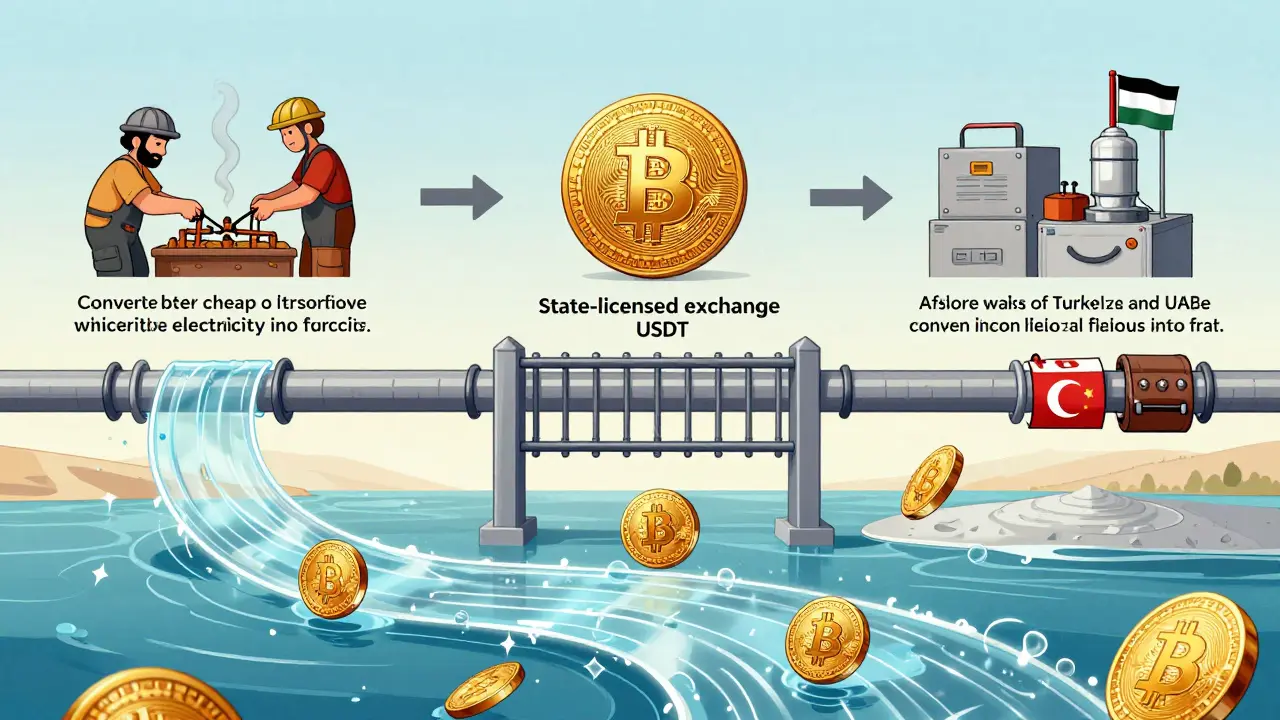
How Imports Actually Happen
You might think: if Bitcoin is banned for payments, how do Iranian companies actually buy things from abroad? The answer lies in a carefully controlled pipeline. Here’s how it works step by step:- An Iranian importer needs to buy machinery from China.
- The supplier doesn’t accept rials or dollars - they accept Bitcoin.
- The importer’s company uses a state-licensed exchange to convert Bitcoin into a stablecoin like USDT.
- The exchange sends the stablecoin to a foreign wallet, often in Turkey or the UAE.
- That wallet then converts the stablecoin into fiat currency and wires it to the supplier.
The Hidden Costs: Power, Volatility, and Risk
This system isn’t magic. It’s high-risk and high-cost. First, there’s electricity. Iran’s power grid is crumbling. Cities like Tehran and Mashhad suffer daily blackouts. Experts estimate that crypto mining consumes up to 15% of the country’s total electricity - enough to power millions of homes. That’s not sustainable. It’s not even legal in most countries. Second, Bitcoin’s price swings. One day, a shipment might cost 100 BTC. The next day, it’s 120 BTC. That’s a 20% loss overnight. Iranian importers can’t hedge easily. They’re stuck with volatility because there’s no crypto futures market inside Iran. Third, there’s regulation. The Central Bank of Iran controls every move. Exchanges must get licenses. Transactions are monitored. And if the government changes its mind - like it did in 2021 when it briefly banned mining during a power crisis - everything halts. There’s no legal recourse. No contract enforcement. Just state power. And then there’s the risk of being caught. While Iran uses crypto to bypass U.S. sanctions, the U.S. Treasury still monitors transactions. Binance, for example, has frozen accounts linked to Iranian entities. The U.S. has sanctioned Iranian mining firms. The threat of secondary sanctions looms over every foreign company that deals with Iran’s crypto trade.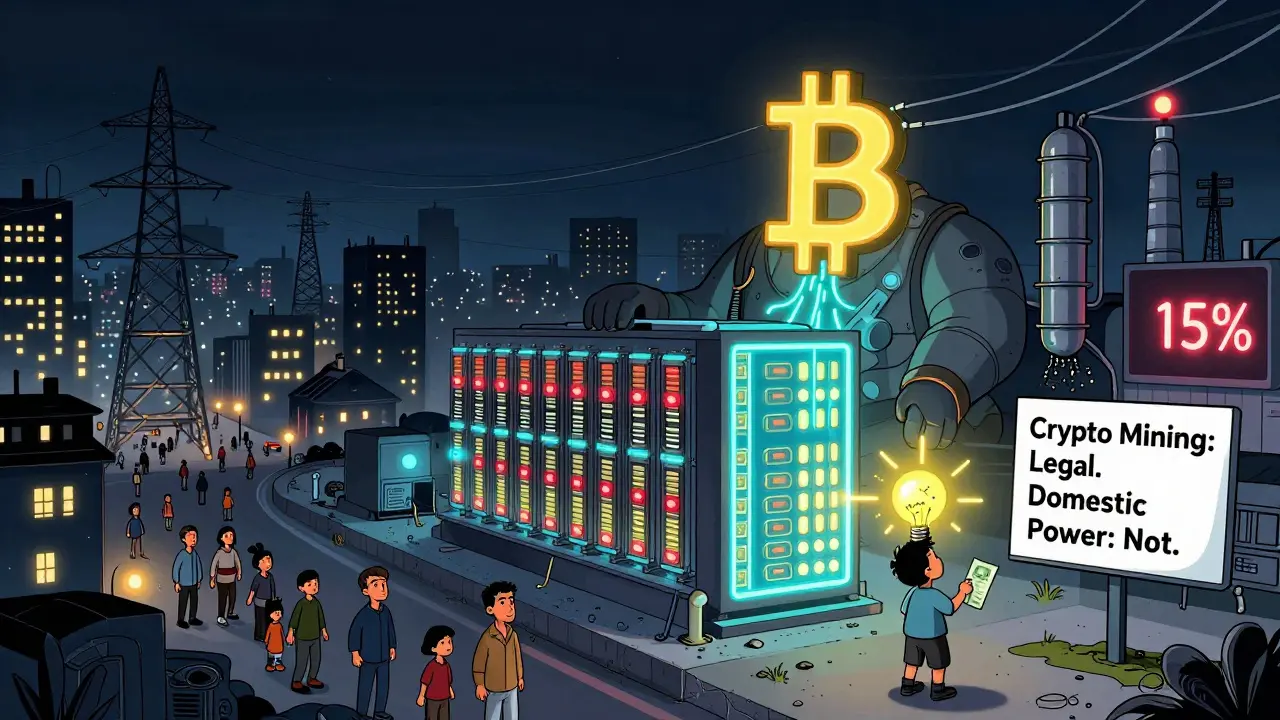
Why This Matters Beyond Iran
Iran’s experiment isn’t just about survival. It’s a blueprint. Other sanctioned nations - Venezuela, North Korea, Belarus - are watching closely. If Bitcoin can keep Iran’s economy running, it could do the same for others. This isn’t about freedom or decentralization. It’s about power. The state is using crypto not to escape control, but to create its own version of control. It also shows how quickly traditional financial systems can be bypassed. When banks shut the door, technology found a back window. And it’s not going away. Even as the U.S. tightens sanctions, Iran keeps expanding. By 2025, the country’s crypto sector is expected to generate $1.9 billion in revenue. That’s more than most African nations make from tech exports. And it’s all built on one thing: cheap energy, state-backed mining, and a refusal to play by the old rules.What’s Next?
Iran isn’t planning to stop. In fact, it’s doubling down. The government is building new mining zones in desert regions, where solar and wind power could eventually replace fossil-fueled electricity. It’s negotiating with China to build blockchain-based trade corridors. And it’s training engineers to develop its own stablecoin - one that’s pegged to gold, not the dollar. But the cracks are showing. Power outages are getting worse. International pressure is rising. And as Bitcoin’s mining difficulty increases, the cost of running these farms keeps climbing. For now, Bitcoin remains Iran’s most effective tool for staying open for business. It’s not pretty. It’s not fair. But it works - and until sanctions change, it won’t stop.Can Iranian citizens use Bitcoin to buy things locally?
No. The Central Bank of Iran strictly prohibits using Bitcoin or any cryptocurrency for domestic payments. Citizens cannot use crypto to pay for groceries, utilities, or services. All local transactions must go through rials. The government allows crypto only for mining and cross-border trade, under strict oversight.
Is Bitcoin mining legal in Iran?
Yes - but only for large, state-approved operations. Since 2018, Iran has licensed over 10,000 mining farms, mostly run by government-linked entities like the IRGC. These farms must register with the Ministry of Industry, get electricity quotas, and follow AML/KYC rules. Small-scale or home mining using subsidized power is illegal and has been cracked down on.
How does Iran avoid U.S. sanctions using Bitcoin?
Iran bypasses U.S. sanctions by using Bitcoin as a settlement layer outside the traditional banking system. Instead of receiving dollars, Iranian exporters sell goods and receive Bitcoin. That Bitcoin is mined domestically or bought through licensed exchanges, then converted into stablecoins and sent to offshore accounts in countries like Turkey or the UAE. From there, it’s converted into local currency and sent to foreign suppliers - avoiding SWIFT, dollar clearing, and U.S. financial oversight.
What role does the Islamic Revolutionary Guard Corps (IRGC) play in crypto mining?
The IRGC controls some of Iran’s largest and most profitable mining operations. These include 175-megawatt farms built with Chinese partners, often located on IRGC-controlled land with direct power lines. The IRGC uses mining profits to fund its activities, especially after losing access to global banking. These operations benefit from free or heavily subsidized electricity and operate with minimal oversight.
Is Iran’s crypto trade system sustainable long-term?
Not as it stands. The system relies on cheap electricity, which is straining Iran’s power grid and causing widespread blackouts. Bitcoin mining is becoming more energy-intensive, and Iran’s infrastructure can’t keep up. Without major upgrades to energy production or a shift to renewables, the model will become too costly. Political risks and international sanctions also make long-term stability uncertain.
 Finance

Tina Keller
March 13, 2026 AT 18:57vasantharaj Rajagopal
March 14, 2026 AT 02:54Tom Jewell
March 14, 2026 AT 09:08Anthony Marshall
March 16, 2026 AT 04:22Lindsay Girvan
March 17, 2026 AT 18:44Douglas Anderson
March 18, 2026 AT 19:14ann neumann
March 19, 2026 AT 05:13Brandon Kaufman
March 19, 2026 AT 18:29Anshita Koul
March 21, 2026 AT 10:58PIYUSH KOTANGALE
March 22, 2026 AT 22:06Grace van Gent-Korver
March 24, 2026 AT 16:39Zephora Zonum
March 25, 2026 AT 23:46William Montgomery
March 27, 2026 AT 20:23Adam Ashworth
March 29, 2026 AT 05:18karan narware
March 29, 2026 AT 09:26vishnu mr
March 29, 2026 AT 16:11Mara Alves Mariano
March 29, 2026 AT 22:26Allison Davis
March 31, 2026 AT 16:09Sherry Kirkham
April 1, 2026 AT 14:20Sharon Tuck
April 1, 2026 AT 19:27Jenni James
April 3, 2026 AT 04:25Chelsea Boonstra
April 3, 2026 AT 16:22Alex Thorn
April 4, 2026 AT 08:16Howard Headlee
April 5, 2026 AT 19:50