

Five years ago, if you asked whether cryptocurrency would ever get clear legal recognition in the U.S., most experts would’ve shrugged. Regulatory chaos ruled. The SEC sued one company. The CFTC claimed jurisdiction over another. Banks refused to touch crypto clients. And stablecoins? No one knew if they were securities, commodities, or something entirely new. Then, in 2025, everything changed.
2025: The Year Cryptocurrency Went Legally Real
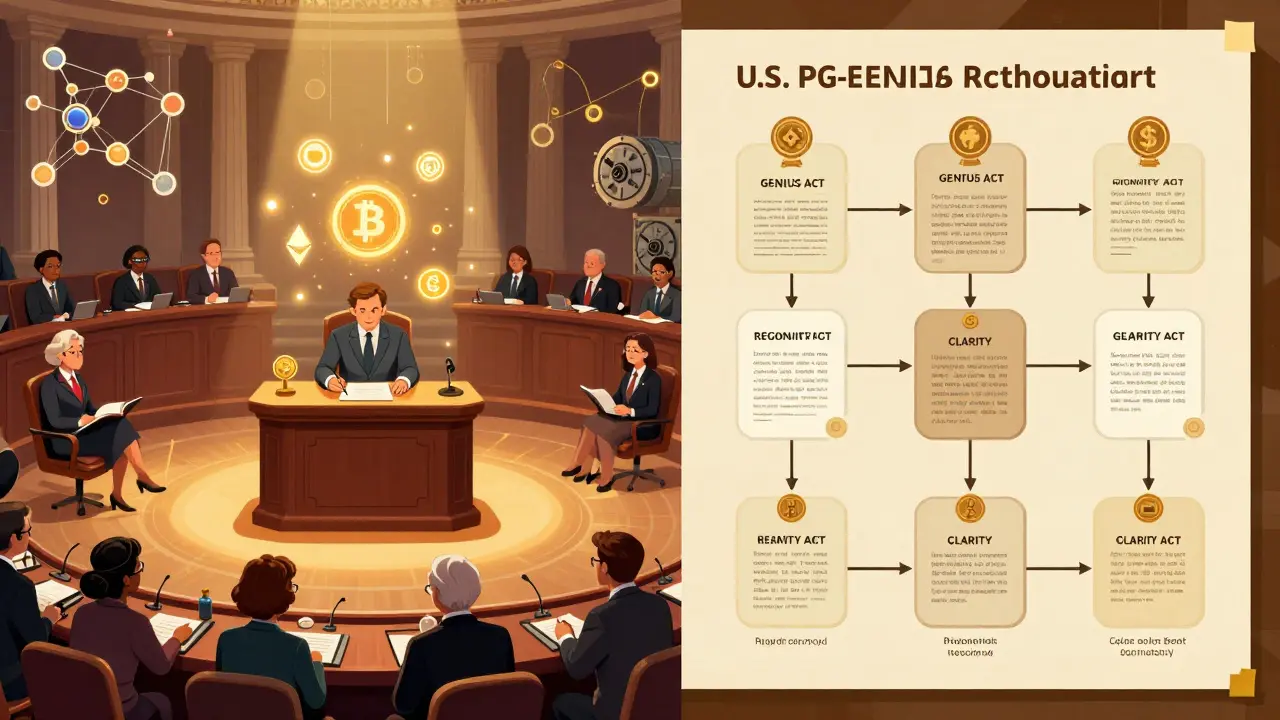
The breakthrough didn’t come from a court ruling or a presidential tweet. It came from Congress. In July 2025, the GENIUS Act (Guiding and Establishing National Innovation for U.S. Stablecoins Act of 2025) became the first comprehensive federal law to formally recognize and regulate stablecoins. Signed into law after bipartisan support, it didn’t just allow stablecoins - it gave them a legal home. Issuers now must hold reserves backed 1:1 by U.S. Treasury securities or FDIC-insured bank deposits. Audits are mandatory. Transparency is required. And most importantly, they’re no longer treated like wildcards - they’re now legally recognized as payment instruments.
This wasn’t an isolated move. The same legislative session also passed the CLARITY Act (Digital Asset Market Clarity Act of 2025), which finally settled the decade-long fight between the SEC and CFTC over who controls what. Under this law, digital assets are clearly classified: if a coin is used as money or a medium of exchange (like Bitcoin or Ethereum), it’s a commodity under the CFTC. If it’s sold as an investment contract with expectations of profit from others’ efforts (like certain tokenized securities), it’s a security under the SEC. No more guessing. No more enforcement raids based on ambiguity.
What You Can Legally Do Now - And What You Can’t
On January 23, 2025, President Biden’s Executive Order 14067 was officially revoked. In its place, the "Strengthening American Leadership in Digital Financial Technology" (executive order signed January 23, 2025) was issued. This single document flipped the script. It explicitly affirmed your right to:
- Run a full node on the Bitcoin or Ethereum network
- Mine cryptocurrency from your home
- Send and receive crypto peer-to-peer without intermediaries
- Hold crypto in self-custody wallets - no bank permission needed
And here’s the kicker: it banned the U.S. government from creating a central bank digital currency (CBDC). The Anti-CBDC Act (part of the 2025 legislative package) made it illegal for federal agencies to develop or deploy a digital dollar. That’s not a policy preference - it’s the law. Americans now have a legal right to choose their own digital money.
Banking Finally Opened Its Doors
Before 2025, most banks treated crypto like a contagious virus. Now? They’re building crypto desks.
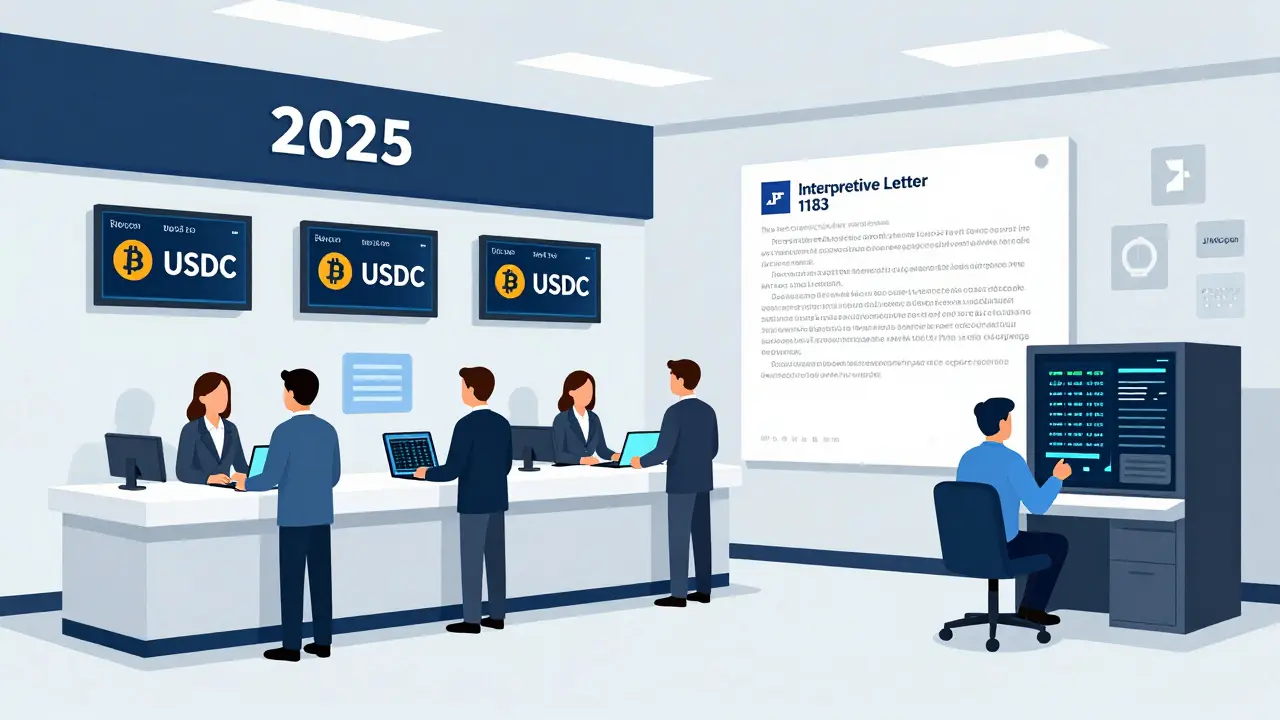
In March 2025, the Office of the Comptroller of the Currency (OCC) (federal regulator for national banks) issued Interpretive Letter 1183. It didn’t just permit banks to participate in crypto - it clarified exactly how. National banks can now:
- Hold crypto assets as custodians for customers
- Reserve funds for stablecoin issuers
- Act as independent nodes on public blockchains
- Set up crypto payment rails for businesses
This wasn’t a loophole. It was a full reversal of the 2021 ban. Banks like JPMorgan and Wells Fargo now offer crypto custody services. Credit unions are launching crypto-linked savings accounts. The financial system didn’t just accept crypto - it integrated it.
Stablecoins: From Shadow to Standard
Stablecoins were once the wild west. Tether’s reserves? Secret. Circle’s? Questionable. Now? Under the GENIUS Act, every issuer must publish daily attestations from independent auditors. Reserves must be held in cash or U.S. Treasuries. No offshore shell companies. No risky commercial paper. No leverage.
That’s why in 2025, U.S.-backed stablecoins like USD Coin (USDC) and Binance USD (BUSD) saw their market share jump to 87% of global stablecoin volume. Why? Because now, institutional investors - pension funds, hedge funds, even state treasuries - can trust them. They’re not just digital tokens anymore. They’re legal financial instruments, recognized by the Federal Reserve as eligible collateral for interbank settlements.
Enforcement Is Now Predictable
Remember when the SEC sued Coinbase, Kraken, and Binance for “unregistered securities”? Those cases are now moot. The CLARITY Act redefined what counts as a security in crypto. Tokens that function as currency - Bitcoin, Ethereum, Solana, Litecoin - are commodities. Only tokens sold with promises of profit from a centralized team (like certain NFT projects or tokenized real estate schemes) are securities.
On March 20, 2025, the SEC staff issued a formal statement: “Mining, staking, and running nodes do not constitute securities activities.” That ended years of fear. Miners no longer need lawyers. Node operators can sleep at night. Developers aren’t being chased for building open networks.
And the Financial Crimes Enforcement Network (FinCEN) (U.S. agency responsible for AML/CFT enforcement) made sure this wasn’t a free-for-all. All crypto businesses - whether regulated by the SEC, CFTC, or state agencies - must still comply with the Bank Secrecy Act. KYC, transaction monitoring, suspicious activity reports - all still required. But now, the rules are the same for everyone. No more regulatory arbitrage.

Why This Matters Beyond the U.S.
The EU passed MiCA in 2023. Japan tightened rules in 2024. But the U.S. didn’t just catch up - it leapfrogged. By clearly defining jurisdiction, banning a CBDC, and empowering banks, America signaled that innovation, not control, is the goal.
That’s why crypto startups that once fled to Singapore or Dubai are now setting up shop in Austin, Miami, and even Leeds. The legal clarity attracted $23 billion in venture funding in 2025 - more than the previous five years combined. And it’s not just startups. Visa and Mastercard now process crypto-to-fiat payments. PayPal lets users pay with Bitcoin. Walmart’s supply chain uses Ethereum-based tracking. This isn’t niche anymore.
What’s Next? The Road Beyond 2025
The 2025 framework isn’t the end. It’s the foundation. The next steps are already in motion:
- Creation of a Strategic Bitcoin Reserve (proposed federal initiative to hold Bitcoin as a sovereign asset) - under discussion in Congress.
- Interoperability rules between U.S. stablecoins and global payment systems like SWIFT.
- Standardized reporting for decentralized finance (DeFi) protocols under the CFTC’s oversight.
- Legislation to protect users from fraudulent smart contract exploits - not by banning DeFi, but by requiring insurance backstops.
One thing’s certain: the era of regulatory guesswork is over. The law now recognizes cryptocurrency not as a threat, but as a new financial layer - one that’s faster, cheaper, and more open than what came before.
Is cryptocurrency legal in the U.S. now?
Yes. Since 2025, cryptocurrency is fully legal to own, trade, mine, and use as payment. The GENIUS Act, CLARITY Act, and Anti-CBDC Act removed all federal ambiguity. You can hold Bitcoin in a wallet, run a node, or use USDC to pay for goods without breaking any law.
Can banks hold cryptocurrency now?
Yes. The OCC’s Interpretive Letter 1183 (March 2025) explicitly permits national banks and federal savings associations to custody crypto, hold stablecoin reserves, and act as nodes on public blockchains. Major banks like JPMorgan and Bank of New York Mellon now offer these services.
Are stablecoins regulated like money?
Yes. Under the GENIUS Act, stablecoins are legally recognized as payment instruments. Issuers must hold 1:1 reserves in cash or U.S. Treasuries, publish daily audits, and comply with anti-money laundering rules. They’re treated like digital cash - not securities or commodities.
Will the U.S. create a digital dollar?
No. The Anti-CBDC Act, passed in 2025, makes it illegal for any federal agency to develop, test, or deploy a central bank digital currency. This law is binding and cannot be overturned without new legislation.
Do I need to report crypto transactions to the IRS?
Yes. The IRS still requires you to report crypto sales, trades, and income. Legal recognition doesn’t erase tax obligations. But now, exchanges and custodians are required to issue Form 1099-B for all taxable events - making compliance easier than ever.
Can I still mine Bitcoin at home?
Absolutely. The 2025 executive order explicitly protects the right to mine cryptocurrency. No permits are needed. No local bans override federal law. Home mining is now a protected financial activity under U.S. law.
 Finance




Dominica Anderson
February 16, 2026 AT 13:46Stablecoins as 'payment instruments'? That's not regulation. That's federal endorsement of unbacked digital IOUs. And don't get me started on the Anti-CBDC Act. You think this stops surveillance? It just moves it underground.
Tarun Krishnakumar
February 17, 2026 AT 21:39Meanwhile, the Fed’s quietly buying up all the U.S. Treasuries backing those '1:1 reserves'. You think Circle’s reserves are in vaults? Nah. They’re in Treasury auctions, being leveraged by the same banks that bailed out Wall Street in 2008.
And don’t tell me about 'transparency'. The auditors are hired by the issuers. The system’s rigged. They just made it look cleaner. Same scam. New PowerPoint.
jennifer jean
February 19, 2026 AT 08:32Also, my cousin in Texas just started mining with a solar-powered rig. She says it’s cheaper than her electric bill now. Wild times 🌞💰
Charrie VanVleet
February 19, 2026 AT 11:29Before 2025, I couldn’t even open a crypto account without getting a 45-minute lecture from my bank manager. Now? My credit union has a 'Crypto Savings' option with 3.2% APY. I put in $500 last month.
To the devs building DeFi tools: thank you. You didn’t ask for permission. You just built it. And now the system has no choice but to adapt. That’s how real change happens.
Geet Kulkarni
February 19, 2026 AT 12:53Stablecoins are now 'payment instruments'? So if I use USDC to buy a coffee, and the merchant goes bankrupt, am I protected by FDIC? No.
And '1:1 reserves'? Tell that to the 100+ stablecoins that vanished in 2022. This isn't regulation-it's PR with a law book.
Also, why are we celebrating a system that still requires KYC? That’s not freedom. That’s identity slavery with a blockchain sticker on it.
Paul David Rillorta
February 21, 2026 AT 12:49that people might stop using dollars? that their power is slipping? that a 14yo in ohio with a raspberry pi could outpace the federal reserve?
lol. they're not 'leading innovation'. they're panicking. and they're trying to look cool while doing it.
andy donnachie
February 23, 2026 AT 04:00Before 2025, if you asked me whether Bitcoin was a security or commodity, I’d say 'ask the lawyer who’s billing you $500/hour'. Now? Clear lines. Clear jurisdiction. Clear liability.
It’s not perfect-but it’s functional. And for crypto, that’s a miracle.
Lauren Brookes
February 23, 2026 AT 08:30People don’t trust institutions anymore. Not banks. Not the Fed. Not even Congress.
So they built something outside the system. And instead of crushing it, the system finally said: 'Okay. We’ll meet you halfway.'
That’s not surrender. That’s evolution.
Even if it’s messy. Even if it’s slow. Even if it’s imperfect.
It’s the first time in my lifetime that a grassroots movement forced a government to adapt-not to control it, but to coexist with it.
Chris Thomas
February 23, 2026 AT 12:02Bitcoin is a commodity? Then why does its price correlate with equity markets? Why do institutional investors treat it as a risk asset? Because it’s not a commodity-it’s a speculative instrument masquerading as currency.
And the 'no CBDC' clause? That’s not freedom. That’s a political stunt to appease libertarians while the Fed quietly develops a wholesale CBDC for banks. You think they’re not building it? They’re just not telling you.
Andrew Edmark
February 23, 2026 AT 15:43This isn’t just about money. It’s about autonomy.
I run a full node on my old laptop. I don’t need a bank. I don’t need permission. And now? The law says I’m allowed to.
That’s worth more than any price chart.
kieron reid
February 24, 2026 AT 01:25Every 'clarification' here was forced by lawsuits. Every law passed because the regulators were getting roasted in public.
This isn’t progress. It’s damage control. And the moment crypto’s market cap hits $20T? They’ll be back with new rules. Always are.
Avantika Mann
February 25, 2026 AT 18:55Now? He says he can finally use USDC to pay his suppliers in Bangalore without paying 8% in fees.
This isn’t just American-it’s global. People didn’t wait for permission. They just used what worked. And now the system had to catch up.
That’s the real story here.
Nikki Howard
February 25, 2026 AT 22:49The GENIUS Act mandates reserve backing, yet the auditing framework is entirely self-regulated. There is no public oversight. No congressional audit. No transparency mechanism beyond quarterly attestations.
This is not regulation. It is privatization with a veneer of legitimacy.
Sasha Wynnters
February 27, 2026 AT 12:19For 15 years, the Fed preached 'digital dollars'. The people whispered 'Bitcoin'.
Now? The Fed’s silent. The banks are building crypto desks. And the guy in Iowa who mines with a repurposed gaming PC? He’s got more real power than any central banker.
This isn’t policy. It’s poetry. And the rhyme? 'We tried to control it. We failed. So we gave it a badge.'
AJITH AERO
February 27, 2026 AT 21:47But my electricity bill went up 40%. And the grid’s still run by Duke Energy.
Who’s really winning here? The miner? Or the utility company that just got a new monopoly on crypto power?
Same game. New rules. Same losers.
Angela Henderson
February 28, 2026 AT 00:38I didn’t get the laws. But I got that.
And honestly? That’s all I needed to know.
Kyle Tully
March 1, 2026 AT 21:10You let me mine but you track every transaction? You let me use USDC but you demand my SSN?
This isn’t innovation. It’s a trap wrapped in a press release.
And don’t get me started on 'no CBDC'-they’re just waiting for a crisis to override it. They always do.
Ian Plunkett
March 3, 2026 AT 12:18Letting banks custody crypto? That’s not innovation. That’s the old guard adopting the new tech to keep control.
Same power. New interface.
And the Anti-CBDC Act? That’s not a win for freedom. It’s a political maneuver to keep libertarians quiet while the Fed quietly builds a parallel system for institutions.
Don’t be fooled. The game didn’t change. The players just changed their uniforms.
george chehwane
March 4, 2026 AT 15:41By calling it a commodity, you’re forcing it into a regulatory box designed for 1930s futures markets.
This isn’t clarity. It’s category error dressed in legalese.
And don’t get me started on 'node operators not engaging in securities activities'-that’s just a loophole for developers to avoid liability while the SEC waits for the next lawsuit.
Scott McCrossan
March 5, 2026 AT 19:15So what’s their solution?
Let people own it. But only if they report it.
Let banks custody it. But only if they’re FDIC-backed.
Let stablecoins exist. But only if they’re backed by Treasuries.
Translation: 'We can’t stop it. So we’ll own it.'
And the Anti-CBDC Act? That’s not freedom. It’s a distraction. They’re not banning a CBDC-they’re buying time until they can sneak one in through the back door.
Trust me. They’re already drafting the next executive order.
Anandaraj Br
March 7, 2026 AT 12:00Same thing. Just with a CEO instead of a Fed chair.
And who audits those '1:1 reserves'? The same firms that audited FTX?
This isn’t freedom. It’s a new kind of control.
And don’t tell me about 'transparency'. The audits are private. The data is locked.
They just made the cage prettier. Still a cage.
sruthi magesh
March 8, 2026 AT 00:59You think this makes America a crypto leader? No. It makes it the last to surrender.
China banned crypto in 2021. India taxed it into submission. The EU regulated it with teeth.
The U.S.? It waited until crypto was too big to kill.
Now it’s trying to claim credit.
It didn’t lead. It followed. And now it’s trying to tax the trail.
Dominica Anderson
March 9, 2026 AT 04:45Wait for the next crisis. A bank run. A debt ceiling collapse. A cyberattack on the Fed.
They’ll invoke 'national emergency' and bypass it.
They always do.
Charrie VanVleet
March 9, 2026 AT 08:23But the OCC’s Interpretive Letter 1183? That’s the real shift. Banks now act as nodes. That means they’re not just intermediaries-they’re infrastructure.
And infrastructure doesn’t disappear. It evolves.
So yes, the government didn’t lead. But the system? It changed. Quietly. Irreversibly.