

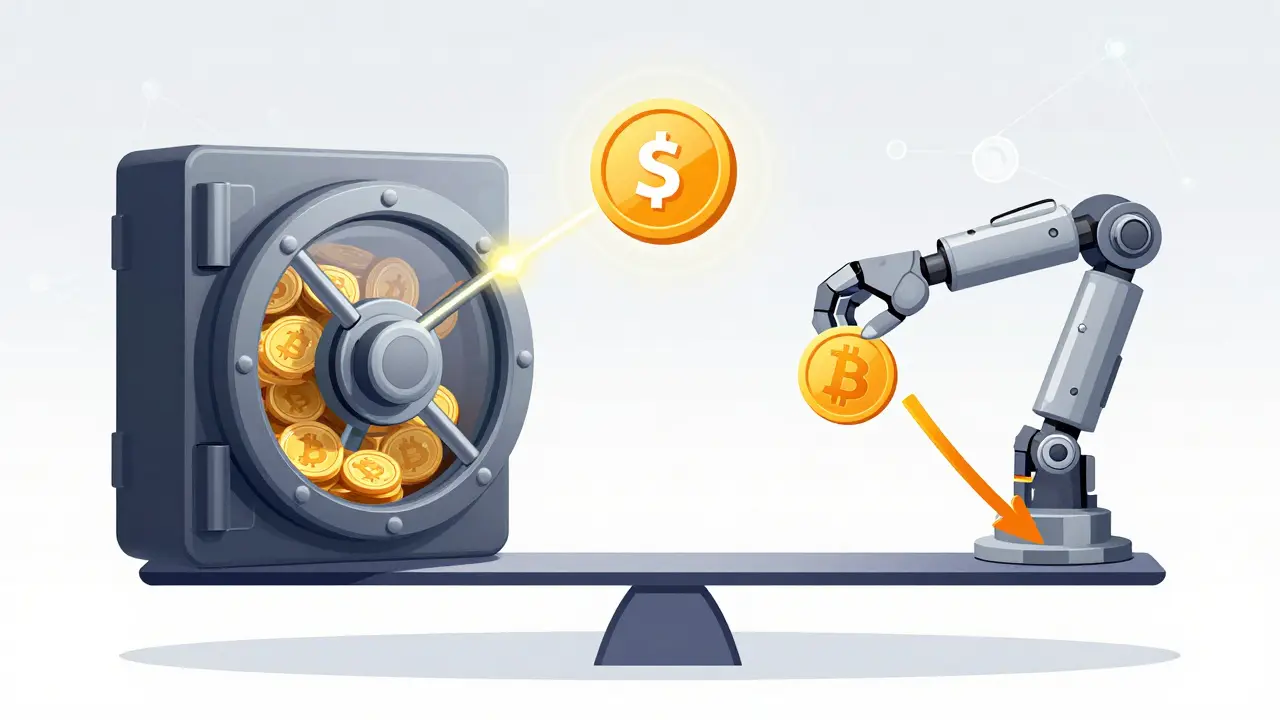
When you hear "stablecoin," you probably think of USDT or USDC-digital dollars backed by real cash in a bank. But USDX was different. It wasn’t backed by dollars. It was backed by Bitcoin. And it promised to stay stable without touching the banking system at all. That’s the story of Stables Labs and its synthetic stablecoin, USDX-and its staked version, sUSDX.
How USDX Was Supposed to Work
USDX wasn’t like other stablecoins. Instead of holding dollars in a vault, it used Bitcoin as collateral. The idea was simple: lock up BTC, then create USDX tokens worth $1 each. To keep those tokens stable-even if Bitcoin’s price swung up or down-the system used something called a delta-neutral hedge. That means for every Bitcoin locked up, the protocol would also take a short position in Bitcoin futures. If Bitcoin went up, the short position lost money, but the locked BTC gained value. If Bitcoin fell, the locked BTC lost value, but the short position made money. The goal? Net zero. No matter what Bitcoin did, USDX should stay at $1.
This wasn’t just theory. The system generated yield from funding rates in the derivatives markets. When traders paid to borrow Bitcoin for shorting, that money flowed back to USDX holders. And if funding rates turned negative (meaning short sellers got paid instead), the protocol had an insurance fund to cover the loss. That’s what made USDX different from MakerDAO’s DAI, which uses a mix of crypto assets, or centralized stablecoins that rely on banks.
What Is sUSDX?
Staked USDX, or sUSDX, was the way users earned yield without lending their coins or risking them in risky DeFi pools. When you staked USDX, you didn’t get more tokens. Instead, the value of your sUSDX tokens increased over time. Think of it like a savings account where your balance grows without adding more cash. The yield came from the same hedging trades that kept USDX pegged. And unlike some DeFi tokens that rebase (changing your supply), sUSDX kept your token count the same while making each one worth more.
It was elegant. No complex lending. No rehypothecation. Just staking and watching your balance grow. But it only worked if the peg held.
The Crash That Changed Everything
In early November 2023, everything fell apart.
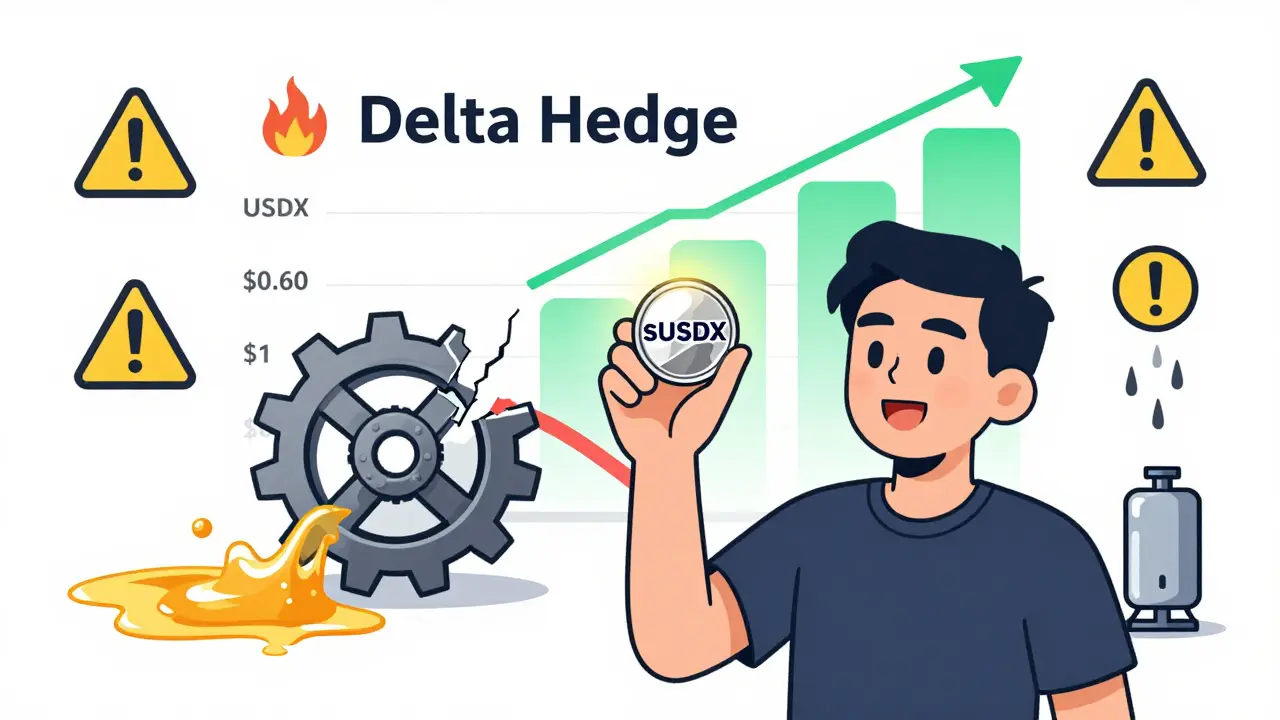
A hacker exploited a flaw in the Balancer protocol, causing a sudden spike in borrowing costs across DeFi. That broke the delta-neutral hedge. The insurance fund ran dry. Bitcoin’s price didn’t even need to move much-the system couldn’t adjust fast enough. Within 48 hours, USDX dropped from $1 to $0.60. Some users lost 40% of their holdings overnight.
It wasn’t just a price dip. It was a loss of trust. Reddit threads filled with users who’d trusted the "delta-neutral" label. One person wrote, "I trusted the math. It broke faster than Terra." Trustpilot reviews collapsed from 4.2 to 1.8 out of 5. Twitter lit up with anger: "How is this better than just holding BTC?"
Stables Labs responded with a statement: "The stabilization mechanism may exhibit adjustment latency under extreme market conditions." Translation: we didn’t see this coming, and we can’t fix it right now.
The Recovery Plan (And Why It’s Not Working)
Unlike Terra’s UST, which vanished without a trace, Stables Labs tried to fix things. They announced a "USDX Restoration Arrangement"-a phased plan to return value to users who registered. By December 15, 2023, they restored 35% of the original value. That’s something. But it’s not $1. And it’s not fast.
Here’s the problem: the recovery process was confusing. You had to register across multiple chains. Support took up to two weeks to respond. Many users didn’t even know how to claim their share. And the protocol’s complexity made it hard to explain. A 2023 internal survey showed 68% of new users dropped off during onboarding. Now, after the crash, even fewer were willing to try.
Why USDX Failed When Simpler Stablecoins Didn’t
USDX was trying to do something no one else had pulled off: create a Bitcoin-backed stablecoin without banks. That’s ambitious. But ambition doesn’t beat simplicity.
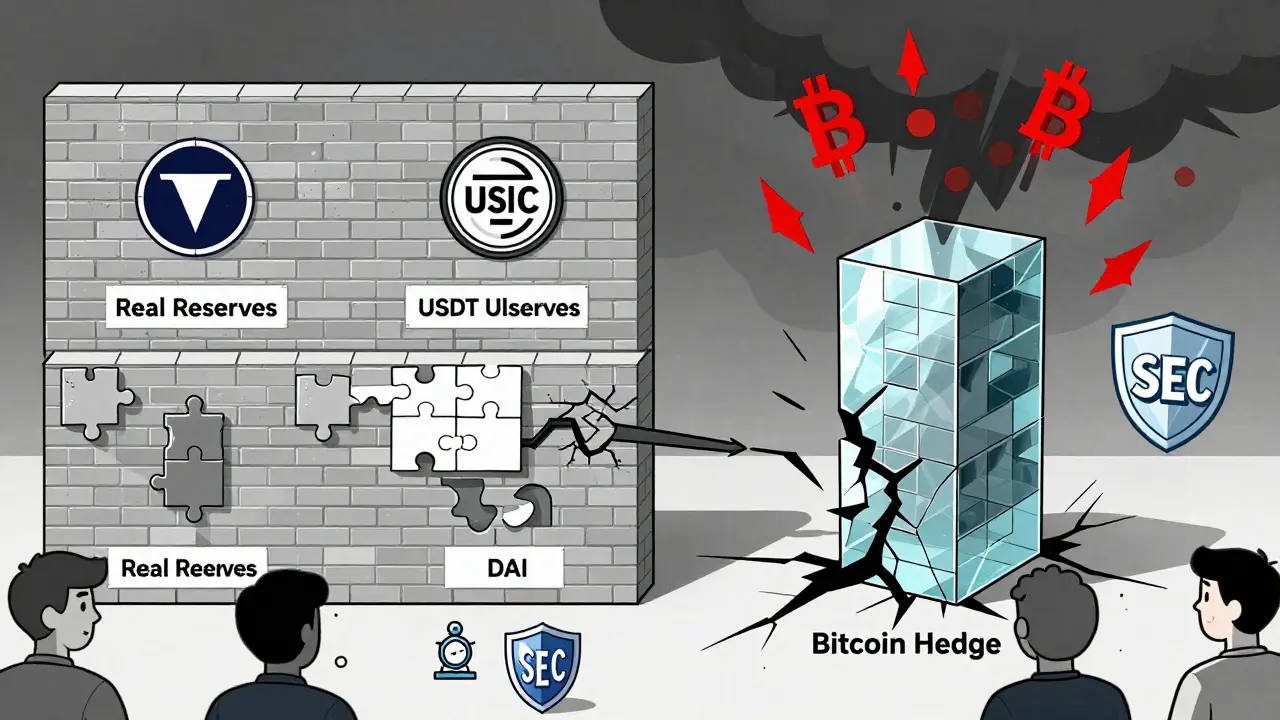
USDT and USDC? They’re just digital dollars. If you hold them, you’re trusting a company to hold real money. It’s boring. But it works.
DAI? It’s backed by a mix of crypto assets and managed by a decentralized governance system. It’s complex, but it’s been tested through multiple bear markets.
USDX? It relied on a single, fragile mechanism-delta-neutral hedging-on a volatile asset (Bitcoin). When markets moved fast, the system couldn’t react. Experts from Beosin Security warned about oracle manipulation risks and insufficient collateral diversification. Dr. Michael Saylor himself said synthetic stablecoins using volatile assets face "inherent structural challenges." He was right.
Where Is USDX Today?
As of January 2026, USDX is still trading around $0.65. sUSDX still exists, but its value growth has slowed to a trickle. The protocol has launched a new stablecoin called USD0x, which uses better collateral rules and circuit breakers to prevent another crash. But USDX? It’s a ghost of what it promised.
Market share? USDX once held 0.44% of the $153 billion stablecoin market. Today, it’s barely measurable. DappRadar shows most transactions still happen on DeFi platforms-not for payments, but for speculative trading. And regulators are watching. The SEC has flagged synthetic stablecoins as high-risk for retail investors.
Industry analysts at Messari give USDX only a 40% chance of ever returning to $1. A January 2024 survey of 50 DeFi professionals found 62% believe USDX will be replaced by simpler alternatives. Only 38% think the model can survive-if it gets way more transparent.
What You Should Know Before Touching sUSDX
If you’re still considering sUSDX, here’s the truth:
- It’s not stable. It hasn’t been since November 2023.
- Yield is minimal now. The hedging trades that once paid you are gone or broken.
- Recovery is slow, opaque, and requires manual registration.
- There’s no guarantee you’ll get your money back-even if you register.
- It’s not a payment tool. No one uses it to buy coffee.
It’s not a savings account. It’s not a store of value. It’s a failed experiment with a lingering digital footprint.
What Happened to USDX Is a Warning
The USDX collapse didn’t just hurt its holders. It shook the whole DeFi space. It proved that even clever engineering can’t replace basic reliability. Complex systems are beautiful until they break. And when they break, users don’t care about the math-they care about their money.
The Blockchain Association responded in January 2024 by forming a working group to set minimum standards for synthetic stablecoins. That’s a direct result of USDX’s failure.
So if you’re looking for a stablecoin, stick to the ones with real reserves. If you want to experiment with Bitcoin-backed yield, wait for the next generation-ones built with lessons learned from USDX’s fall.
USDX was an interesting idea. But ideas don’t pay bills. Stability does.
 Finance



Matthew Kelly
January 19, 2026 AT 16:37Sara Delgado Rivero
January 21, 2026 AT 15:31Shamari Harrison
January 22, 2026 AT 15:51Taylor Mills
January 23, 2026 AT 22:58tim ang
January 24, 2026 AT 04:15Margaret Roberts
January 25, 2026 AT 05:25Mike Stay
January 25, 2026 AT 07:09steven sun
January 25, 2026 AT 15:59Jen Allanson
January 25, 2026 AT 17:36Mark Estareja
January 27, 2026 AT 05:05Bonnie Sands
January 27, 2026 AT 05:26Arielle Hernandez
January 27, 2026 AT 16:01HARSHA NAVALKAR
January 28, 2026 AT 14:25Adam Fularz
January 30, 2026 AT 00:18Arnaud Landry
January 30, 2026 AT 21:10Athena Mantle
January 31, 2026 AT 11:02carol johnson
January 31, 2026 AT 23:58Ryan Depew
February 2, 2026 AT 01:06Kevin Pivko
February 3, 2026 AT 22:27Mathew Finch
February 5, 2026 AT 02:52