

FlairDex isn’t another copycat DeFi project. It’s a purpose-built decentralized exchange on Avalanche, designed to handle stablecoin trades with near-zero slippage and volatile asset swaps at a fraction of the cost of competitors. But here’s the catch: you can’t buy FLDX yet. Not on Coinbase. Not on Binance. Not even on KuCoin, despite rumors. That’s not a bug - it’s the biggest hurdle for anyone trying to decide if this platform is worth your time.
How FlairDex Works (Without the Hype)
FlairDex runs on the Avalanche blockchain, which means trades settle in under a second and cost pennies. That’s not theoretical - it’s a real advantage over Ethereum-based DEXs like Uniswap, where gas fees can spike during market volatility. But what makes FlairDex different isn’t just speed. It’s the dual-swap engine.
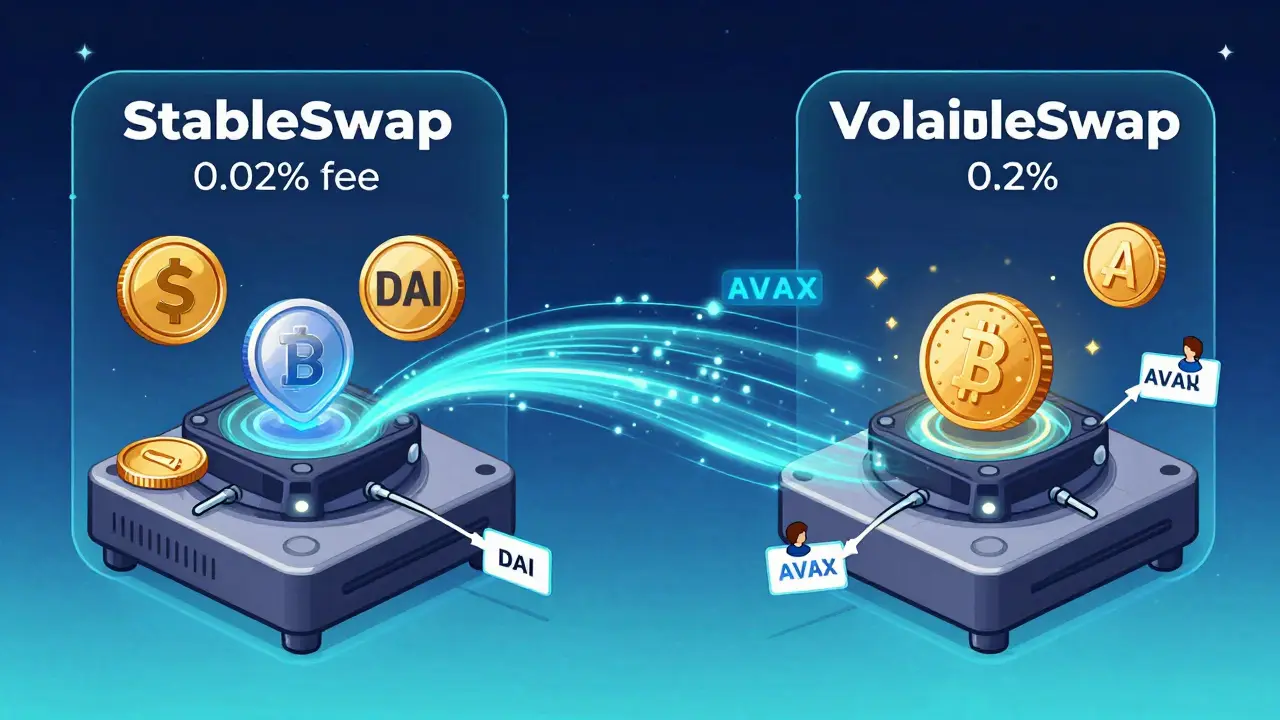
Most DEXs use one model: either Uniswap’s constant product formula (good for volatile assets) or Curve’s stableswap (great for pegged coins like USDC and DAI). FlairDex does both. Need to swap USDC for DAI? You get the 0.02% fee of a stableswap. Want to trade AVAX for a new memecoin? The 0.2% volatile swap kicks in. No need to switch platforms. No hidden fees. Just two optimized engines under one roof.
The ve(3,3) System: Voting Power That Actually Pays
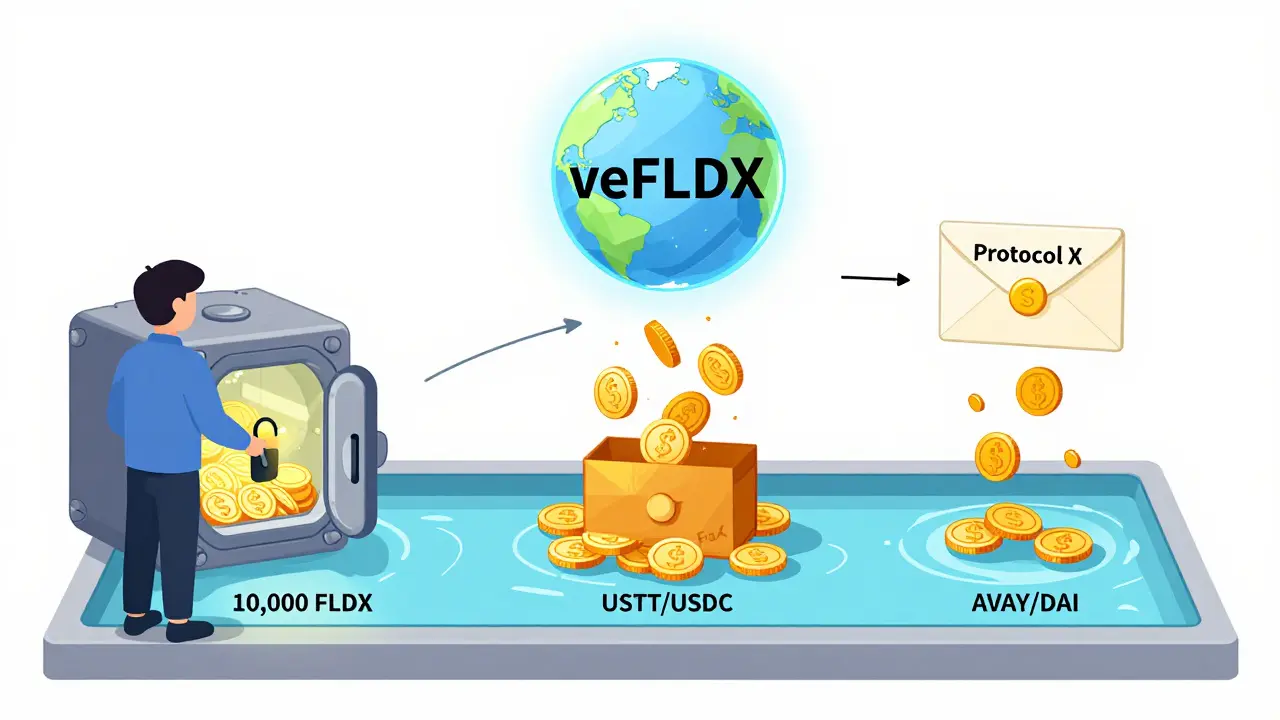
Here’s where FlairDex gets clever. Instead of handing out governance tokens like candy, it uses a ve(3,3) model - a system borrowed from Curve but refined for real-world incentives. When you lock your FLDX tokens into the protocol, you get veFLDX. Not just voting rights. You get a cut of every trade fee generated by the liquidity pools you support.
Let’s say you lock 10,000 FLDX for two years. You now help decide which pools - say, USDT/USDC or AVAX/DAI - get boosted emissions. The more votes you cast, the more fees you collect. And here’s the kicker: anyone can create a “bribe” to influence those votes. A new DeFi protocol? They can pay you in their own token to direct your veFLDX toward their liquidity pool. No governance proposal. No waiting weeks. Just a direct financial incentive to move liquidity where it’s needed.
This isn’t just theory. It’s a working system that turns passive holders into active market participants. You’re not just staking. You’re shaping the market.
Why FlairDex Could Be the Native Liquidity Layer of Avalanche
Avalanche has a problem: too many DEXs. Trader Joe, Pangolin, Benqi - all fighting for the same users. FlairDex doesn’t want to beat them. It wants to become the backbone they all rely on.
Its fee structure is the clearest signal. At 0.02% for stable swaps, it’s half the cost of Curve and a third of what Uniswap charges for similar trades. That’s not a marketing claim - it’s a hard technical advantage. For stablecoin traders, that adds up fast. If you’re swapping $10 million in USDC daily, you save $2,000 a day compared to the next cheapest option. That’s real money.
And the ve(3,3) system isn’t just for users. Protocols building on Avalanche can use FlairDex to bootstrap liquidity without spending millions on incentives. They bribe veFLDX holders directly. That’s cheaper, faster, and more efficient than traditional liquidity mining.
What’s Missing? The Big Red Flags
Here’s the reality: FlairDex is still in beta. Not in the “we’re testing features” sense. In the “you can’t even buy the token” sense.
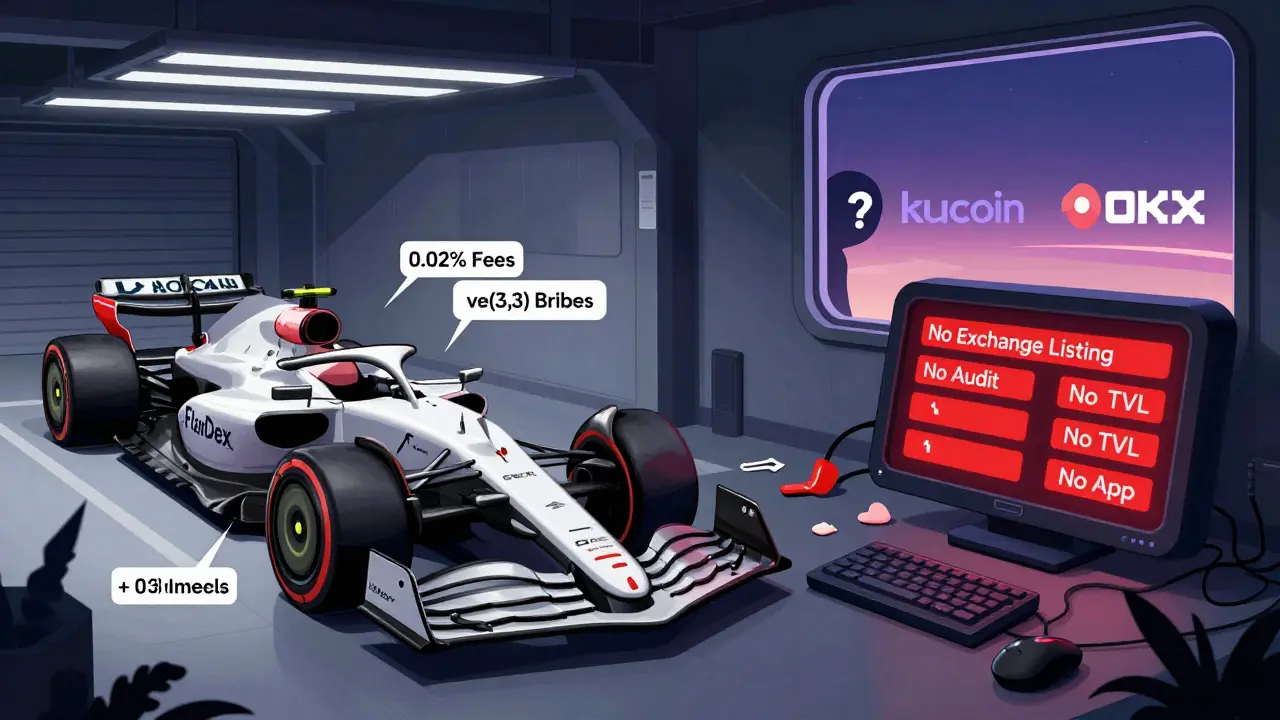
- No exchange listings. FLDX isn’t on any major exchange as of March 2026. No price. No charts. No way to know if it’s worth anything.
- No public TVL (Total Value Locked). We don’t know how much money is actually in the protocol. Is it $50 million? $200 million? No one’s saying.
- No audit reports. The code is open source, but there’s no third-party security review from firms like CertiK or Hacken. That’s risky for a platform handling millions in trades.
- No mobile app. No user interface walkthroughs. No tutorial videos. If you’re not already deep in DeFi, you’re on your own.
Compare that to Trader Joe. It’s been live since 2021. Has a $1.2 billion TVL. Audited by CertiK. Has a mobile app. And still, FlairDex is trying to outcompete it on fees and governance. That’s bold. But bold doesn’t mean safe.
Perpetuals Are Coming - But Not Yet
FlairDex’s roadmap includes perpetual futures trading - meaning you could go long or short on AVAX or other tokens with up to 10x leverage. That’s a huge step beyond spot trading. It’s the kind of feature that attracts professional traders.
But it’s not live. Not even in testnet. The team announced it in late 2025, with a target of Q3 2026. That’s fine - if you’re patient. If you need leverage now, this isn’t your platform.
Who Is This For? (And Who Should Stay Away)
If you’re a DeFi power user - someone who already uses Avalanche, understands liquidity pools, and has a wallet full of tokens - FlairDex is worth watching. The fee savings alone could justify the effort. The bribing mechanism is unique. The integration with Avalanche is seamless.
If you’re new to crypto? If you don’t know what a veToken is? If you want to buy FLDX on Coinbase tomorrow? Walk away.
This isn’t a “buy and hold” token. It’s a tool for people who want to influence DeFi markets. And right now, you can’t even get the tool.
The Bottom Line
FlairDex has the technical edge. It’s fast. It’s cheap. It’s smart. The ve(3,3) model could redefine how liquidity is incentivized on-chain. But without exchange listings, audits, or public data, it’s still a promise - not a product.
It’s like a Formula 1 car sitting in a garage with no keys. The engine is built. The aerodynamics are perfect. But until you can turn the key, it’s just a very expensive paper model.
Keep an eye on it. Watch for FLDX to list on KuCoin or OKX. Watch for TVL to break $100 million. Watch for audit reports to drop. Until then, treat it like a high-risk alpha opportunity - not a mainstream investment.
Can I buy FLDX on any exchange right now?
No. As of March 2026, FLDX is not listed on any major exchange, including Binance, Coinbase, KuCoin, or OKX. While rumors suggest KuCoin or OKX may list it soon, there’s no official confirmation. You cannot buy FLDX unless you’re participating in a private liquidity pool or OTC deal - both of which carry high risk.
How does FlairDex compare to Uniswap and Curve?
FlairDex combines the best of both. For stablecoin swaps, it’s cheaper than Curve (0.02% vs. 0.04%). For volatile assets, it’s competitive with Uniswap (0.2% vs. 0.3%). But unlike Uniswap, it has a built-in governance incentive system (ve(3,3)) that lets users earn fees directly from the pools they support. Curve doesn’t allow bribes. Uniswap’s governance is slow and complex. FlairDex is faster, leaner, and more financially aligned.
Is FlairDex safe to use?
It’s untested. The code is open source, but there’s no public audit from a reputable firm like CertiK or SlowMist. No TVL data. No history of hacks - but also no history of real usage. If you’re comfortable with smart contract risk and understand that your funds could be lost due to a bug, then you can try it. If you’re risk-averse, wait until audits and listings are confirmed.
What’s the point of locking FLDX if I can’t sell it?
You’re not locking FLDX to sell it. You’re locking it to earn. When you lock FLDX, you get veFLDX, which lets you vote on which liquidity pools get boosted emissions. Those pools generate trading fees - and you get a share. You also earn bribes from protocols that pay you to direct your vote. Even if FLDX has no market price, the fees and bribes you collect are real, spendable assets (like USDC or AVAX). It’s a yield engine, not a speculation tool.
Why hasn’t FlairDex launched on major exchanges yet?
Most likely because the team is focused on building liquidity first. Exchanges want trading volume before listing. But volume needs tokens in circulation. It’s a chicken-and-egg problem. The team may be waiting for a major DeFi protocol to integrate FlairDex as its primary liquidity layer - then use that partnership to trigger exchange listings. Until then, the project remains in a pre-launch limbo.
 Finance

Jeff French
March 2, 2026 AT 02:44Elana Vorspan
March 3, 2026 AT 22:05Ifeanyi Uche
March 4, 2026 AT 02:03aaron marp
March 5, 2026 AT 05:28Alyssa Herndon
March 6, 2026 AT 03:49Kenneth Genodiala
March 6, 2026 AT 04:32Patrick Streeb
March 6, 2026 AT 13:20Brian Lemke
March 8, 2026 AT 06:38kati simpson
March 8, 2026 AT 17:49Cory Derby
March 8, 2026 AT 22:55Colin Lethem
March 9, 2026 AT 07:40lori sims
March 11, 2026 AT 05:16Reggie Fifty
March 12, 2026 AT 02:06Kristi Emens
March 13, 2026 AT 16:25Jeff French
March 14, 2026 AT 13:58Deborah Robinson
March 15, 2026 AT 00:15Michelle Mitchell
March 16, 2026 AT 02:15Kaitlyn Clark
March 17, 2026 AT 09:49