

You connect your wallet to dYdX and expect the borderless promise of crypto to hold true. No banks, no borders, just code. Then you hit a wall. A red banner flashes: "Your region is restricted." It’s frustrating, especially when you’re trying to trade perpetual futures on a platform that markets itself as fully decentralized. But here’s the twist most people miss: dYdX isn’t entirely decentralized in the way you might think, and that hybrid structure is exactly why it blocks users from over 20 jurisdictions.
If you live in the US, UK, or Canada, you can’t open new positions. If you’re in sanctioned zones like Iran or North Korea, you’re out completely. This article breaks down exactly which countries are banned, how dYdX enforces these rules technically, and why a supposedly permissionless protocol still needs a compliance officer.
The Core Contradiction: Decentralized Tech, Centralized Control
To understand the restrictions, you have to look at how dYdX actually works. It’s not a pure peer-to-peer protocol like early Bitcoin. It’s a hybrid. The core trading logic lives on-chain, but the user interface (the frontend) and key operational services run through centralized entities. Specifically, dYdX Operations Services Ltd. (DOS) manages the frontends, while dYdX Trading Inc., based in New York, handles regulatory compliance.
This setup allows dYdX to offer high-speed trading comparable to centralized exchanges (CEXs) like Binance or Coinbase. But it also means they must adhere to traditional financial laws. When you use dydx.trade, you aren’t just interacting with smart contracts; you’re accessing a service provided by a company subject to US and international regulations. That’s why geographic blocking exists. It’s not a bug; it’s a feature required for legal survival.
Which Countries Are Actually Blocked?
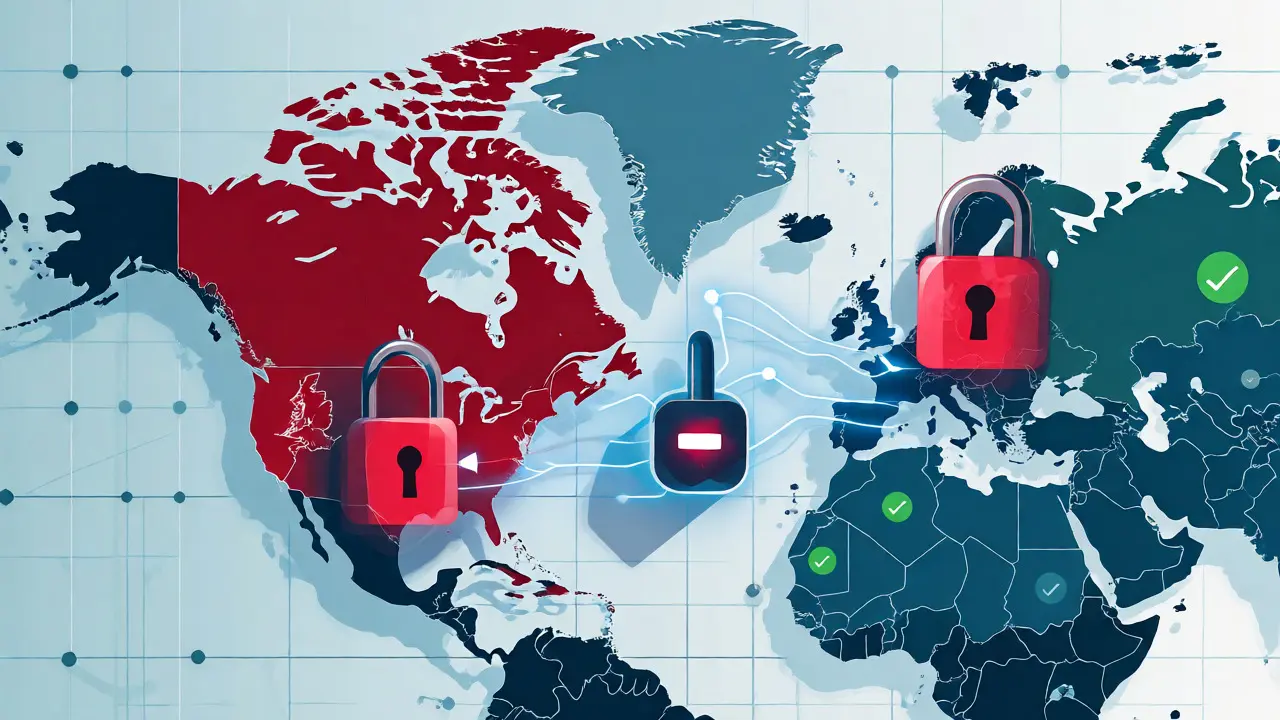
The list of restricted jurisdictions is extensive and aligns closely with US sanctions and local financial regulations. While dYdX claims availability in over 180 countries, the exclusion list is specific and non-negotiable.
| Region Type | Specific Countries/Territories | Primary Reason |
|---|---|---|
| Major Financial Hubs | United States, United Kingdom, Canada | Strict securities and derivatives regulations (SEC, FCA) |
| US Sanctioned Nations | Iran, Cuba, North Korea, Syria, Myanmar (Burma) | OFAC sanctions enforcement |
| Conflict Zones/Sanctions | Crimea, Donetsk, Luhansk | Regional conflict and specific territorial sanctions |
| Other Restricted Areas | Iraq, Libya, Mali, DRC, Somalia, Sudan, Yemen, Zimbabwe | AML/CTF risks and political instability |
Notice who isn’t on this list? China, Russia, South Korea, and Japan. Unlike many other DeFi platforms that ban these regions due to local capital controls or vague regulatory pressure, dYdX often leaves them accessible. This suggests their compliance strategy is heavily weighted toward US-centric regulations rather than a blanket global approach. However, always check the latest Terms of Service, as lists change when governments update sanctions.
How dYdX Enforces Geo-Blocking Technically
You might wonder, "If it's on the blockchain, how can they stop me?" They don't stop the blockchain transactions directly. Instead, they restrict access to the frontend. Here is the step-by-step mechanism:
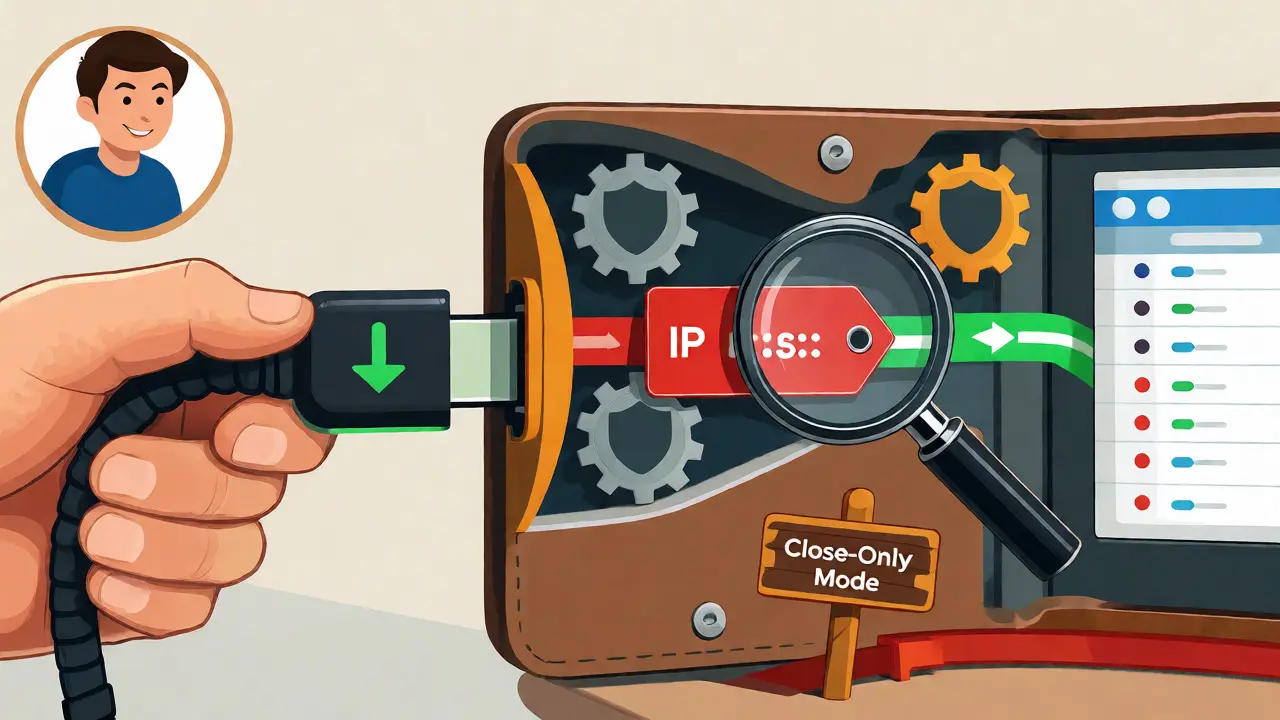
- IP and Wallet Flagging: When you connect your wallet to the dYdX web interface, the system checks your IP address against a database of restricted regions. If you’re in a blocked country, the interface flags your session.
- Close-Only Mode: If you already had an account open before moving to a restricted area, or if the system detects a violation, your account enters "close-only mode." You can cancel orders, reduce positions, and withdraw funds. But you cannot deposit, transfer, or open new trades.
- The Seven-Day Countdown: This is the critical part. If your wallet remains in close-only mode for seven consecutive days without resolving the issue (like moving back to a permitted jurisdiction), the status automatically escalates to "Blocked."
- Full Block: Once blocked, you lose access to subaccounts, trading history, and withdrawal functions via the frontend. The only thing left is exporting your Secret Recovery Phrase to manage assets manually via the chain explorer.
This technical enforcement proves that despite the decentralized backend, the user experience is centrally controlled. You are renting access to a compliant interface, not owning the entire stack outright.
Why Do They Restrict Major Markets Like the US and UK?
It comes down to risk management and legal liability. The US Securities and Exchange Commission (SEC) has taken an aggressive stance on crypto derivatives, often classifying them as unregistered securities. By restricting US users, dYdX avoids becoming a target for enforcement actions that could shut down its operations entirely.
Similarly, the UK’s Financial Conduct Authority (FCA) requires strict registration for crypto firms offering derivatives. Since dYdX operates through corporate entities like the dYdX Foundation in Switzerland and dYdX Trading Inc. in New York, they must comply with these frameworks. Ignoring these rules would mean risking fines, lawsuits, or being forced off-ramps from fiat currencies.
Think of it this way: If dYdX were truly 100% decentralized with no central entity to sue, they wouldn’t need to block anyone. But because they want institutional-grade liquidity and a smooth UI, they accepted the trade-off: convenience for compliance.
What Happens If You Try to Bypass Restrictions?
Many users try to use VPNs to mask their location. Does it work? Sometimes, but it’s risky. dYdX doesn’t just rely on IP addresses. They analyze transaction patterns and wallet behavior. If a wallet suddenly appears in a restricted zone but interacts with the protocol in ways typical of a resident, it triggers manual reviews.
Furthermore, violating the Terms of Service can lead to more than just a closed position. In severe cases involving money laundering suspicions, funds could be frozen at the entry/exit points (on-ramps/off-ramps) even if the on-chain assets remain theoretically yours. You retain custody of your private keys, but your ability to interact with the ecosystem becomes severely limited.
The Broader Implication for DeFi
dYdX isn’t alone. Platforms like Uniswap and Aave have also implemented front-end blocking mechanisms. This trend signals a maturing industry where "decentralization" is becoming a spectrum rather than a binary switch. We are moving toward "regulated decentralization," where protocols adopt selective compliance to survive in a world dominated by nation-states.
For traders, this means doing your homework. Don’t assume a platform is globally available just because it uses blockchain tech. Check the geographic eligibility section in the docs. If you live in a restricted country, consider using alternative derivatives exchanges that operate strictly on-chain with no centralized frontends, though you may sacrifice speed and user experience.
Frequently Asked Questions
Can I use a VPN to trade on dYdX from a restricted country?
Yes, many users do, but it carries risk. dYdX monitors IP addresses and wallet activity. If detected, your account may enter close-only mode. Repeated violations could lead to a full block, preventing withdrawals via the frontend.
Why is the United States specifically blocked on dYdX?
The US has strict regulations regarding cryptocurrency derivatives, enforced by the SEC. To avoid legal complications and potential classification of their tokens as securities, dYdX restricts US residents from opening new positions.
What happens to my funds if I get blocked?
You do not lose ownership of your crypto. However, you lose access to the dYdX frontend features. You will need to export your Secret Recovery Phrase and manage your assets directly on the blockchain using a different wallet interface or explorer.
Is dYdX truly decentralized if it has geo-restrictions?
It is a hybrid model. The trading engine is decentralized on-chain, but the frontend and operational services are centralized. This allows for better performance and regulatory compliance but introduces points of control that pure decentralized protocols lack.
Are China and Russia allowed on dYdX?
Generally, yes. Unlike some competitors, dYdX does not currently block users from China, Russia, South Korea, or Japan. However, local banking restrictions may still make funding your account difficult.
 Finance

Sue Long Merrill
September 23, 2026 AT 17:26It is entirely unsurprising that a platform operated by New York-based entities would restrict United States residents. The notion of borderless finance was always contingent upon regulatory arbitrage rather than pure technological determinism. One must recognize that compliance is the price of institutional adoption.