

You might have heard of DefiPlaza as a solution to one of the biggest headaches in decentralized finance: impermanent loss. The promise sounds too good to be true, doesn't it? A platform that lets you earn fees without watching your capital vanish when prices swing wildly. But here is the catch that most marketing materials gloss over. DefiPlaza suffered a catastrophic security breach on the Ethereum network that drained all user funds. That isn’t just a minor glitch; it’s a total loss event.
So, is DefiPlaza worth using today? The answer depends entirely on whether you are looking for a high-volume trading hub or a niche experiment on the Radix network. If you want the liquidity and safety of giants like Uniswap, this isn’t it. If you are deeply embedded in the Radix ecosystem and understand the risks of early-stage DeFi protocols, there might be something here for you. Let’s break down what DefiPlaza actually is, what went wrong, and whether its current iteration on Radix offers any real value.
What Exactly Is DefiPlaza?
DefiPlaza is a decentralized cryptocurrency exchange (DEX) designed as an Automated Market Maker (AMM). Unlike centralized exchanges where a company holds your money, a DEX uses smart contracts to facilitate trades between users. DefiPlaza specifically focuses on solving Impermanent Loss, which occurs when the price of assets in a liquidity pool changes significantly compared to when they were deposited. In traditional AMMs like Uniswap, if one token pumps while the other stays flat, you end up with less value than if you had just held the tokens in your wallet.
DefiPlaza attempts to fix this with its proprietary CALM (Constant Function Automated Liquidity Management) algorithm. The idea is clever: the system treats trades that increase impermanent loss differently from those that reduce it. By adjusting how liquidity is managed, the platform aims to make providing liquidity sustainably profitable. It started on Ethereum but has since migrated primarily to the Radix blockchain. This shift is crucial because it means the platform is no longer competing directly with the massive liquidity pools of Ethereum-based DEXs. Instead, it operates in a smaller, more specialized environment.
The Elephant in the Room: The Ethereum Exploit
We cannot talk about DefiPlaza without addressing the security incident that defined its history. During its time on Ethereum, the platform experienced a critical vulnerability that allowed an attacker to drain all liquidity. For users who had deposited funds, this meant a 100% loss of their capital. This is not a hypothetical risk; it happened.
Here is how it unfolded: An attacker exploited a flaw in the smart contract. However, in a twist that highlights the complexity of modern DeFi security, an MEV (Maximal Extractable Value) bot operated by an entity called "Yoink" front-ran the attack. Yoink paid a bribe of 62.5 ETH to a Lido validator to execute their transaction first, capturing about $24,000 worth of tokens. Remarkably, after being contacted by the DefiPlaza team, Yoink returned the funds within 30 minutes. Despite this heroic recovery effort, only about 10% of the total drained funds were ever recovered. The rest was gone forever.
This event raises serious questions about trust. Even though the code is open-source and audited, audits are snapshots in time. They do not guarantee future safety against new exploit vectors. When evaluating DefiPlaza now, you must accept that the platform has a history of total fund loss. The migration to Radix is an attempt to start fresh, but past performance is the best indicator of future risk in smart contract development.
Current Status on the Radix Network
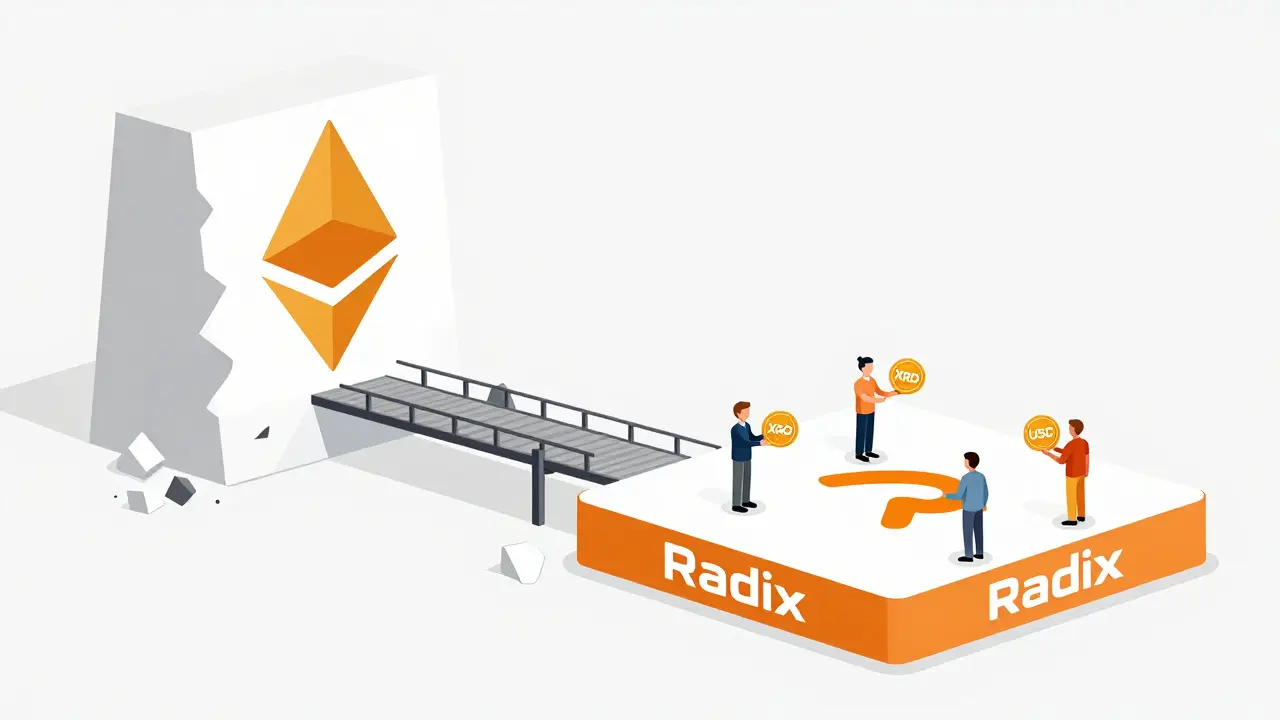
Today, DefiPlaza operates primarily on the Radix network is a Layer-1 blockchain designed specifically for decentralized applications. This move was strategic. Radix offers lower transaction costs and different technical advantages for DeFi applications. However, this also limits DefiPlaza’s reach. You won’t find thousands of trading pairs here. Currently, the platform lists around 37 cryptocurrencies and supports one stablecoin. There are zero fiat currency pairs, meaning you cannot buy crypto directly with dollars or pounds. You need crypto to use the platform.
Let’s look at the numbers. As of mid-2026, DefiPlaza ranks #272 among all cryptocurrency exchanges. Its 24-hour trading volume hovers around $5,214. To put that in perspective, major DEXs process billions daily. DefiPlaza is a micro-market. The most active trading pairs are concentrated within the Radix ecosystem:
- XRD/DFP2: ~$1,290 in 24h volume
- XUSDC/XRD: ~$1,242 in 24h volume
- XWBTC/XRD: ~$936 in 24h volume
This data tells us two things. First, DefiPlaza is not a place for high-frequency traders or large institutional moves. Second, it serves a specific community of Radix enthusiasts. If you hold XRD (the native Radix token) and want to swap it for other ecosystem tokens like WBTC or USDC equivalents, DefiPlaza provides a low-cost option. But if you are looking for exotic altcoins or deep liquidity, you will likely face high slippage or simply won’t find the pair you need.
| Feature | DefiPlaza | Uniswap V3 | PancakeSwap |
|---|---|---|---|
| Primary Chain | Radix | Ethereum + Multi-chain | BSC + Multi-chain |
| Core Innovation | CALM Algorithm (IL mitigation) | Concentrated Liquidity | Syrup Pools & Low Fees |
| Security History | Major Exploit (Ethereum) | Minor Bugs, No Total Drains | Minor Bugs, No Total Drains |
| Trading Volume (24h) | ~$5,200 | $Billions | $Billions |
| Best For | Radix Ecosystem Users | Large Trades, Wide Variety | Low Cost, Meme Coins |

Features Beyond Trading: LaunchPlaza and Bridges
DefiPlaza isn’t just trying to be a swap interface. The team has expanded into broader ecosystem tools. One notable addition is LaunchPlaza is a service helping project founders launch tokens on Radix. This feature allows creators to issue tokens with built-in staking, burning, and editing capabilities. For developers building on Radix, this reduces the technical barrier to entry. You don’t need to write complex smart contracts from scratch to get a basic token live.
Additionally, the platform developed bridge functionality to move the DFP2 token between Ethereum and Radix networks. While the Ethereum side is largely dormant due to the exploit, the bridge represents an attempt to maintain interoperability. However, cross-chain bridges are historically some of the most vulnerable parts of DeFi. Given DefiPlaza’s past security issues, using their bridge requires extreme caution. Always verify bridge transactions independently and consider using established third-party bridges instead.
User Experience and Interface
If you have used any modern DEX, DefiPlaza will feel familiar. The interface is clean, adopting a design that mixes modern DeFi aesthetics with ancient Greek visual elements. It’s distinctive, if a bit quirky. Navigation is straightforward: connect your wallet, select your token pair, and swap. The platform supports MetaMask and WalletConnect, which covers most desktop and mobile wallets.
However, the simplicity of the UI masks the complexity underneath. To truly benefit from DefiPlaza’s CALM algorithm, you need to understand how liquidity provision works. Casual users who just want to swap tokens won’t notice much difference between DefiPlaza and other DEXs. The value proposition is targeted at liquidity providers who are sophisticated enough to calculate impermanent loss manually. For these users, the platform offers NFTs that represent their liquidity position and distributes airdrops in XRD tokens. This incentivizes long-term participation, but again, only if you believe in the sustainability of the model.
Is DefiPlaza Safe? A Risk Assessment
Safety in DeFi is never binary. It’s a spectrum of risks. Here is where DefiPlaza stands:
- Smart Contract Risk: High. The previous Ethereum exploit proves that vulnerabilities exist. While the code is open-source and audited, audits are not guarantees. The migration to Radix may offer better architectural security, but new chains often have fewer independent auditors reviewing their ecosystems.
- Liquidity Risk: Moderate to High. With only ~$5k in daily volume, large trades will suffer from slippage. If you try to pull out a significant amount of capital quickly, you might not get the expected rate.
- Counterparty Risk: Low. Since it’s non-custodial, you control your keys. DefiPlaza cannot freeze your funds. However, if the smart contract fails, your funds are lost, as seen in the past.
- Regulatory Risk: Unknown. As a decentralized protocol on Radix, it falls into a gray area. Regulatory changes could impact the usability of the platform or the underlying assets.
My advice? Never deposit more than you can afford to lose. Treat DefiPlaza as a high-risk, experimental playground rather than a savings account. If you are testing the waters, start with small amounts. Use hardware wallets for signing transactions. And always double-check the contract addresses before interacting.
Who Should Use DefiPlaza?
DefiPlaza is not for everyone. In fact, it’s probably not for most people. Here is who fits the profile:
- Radix Ecosystem Believers: If you are bullish on Radix and want to support its infrastructure, DefiPlaza is a key component. Your usage helps validate the network.
- Sophisticated Liquidity Providers: If you understand impermanent loss inside out and want to test alternative AMM models, the CALM algorithm is worth exploring. Just remember the historical context.
- Token Developers: If you are launching a project on Radix, LaunchPlaza offers a quick way to get started.
Who should avoid it? Anyone seeking high-volume trading, anyone uncomfortable with past security breaches, and anyone unfamiliar with managing private keys and gas fees. If you are a beginner, stick to centralized exchanges or well-established DEXs with deeper liquidity and longer track records.
Final Verdict
DefiPlaza is a fascinating case study in DeFi resilience and innovation. The CALM algorithm addresses a real pain point, and the migration to Radix shows adaptability. But the shadow of the Ethereum exploit looms large. Trust is hard to build and easy to break. Until DefiPlaza demonstrates consistent security and growing volume on Radix, it remains a niche tool for specialists, not a mainstream exchange.
Use it if you know what you are doing. Avoid it if you are looking for safety and convenience. In the world of crypto, there are no free lunches-only trade-offs between risk, reward, and complexity.
Did DefiPlza hack happen on Radix?
No, the major security incident occurred on the Ethereum network before the platform migrated to Radix. All liquidity on Ethereum was drained, resulting in total loss for users on that chain. The Radix version is a separate deployment with new smart contracts.
What is the CALM algorithm?
CALM stands for Constant Function Automated Liquidity Management. It is DefiPlaza's proprietary algorithm designed to mitigate impermanent loss by treating trades that increase IL differently from those that reduce it, aiming to make liquidity provision more sustainable.
Can I buy crypto with USD on DefiPlaza?
No, DefiPlaza does not support fiat currency pairs. You must already own cryptocurrency (such as XRD, ETH, or BTC) to use the platform for swapping or providing liquidity.
Is DefiPlaza safe to use in 2026?
Safety is relative. While the platform is open-source and audited, its history includes a total fund drain on Ethereum. Current operations on Radix are unproven in terms of long-term security. Use with extreme caution and only funds you can afford to lose.
What tokens are available on DefiPlaza?
DefiPlaza currently lists approximately 37 cryptocurrencies, primarily focused on the Radix ecosystem. Key pairs include XRD/DFP2, XUSDC/XRD, and XWBTC/XRD. It supports one stablecoin and no fiat currencies.
 Finance