

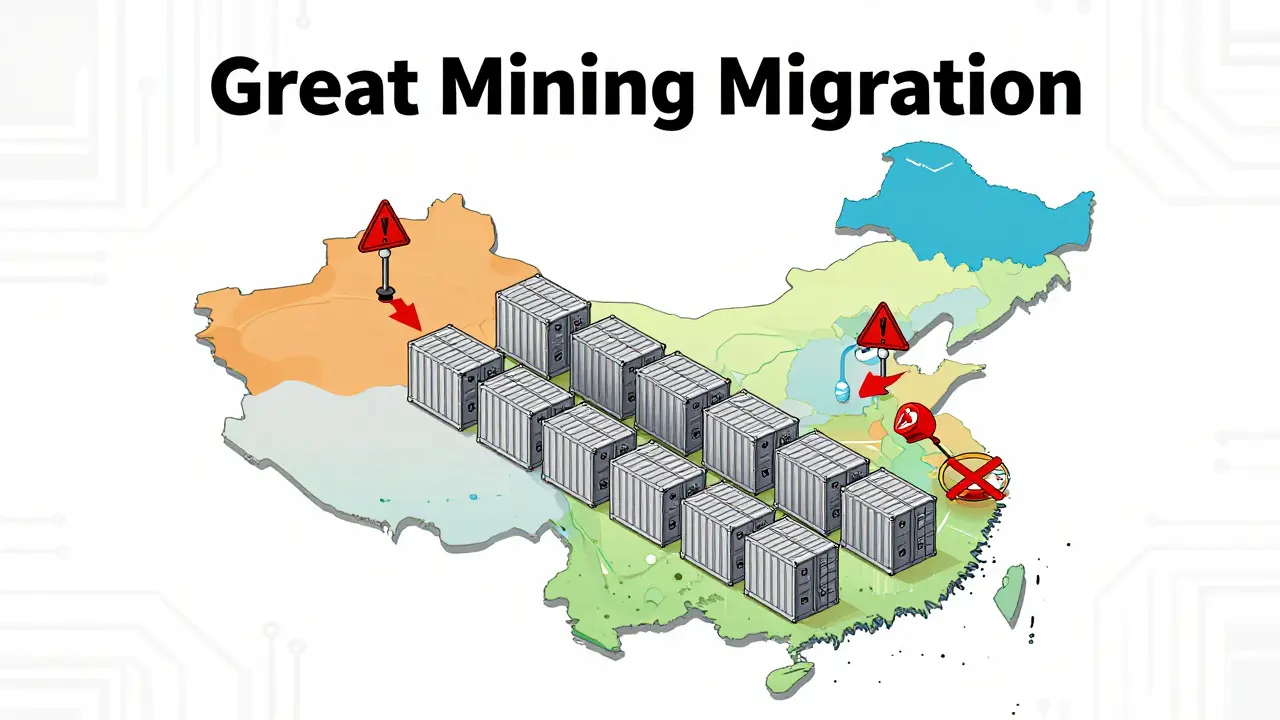
Imagine moving an entire industrial factory across international borders in just a few months. Not because you want to, but because the lights are about to go out. That is exactly what happened to Bitcoin mining, which is the process of using powerful computers to secure the Bitcoin network and create new coins operators in China between 2020 and 2021. It was not a slow drift; it was a stampede. Industry experts call it the "Great Mining Migration," and it fundamentally changed where the world’s digital gold is dug up.
The numbers tell a stark story. In September 2020, nearly three-quarters (75.5%) of all global Bitcoin mining power sat inside China. By April 2021, that number had plummeted to 46%. The Chinese government did not just restrict trading; they targeted the miners themselves with unprecedented force. This crackdown forced a massive geographical shift, turning Bitcoin mining into one of the most mobile industries on the planet.
Why China Was No Longer an Option
To understand the exodus, you have to look at the regulatory hammer that fell in 2021. Previous actions by local governments were often ignored or worked around by miners who simply moved from province to province within China. They chased cheap hydroelectric power during rainy seasons, a practice known as seasonal migration. But the central government’s move in 2021 was different. Announcements came from top-ranking committees, carrying weight that local officials could not ignore.
Inner Mongolia served as the warning shot. The province banned Bitcoin mining as part of broader limits on energy-intensive industries. Since Inner Mongolia relies heavily on coal, the environmental cost was too high for Beijing to overlook. When the central government followed suit, the message was clear: the era of unchecked domestic mining was over. Miners faced a choice-shut down or pack up their ASICs (Application-Specific Integrated Circuit machines) and leave.
Kazakhstan: The Primary Beneficiary
If you had to bet on where the miners would go first, Kazakhstan, which is a Central Asian country with abundant energy resources would be a smart pick. It became the single biggest winner of the Chinese exodus. Between September 2019 and April 2021, Kazakhstan’s share of global mining power surged six-fold, jumping from a tiny 1.4% to 8.2%.
By mid-October 2021, Kazakhstan had surpassed China to become the second-largest cryptocurrency mining nation globally. Why? Power. Kazakhstan has massive coal mines and existing electrical infrastructure capable of handling huge loads. For miners fleeing China, the draw was simple: cheap electricity and a regulatory environment that didn’t explicitly ban them yet. However, this boom came with a catch. Much of that power came from coal, raising significant concerns about the carbon footprint of these relocated operations.
| Country | Share Sept 2020 | Share April 2021 | Trend |
|---|---|---|---|
| China | 75.5% | 46% | Major Decline |
| United States | ~13% | ~15% | Stable Growth |
| Kazakhstan | 1.4% | 8.2% | Rapid Surge |
| Russia | ~11% | 6.8% | Slight Decline |
The United States and the Texas Boom
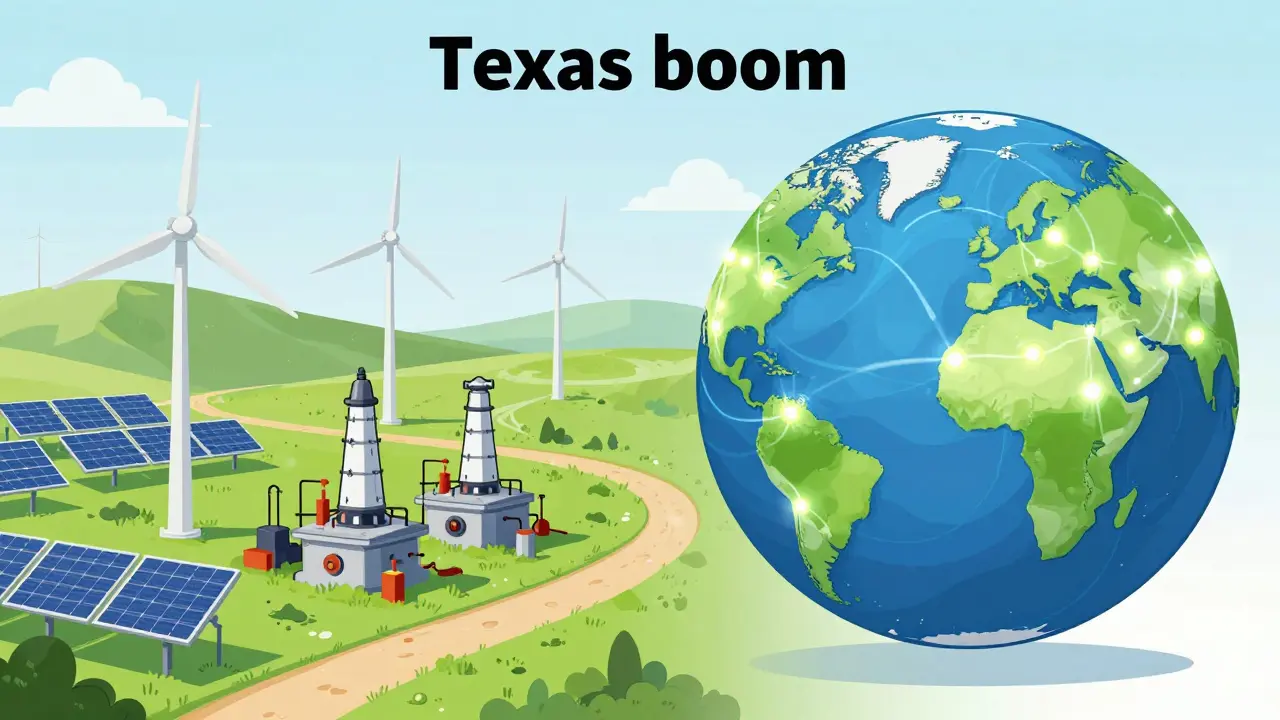
While Kazakhstan took the lion's share of immediate displacement, the United States emerged as the strategic long-term home for many miners. Specifically, Texas, which is a U.S. state with a deregulated energy market became a magnet for large-scale operations. Texas accounts for roughly half of the 5.2 gigawatts of Bitcoin mining capacity being installed across the U.S.
What makes Texas so attractive? First, the energy market is deregulated, allowing miners to negotiate directly with power producers. Second, the legislative stance is pro-Bitcoin. Third, and perhaps most importantly, the energy mix is changing. Texas gets 22.5% of its power from wind and solar. This allows miners to access renewable energy sources, addressing the environmental criticisms leveled at the industry.
There is also a practical benefit for the grid itself. During peak demand times, when power prices spike or the grid threatens to fail (like during the 2021 winter storms), miners can throttle back their consumption instantly. This flexibility helps stabilize the grid, making mining partners rather than just parasites on the electrical infrastructure.
The Mechanics of the Great Migration
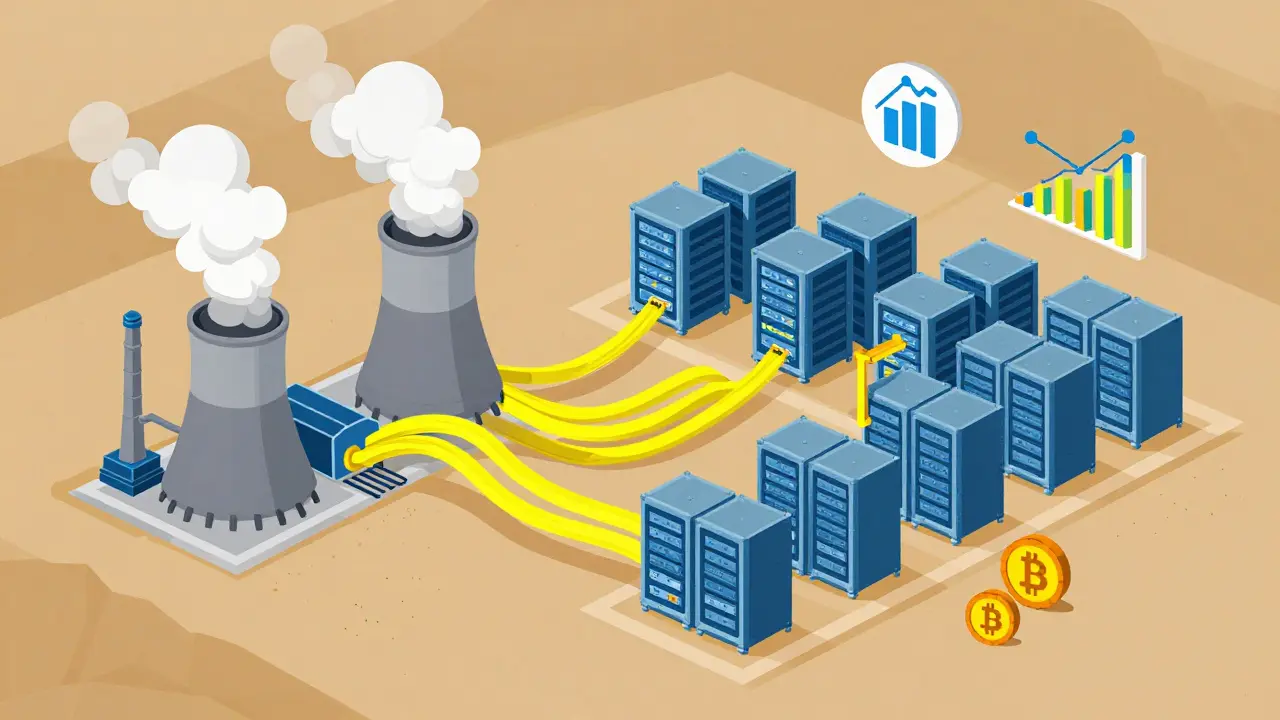
You might wonder how such a massive industrial shift happens so quickly. The answer lies in the nature of the equipment. Bitcoin mining rigs are modular. An ASIC machine is essentially a loud, hot computer box. You unplug it, put it in a shipping container, fly it across the world, plug it into a new socket, and connect it to the internet. That’s it.
This portability meant that entire mining farms could relocate across international borders within months. Unlike traditional manufacturing, there is no need for complex supply chains or specialized labor forces at the destination-just electricity and internet connectivity. This inherent mobility allowed miners to evaluate destinations based purely on three factors: energy cost, regulatory stability, and infrastructure capacity.
Impact on Decentralization and Network Health
The short-term impact of the exodus was chaotic. As miners packed up and moved, the global hashrate, which is the total computational power dedicated to securing the Bitcoin network dropped temporarily. Transactions slowed slightly, and fees spiked. But the long-term effect was surprisingly positive for Bitcoin’s core philosophy.
Before 2021, having 75% of mining power in one country created a massive concentration risk. If China decided to cut the power cords, the Bitcoin network could have been paralyzed. The exodus forced decentralization. Now, mining power is spread across North America, Central Asia, Russia, and other regions. This geographic distribution makes the network more resilient to any single government’s actions.
Other Destinations: Russia, Iran, and Beyond
Kazakhstan and Texas weren't the only stops on the map. Russia, which is a Eurasian country with vast natural resources maintained a steady share, holding around 6.8% by April 2021. Its appeal lay in low-cost electricity and a lack of explicit bans at the time. Similarly, Iran, which is a Middle Eastern country with subsidized energy held about 4.6%, though its status remains volatile due to fluctuating government policies.
Galaxy Digital research predicted that hashrate would also flow into Pakistan and other regions with existing power capacity. The key driver everywhere was the same: miners needed places where the grid could respond to huge demand without collapsing or costing a fortune.
Conclusion: A New Normal for Mining
The Chinese crypto mining exodus was not just a relocation event; it was a stress test for the global energy and regulatory landscape. It proved that Bitcoin mining is highly mobile and responsive to economic incentives. While Kazakhstan saw the fastest growth, the U.S., particularly Texas, positioned itself as the stable, long-term hub for institutional-grade mining.
For the average person, this means Bitcoin is now more decentralized than ever before. The risk of a single point of failure has diminished. However, the environmental debate continues. As miners settle into their new homes, the pressure is on countries like Kazakhstan to clean up their energy grids and on places like Texas to maximize renewable integration. The migration is over, but the evolution of where and how we mine Bitcoin is just beginning.
Why did China ban Bitcoin mining?
China banned Bitcoin mining primarily due to concerns over excessive energy consumption and environmental impact. Mining is extremely energy-intensive, and much of China's power comes from coal. The government wanted to curb pollution and control the financial risks associated with cryptocurrency speculation.
Where did most Chinese Bitcoin miners go?
The majority of displaced miners initially relocated to Kazakhstan, which saw its global mining share jump from 1.4% to 8.2% in less than a year. Other major destinations included the United States (especially Texas), Russia, and Iran.
Is Bitcoin mining legal in the US?
Yes, Bitcoin mining is legal in the United States. States like Texas and Wyoming have actively welcomed mining operations, offering favorable regulations and access to affordable energy markets.
How does the Chinese ban affect Bitcoin decentralization?
The ban actually improved Bitcoin's decentralization. Before the ban, over 75% of mining power was concentrated in China, creating a single point of failure. The exodus spread mining power across multiple continents, making the network more resilient to government interference.
What is the environmental impact of mining in Kazakhstan?
Mining in Kazakhstan has raised environmental concerns because much of the country's electricity is generated from coal. This results in a higher carbon intensity compared to mining in regions with renewable energy sources, such as parts of the United States or hydropower-rich areas.
 Finance