

Most people think using Bitcoin in Decentralized Finance (DeFi) means trusting a middleman. They send their BTC to a company like BitGo, get a receipt token called WBTC, and hope the custodian doesn’t lose the keys or freeze their funds. But there’s another way. Wrapped Rootstock Bitcoin (WRBTC) offers a path that keeps your Bitcoin secured by the network you actually trust: Bitcoin itself. It isn’t just another wrapped token; it’s a bridge built on proof-of-work security, designed for users who want Ethereum compatibility without the centralization risks.
If you’ve ever wondered how to earn yield on your Bitcoin while keeping it decentralized, WRBTC is worth understanding. It sits at the intersection of two massive ecosystems: the immutability of Bitcoin and the programmability of Ethereum. Let’s break down what it actually is, how it works under the hood, and whether it fits into your portfolio strategy as we move through late 2026.
The Core Concept: Dual Wrapping and Security
To understand WRBTC, you first need to grasp Rootstock Bitcoin (RBTC). RBTC is not a new cryptocurrency invented out of thin air. It is Bitcoin running on the Rootstock sidechain. Rootstock uses merged mining, meaning Bitcoin miners secure the Rootstock network alongside the main Bitcoin chain. This gives RBTC the same security guarantees as BTC, but with smart contract capabilities.
WRBTC takes this one step further. It is an ERC-20 token on the Ethereum blockchain that represents RBTC. Think of it as a Russian nesting doll of value:
- Bitcoin (BTC): The base asset, secured by global hash power.
- Rootstock Bitcoin (RBTC): Bitcoin’s value moved to a sidechain for smart contracts, still secured by Bitcoin miners via the PowPeg mechanism.
- Wrapped Rootstock Bitcoin (WRBTC): RBTC represented as an ERC-20 token on Ethereum, allowing it to interact with Ethereum DeFi protocols like Uniswap or Aave.
This structure creates a strict 1:1 peg at every layer. One WRBTC equals one RBTC, which equals one BTC. The magic lies in how these layers talk to each other without needing a centralized bank to hold the assets.
How the Bridge Works: PowPeg vs. Custodial Models
The biggest differentiator for WRBTC is its security model. When you wrap Bitcoin into WBTC, you are trusting BitGo, a regulated custodian. If BitGo gets hacked or decides to freeze your account, your WBTC is stuck. WRBTC avoids this by using a federated bridge powered by the PowPeg (Proof-of-Work Peg).
Here is the step-by-step process of moving value from Rootstock to Ethereum:
- Locking: You send RBTC to a specific address on the Rootstock network.
- Federation Validation: A group of independent nodes (the federation) monitors the Rootstock chain. Once they confirm your transaction has enough block confirmations, they sign off on it.
- Minting: The smart contract on Ethereum receives these signatures and mints the equivalent amount of WRBTC to your Ethereum wallet.
- Unwrapping: To go back, you burn WRBTC on Ethereum. The federation detects the burn and releases the corresponding RBTC on Rootstock.
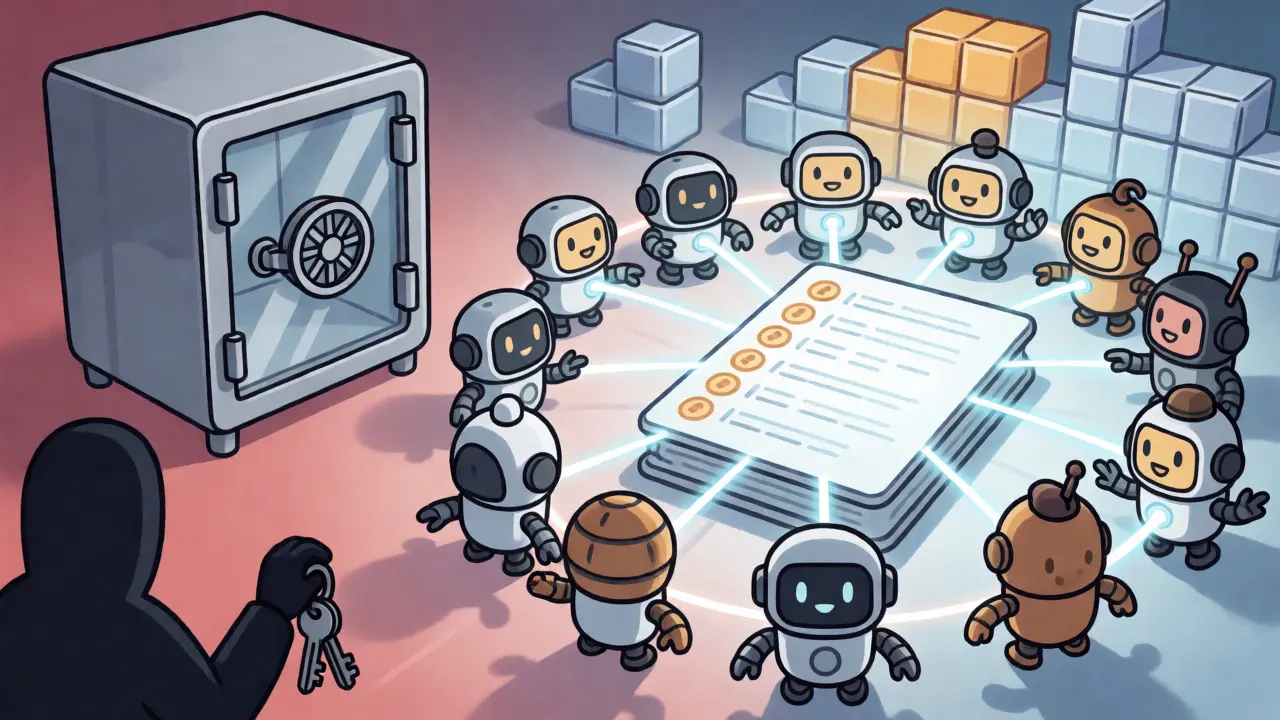
This system relies on decentralization rather than custody. The federation consists of over 50 independent nodes operated by entities like IOV Labs and Money on Chain. While no system is perfect, this setup removes the single point of failure found in custodial models. If one node goes down, the others keep the bridge running.
Technical Specifications and User Experience
For developers and power users, WRBTC behaves like any standard ERC-20 token. Its contract address on Ethereum is 0x542fda317318ebf1d3deaf76e0b632741a7e677d. This means you can store it in MetaMask, trade it on decentralized exchanges, or use it as collateral in lending protocols. However, interacting with it requires managing two networks.
You need to configure your wallet to support both Ethereum (Chain ID 1) and Rootstock (Chain ID 30). For Rootstock, the RPC URL is typically https://public-node.rsk.co/. Users often report confusion here because gas fees differ significantly between the two chains. On Rootstock, fees are paid in RBTC and are generally low. On Ethereum, you pay in ETH, which can spike during network congestion.
| Feature | WBTC (Wrapped Bitcoin) | WRBTC (Wrapped Rootstock BTC) |
|---|---|---|
| Custody Model | Centralized (BitGo) | Decentralized Federation (PowPeg) |
| Security Source | Legal Contract + Custodian | Bitcoin Hashrate + Node Consensus |
| Ethereum Compatibility | Native ERC-20 | ERC-20 via Bridge |
| Liquidity (TVL) | High ($5B+) | Niche ($80M-$100M range) |
| Regulatory Risk | Higher (SEC scrutiny) | Lower (Decentralized nature) |
Transaction times vary. Minting WRBTC usually takes 15 minutes to 2 hours, depending on Bitcoin network confirmation speeds. This isn’t instant, so it’s not ideal for high-frequency trading, but it works fine for holding and yielding strategies.
Use Cases: Why Choose WRBTC Over WBTC?
Why would anyone choose WRBTC when WBTC has vastly more liquidity? The answer comes down to philosophy and risk tolerance.
Trust Minimization: If you believe in "not your keys, not your coins," WRBTC aligns better with Bitcoin ethos. You aren’t handing your private keys or your BTC to a third-party company. The security is derived from the consensus of the Rootstock network, which is anchored to Bitcoin.
Yield Farming Opportunities: Because WRBTC is less saturated than WBTC, some DeFi protocols offer higher APYs to attract liquidity. In 2023 and 2024, users reported yields between 5% and 8% on platforms like Sovryn or THORChain by providing WRBTC liquidity. While lower volume means slippage can be higher on large trades, the incentives can be attractive for long-term holders.
Interoperability Testing: Developers use WRBTC to test cross-chain applications that involve Bitcoin security. Since Rootstock is EVM-compatible, code written for Ethereum often works on Rootstock, making WRBTC a useful tool for bridging logic between the two worlds.
Risks and Challenges
No technology is free of drawbacks, and WRBTC has several hurdles to clear before mass adoption.
Liquidity Constraints: With a market cap hovering around $287 million (compared to WBTC’s multi-billion scale), WRBTC suffers from lower depth. Large sell orders can impact price more significantly than they would on WBTC. If you’re trading small amounts, this matters little. If you’re moving millions, you’ll feel the difference.
Complexity Barrier: Bridging assets across three layers (BTC -> RBTC -> WRBTC) is complicated. Beginners often make mistakes, such as sending tokens to the wrong network or underpaying gas fees. Support tickets frequently cite incorrect network configuration as a top issue.
Smart Contract Risk: While the PowPeg is robust, the bridge contracts themselves have been audited by firms like Trail of Bits. They identified moderate risks related to network partitions. If the federation nodes disagree due to extreme network lag, withdrawals could temporarily stall. No major exploits have occurred in years, but the code complexity remains a vector for potential bugs.

Market Position and Future Outlook
As of late 2026, the wrapped Bitcoin sector continues to grow, driven by demand for Bitcoin-backed stablecoins and yield products. WRBTC occupies a specialized niche. It appeals to the "Bitcoin Maximalist" who wants DeFi exposure but refuses to compromise on decentralization.
Recent developments show promise. Partnerships with oracle providers like Chainlink have improved price feed reliability. Additionally, efforts to integrate Layer 2 solutions aim to reduce the Ethereum gas costs associated with wrapping and unwrapping. If these upgrades succeed, WRBTC could become more competitive against cheaper alternatives on other chains.
However, it faces stiff competition from newer Layer 2 native Bitcoin solutions. Projects that bring Bitcoin directly to Arbitrum or Optimism without a sidechain intermediate step are gaining traction. WRBTC must prove that its dual-layer security model offers enough value to justify the extra steps.
Practical Tips for Using WRBTC
If you decide to experiment with WRBTC, keep these practical tips in mind:
- Test Small Amounts First: Always send a tiny amount through the bridge to ensure your wallet settings are correct before moving significant capital.
- Monitor Gas Prices: Avoid bridging during peak Ethereum congestion. Check tools like Etherscan’s gas tracker to save on fees.
- Keep ETH Ready: You need ETH on the destination chain to pay for gas when you unwrap or trade WRBTC. Running out of ETH can leave you stranded with tokens you can’t move.
- Check Exchange Listings: Not all centralized exchanges support WRBTC deposits and withdrawals. Verify availability on platforms like HTX or Kraken before planning an exit strategy.
WRBTC isn’t for everyone. It’s a tool for those who prioritize security architecture over convenience. As the DeFi landscape matures, the distinction between "custodial wrapped" and "trust-minimized wrapped" assets will likely become a key decision factor for sophisticated investors.
Is WRBTC the same as WBTC?
No. WBTC is issued by BitGo, a centralized custodian, and wraps Bitcoin directly onto Ethereum. WRBTC wraps Rootstock Bitcoin (RBTC) onto Ethereum. WRBTC relies on a decentralized federation and Bitcoin's proof-of-work security, whereas WBTC relies on legal agreements and BitGo's custody.
How long does it take to convert RBTC to WRBTC?
The process typically takes between 15 minutes and 2 hours. This duration depends on the number of confirmations required on the Rootstock chain and the current activity level of the federation nodes validating the transfer.
Can I use WRBTC in any Ethereum wallet?
Yes, since WRBTC is an ERC-20 token, it is compatible with any wallet that supports Ethereum, such as MetaMask, Trust Wallet, or Ledger. You just need to add the specific contract address to see the balance.
What happens if the Rootstock network halts?
If Rootstock halts, the federation cannot validate new transactions. This means you wouldn't be able to mint new WRBTC or unwrap existing WRBTC until the network resumes. Your funds remain safe on the respective chains, but mobility is paused.
Is WRBTC safer than WBTC?
"Safer" depends on your threat model. WRBTC is safer from a censorship and counterparty risk perspective because it doesn't rely on a single custodian. However, WBTC has a longer track record and higher liquidity, which reduces execution risk during large trades. WRBTC introduces smart contract and federation consensus risks instead.
 Finance