

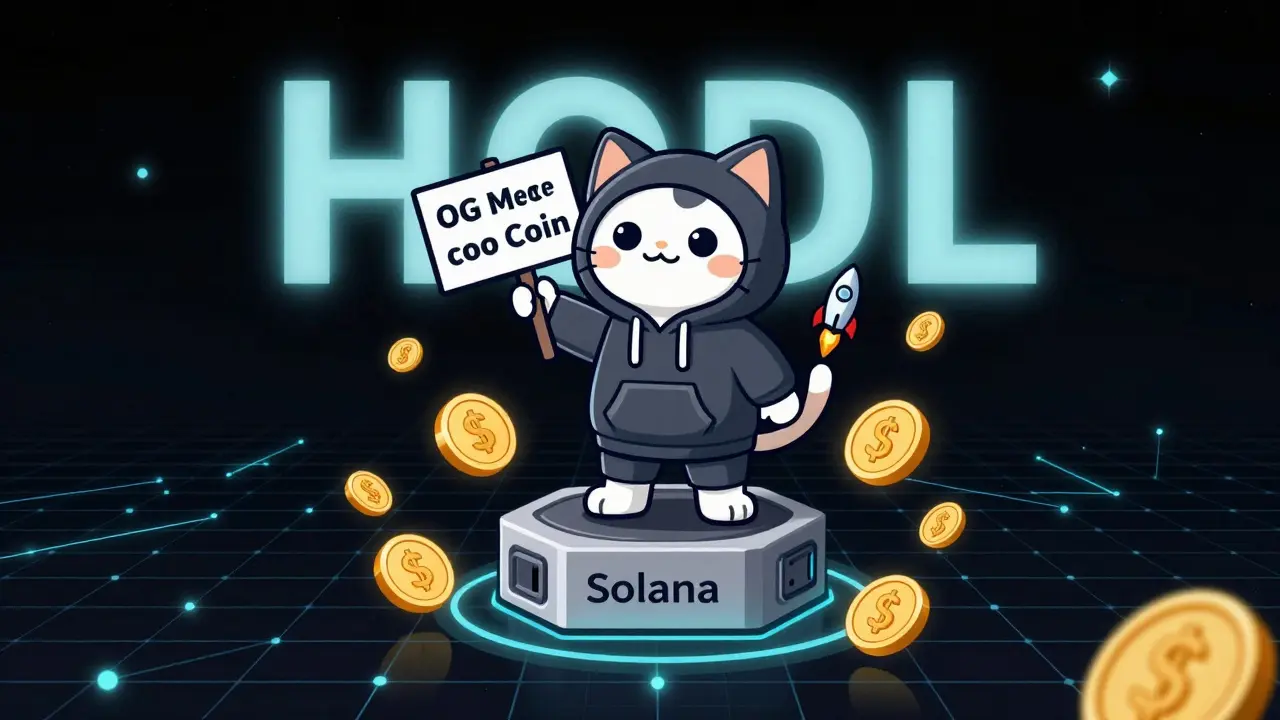
If you’ve seen HODI popping up on crypto TikTok or Telegram groups, you’re not alone. Cat in Hoodie - or HODI - is one of the latest cat-themed meme coins trying to ride the wave of Dogecoin and Shiba Inu fame. But here’s the real question: is it just another funny joke token, or is there something behind it? Let’s cut through the noise and see what HODI actually is, how it works, and whether it’s worth your time - or your money.
What is HODI, really?
Cat in Hoodie (HODI) is a meme cryptocurrency launched in 2024 on the Solana blockchain. Unlike Bitcoin or Ethereum, it doesn’t aim to solve a problem or build infrastructure. Its whole purpose is to be a fun, community-driven token with a cute cat in a hoodie as its mascot. The name “HODI” is a playful twist on the crypto slang “HODL” - which means holding onto your coins no matter what. So right away, you know this isn’t a serious finance project. It’s a meme with a token attached.
It’s not the first cat coin. There’s Nyan Cat, Floki Inu, CatCoin - you name it. But HODI tries to stand out by claiming it’s “OG” - meaning original. Its whitepaper, if you can call it that, says it wants to be the “ultimate cat meme coin.” No technical specs. No real-world use case. Just vibes, a logo, and a promise to build an NFT collection someday.
How does HODI work?
HODI runs on Solana, which is a big deal. Solana can handle 65,000 transactions per second and charges almost nothing to send tokens - around $0.00025 per transfer. That’s why most meme coins now use Solana instead of Ethereum. Ethereum fees can hit $50 during busy times. Solana? You barely notice it.
The total supply of HODI is capped at 1 billion tokens. But here’s the weird part: different sources list different numbers. CoinGecko says 999,939,989. CoinMarketCap says 999,834,914.69577. That’s not a typo. It’s messy. And that’s a red flag. When even the basic math doesn’t add up, you’ve got to ask why.
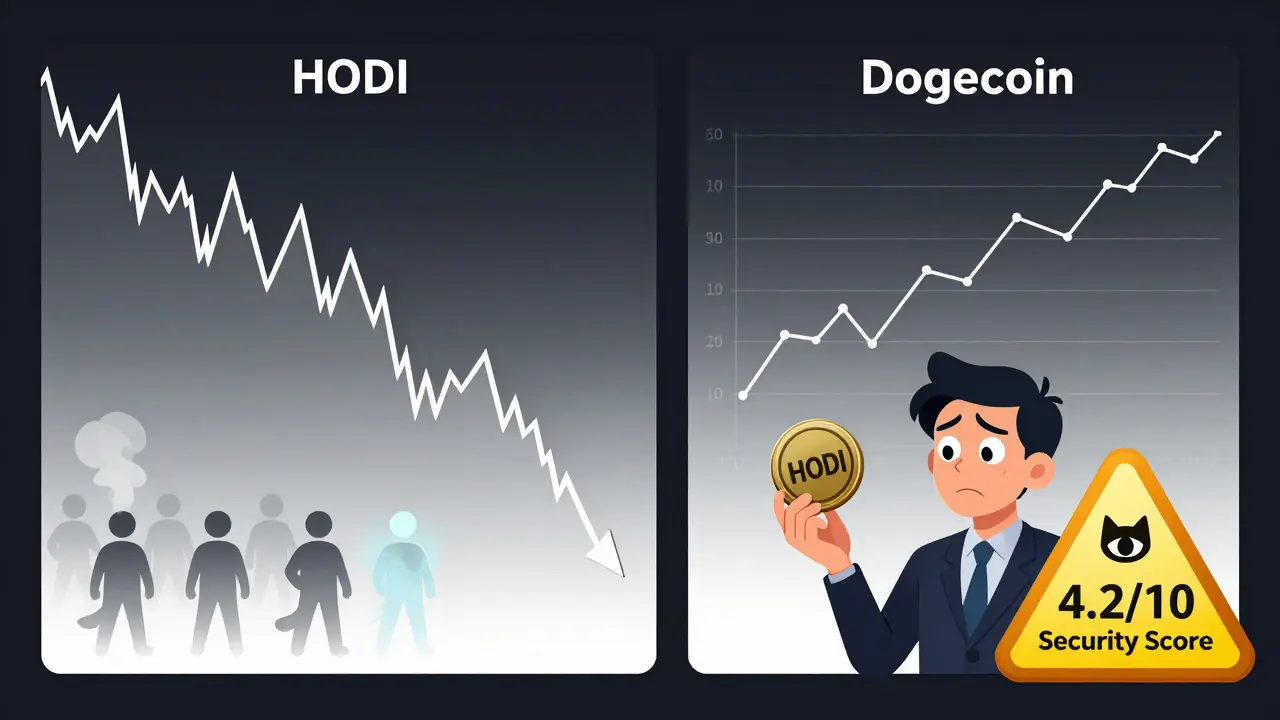
The smart contract address is real: HodiZE88VH3SvRYYX2fE6zYE6SsxPn9xJUMUkW1Dg6A. It’s been checked by Binance and CoinMarketCap. So technically, the code isn’t hacked. But that doesn’t mean it’s safe. CertiK, a top blockchain security firm, gave it a 4.2 out of 10. Why? Because the contract has known vulnerabilities - like reentrancy bugs - that could let someone drain funds if they find the right exploit.
Price and market performance
As of November 2025, HODI’s price is all over the map:
- CoinGecko: $0.000213
- Binance: $0.000068
- CoinMarketCap: $0.00006927
- Tapbit: $0.000114
Why such a difference? Because HODI trades on tiny decentralized exchanges (DEXs), not big platforms like Coinbase. Each exchange has its own buyers and sellers. So the price jumps around like a ping-pong ball.
Its market cap is only $69,270. For context, Dogecoin is worth over $15 billion. Shiba Inu? $9.8 billion. Even Floki Inu, another cat coin, sits at $482 million. HODI is practically invisible in the crypto world. It’s ranked #4942 out of over 20,000 coins. That’s not just small - it’s barely on the map.
Here’s the kicker: HODI’s all-time high was $0.002388 in May 2024. Today? It’s down 97.1%. If you bought at the peak, you’d need a miracle to break even.
Who’s behind it?
The team behind HODI was anonymous at first. Then they “doxxed” - meaning they revealed their identities. But no one knows who they are. No LinkedIn profiles. No GitHub. No public interviews. No real name attached. That’s not unusual for meme coins. But it’s risky. If the devs vanish tomorrow, your tokens turn to dust. And there’s zero evidence they’ve built anything beyond a website and a token.
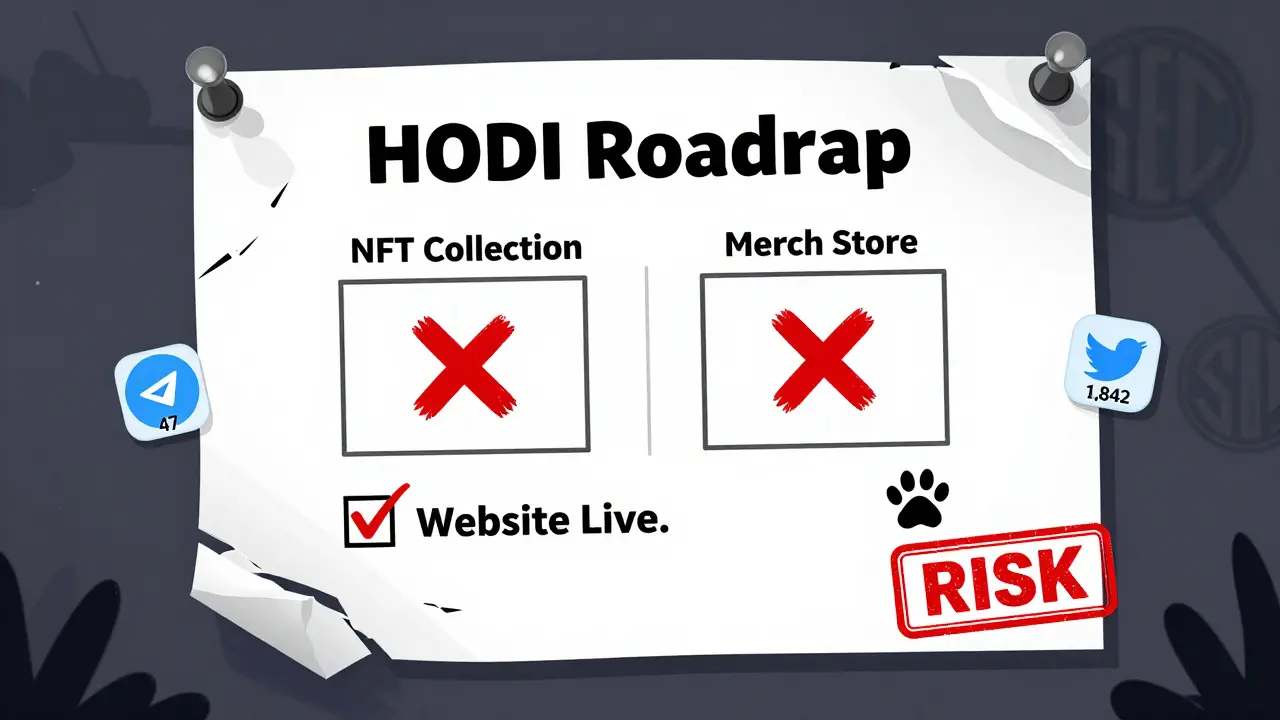
The roadmap? A three-page PDF from June 2025. It talks about “NFT integration” and a “merch store.” No dates. No progress updates. No code. Just promises. Meanwhile, the Telegram group has 47 members - down from 120 in June. The Twitter account has 1,842 followers. That’s not a community. That’s a ghost town.
Why is it still trading?
Because people are chasing quick wins. On November 24, 2025, HODI spiked 32.48% in one day. That’s the kind of move that gets shared on Twitter. Traders who bought at the bottom made a killing. But here’s the catch: those same traders sold right after. The liquidity pool - the money that lets people buy and sell - dropped by 80% within hours. That’s classic pump-and-dump behavior.
Users report being unable to sell their HODI. One Reddit user lost $287 because the trade just failed. Another on Trustpilot said she tried 10 times to cash out - and couldn’t. Why? Low liquidity. If only 10 people are buying at any moment, and 100 people try to sell, the price crashes. And you’re stuck.
Trading volume is tiny too. Binance reports $12,129 in 24 hours. That’s less than what a single large investor might move in one trade. The Vol/Mkt Cap ratio is 17%. For comparison, Bitcoin is under 2%. That means HODI’s price is being driven by speculation, not real demand.
Should you buy HODI?
Let’s be clear: HODI is not an investment. It’s a gamble. If you’re thinking of putting money into it, here’s what you need to know:
- Only risk what you can afford to lose. If you lose $100, will it ruin your week? Then don’t do it.
- Never go all-in. Experienced traders say keep meme coins under 0.5% of your total portfolio.
- Use low slippage. Set your trade slippage to 0.5-1%. Higher than that, and you’ll get ripped off.
- Sell fast. If you get a 15-20% gain, take it. Don’t wait for “the moon.” That’s how people lose money.
- Don’t trust the roadmap. No one has delivered on a single promise yet.
There’s no utility. No product. No team you can contact. No real community. Just a cat in a hoodie and a promise.
The bigger picture
HODI exists because the meme coin market is exploding. In 2025, meme coins made up 8.7% of the entire crypto market. But 89% of that value is held by just three coins: Dogecoin, Shiba Inu, and Floki Inu. HODI is fighting for scraps.
Delphi Digital found that 87% of meme coins with a market cap under $100,000 vanish within a year. HODI is at $69,270. That’s not just below the threshold - it’s in the danger zone.
And regulators are watching. The SEC shut down a similar token, CATGIRL, in August 2025 for promising future utility without delivering anything. HODI’s roadmap says “NFTs” and “merch.” That’s exactly the kind of language that triggers regulators. If they come after HODI, your tokens could become worthless overnight.
Final verdict
Is Cat in Hoodie (HODI) a scam? Not technically. The code works. The contract is live. The tokens exist. But it’s a classic case of “no substance, just hype.” It’s a lottery ticket wrapped in a meme.
If you want to play it, fine. But treat it like a $5 lottery ticket - not an investment. Buy a tiny amount. Set a profit target. Get out fast. And never, ever believe the hype.
For everyone else? Skip it. There are better places to put your time - and your money.
Is Cat in Hoodie (HODI) a real cryptocurrency?
Yes, HODI is a real token on the Solana blockchain with a verified smart contract. But “real” doesn’t mean valuable. It has no utility, no team, and no product - just a logo and a meme. It exists because people are trading it, not because it solves any problem.
Can I buy HODI on Coinbase or Binance?
You can’t buy HODI on Coinbase or any major centralized exchange. It’s only available on decentralized exchanges (DEXs) like Raydium and Jupiter on Solana. That means you need a Solana wallet like Phantom or Solflare. It’s harder to access, riskier to trade, and harder to sell.
Why is HODI’s price so different on different sites?
Because HODI trades on tiny, low-liquidity exchanges. Each platform has its own buyers and sellers. If only 10 people are trading on one site, the price can swing wildly based on one big buy or sell. That’s why CoinMarketCap, Binance, and Tapbit all show different prices - none of them are wrong, but none of them reflect a stable market.
Is HODI a good long-term investment?
Absolutely not. HODI has lost over 97% of its value since its peak. It has no revenue, no product, no team activity, and zero institutional backing. Experts estimate it has a 92% chance of becoming worthless within 18 months. If you’re looking for growth, this isn’t it.
What happened to the HODI team?
They claimed to have “doxxed” - meaning revealed their identities - but no names, photos, or social profiles have ever been confirmed. No interviews, no updates, no GitHub commits. That’s not transparency. That’s a red flag. In crypto, anonymous teams aren’t always bad - but when combined with zero progress, it’s a warning sign.
Can I sell my HODI tokens easily?
Sometimes - but not always. Many users report failed sell transactions, especially during price spikes. Low liquidity means there aren’t enough buyers. If 100 people try to sell at once and only 5 are buying, the price crashes and your trade fails. Always use low slippage (0.5-1%) and set profit targets to avoid getting stuck.
Is HODI regulated or safe?
No. HODI has no regulatory oversight. Its contract has known security flaws, and its roadmap promises “future utility” - a phrase the SEC used to shut down similar tokens in 2025. It’s not illegal to own HODI, but it’s not safe either. Treat it like gambling, not investing.
What’s the future of HODI?
The future looks bleak. With a market cap under $100,000, no active development, and a shrinking community, HODI is on track to fade into obscurity. The only planned update - an NFT collection - has no timeline, no previews, and no proof of work. Most experts believe it will lose all value within a year. Don’t count on a comeback.
 Finance
Richard Cooper
February 27, 2026 AT 21:15Dee Resin
March 1, 2026 AT 08:58Tanvi Atal
March 3, 2026 AT 08:29Sony Sebastian
March 3, 2026 AT 13:27Brian Lemke
March 4, 2026 AT 06:25Megan Lavery
March 5, 2026 AT 20:11Mae Young
March 7, 2026 AT 00:16Trenton White
March 7, 2026 AT 09:25Cheryl Fenner Brown
March 8, 2026 AT 03:30Michael Teague
March 8, 2026 AT 18:52kati simpson
March 8, 2026 AT 21:41Cory Derby
March 9, 2026 AT 17:52Sriharsha Majety
March 11, 2026 AT 07:53Tabitha Davis
March 13, 2026 AT 05:37Vishakha Singh
March 15, 2026 AT 02:57Don B.
March 16, 2026 AT 00:06Arya Dev
March 17, 2026 AT 22:13Leslie Cox
March 19, 2026 AT 19:10John Fuller
March 21, 2026 AT 17:39