

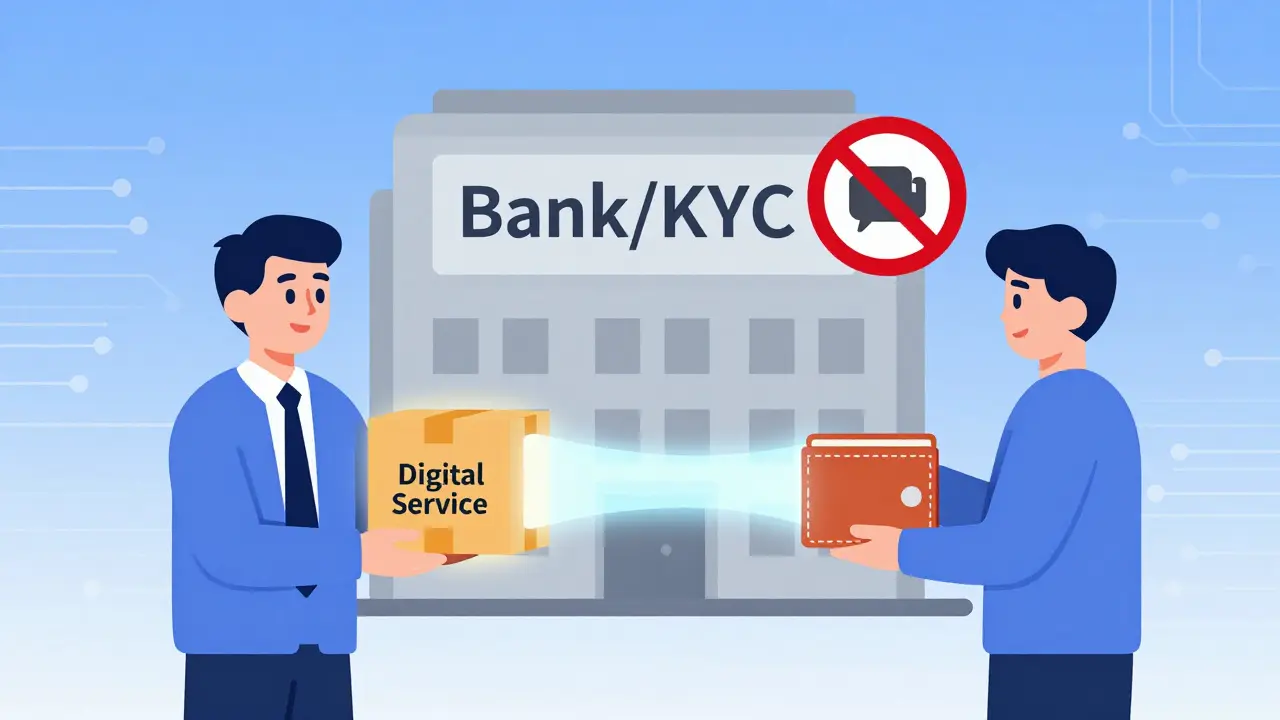
Imagine a customer wants to buy your digital product or service. They have the funds in their wallet, but they refuse to hand over their passport, driver's license, or selfie to complete the transaction. In the traditional banking world, this deal would die instantly. But in the crypto economy, it is not only possible; it is the standard for privacy-conscious users. You can accept cryptocurrency payments without forcing your customers through Know Your Customer (KYC) checks, provided you structure your business correctly.
The core issue here is not just about technology; it is about legal classification and operational design. Most merchants get confused because they assume that accepting crypto automatically makes them a regulated financial institution. It does not. If you simply exchange goods or services for Bitcoin, Ethereum, or stablecoins, you are generally considered a merchant, not a Virtual Asset Service Provider (VASP). This distinction allows you to bypass the heavy identity verification requirements that plague centralized exchanges and custodial processors.
Why Merchants Can Skip Customer KYC
To understand why you don't need to verify your customers, you have to look at who regulators are actually targeting. The Financial Action Task Force (FATF), the global anti-money laundering watchdog, issued guidance in 2019 and updated it in 2021 to define VASPs. These are entities that exchange, transfer, or safeguard virtual assets on behalf of others. Think of Coinbase, Binance, or even a custodial payment processor like BitPay. They hold your money. They control the keys. Therefore, they must know who you are.
You, as a merchant selling software, consulting, or physical goods, do not fit this definition. You are not holding customer funds. You are not acting as an intermediary for their crypto. You are simply receiving payment. In the United States, the Financial Crimes Enforcement Network (FinCEN) clarified in 2013 that businesses accepting convertible virtual currency solely as payment for goods are typically not money transmitters. Similarly, the European Union’s MiCA framework regulates crypto-asset service providers but leaves ordinary e-commerce merchants largely untouched regarding customer identification.
This regulatory gap is your opportunity. By adopting a non-custodial model, you align yourself with the law while respecting your customers' privacy. You never touch their private keys, and you never require them to create an account on a third-party platform just to pay you. The transaction happens directly between their wallet and yours.
The Three Models for No-KYC Merchant Acceptance
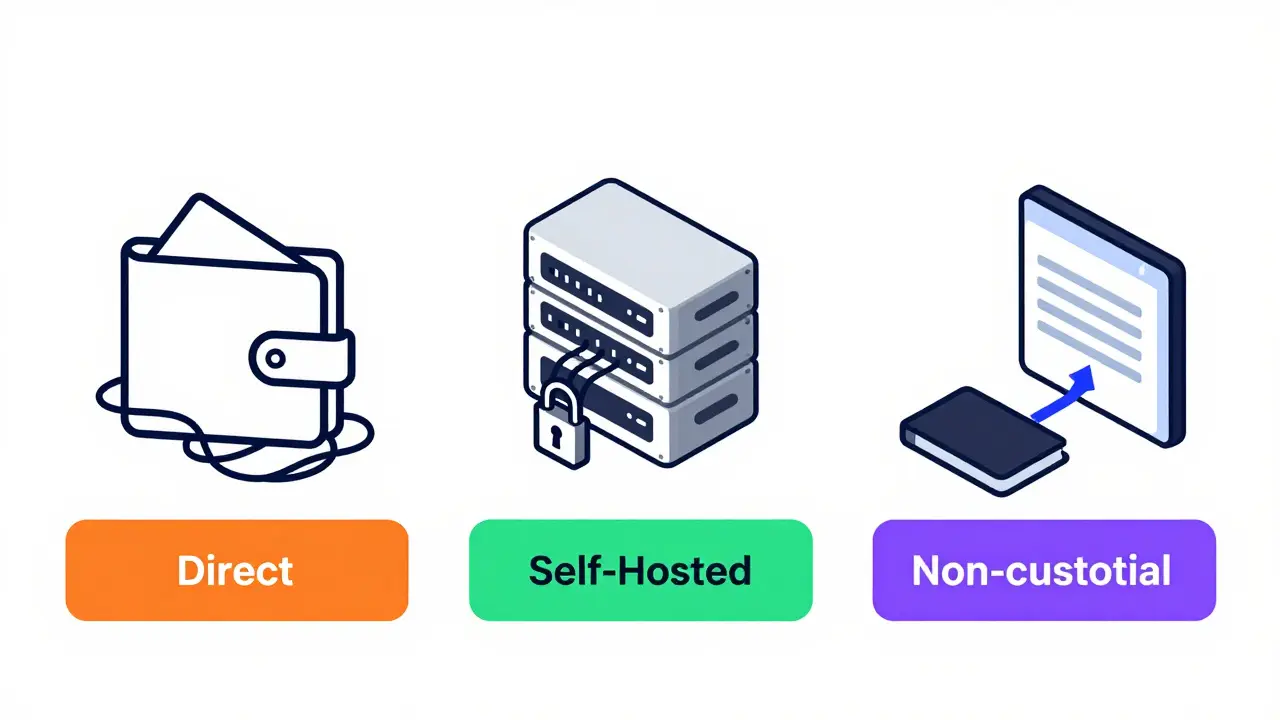
If you want to implement this, you have three primary technical paths. Each offers a different balance of control, complexity, and convenience.
- Direct Self-Custodial Acceptance: This is the oldest method. You generate a static Bitcoin address from your wallet, put it on your website, and ask customers to send funds. It requires no software, no registration, and zero fees beyond network costs. However, it is operationally fragile. Reconciling orders becomes a nightmare when multiple people use the same address. It also harms privacy because address reuse links all transactions to one entity. Most modern merchants avoid this unless they are dealing with very low volumes.
- Self-Hosted Processors (e.g., BTCPay Server): Launched in 2017 by developer Nicolas Dorier, BTCPay Server is an open-source, self-hosted payment processor that connects directly to a merchant’s own Bitcoin node. It generates a unique address for every invoice using hierarchical deterministic (HD) wallet technology. This solves the reconciliation and privacy issues of static addresses. Since you host the server, no third party ever sees your data or holds your funds. There is no sign-up, no central account, and therefore no regulatory checkpoint for your customers. The trade-off? You must manage the infrastructure. Setting up a full Bitcoin node and configuring the server can take hours or days, requiring familiarity with Linux, Docker, and networking.
- Non-Custodial Payment Gateways: Services like Aurpay, MaxelPay, and TxNod bridge the gap. They offer the user experience of a traditional processor-hosted checkout pages, webhooks, and dashboards-but route funds directly to your wallet. Because they do not take custody of funds, they argue they are not VASPs and thus do not need to KYC you or your customers. For example, Aurpay claims merchants can start accepting USDT, BTC, and ETH in under 15 minutes with a flat 0.8% fee. Similarly, TxNod is a non-custodial multi-chain gateway built around hardware wallets, allowing solo founders to accept payments without company registration or identity checks. These gateways handle the technical heavy lifting, including address derivation and payment detection, while you retain full control over your private keys.
Comparison: Custodial vs. Non-Custodial Gateways
| Feature | Custodial (e.g., BitPay, Coinbase Commerce) | Non-Custodial (e.g., BTCPay, TxNod, Aurpay) |
|---|---|---|
| Fund Flow | Funds go to processor’s wallet, then settled to you (often converted to fiat). | Funds go directly to your wallet on-chain. |
| Merchant KYC | Required. Business docs, ID, tax forms. | Not required. No identity verification needed. |
| Customer KYC | Usually none, but high-risk users may be flagged. | None. Customers pay from any wallet. |
| Counterparty Risk | High. Processor can freeze accounts or fail. | Zero. You control the keys; no one can freeze your funds. |
| Setup Complexity | Low. Sign up and integrate. | Varies. Self-hosted is hard; non-custodial gateways are easy. |
| Fees | Typically 1% - 3.5% + fixed fees. | Often lower. Flat rates like 0.8% or subscription models. |
How Customers Acquire Crypto Without KYC
Your ability to accept no-KYC payments depends partly on how easily your customers can get crypto without verifying their identities themselves. If your buyers are forced to use a strict KYC exchange to buy Bitcoin before paying you, the friction remains high. Fortunately, the ecosystem supports several anonymous acquisition methods.
In 2026, platforms like GODEX offer instant swaps with no account registration, supporting over 900 coins with fees around 0.8%. Peer-to-peer (P2P) markets like Bisq or LocalMonero connect buyers and sellers directly, often using escrow without platform-level identity checks. For those preferring in-person transactions, Bitcoin ATMs allow cash-for-BTC purchases, though many now impose limits or ID checks above $900-$1,000 due to local laws. Decentralized exchanges (DEXs) like Uniswap or PancakeSwap allow users to swap tokens without any identity check, though they cannot accept fiat directly. Finally, mining remains the most independent method, where users earn coins directly into their wallets by contributing computing power.
When you accept major assets like BTC, ETH, or stablecoins like USDC and USDT, you tap into the largest pools of liquidity. However, if you want to maximize privacy for both parties, consider accepting Monero (XMR). Unlike Bitcoin, which is transparent on the blockchain, Monero obscures sender, receiver, and amount details. While liquidity is lower, it offers the strongest protection against chain analysis.
Regulatory Risks and Compliance Best Practices
Just because you don’t have to perform KYC doesn’t mean you are immune to compliance risks. Regulators are increasingly focused on the "Travel Rule," which requires VASPs to share originator and beneficiary information for transfers above certain thresholds (typically $1,000). While this rule targets service providers, not merchants, it creates a ripple effect. If a customer buys crypto on a KYC’d exchange and sends it to you, that exchange may log the transaction. Blockchain analytics firms already track large flows, linking addresses to real-world identities.
To protect your business, adopt a risk-based approach. Even without formal KYC obligations, you should screen large transactions against sanctions lists. Tools like Chainalysis or Elliptic can help identify if a payment comes from a known illicit source. Implement internal thresholds: manually review payments that seem unusually large or suspicious. Keep detailed records of your own transactions for tax purposes. Remember, you are still responsible for reporting income and capital gains in your jurisdiction, regardless of whether you verified your customer’s ID.
Also, be aware of evolving definitions. The EU’s MiCA regulation and national implementations in the US and UK continue to broaden what constitutes a regulated service. If a non-custodial gateway starts offering additional services like fiat conversion or lending, it may cross the line into VASP territory. Stick to pure payment processing-receiving and forwarding-to stay within the safest legal gray area.

Choosing the Right Solution for Your Business
Your choice depends on your technical skills, volume, and risk tolerance. If you are a solo founder or indie hacker building a small project, a non-custodial gateway like TxNod or Aurpay offers the best balance. You get rapid setup (under 15 minutes for some), multi-chain support, and no KYC hurdles. TxNod, for instance, integrates with hardware wallets like Ledger and Trezor, ensuring your private keys never leave your device. It charges a flat monthly fee rather than a percentage of sales, which can be more cost-effective for high-volume merchants.
If you value maximum sovereignty and have the technical expertise, BTCPay Server is the gold standard. You run your own node, you see every transaction, and you rely on no third party. It is ideal for privacy advocates and those wary of any corporate intermediary. However, the maintenance burden is real. You must handle backups, security updates, and node synchronization.
Avoid custodial processors if your goal is true no-KYC acceptance. While they make integration easy, they introduce counterparty risk. They can freeze your account, delay payouts, or force you to provide extensive documentation later. In a world where financial censorship is a concern, relying on a middleman defeats the purpose of using crypto.
Practical Implementation Steps
Ready to start? Here is a simplified roadmap to go live quickly:
- Select your asset mix: Start with Bitcoin and a stablecoin like USDT or USDC. They offer the best liquidity and recognition. Add Monero later if privacy is paramount.
- Choose your gateway: For ease, pick a non-custodial provider. Install their plugin for WooCommerce, Shopify, or use their API for custom builds. Ensure they support direct wallet routing.
- Set up your wallet: Use a hardware wallet for security. Generate a new extended public key (xpub) specifically for business transactions. Never expose your private keys or seed phrase to any service.
- Configure invoices: Enable automatic address generation. Each customer should receive a unique QR code or address. This simplifies accounting and protects privacy.
- Test the flow: Send small test transactions to verify that webhooks trigger correctly and payments are recorded in your dashboard. Check confirmation times and network fees.
- Communicate clearly: Tell your customers exactly which networks to use. Mistakes happen when users send ERC-20 tokens on the wrong chain. Provide clear instructions to prevent lost funds.
By embracing non-custodial tools, you unlock a faster, cheaper, and more private payment channel. You respect your customers’ right to anonymity while maintaining full control over your revenue. As regulations evolve, this model remains robust because it relies on open protocols and decentralized infrastructure, not permissioned databases.
Is it legal to accept crypto without KYC?
Yes, in most jurisdictions, it is legal for merchants to accept cryptocurrency as payment for goods or services without performing KYC on customers. Regulations like FATF’s Travel Rule and EU’s MiCA target Virtual Asset Service Providers (VASPs)-entities that exchange, transfer, or safeguard assets on behalf of others. Ordinary merchants who simply receive payments are generally not classified as VASPs, provided they do not hold customer funds or act as intermediaries.
What is the difference between custodial and non-custodial gateways?
A custodial gateway (like BitPay) holds customer funds in its own wallets before settling them to you, often converting them to fiat. This requires the gateway to perform KYC on you and potentially monitor transactions. A non-custodial gateway (like BTCPay Server or TxNod) routes funds directly from the customer’s wallet to yours. Since the gateway never touches the money, it does not need to verify identities, offering greater privacy and eliminating counterparty risk.
Can I accept Bitcoin without revealing my customer’s identity?
You can accept Bitcoin without asking for your customer’s identity documents. However, Bitcoin is a transparent ledger. While the transaction itself does not contain names, blockchain analytics can sometimes link addresses to real-world identities based on IP logs, exchange data, or spending patterns. For stronger privacy, consider accepting Monero (XMR), which obscures transaction details, or use mixing services, though these carry higher regulatory scrutiny.
Do I need to register a company to use non-custodial gateways?
No. Many non-custodial payment gateways, such as TxNod and Aurpay, do not require merchants to register a company or submit business documents. They operate on the principle that since they do not hold funds, they are not subject to the same KYC mandates as banks or exchanges. This makes them ideal for solo founders, indie hackers, and small projects.
How do customers buy crypto without KYC to pay me?
Customers can acquire crypto anonymously through several methods: peer-to-peer (P2P) platforms like Bisq or LocalMonero, instant swap services like GODEX or SimpleSwap, Bitcoin ATMs (for smaller amounts), decentralized exchanges (DEXs) like Uniswap, or by mining. These methods allow users to obtain coins without submitting identity documents, enabling them to pay you privately.
What are the risks of accepting no-KYC crypto payments?
The main risks include receiving funds from sanctioned sources or involved in illicit activities, which could attract regulatory attention. Additionally, blockchain transparency means that while you don’t collect IDs, your own address history is public. To mitigate this, use unique addresses per invoice, screen large transactions against sanctions lists, and keep accurate records for tax compliance. Avoid mixing services if you want to maintain a clean reputation.
Is BTCPay Server better than commercial non-custodial gateways?
It depends on your technical skills. BTCPay Server offers maximum control and privacy since you host it yourself, but it requires significant setup time and maintenance. Commercial non-custodial gateways like TxNod or Aurpay offer easier integration, multi-chain support, and dedicated support, making them better for non-technical merchants who still want to avoid KYC and custody risks.
 Finance



Jesse Alston
May 17, 2026 AT 14:30Great breakdown of the technical side here. I've been running BTCPay for my indie SaaS project for about two years now and honestly, once you get past the initial setup headache, it's incredibly liberating not having a middleman breathing down your neck. The key is just being disciplined about backups. If you lose your keys or seed phrase with a non-custodial setup, there is no customer support to call. It's truly 'your keys, your coins' in the most literal sense. I'd recommend anyone trying this to start small and test thoroughly before going live with real customers.
Sudarshan Anbazhagan
May 19, 2026 AT 02:30While the author presents a seemingly straightforward path to financial sovereignty one must consider the broader regulatory landscape which is rapidly evolving and becoming increasingly hostile towards such arrangements. The distinction between a merchant and a VASP is not as clear cut as suggested especially when considering how local authorities interpret the handling of digital assets. Many jurisdictions are beginning to require merchants to implement some form of due diligence regardless of whether they hold custody. This is a slippery slope that could lead to significant legal repercussions for those who ignore these nuances. One should not be so naive as to believe that technology alone can shield them from the reach of the state apparatus.
Matt Davis
May 19, 2026 AT 08:55This entire premise is fundamentally flawed and dangerously misleading. You cannot simply wave away the Travel Rule because you're selling software instead of shuffling coins around. Regulators don't care about your philosophical stance on privacy; they care about compliance. If you accept crypto without KYC, you are essentially operating in the shadows, which makes you a prime target for investigation. The idea that you can bypass identity verification by using a self-hosted server is laughable. Blockchain analytics firms like Chainalysis can link your IP address, transaction patterns, and even metadata to your real-world identity faster than you can blink. Stop spreading this dangerous misinformation.
Bronwen Butler
May 21, 2026 AT 08:27actually the travel rule applies to vasp only not merchants. everyone keeps confusing the two. if you sell goods you are not a money transmitter. its basic fincen guidance from 2013. people need to read the actual regulations instead of panicking.
Matt Davis
May 23, 2026 AT 00:50You are missing the point entirely. While the letter of the law might distinguish between VASPs and merchants, the spirit of enforcement is changing. Agencies are finding ways to pressure platforms and processors to de-risk any entity that doesn't perform KYC. If your payment processor flags you, or if your bank sees incoming fiat conversions from questionable sources, you will have a problem. The 'letter of the law' offers little protection when you are facing account freezes or audits. It is a game of cat and mouse, and the cat is getting smarter.
Amit Varpe
May 23, 2026 AT 09:27India needs more guides like this :). Too many people are stuck in the old banking system. Crypto is the future for our economy. We should embrace it fully. No KYC means true freedom for Indian merchants. Let's go India! 🇮🇳
Yash Lodha
May 24, 2026 AT 12:02The surveillance state is watching every byte. They want to know who you are, what you buy, and where you send your money. Using BTCPay is a step in the right direction but remember that the blockchain itself is a ledger of truth that cannot be erased. Your IP address is a beacon in the dark. They are building a web of data points to trap you. Even if you skip KYC, the pattern of your life is being recorded. Stay paranoid. Trust no one. The system is designed to fail you.
Bianca Vilas Boas Lourenço
May 26, 2026 AT 00:48Ugh, why does everyone make this so complicated? 😒 Just use Coinbase Commerce and move on with your life. Trying to host your own node sounds like a nightmare for someone who isn't a Linux wizard. And please, stop talking about 'privacy' like it's some magical virtue. It's usually just an excuse for shady stuff. Anyway, good luck figuring out Docker containers while trying to run a business. Sounds exhausting 🙄💅
Pauline Larocco71
May 27, 2026 AT 13:24i totally get why ppl are scared of kyc but at the same time i feel like if you are doing something legit you shouldnt have anything to hide. but then again i am not a lawyer and i see so many people struggling with traditional banks too. maybe there is a middle ground? i tried setting up btcpay once and it was soo hard lol. i gave up after three days. maybe txnod is easier? has anyone tried that?
Albert Lee
May 28, 2026 AT 18:48I hear you on the difficulty of setup! It can be daunting at first. But think about the long-term benefits. You are taking control of your financial destiny. It's empowering to know that no third party can freeze your funds or delay your payouts. If you find BTCPay too complex, starting with a user-friendly non-custodial gateway like TxNod or Aurpay is a fantastic compromise. You still get the core benefit of direct wallet routing without the heavy lifting of server management. You've got this! 💪
Michelle Bonahoom
May 30, 2026 AT 04:47this is all just noise. nobody cares about monero or btc privacy anymore. the exchanges have already flagged everything. you are wasting your time trying to be anonymous. just pay taxes and shut up. typical tech bro fantasy thinking they can outsmart the government. lazy and stupid.
Kimberly Herbstritt
May 31, 2026 AT 02:47Hi there! I actually disagree with the harsh take above. Privacy is a fundamental right, not just a tool for illicit activities. Most people just want to keep their shopping habits private, similar to how cash works. The fact that regulators are pushing for total transparency is concerning for civil liberties. It's nice to have options that respect individual autonomy. Thanks for sharing this guide though, it's helpful to see the technical possibilities!
Sharada Vakkund
May 31, 2026 AT 03:12Welcome to the discussion everyone! It's great to see such diverse perspectives here. For those interested in the technical implementation, I highly recommend looking into the community forums for BTCPay Server. There are many experienced users willing to help newcomers navigate the setup process. Remember, we are all learning together. Let's support each other in building a more inclusive and decentralized financial ecosystem. Feel free to ask questions!
Ankush Pokarana
June 1, 2026 AT 21:51the essence of freedom lies in the ability to transact without permission. when we rely on centralized entities we surrender our autonomy to algorithms and bureaucrats who do not share our values. the blockchain offers a path to reclaim this agency but it requires discipline and understanding. it is not merely a technical challenge but a philosophical one. we must question why we accept surveillance as the price for convenience. the journey is long but the destination is worth it.
Sarah C
June 2, 2026 AT 13:39I appreciate the detailed comparison table. It really clarifies the trade-offs between custodial and non-custodial solutions. As someone who values simplicity, I'm leaning towards a non-custodial gateway for now. The idea of retaining full control over my keys is very appealing. Thanks for putting this together!