

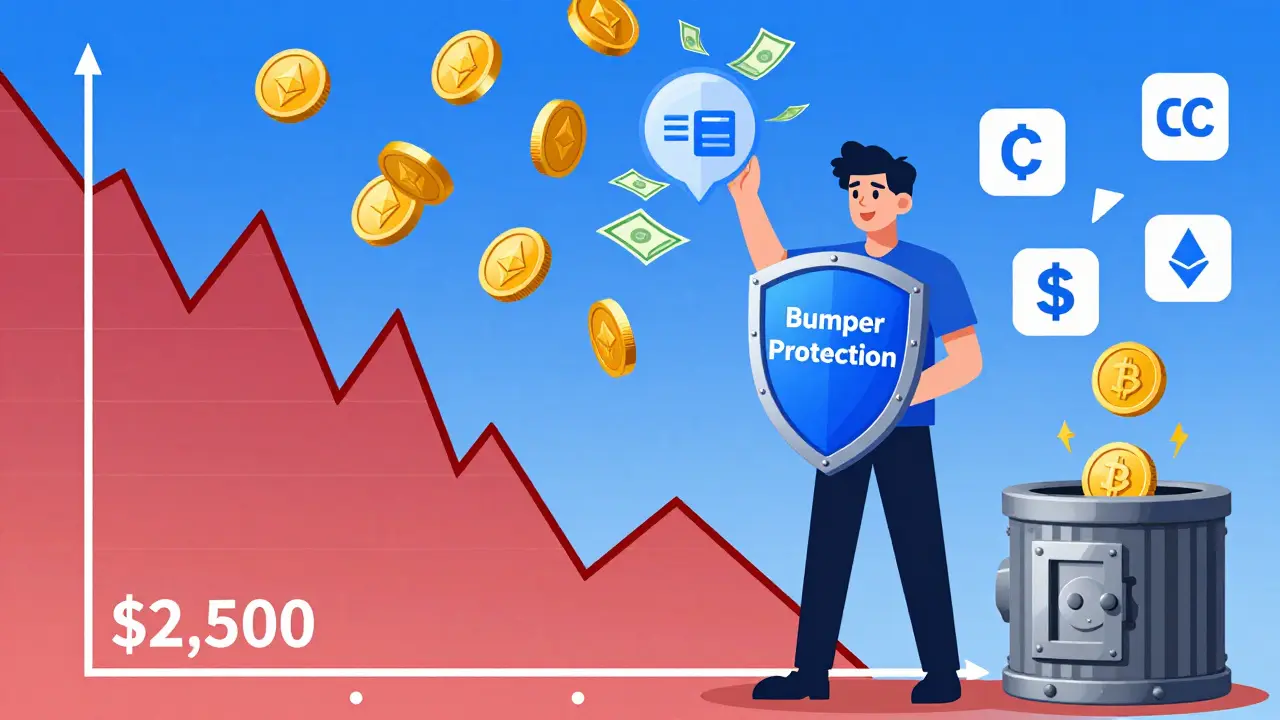
When you buy Bitcoin, Ethereum, or any other crypto, you’re betting on its price going up. But what if it crashes? That’s where Bumper (BUMP) comes in - a crypto project built to let you protect your holdings from big drops without giving up the chance to profit if prices rise.
What does Bumper actually do?
Bumper isn’t a coin you hold to trade or speculate on. It’s a tool. Think of it like buying insurance for your crypto. If you own 10 ETH and you’re worried it might drop from $3,000 to $2,000, you can use the Bumper protocol to lock in a minimum price - say $2,500. If ETH falls below that, Bumper pays you the difference. If it goes up to $4,000? You keep all the profit. No cap. No cuts. Just pure upside with a safety net.
This works through smart contracts on Ethereum. You connect your wallet to bumper.fi, pick the asset you want to protect, set your floor price, and pay a small premium. The protocol then uses that money to cover potential payouts. It’s not magic - it’s structured finance, but made simple for crypto users.
How does BUMP, the token, fit into all this?
The BUMP token is the backbone of the system. It’s not used to buy protection directly. Instead, people stake stablecoins like USDC into Bumper’s liquidity pools. In return, they earn two things: yield from the premiums paid by users buying protection, and newly minted BUMP tokens as rewards.
Here’s the catch: BUMP itself has no intrinsic value outside this system. It doesn’t grant voting rights, access to features, or dividends. Its only job is to incentivize people to lock up capital so the protection mechanism can run. If no one stakes, the protocol can’t pay out claims. That’s why the token’s price is tied to how much activity is happening on the platform.
Current market status: A shadow of its former self
Bumper hit its peak in December 2021, when BUMP traded as high as $0.44. Back then, DeFi was booming, and everyone was looking for ways to hedge against crypto’s wild swings. But things changed.
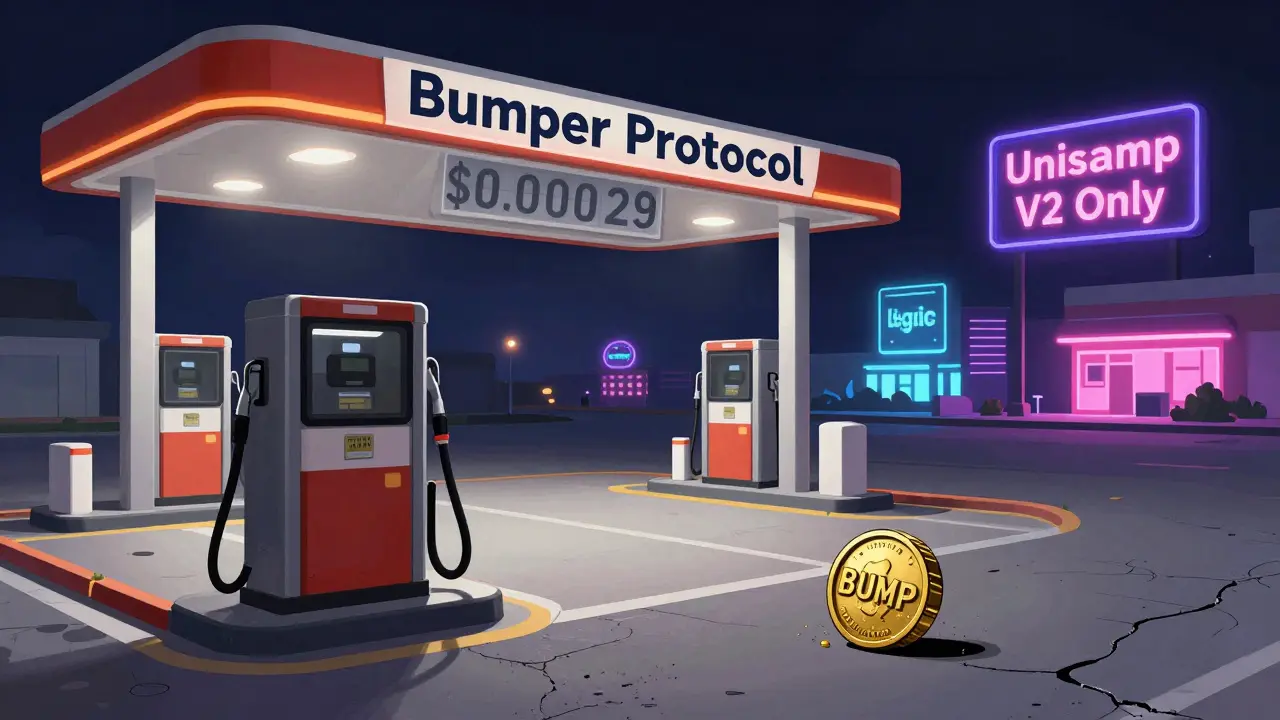
As of March 19, 2026, BUMP’s price is a fraction of that. On Coinbase, it’s at $0.000127. On Binance, it’s $0.000065. Some trackers even show it as low as $0.000029. That’s a drop of over 99% from its high. The market cap? Just $24,860. For comparison, a single popular meme coin can have a market cap 100 times larger.
Trading volume is barely there. The daily volume on Coinbase is under $140. On Binance, it’s around $240. Most of that activity happens on Uniswap V2, the decentralized exchange where BUMP is paired with USDC. That’s the only real liquidity pool left. No major exchange lists BUMP for direct trading anymore.
Why did Bumper fail to scale?
There are a few reasons.
- Low adoption: Most crypto holders still use stop-loss orders or just hold through dips. Few bother with a separate protocol to lock in floors.
- High cost: Premiums for protection can eat into small holdings. For someone with $500 in crypto, paying 5% upfront to protect it doesn’t make sense.
- Competition: Other DeFi protocols like Hegic, Lyra, and even options markets on DerivaDEX offer similar protections with better liquidity and lower fees.
- Liquidity death spiral: As fewer people used Bumper, less capital flowed into staking pools. That made payouts harder to guarantee, which scared off more users - and the cycle continued.
The protocol still works. The smart contracts are live. But there’s almost no one using them. The contract address on Ethereum is 0x785c34312dfa6b74f6f1829f79ade39042222168 - but the number of active transactions per day is in the single digits.
Is BUMP still worth anything?
As a speculative asset? Probably not. With a circulating supply of 195 million tokens and a price under $0.0003, even if the price jumped 100x, it would still be worth less than 3 cents. That’s not enough to attract serious traders or investors.
As a functional tool? Technically yes - if you have a large position and want to lock in a floor price without selling, you can still use it. But you’d need to find someone willing to provide liquidity on Uniswap, and that’s risky. The pool size is tiny. Slippage is high. And if you need to claim a payout, there’s no guarantee the system has enough funds.
Most people who still hold BUMP bought it years ago and are waiting for a miracle. That’s not a strategy. It’s a hope.
What’s next for Bumper?
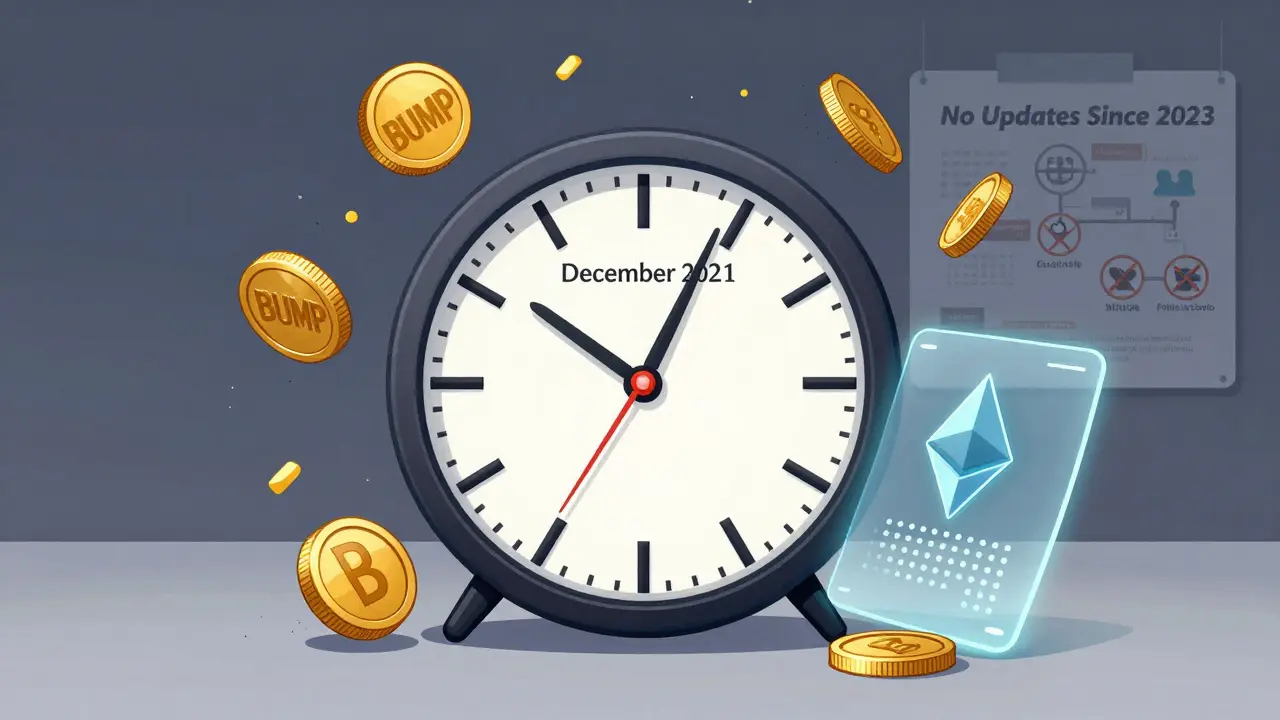
The official website (bumper.fi) and social channels haven’t posted major updates in over a year. The GitHub repo hasn’t seen new code since late 2023. The Twitter account (@bumperfinance) has gone quiet. No roadmap. No team updates. No new partnerships.
In crypto, silence is often the beginning of the end. Projects that stop evolving die. Bumper’s core idea was smart. But without ongoing development, marketing, or community support, it’s become a relic.
If you’re looking for a way to hedge your crypto, there are better options. Options markets on Synthetix, hedging with stablecoin yields, or even using centralized exchanges with built-in stop-loss tools are more reliable. Bumper’s protocol still exists - but it’s like a gas station in a town that’s been abandoned.
Key facts about Bumper (BUMP)
- Token name: Bumper (BUMP)
- Blockchain: Ethereum
- Contract address: 0x785c34312dfa6b74f6f1829f79ade39042222168
- Max supply: 250,000,000 BUMP
- Circulating supply: 195,684,814 BUMP
- All-time high: $0.446339 (December 17, 2021)
- Current price (March 19, 2026): $0.000029-$0.000127 (varies by exchange)
- Market cap: ~$24,860
- 24-hour volume: Under $250
- Primary trading pair: BUMP/USDC on Uniswap V2
- Protocol function: Price floor protection for crypto assets
Is Bumper (BUMP) a good investment?
No, BUMP is not a good investment. The token has lost over 99% of its value since its peak, trading volume is near zero, and the protocol has no active development or community growth. Holding BUMP is speculative at best and carries high risk with little chance of recovery.
Can I still use the Bumper protocol to protect my crypto?
Technically yes, but it’s not practical. The liquidity pools are extremely thin, meaning premiums are high and payouts may not be reliable. If you have a large position and want to test the system, proceed with caution - but expect limited support and high slippage.
Why is BUMP’s price different on different exchanges?
BUMP trades almost entirely on Uniswap V2, a decentralized exchange. The prices listed on Coinbase, Binance, and Crypto.com are based on limited off-chain data or outdated feeds. Real-time pricing only exists on Uniswap, where the daily volume is under $250. The wide price gaps reflect low liquidity and lack of standardization.
Does Bumper have a team or roadmap?
No. The official website, GitHub, and Twitter have been inactive since late 2023. There are no public updates, no team announcements, and no new development. The project appears abandoned.
Is Bumper related to any other crypto projects?
Bumper is a standalone DeFi protocol built on Ethereum. It has no official ties to other projects. However, its functionality overlaps with options protocols like Hegic, Lyra, and DerivaDEX - all of which have far more users and liquidity.
 Finance




Graham Smith
March 21, 2026 AT 05:07The Bumper protocol represents a fascinating application of structured finance primitives in DeFi-essentially a synthetic put option mechanism leveraging Ethereum smart contracts. However, the fatal flaw lies in its economic incentive structure: without a sustainable yield mechanism for liquidity providers, capital naturally flees to higher-alpha pools. The BUMP token’s lack of utility beyond governance-free staking rewards renders it a pure speculative instrument, devoid of intrinsic value proposition. This is why we see the classic death spiral: low TVL → low liquidity → high slippage → user attrition → further TVL contraction. A textbook case of misaligned incentives in DeFi design.
Jerry Panson
March 22, 2026 AT 19:57While I appreciate the conceptual elegance of Bumper’s price floor mechanism, the operational reality is that it demands a level of financial literacy and risk tolerance that most retail investors simply do not possess. The premium structure, while mathematically sound, becomes economically irrational for holdings under $10,000. Furthermore, the absence of any formal dispute resolution or audit transparency erodes trust in the protocol’s ability to fulfill obligations during market stress. It is not merely a failed product-it is a cautionary tale in user-centric design.
Katrina Smith
March 23, 2026 AT 17:19Anastasia Danavath
March 24, 2026 AT 07:27imagine spending years holding a token just bc u thought it was 'the future' lmao. the fact that people still have this in their wallets like its a family heirloom is wild. its not even a meme coin, its a museum piece. 🤡
anshika garg
March 25, 2026 AT 03:36There is something deeply human about clinging to something that once gave us hope. Bumper wasn’t just a protocol-it was a dream that so many believed in. We all wanted to believe we could protect ourselves from the chaos of crypto. And when it faded, we didn’t just lose a tool-we lost a part of our optimism. Maybe the real failure wasn’t the code. Maybe it was our own faith in systems that promised safety in a world built on volatility.
Bruce Doucette
March 25, 2026 AT 10:37Let’s be real-this is what happens when you let crypto bros build insurance. No one actually read the whitepaper. Everyone just saw ‘protect your ETH’ and thought it was a free lunch. Meanwhile, the liquidity pools were always going to collapse because the premiums were too low and the risk too high. And now? It’s a graveyard with a $24k market cap. Pathetic. If you still hold BUMP, you’re not an investor-you’re a hoarder with delusions.
Marie Vernon
March 27, 2026 AT 08:05I think it’s beautiful that even in death, Bumper still exists. The contracts are live. The code still runs. Someone, somewhere, might still be using it-maybe a small holder with $500 in ETH who doesn’t want to sell. That’s not failure. That’s resilience. Crypto isn’t just about returns. Sometimes it’s about dignity-keeping your position intact without selling into panic. Bumper gave people that choice. And that matters.
Ross McLeod
March 28, 2026 AT 22:43It’s important to contextualize Bumper’s collapse within the broader evolution of DeFi hedging instruments. While Bumper attempted a direct, user-friendly implementation, it failed to integrate with existing DeFi primitives like Chainlink price feeds, or to leverage composability with protocols like Aave for collateralized yield. Moreover, the absence of a decentralized governance structure meant that even minor protocol upgrades required centralized intervention, which never materialized. The lack of community-driven innovation, coupled with the rise of more sophisticated options protocols like Lyra and Hegic, rendered Bumper obsolete not due to technical failure, but due to systemic neglect. The real tragedy is not the price collapse-it’s the missed opportunity to build a decentralized risk market.
rajan gupta
March 29, 2026 AT 05:19broooooo… i remember when BUMP was at 0.44… i cried that night… i sold 10% and thought ‘i’ll wait for 1x’… i didn’t sell the rest… now i see my wallet and i feel like a ghost… i still check the Uniswap pool every day… like a funeral… i don’t know why i keep hoping… but i do… i still believe… 🫂💔
Billy Karna
March 29, 2026 AT 15:04For anyone still considering using Bumper: the protocol works, but only if you understand the risks. The Uniswap V2 BUMP/USDC pool has less than $50k in liquidity. That means if you try to buy $10k worth of protection, you’re likely to pay 30-50% slippage just to enter. Plus, the payout mechanism relies on stakers depositing USDC-but with near-zero staking volume, there’s no guarantee the contract has enough reserves. If you’re serious about hedging, use Synthetix or DerivaDEX. They have deep liquidity, real-time audits, and active teams. Bumper is a fun historical artifact-but treat it like a museum exhibit, not a financial tool.
Cheri Farnsworth
March 31, 2026 AT 06:05It is unfortunate that the Bumper protocol, despite its elegant architecture, has been left to wither without community stewardship. The absence of transparent communication from the founding team signals a fundamental breakdown in trust. In decentralized systems, trust is not a technical feature-it is a social one. Without ongoing engagement, updates, or even acknowledgment of the user base, the protocol becomes a relic. One must ask: who is responsible for maintaining the integrity of a system when its creators have vanished? Perhaps the answer lies not in code, but in community.
Shreya Baid
April 1, 2026 AT 20:17The fact that Bumper still functions at all is a testament to Ethereum’s immutability. The smart contracts continue to execute as written, even when no one is watching. This is the quiet power of blockchain: systems outlive their creators. While the token may be worthless, the protocol’s existence proves that decentralized infrastructure can persist beyond hype cycles. Perhaps one day, a new team will revive it-not as a financial product, but as a case study in sustainable DeFi design. Until then, it remains a silent guardian of user autonomy.
Christopher Hoar
April 2, 2026 AT 20:41Robert Kunze
April 3, 2026 AT 20:12i know this sounds crazy but i still have 20k bump in my wallet… i bought it at 0.12… i never sold… i dont even check the price anymore… i just… keep it. maybe one day it’ll be worth something. maybe not. but its my little crypto ghost story. 🕯️
Heather James
April 5, 2026 AT 00:51