

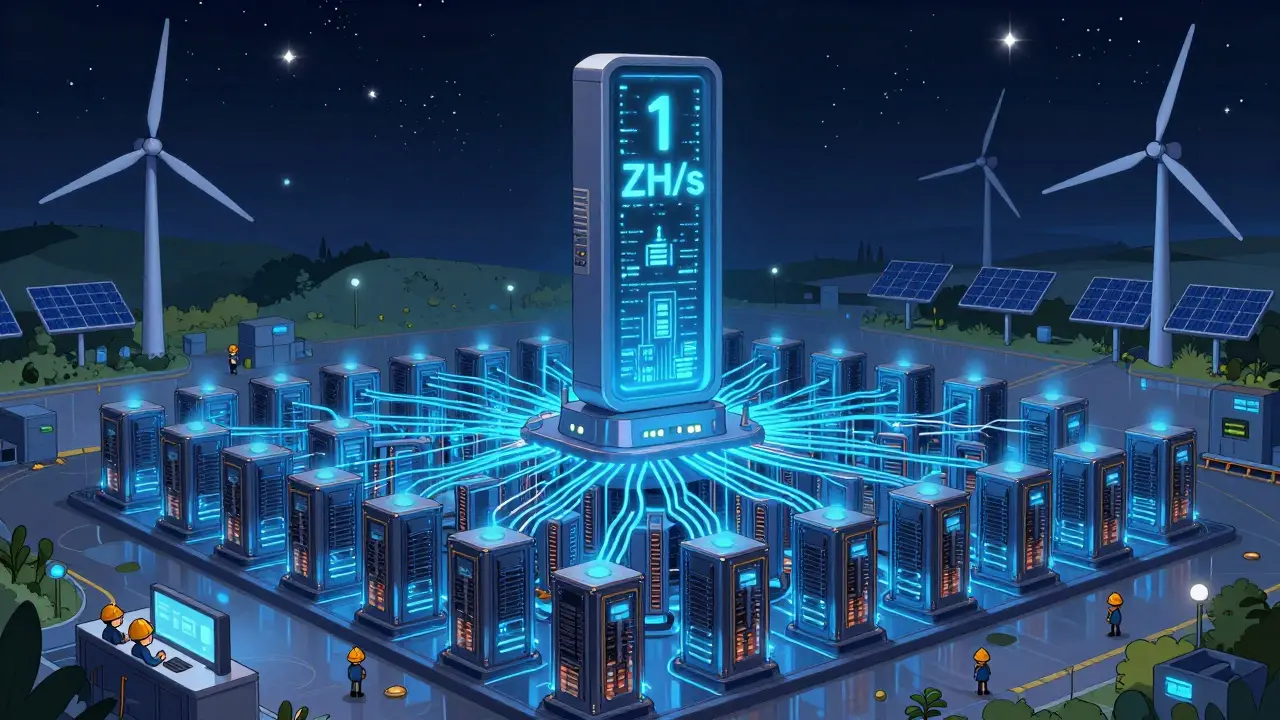
The Bitcoin network just crossed 1 Zetahash per second - that’s 1,000,000,000,000,000,000,000 calculations every second. It’s not science fiction. It’s real. And it’s only getting faster.
If you’ve ever wondered how Bitcoin stays secure without banks or governments, the answer is simple: raw computing power. Every time someone mines a new block, thousands of machines around the world compete to solve a math puzzle. The more power you throw at it, the harder it becomes for anyone to cheat. That’s the hash rate. And right now, it’s on a trajectory that’s hard to ignore.
Where We Are Right Now
As of early April 2025, Bitcoin’s 7-day average hash rate hit 929 EH/s (exahashes per second). But the real milestone came when the 1-day average spiked past 1 ZH/s - a level no one predicted just two years ago. This isn’t a glitch. It’s the result of industrial-scale mining operations, cheaper energy, and smarter hardware.
Companies like HIVE Digital Technologies now run over 22 EH/s across global data centers - up 267% in just one year. That’s not just growth. That’s a full-scale industry expansion. The old days of miners using home PCs are long gone. Today, 83% of Bitcoin’s total hash rate comes from professional mining farms, not hobbyists.
What Drives Hash Rate Growth?
It’s not just one thing. It’s a chain reaction.
- Bitcoin’s price: When the price goes up, more miners jump in. If Bitcoin hits $600,000 by 2030 (as DigitalCoinPrice predicts), mining becomes profitable even for older machines.
- Hardware efficiency: New ASICs like the Antminer S21 deliver 200 TH/s using less power than a hair dryer. These machines cut energy costs - the biggest expense for miners - by 30% compared to models from 2023.
- Energy costs: Miners don’t care where they mine, only how cheap electricity is. In Texas and Kazakhstan, power costs as low as $0.045/kWh make mining profitable even at $5,000 Bitcoin prices. On the U.S. East Coast, where rates hit $0.12/kWh, many operations shut down.
- Halving cycles: Every four years, Bitcoin miners get half the reward. The next halving is in 2028. Historically, hash rate dips right after, then rebounds as prices rise. Most models assume this pattern will repeat.
Put it all together, and you get what’s happening now: a feedback loop. Higher price → more mining → higher difficulty → better hardware → lower costs → higher price again.
Projections: The Numbers Behind the Hype
Not all forecasts are created equal. Some are based on gut feelings. Others use real data.
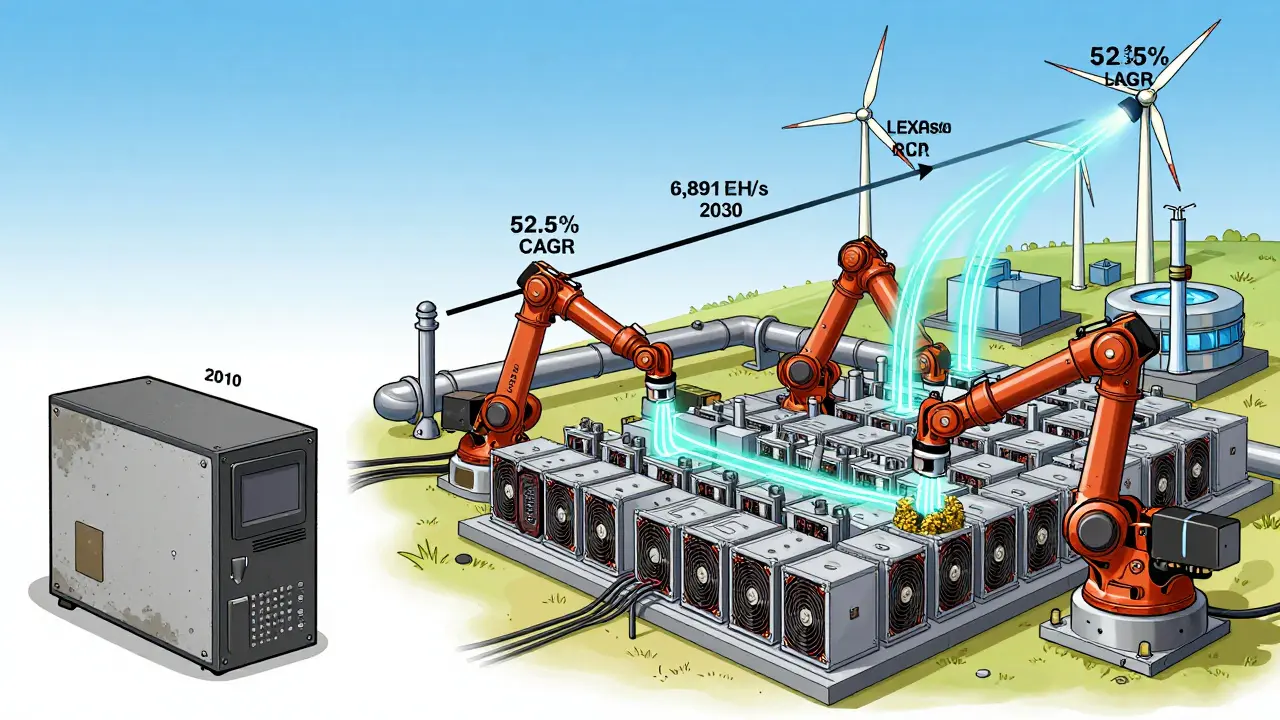
GoMining’s model, using data from 2018 onward (when mining went industrial), assumes a 52.5% compound annual growth rate. That’s aggressive - but it’s backed by what’s already happened. Since 2018, the network has grown 57 times. If that pace continues, Bitcoin’s hash rate could hit 6,891 EH/s by 2030.
Other analysts are more cautious. Markntel Advisors projects a 14.19% CAGR for the entire cryptocurrency market through 2030. If Bitcoin mining follows that trend, hash rate might only reach 2,543 EH/s. That’s still massive - but half of GoMining’s high-end estimate.
Here’s a realistic range based on current trends:
| Scenario | CAGR | Projected Hash Rate (2030) | Key Assumptions |
|---|---|---|---|
| Conservative | 35% | 2,543 EH/s | Regulatory crackdowns, slower adoption, energy limits |
| Base Case | 45% | 4,128 EH/s | Steady price growth, moderate hardware advances |
| High Growth | 52.5% | 6,891 EH/s | Bitcoin hits $1M+, AI-powered mining, global energy expansion |
The high-growth scenario isn’t fantasy. It’s what’s already unfolding. HIVE Digital is turning data centers into AI-ready facilities. Companies like Lancium are linking mining rigs to renewable grids, turning waste energy into profit. These aren’t side projects - they’re core strategies.
The Big Wild Cards
Even the best models can’t predict everything.
Regulation: If the U.S. or EU bans mining equipment imports or taxes energy use at 150% higher rates (as AInvest warns), growth could stall overnight. China’s 2021 ban caused a 40% drop in hash rate - but the network recovered in 12 months. Resilience doesn’t mean immunity.
Energy sustainability: The Bitcoin Mining Council says 56.1% of global mining now uses sustainable energy. That’s up from 37% in 2021. This isn’t just PR. It’s survival. As governments clamp down on carbon emissions, miners who rely on coal or gas will get squeezed.
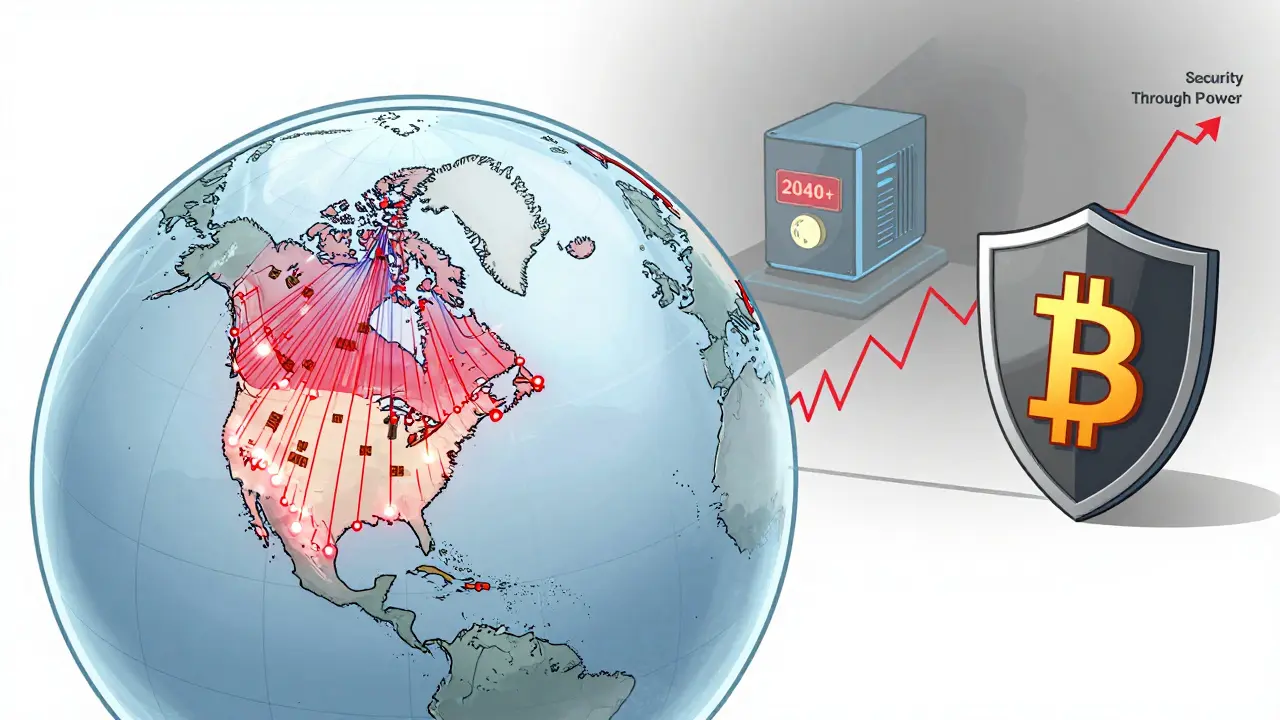
Quantum computing: MIT’s 2025 report says Bitcoin’s SHA-256 algorithm won’t be broken by quantum machines until at least 2040. So no immediate threat. But if a breakthrough happens in 2032, the entire security model would need a redesign. That’s a long-term risk, not a near-term one.
What This Means for Miners and Investors
If you’re a miner, your strategy needs to change.
- Don’t buy old ASICs. The turnoff price - the Bitcoin price below which you lose money - is now $5,000-$6,000 for older models. Newer machines like the S21 Pro can run profitably at $3,500.
- Location matters more than ever. A mining rig in Texas with $0.04/kWh power can outearn two rigs in Germany paying $0.15/kWh.
- Pool fees are rising. With more miners competing, pools charge more. You need to calculate your net reward, not just your hash power.
If you’re an investor:
- Bitcoin’s security is getting stronger. Higher hash rate = harder to attack. That’s good for long-term value.
- Companies with real mining operations (like HIVE or Bitfury) are becoming infrastructure plays, not just crypto bets.
- Watch energy partnerships. Firms that link mining to wind farms or hydro plants are building long-term moats.
What’s Next?
The next five years will define Bitcoin’s future as a global network. We’re not just watching a currency grow - we’re watching a new kind of infrastructure emerge.
By 2030, Bitcoin’s hash rate could be larger than the entire global supercomputer network. That’s not hype. It’s math. And if history is any guide, the network will keep growing - not because of speculation, but because it’s the most secure, decentralized, and energy-efficient way to validate value on a global scale.
The real question isn’t whether hash rate will keep rising. It’s whether the world will adapt fast enough to handle it.
What is Bitcoin hash rate and why does it matter?
Bitcoin hash rate measures how much computing power is being used to secure the Bitcoin network. It’s the total number of calculations per second miners perform to validate transactions and create new blocks. A higher hash rate means the network is more secure - it becomes exponentially harder for anyone to take control or double-spend Bitcoin. It’s not just a number; it’s Bitcoin’s armor.
Can Bitcoin’s hash rate keep growing forever?
Not indefinitely, but it has room to grow for at least another decade. Physical limits like energy availability, semiconductor supply, and heat dissipation will eventually slow growth. But right now, we’re far from those limits. New mining locations (like Iceland, Georgia, and parts of the U.S. Midwest), better cooling tech, and integration with renewable energy projects are opening new capacity. The bottleneck isn’t technology - it’s policy and access to cheap power.
How do Bitcoin halvings affect hash rate?
After each halving, miners get half the Bitcoin reward for each block they mine. This usually causes a short-term drop in hash rate as less profitable miners shut down. But historically, within 6-12 months, Bitcoin’s price rises enough to bring those miners back - often with more efficient hardware. The 2024 halving didn’t cause a crash. Instead, hash rate hit new records within months. This shows the market has learned to adapt.
Why do hash rate projections vary so much?
Because they rely on different assumptions. Some models assume Bitcoin hits $1 million by 2030 - others think it stays under $100,000. Some assume unlimited energy access; others factor in climate regulations. The 52.5% CAGR projection from GoMining is based on historical growth since 2018, when mining became industrial. More conservative models use longer-term averages or broader market trends. The truth is probably somewhere in the middle.
Is high hash rate good for Bitcoin’s price?
Yes, indirectly. A rising hash rate signals strong confidence from miners - people who put real money and hardware behind their belief in Bitcoin. When miners keep investing, it reduces sell pressure because they hold Bitcoin instead of cashing out. It also makes the network more secure, which attracts institutional investors. High hash rate doesn’t cause price to rise, but it’s one of the strongest indicators that the network is healthy and growing.
 Finance




Christina Young
March 6, 2026 AT 03:35Hash rate hitting 1 ZH/s? Cute. Let me know when it’s powering actual human needs instead of gambling on digital scarcity.
Steven Lefebvre
March 7, 2026 AT 14:14This is wild to think about. All this computing power just to validate transactions? I get the security angle, but isn’t there a smarter way to build trust without burning so much electricity?
nalini jeyapalan
March 9, 2026 AT 11:02You’re all missing the point. The real story isn’t the hash rate-it’s who owns the hardware. If 83% is controlled by industrial farms, then Bitcoin isn’t decentralized. It’s just corporate mining with a blockchain veneer.
HIVE Digital, Bitfury, MicroStrategy-they’re not miners. They’re utility monopolies in disguise. And when regulation catches up, you’ll see how fragile this whole thing really is.
Drago Fila
March 10, 2026 AT 08:35Love seeing this kind of progress. The fact that we’re turning waste energy into real value? That’s innovation. Texas wind farms, Icelandic geothermal, even flared gas from oil rigs-miners are the unsung heroes of renewable integration.
People say Bitcoin is wasteful. Nah. It’s the first technology that turns waste into wealth. That’s not a bug-it’s the feature.
Bill Pommier
March 11, 2026 AT 14:58Let me be perfectly clear: This entire narrative is a delusional fantasy engineered by venture capitalists and ASIC manufacturers. The hash rate is not a measure of security-it’s a measure of energy waste. And we are all paying for it in carbon emissions and grid instability.
The U.S. Department of Energy has warned about this. The IMF has flagged it. And yet here we are, celebrating a trillion-dollar electricity bill as if it’s progress.
Olivia Parsons
March 11, 2026 AT 17:42Just to clarify-hash rate means more people are securing the network. That’s good. But it also means more electricity. So if you care about climate, you should care about where that power comes from. Not all mining is equal.
Look at the Bitcoin Mining Council’s data. 56% sustainable? That’s a start. But we need transparency. Not hype.
Issack Vaid
March 13, 2026 AT 17:11How ironic. We built a decentralized system, then turned it into the most centralized industrial operation on Earth. The irony is not lost on me.
Miners in Kazakhstan, Texas, and Paraguay aren’t freedom fighters-they’re factory workers for a financial oligarchy. The blockchain is just the brand.
Shawn Warren
March 14, 2026 AT 10:45The next halving is in 2028 and if history repeats we’ll see another surge after price recovery
Miners are smarter now they don’t shut down immediately they upgrade hardware and wait it out
This isn’t a cycle it’s an evolution
Jackson Dambz
March 15, 2026 AT 10:09Why are we even talking about this? Hash rate doesn’t make Bitcoin valuable. It just makes it more expensive to run.
Someone’s making money off this. Not you. Not me. Definitely not the planet.
Megan Lutz
March 16, 2026 AT 18:21The assumption that hash rate growth equals security growth is mathematically flawed. Security depends on distribution, not raw power. If 10 companies control 70% of the hash rate, then a 51% attack requires far less capital than it did in 2017.
This isn’t a feature-it’s a vulnerability masked as strength. The network is becoming more robust statistically, but less resilient structurally.
And yet, no one talks about this. Everyone’s too busy hyping the numbers to notice the architecture is rotting.
Austin King
March 17, 2026 AT 13:27Just thinking about how much energy this uses makes me pause. But then I remember-miners are also stabilizing grids in places that had no power infrastructure. There’s a balance here.
We need to stop seeing this as good or bad. It’s complex. And complexity is where real progress happens.
Emily Pegg
March 19, 2026 AT 07:38Why do people keep pretending this isn’t a pyramid scheme? Hash rate goes up → more people join → price goes up → more mining → rinse repeat. It’s not innovation. It’s financial inertia.
And don’t even get me started on the ‘renewable energy’ excuse. Solar panels don’t magically appear because a mining farm shows up. They’re still burning coal in 60% of cases.
😂
Ethan Grace
March 20, 2026 AT 09:10It’s beautiful, really. A global network of machines, humming in unison, validating value without a single human in the loop. We’ve created a digital cathedral. And no one even noticed.
It’s not about Bitcoin. It’s about what happens when you let machines govern trust.
What does that mean for democracy? For governance? For the idea of authority itself?
I don’t know. But I’m watching.
Jamie Hoyle
March 22, 2026 AT 03:566,891 EH/s by 2030? That’s cute. Did they forget that the entire global electricity grid only produces about 30,000 EH/s annually? That’s 100x less than what they’re projecting per year.
They’re not projecting growth. They’re projecting fantasy.
And yet somehow, everyone believes it. That’s the real story here.
Jeffrey Dean
March 24, 2026 AT 02:14Hash rate isn’t progress. It’s addiction. We keep feeding this machine more power, more hardware, more money, because we’re terrified of what happens if we stop.
It’s not a network. It’s a cult with ASICs.
Brian T
March 24, 2026 AT 22:44Who even cares? The price of Bitcoin doesn’t move on hash rate. It moves on FOMO and ETFs. All this talk about mining is just noise to distract from the fact that institutional money is the real driver now.
Miners are just the fuel. The engine is Wall Street.
Nash Tree Service
March 25, 2026 AT 02:43I’ve been mining since 2013. I’ve seen three halvings. I’ve watched miners go from basements to billion-dollar data centers.
The real truth? Most of these projections are based on Bitcoin hitting $1M. But what if it doesn’t? What if it hits $30K again?
Then 80% of these farms shut down overnight. And the whole narrative collapses like a house of cards.
So yes, the numbers look great. But they’re built on hope. Not hardware.
Jane Darrah
March 26, 2026 AT 00:00Okay so let me get this straight-we’re celebrating a machine that uses more electricity than Argentina just to verify transactions? And we call this innovation? This isn’t the future. This is a fever dream written by a Silicon Valley bro who thinks climate change is a myth.
And now we’re supposed to be excited because they’re using ‘waste energy’? What does that even mean? You’re taking energy that was going to be flared or dumped and turning it into… more Bitcoin? For who? For the rich? For hedge funds? For the same people who caused this mess in the first place?
I’m not anti-technology. I’m pro-survival. And right now, we’re using the last bits of our planet’s energy to validate digital gambling. That’s not progress. That’s terminal.
And don’t give me that ‘decentralized’ nonsense. You think HIVE Digital and Bitfury are decentralized? They’re the new banks. With more servers.
Someone please tell me we’re not doing this for the future. Because if we are, we’re already lost.
Denise Folituu
March 27, 2026 AT 09:34Every time someone says ‘Bitcoin is the future,’ I laugh. The future doesn’t need to burn down the present to prove it exists.
And yet here we are. Turning the planet into a server farm.
Who benefits? Not the miners. Not the environment. Definitely not the people.
Just the ones who own the chips.
jack carr
March 27, 2026 AT 13:50Interesting read. I like how it breaks down the numbers. But honestly? I’m just here for the memes.
Also, anyone else notice how every ‘conservative’ projection is still insane? 2,500 EH/s? That’s more than the entire internet’s backbone. We’re not talking about tech-we’re talking about sci-fi.
Eva Gupta
March 28, 2026 AT 23:39From India, I can tell you-this is not just about Bitcoin. It’s about energy equity. In rural areas, we have no grid. But solar + mining rigs? That’s power. Real power. Not just for Bitcoin-for lights, for phones, for schools.
Yes, it’s controversial. But sometimes, innovation doesn’t come from policy. It comes from necessity.
Nancy Jewer
March 29, 2026 AT 11:25From a mining operations standpoint, the key metric isn’t hash rate-it’s PUE (Power Usage Effectiveness). The most efficient farms are hitting PUE under 1.07. That’s better than Google’s data centers.
When you optimize cooling, airflow, and energy sourcing, the environmental impact drops dramatically. The narrative that Bitcoin is inherently wasteful ignores operational reality.
It’s not about the number. It’s about the efficiency behind it.
Julie Potter
March 30, 2026 AT 05:47Let’s be real-no one is going to believe this by 2030. The regulators are coming. The energy companies are coming. The climate activists are coming.
This isn’t a prediction. It’s a wish list written by people who’ve never seen a power outage.
Christina Young
March 30, 2026 AT 22:11Someone actually said ‘waste energy’ like it’s a virtue. You’re not saving the planet-you’re monetizing its collapse.