

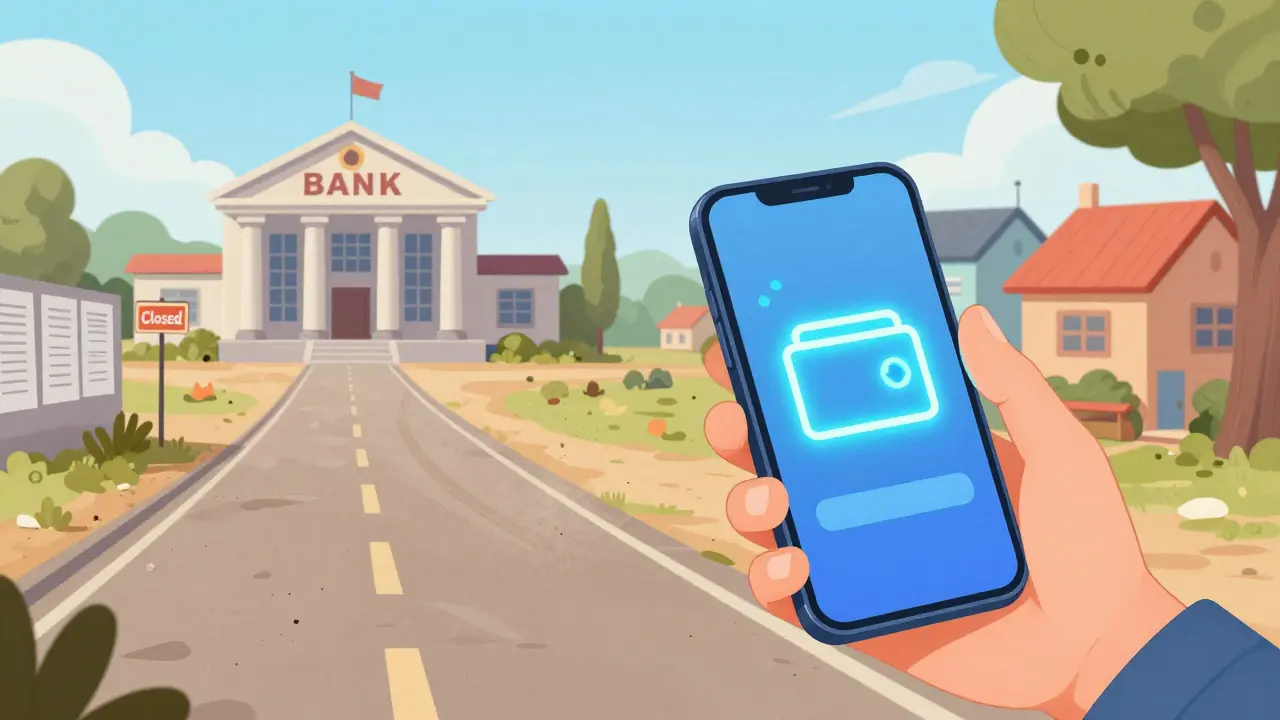
Imagine living in a village where the nearest bank is a four-hour trek away, and even if you make the journey, you're turned away because you don't have a formal ID or a minimum balance. For about 1.4 billion adults globally, this isn't a hypothetical scenario-it's daily life. Traditional banking is built on walls of paperwork and physical infrastructure that simply don't exist in many parts of the world. This is where Cryptocurrency is a digital financial technology that enables individuals to access financial services through decentralized networks without needing a traditional bank account. By stripping away the middleman, it turns a basic smartphone into a full-service bank branch.
The Gap in Traditional Banking
Why is the old system failing so many people? Conventional banks require a level of "proof of existence" that many in developing nations can't provide. Between the lack of official government IDs and the high cost of maintaining physical branches in rural areas, banks simply find it unprofitable to serve the poor. This systemic exclusion keeps people trapped in cash-only economies, where saving is risky and growing a business is nearly impossible.
In Sub-Saharan Africa, the struggle is stark. Back in 2021, only about 49% of adults had a bank account. When you can't save securely or get a loan, you can't hedge against disasters or invest in your future. Blockchain technology changes this by replacing a centralized authority with a distributed ledger. If you have an internet connection and a device, you're in the game. There's no manager to approve your account and no minimum deposit required to start.
Breaking the Remittance Trap
For many families in developing countries, money sent from relatives working abroad is a lifeline. But the process of sending that money is often a racket. Traditional money transfer services can charge between 6% and 15% in fees, and the money can take days or even weeks to arrive. When you're sending $100, losing $15 to a corporate middleman is a huge blow to a family's budget.
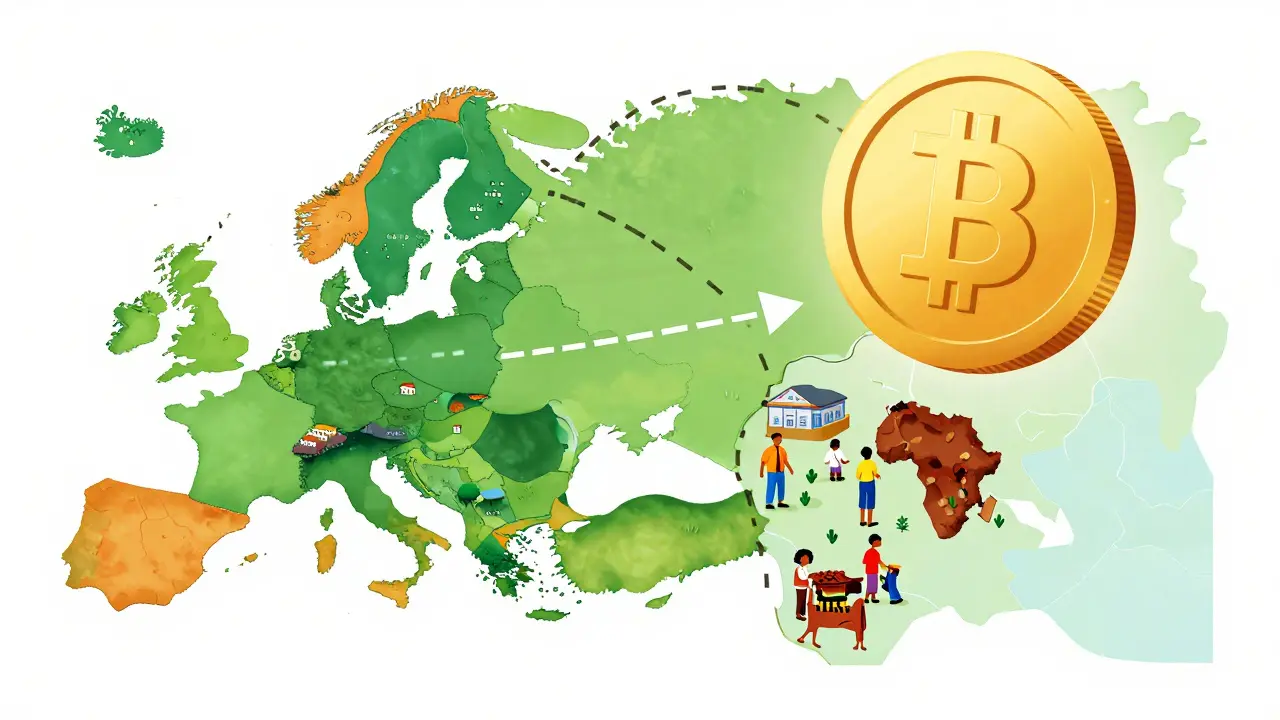
Crypto flips this script. Using Bitcoin or stablecoins, these transfers happen almost instantly. More importantly, the costs usually drop to under 1% of the total transaction value. A migrant worker in Europe can send funds to a relative in Nigeria or Kenya in seconds, ensuring that the vast majority of the money actually reaches the people who need it, rather than disappearing into bank fees.
| Feature | Traditional Banking | Cryptocurrency |
|---|---|---|
| Account Setup | Requires ID, Proof of Address | Instant Wallet Creation |
| Infrastructure | Physical Branches/ATMs | Smartphone & Internet |
| Remittance Cost | High (6% - 15%) | Low (Typically < 1%) |
| Transaction Speed | Days to Weeks (Cross-border) | Minutes/Seconds |
| Accessibility | Limited by Geography | Global Access |
A Shield Against Inflation
In many developing economies, the local currency is a leaking bucket. Chronic high inflation means that the money you save today buys significantly less tomorrow. For someone living on a tight budget, this is a disaster. When a national currency crashes, traditional savings accounts become useless because the value of the money evaporates even if the number in the account stays the same.
This is where the fixed supply of certain digital assets becomes a tool for survival. Many people in currency-unstable regions use crypto as a hedge. Instead of holding a depreciating local currency, they move their wealth into assets that are priced globally. It's not about getting rich quick on a speculative trade; it's about preserving the purchasing power of their hard-earned money so they can afford food and medicine next month.
The Roadblocks to Mass Adoption
If the benefits are so clear, why hasn't everyone switched? The reality is that financial inclusion via crypto isn't a magic wand. There are some serious hurdles. First, there's the "digital divide." While smartphone use is skyrocketing, reliable internet in rural areas is still spotty. You can't use a digital wallet if you can't get a signal.
Then there's the learning curve. Managing a private key or understanding a seed phrase can be intimidating for someone who has never used a digital payment system. If you lose your keys in a decentralized system, there is no "forgot password" button and no customer service line to call. Your money is simply gone. This high stakes environment creates a lot of anxiety for low-income users who cannot afford to lose a single cent.
Regulatory confusion also plays a part. Many governments in developing nations haven't decided if crypto is a currency, a commodity, or something illegal. This uncertainty makes people hesitant. They don't want to adopt a tool that might be banned by the state tomorrow, or that could lead to their assets being frozen.
Beyond Simple Payments: Tokenization
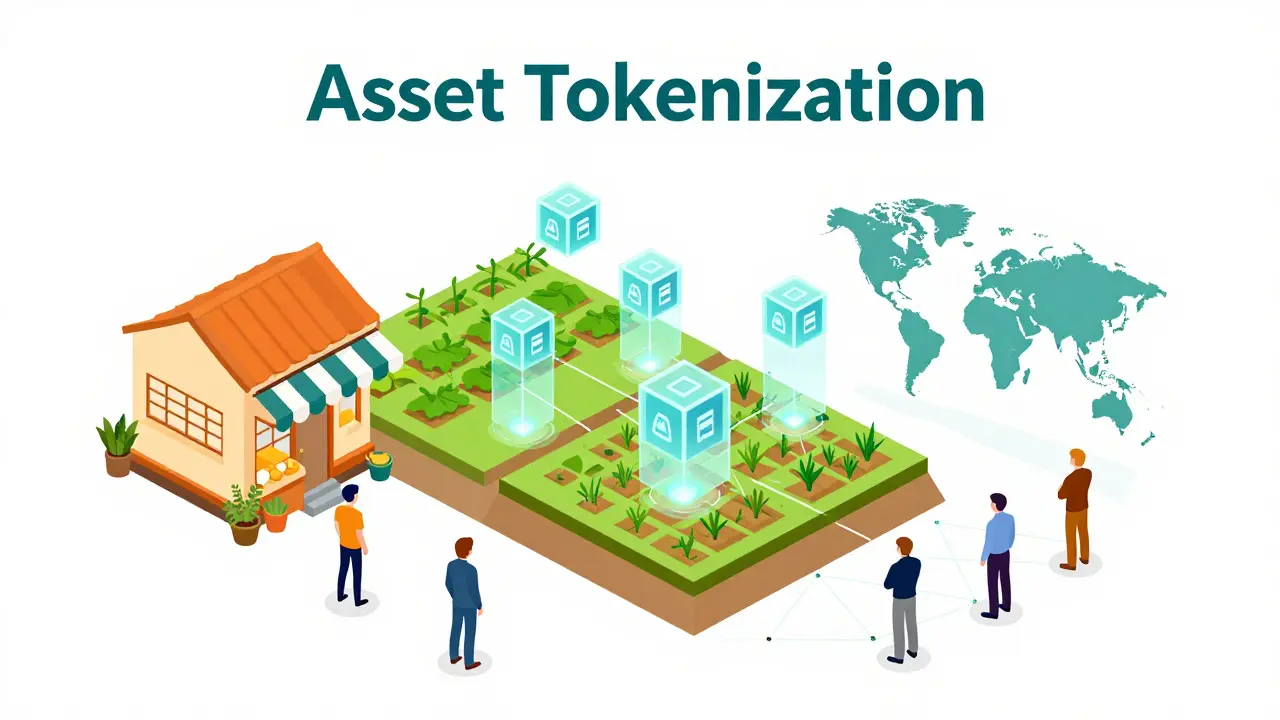
We're starting to see the technology move beyond just sending money. Asset Tokenization is the process of converting a real-world asset-like land or a business share-into a digital token on a blockchain. For a small business owner in a developing country, this could be a game-changer. Most small enterprises are ignored by formal lending markets because they lack traditional collateral.
Tokenization allows these businesses to attract private capital from around the world by selling small, digital fractions of their business. It opens up a global investment pool for a local farmer or a craft shop owner. We're also seeing central banks in countries like Ghana and Nigeria experiment with their own digital currencies to try and bridge this gap, combining the stability of a government-backed currency with the efficiency of blockchain.
The Verdict: Complement, Not Replace
It's a mistake to think that crypto will simply delete the need for banks. The most likely future is a hybrid model. Traditional banks can integrate blockchain to make their own processes faster and cheaper, while crypto provides a primary entry point for those the banks completely ignored. For a farmer in rural Africa, a crypto wallet is a practical alternative to traveling for hours just to deposit a check.
The success of this movement depends on three things: better education to reduce security risks, more stable internet infrastructure, and fair regulations that protect users without killing innovation. If we get those right, the shift from "unbanked" to "financially included" won't depend on where someone was born, but on the device in their pocket.
Is cryptocurrency safe for people with very low income?
It depends on the asset. Highly volatile coins like Bitcoin can be risky for those who can't afford a loss. However, "stablecoins"-which are pegged to the US Dollar-provide a much safer way to preserve value and avoid local inflation without the extreme price swings.
Do you need a smartphone to use crypto for financial inclusion?
While smartphones are the most common way to access wallets, some services allow users to interact with blockchains via SMS or basic USSD codes, making the technology accessible even to those with "feature phones."
Why are remittances cheaper with crypto than with Western Union?
Traditional services rely on a chain of correspondent banks, each taking a small fee and adding a delay. Crypto moves the value directly from the sender's wallet to the receiver's wallet over a global network, removing all those middleman costs.
Can governments stop people from using crypto?
Governments can make it difficult by banning exchanges or restricting the conversion of crypto back into local cash. However, because blockchain is decentralized, it is virtually impossible to stop the underlying network from functioning.
What is the difference between a CBDC and a cryptocurrency?
A cryptocurrency like Bitcoin is decentralized and not controlled by any government. A CBDC (Central Bank Digital Currency) is a digital version of a country's official currency, issued and controlled by the central bank, meaning it's centralized but uses digital tech for efficiency.
 Finance

ssjuul z
April 15, 2026 AT 08:30This is a huge step forward for global equity! 🚀 Using tech to bypass outdated systems is exactly what we need to see more of. Let's get this moving! 😊
Rima Dinar
April 15, 2026 AT 14:10It is truly heart-wrenching to think about the millions of hardworking people who have been systematically excluded from the financial grid just because they lack a piece of paper from a government that may not even function properly, and it gives me so much hope to see how blockchain can act as a supportive bridge to provide them with the dignity of owning their own assets and the freedom to send money to their loved ones without being preyed upon by predatory remittance corporations that profit from poverty. We must continue to coach these communities through the transition so they aren't overwhelmed by the tech and can actually reap the benefits of financial independence in a sustainable way.
Samson Selleck
April 16, 2026 AT 23:05The discourse here completely ignores the systemic volatility inherent in non-pegged assets. While the author posits a utopian shift, they fail to account for the liquidity traps and the sheer inefficiency of Layer 1 scaling solutions when dealing with micro-transactions in low-bandwidth environments. One does not simply "onboard" the unbanked without addressing the profound asymmetry of information regarding private key management. It is a naive projection of Western technocracy onto the Global South.
James Bone
April 18, 2026 AT 12:29Right, because giving a private key to someone who can't read is a totally sound moral strategy. If you lose your seed, you're broke. Great way to "help" people. This is just a new way for whales to gamble with the poor.
Hope Johnson
April 18, 2026 AT 19:43I believe we have to look at this through a lens of collective liberation, where the technology isn't just a tool for payment but a way to redefine how we perceive value and ownership in a world that has traditionally prioritized the accumulation of capital by a select few at the expense of the marginalized. By creating these decentralized pathways, we are not just providing a bank account, but we are fostering a sense of agency and global interconnectedness that allows a farmer in a remote village to stand on equal footing with a trader in a metropolis, provided we remain mindful of the ethical implications of digitizing basic human needs.
aletheia wittman
April 19, 2026 AT 00:41omggg imagine losing your whole life savings cuz you forgot a password... i would literally die!!! 😭😭 its so scarry!!
Rebecca Violette
April 19, 2026 AT 03:58it's honestly just so sad that people have to deal with this stuff... like why is the world so broken?? i cant even handle the thought of it 💔
Carroll Foster
April 20, 2026 AT 23:16Oh great, let's just solve systemic poverty with a few lines of code and some magic internet money. I'm sure the 'on-ramp' friction is totally negligible and the gas fees won't absolutely murder a $10 transfer. Peak efficiency!
william manes
April 21, 2026 AT 00:07Only works if they have US tech! 🇺🇸 Keep it simple. Stop overcomplicating it. 💰
Aaliyah BROTHERS
April 22, 2026 AT 03:00Wake up people!!! These "digital currencies" are just a trap by the Globalists to track every single cent we spend!!! It's a total surveillance nightmare disguised as "help"!!! 👁️🗨️ Absolute madness!
Kelly Cantrell
April 23, 2026 AT 00:40Actually, the push for CBDCs is just the government's way of making sure they can freeze your funds the second you disagree with their agenda. It's all part of the same control mechanism. I'm not saying crypto is perfect, but at least a private wallet keeps the state out of your pocket... for now.
Tyler Webb
April 24, 2026 AT 08:02I totally hear your concerns about the security risks. It really is a lot to handle when you're already struggling. Hopefully we can find some middle ground that keeps people safe. :)
Adam Auksel
April 25, 2026 AT 08:49It's all about education and support! 📚 If we can help people transition slowly, the benefits far outweigh the risks. Let's help each other grow! 🌟