

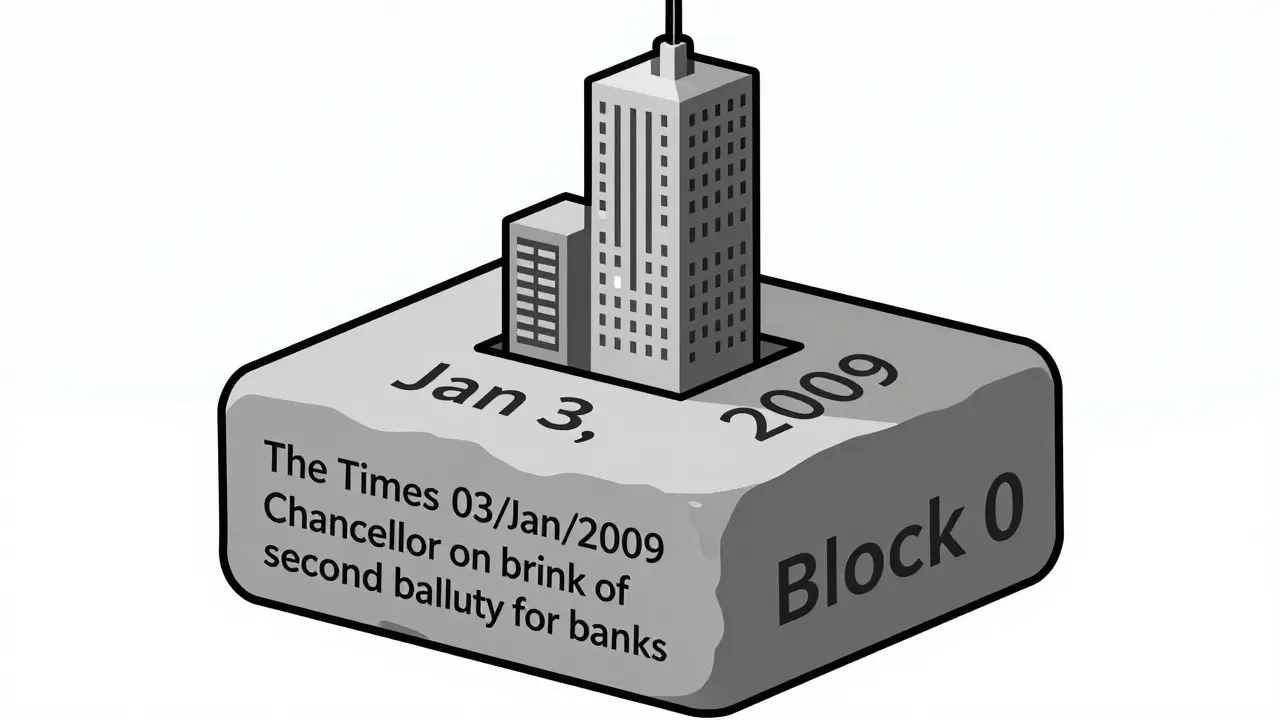
Imagine building a skyscraper. You don't just start stacking bricks on thin air. You need a foundation-a solid, immovable base that holds everything else up. In the world of Bitcoin is the first decentralized cryptocurrency created by an anonymous entity known as Satoshi Nakamoto, that foundation is called the Genesis Block. It’s not just code; it’s a statement, a timestamp, and a technical anchor all rolled into one.
If you’ve ever wondered why Bitcoin can’t be easily faked or rewritten, the answer lies in this very first block. Created on January 3, 2009, at 18:15:05 UTC, the Genesis Block (officially Block 0) started the chain reaction that turned digital math into a global financial system worth hundreds of billions of dollars. But unlike every block that came after it, this one was special. It wasn’t mined through competition. It was hardcoded. And it carries a secret message from its creator that still sparks debate today.
The Hidden Message: A Protest Against Traditional Banking
When you look at the raw data of the Genesis Block, you’ll find something unusual embedded in the coinbase transaction-the special transaction that creates new coins. Tucked away in the input script is a headline from The Times is a British daily newspaper founded in 1785: "The Times 03/Jan/2009 Chancellor on brink of second bailout for banks."
Why include this? It serves two purposes. First, it acts as proof of when the block was created. Since newspapers are dated, anyone can verify that this block couldn’t have been created before January 3, 2009. Second, it’s a philosophical punchline. At that time, the world was reeling from the 2008 financial crisis. Governments were bailing out failing banks with taxpayer money. By embedding this headline, Satoshi Nakamoto was making a point: Bitcoin exists because traditional finance failed us. It’s a digital receipt showing that this new currency was born out of distrust in centralized power.
This isn’t just trivia. It sets the tone for the entire network. Every time someone joins the Bitcoin network, their software checks back to this moment. If the message weren’t there, or if the date were different, your wallet would reject the entire chain. That’s how deeply this single sentence is woven into the fabric of Bitcoin.
Technical Oddities: Why This Block Is Different
In a normal blockchain, miners compete to solve complex mathematical puzzles. The winner gets to add the next block and claim a reward. But there was no previous block for the Genesis Block to reference. So, Satoshi had to create it manually.
Here are the key technical differences that make the Genesis Block unique:
- Previous Hash is Zero: Every block points to the one before it using a cryptographic hash. Since there was no predecessor, the Genesis Block’s “previous hash” field is filled with zeros. This signals to the network: “I am the beginning.”
- Hardcoded Difficulty: The mining difficulty was set to 1.0, the lowest possible value. This made it incredibly easy to mine-so easy that Satoshi could have done it on a standard laptop. Later blocks would require massive supercomputers.
- Unusual Nonce Value: The nonce (the number miners change to solve the puzzle) in the Genesis Block is 2083236893. For such low difficulty, finding a valid hash usually takes seconds. Some experts believe Satoshi intentionally searched for a nonce that produced a hash with many leading zeros, making the block symbolically “heavier” or more significant than necessary.
Most importantly, the Genesis Block contains 50 newly minted bitcoins. However, these coins are permanently locked. They cannot be spent. Ever. This isn’t a bug; it’s a feature of the early code. Coinbase transactions (the ones that pay miners) must wait 100 blocks before they can be spent. Since there are no 100 blocks *before* the Genesis Block, those 50 BTC are trapped forever.
The Unspendable Treasure: A Digital Monument
You might think losing 50 BTC is a mistake. In reality, it’s a safeguard. Because those coins can never move, they act as a permanent marker of the network’s origin. The address associated with this reward is `5FbA5KXmS6Wf4oELJkXmS6Wf4oELJkXmS6Wf4oELJkXmS6Wf4oELJkXmS6Wf4oE`.
Over the years, people have sent small amounts of Bitcoin to this address as tributes. Think of it like leaving flowers on a grave. Between 2010 and 2022, blockchain analytics firm Glassnode tracked about 1,200 separate transactions sending tiny fractions of a bitcoin to this address. On Bitcoin’s 10th anniversary in 2019, someone sent exactly 1.0 BTC. These aren’t attempts to spend the original 50; they’re symbolic gestures honoring the start of the project.
This also means Bitcoin’s maximum supply isn’t quite 21 million. It’s actually 20,999,999.9769 BTC. Those missing satoshis (the smallest unit of Bitcoin) are gone forever, locked in the Genesis Block. For purists, this is perfect. It proves that even the creator didn’t take a cut. No pre-mine. No insider advantage. Just a fair start for everyone who came later.
| Cryptocurrency | Launch Date | Distribution Method | Initial Reward Spendable? |
|---|---|---|---|
| Bitcoin | Jan 3, 2009 | Manual Creation (Proof-of-Work) | No (Permanently Locked) |
| Ethereum | July 30, 2015 | Presale & Foundation Allocation | Yes |
| Ripple (XRP) | 2012 | Centralized Pre-mine | Yes (Controlled by Ripple Labs) |
| Cardano | Sep 2017 | Stake Distribution (Proof-of-Stake) | Yes |
How Other Blockchains Handle Their Start
Bitcoin’s approach to its Genesis Block was revolutionary because it was trustless. No company owned the starting coins. No government approved them. But not all cryptocurrencies follow this model.
Take Ethereum is a decentralized platform that enables smart contracts and decentralized applications (DApps). When Ethereum launched in 2015, its Genesis Block distributed millions of Ether to three groups: presale buyers, the Ethereum Foundation, and future miners. This was a coordinated effort involving thousands of participants. The coins were immediately spendable. This allowed for rapid development but introduced centralization risks early on.
Then there’s Ripple (XRP). Its Genesis Block allocated 100 billion tokens directly to the founding company. This is the opposite of Bitcoin’s model. Instead of earning coins through work, they were handed out by a central authority. Critics argue this makes XRP less decentralized than Bitcoin.
Even newer networks like Cardano use different mechanisms. As a Proof-of-Stake chain, its Genesis Block establishes initial stake distribution rather than mining rewards. Each design choice reflects a different philosophy about trust, fairness, and control. Bitcoin’s Genesis Block remains the gold standard for decentralization because it gave nothing to the creator and required nothing but code to start.
Why Developers Care About the Genesis Block
If you’re building a blockchain, the Genesis Block is your most critical configuration file. It defines the rules of the game. For Bitcoin developers, understanding the Genesis Block is essential for maintaining compatibility.
Here’s what happens if you mess it up: If a node tries to connect to a network where the Genesis Block hash doesn’t match, it will refuse to sync. The hashes must align perfectly. This is why hard forks-like Bitcoin Cash in 2017-still share the same Genesis Block. They diverged later, but they started from the same point. Changing the Genesis Block would create a completely new, incompatible network.
For students learning blockchain development, constructing a Genesis Block is often the first hands-on exercise. Courses like Princeton’s “Bitcoin and Cryptocurrency Technologies” on Coursera dedicate significant time to this. Students learn to set the initial difficulty, define the block reward schedule, and embed custom messages. It teaches them that a blockchain isn’t just software; it’s a social contract encoded in mathematics.
The Cultural Impact: More Than Just Code
The Genesis Block has become a cultural artifact. In 2024, the Bitcoin community celebrated its 15th anniversary with events in 47 countries. People didn’t just talk about price charts; they discussed the history. The Internet Archive added the raw hexadecimal data of the Genesis Block to its permanent collection in 2022, ensuring it survives even if servers fail.
Regulators also pay attention. The U.S. Securities and Exchange Commission has referenced the Genesis Block in legal arguments, noting that Bitcoin’s provable, decentralized launch distinguishes it from many modern token offerings that rely on centralized sales. This historical transparency gives Bitcoin a unique legal standing.
Academic interest is growing too. Google Scholar lists over 1,200 peer-reviewed papers referencing the Genesis Block since 2015. Researchers study it not just for technical insights, but for sociological ones. How did a single block convince millions of strangers to trust a shared ledger? The answer lies in the simplicity and integrity of that first step.
Who created the Bitcoin Genesis Block?
The Genesis Block was created by Satoshi Nakamoto, the pseudonymous individual or group who invented Bitcoin. It was manually coded and released on January 3, 2009.
Can the 50 BTC in the Genesis Block be spent?
No, the 50 BTC reward in the Genesis Block is permanently unspendable. Due to Bitcoin’s protocol requiring a 100-block maturity period for coinbase transactions, and there being no prior blocks, these coins are locked forever.
What does the message in the Genesis Block mean?
The message "The Times 03/Jan/2009 Chancellor on brink of second bailout for banks" serves as a timestamp proving the block’s creation date and a political statement criticizing the 2008 financial crisis and government bailouts.
Is the Genesis Block part of the Bitcoin Core software?
Yes, the Genesis Block is hardcoded into the Bitcoin Core client. All nodes recognize it as the immutable starting point of the blockchain, ensuring network consensus.
Why is the Genesis Block important for security?
The Genesis Block provides the root of trust for the entire Bitcoin network. Its fixed hash ensures that any attempt to rewrite history would require changing this foundational block, which is impossible without global consensus.
 Finance



mark valmart
May 30, 2026 AT 15:03man i always forget how much of a middle finger that headline is to the whole banking system. it’s wild thinking about how satoshi just hardcoded that in and never looked back. feels like the ultimate act of defiance against the crash.
Crystal Davis
May 30, 2026 AT 22:13actually you’re missing the point entirely if you think it’s just about defiance. the technical implications of the zero previous hash are what matter here. without that specific cryptographic anchor the entire proof-of-work chain would be invalid from block one. stop romanticizing code as poetry.
Debbie Lewis
June 1, 2026 AT 04:09i guess it depends on how you look at it. for me it’s pretty cool that there’s this digital monument that no one can touch or move. kind of gives me peace of mind knowing the start was so pure.
Eric Grosso
June 1, 2026 AT 10:10wait but if the difficulty was 1.0 why did he need to search for such a high nonce? seems like overkill unless he wanted to show off his laptop could handle it easily lol
Edith Mair
June 3, 2026 AT 02:36you really think satoshi was showing off? please. the nonce value is likely just a result of him running the solver until it found a valid hash with extra leading zeros for symbolic weight. it’s not vanity, it’s cryptography. do your research before posting nonsense.
Sam Dashti
June 4, 2026 AT 16:26oh man the idea of 50 btc sitting there forever trapped in the void is just beautiful in a tragic sort of way. like a digital time capsule that nobody can open. i love that aesthetic honestly. it makes the network feel ancient even though it’s young.
Joe Clements
June 6, 2026 AT 09:29it’s actually quite comforting to know that the creator didn’t take any coins for himself. shows real integrity right there. makes me trust the project more knowing it started fair.
Rosie Morris
June 6, 2026 AT 10:50i totally agree with you mark it’s soo nice that he didn’t take a cut. makes me feel warm inside knowing its all about the community now. love the vibe of this post!
lorna erni
June 6, 2026 AT 13:32stop acting like everyone else is stupid. the comparison table in the article clearly shows ethereum and ripple had pre-mines. bitcoin is the only one that didn’t. it’s basic knowledge at this point. get with the program people.
kamal ifrani
June 6, 2026 AT 18:21ugh another article praising bitcoin like it’s some holy relic. meanwhile the energy consumption required to maintain this ‘trustless’ system is destroying the planet. typical western tech bro ignorance wrapped up in a neat little blockchain package. disgusting.
Bill Gunn
June 7, 2026 AT 20:45hey hey let’s keep it positive folks! 🌟 the genesis block is a fascinating piece of history regardless of where you stand on mining. it’s great to see people engaging with the technical roots of crypto. keep learning! 🚀
Dana Rapoport
June 9, 2026 AT 19:56the philosophical underpinning of the genesis block is what truly resonates. it represents a shift from centralized authority to distributed consensus. we must consider the societal impact of such a foundational change in how we perceive value.
Hadleigh Edwards
June 9, 2026 AT 22:40and when you really sit down and think about the long-term implications of having an immutable starting point that cannot be altered by any single entity or government it becomes clear that this was not just a technical achievement but a monumental step forward for human liberty and financial sovereignty which will undoubtedly shape the economic landscape for generations to come in ways we can scarcely imagine today.
Christina Pearce
June 11, 2026 AT 17:05i’m curious about the legal aspect mentioned. does the sec actually care about the genesis block hash in court cases? seems like a very technical detail for lawyers to focus on.
Barclay Chantel
June 12, 2026 AT 10:55how pedestrian. discussing the genesis block as if it were merely a legal footnote is beneath us. it is a cultural artifact of the highest order, akin to the declaration of independence but written in sha-256. most of you clearly lack the refinement to appreciate the nuance.
Miss Masquer
June 13, 2026 AT 21:59as someone who has studied various cultural movements across different countries i find it fascinating how a purely mathematical construct has become a symbol of resistance globally. the fact that people in 47 countries celebrated the anniversary shows how deeply embedded this narrative has become in our collective consciousness transcending borders and languages.
Joshua Alcover
June 15, 2026 AT 21:02the implementation of the genesis block serves as a critical vector for establishing sovereign cryptographic infrastructure independent of hostile foreign entities. the hardcoded nature ensures that no external actor can compromise the initial state vector thereby preserving national security interests through decentralized resilience protocols.
Diana Morris
June 17, 2026 AT 00:21get real already the whole thing is just math don’t overcomplicate it with your politics. buy hold repeat.
Dianne Wright
June 17, 2026 AT 14:21everyone is so obsessed with the past they forget the present reality. i mean sure it’s interesting but honestly it doesn’t change anything for my wallet today. why are we still talking about 2009?
trisya hazriyana
June 20, 2026 AT 03:34lol yeah because nothing says innovation like copying a newspaper headline from 2009. ground breaking stuff. maybe next time try something original instead of relying on historical trauma bonding.
stalin brian
June 20, 2026 AT 20:35i dunno guys i just think its kinda cool that u can verify the date yourself. doesnt that beat trusting a bank statement? seems pretty solid to me tbh.
saradee dee
June 22, 2026 AT 05:58oh my god this is so dramatic! the idea that 50 bitcoins are lost forever is just heartbreaking yet amazing at the same time. it’s like a ghost story but with numbers. i am literally shaking with excitement reading this!