

Total Value Locked (TVL): What It Means for Crypto and DeFi
When you hear Total Value Locked, the total worth of assets that are locked in a smart‑contract‑based protocol, also known as TVL, you’re looking at a core health indicator for DeFi, decentralized finance platforms that run on blockchain. It tells you how much capital users have committed to lending, borrowing, staking, or providing liquidity. In plain terms, TVL is the sum of every token value that a protocol has locked up, whether it’s stablecoins, native coins, or wrapped assets. That number changes every minute as people add or withdraw funds, making it a real‑time snapshot of a platform’s popularity and trust.
Why TVL Matters and How It’s Calculated
Understanding Total Value Locked helps investors gauge market depth and compare projects side by side. The calculation is simple: take the amount of each token held in a protocol’s smart contracts, multiply by its current market price, and add them all together. This means TVL requires reliable price feeds—usually provided by on‑chain oracles—to avoid skewed numbers. Liquidity, the ease with which an asset can be bought or sold without affecting its price directly influences TVL; deep liquidity pools attract more users, which in turn boosts the locked value. In practice, a higher TVL signals stronger network effects, better security (more assets to protect), and often lower risk for lenders. Analysts use TVL to spot trends: a sudden surge may indicate a new yield‑farming incentive, while a drop can warn of capital flight or a protocol’s vulnerability. TVL also encompasses the total risk exposure of the ecosystem, because every locked dollar is at stake in smart‑contract code. Finally, TVL influences token pricing—projects with massive TVL often command premium valuations, as traders view them as more robust.
For anyone navigating crypto markets, keeping an eye on TVL is as useful as watching price charts. It gives a quick pulse on how much real value is being used rather than just traded. Below, you’ll find articles that break down TVL in the context of airdrops, exchange reviews, tax changes, and emerging DeFi tools, so you can see the metric in action across different scenarios. Whether you’re a trader, a developer, or just curious about why certain tokens climb faster than others, the posts ahead will show how TVL shapes decisions, highlights opportunities, and flags potential pitfalls.
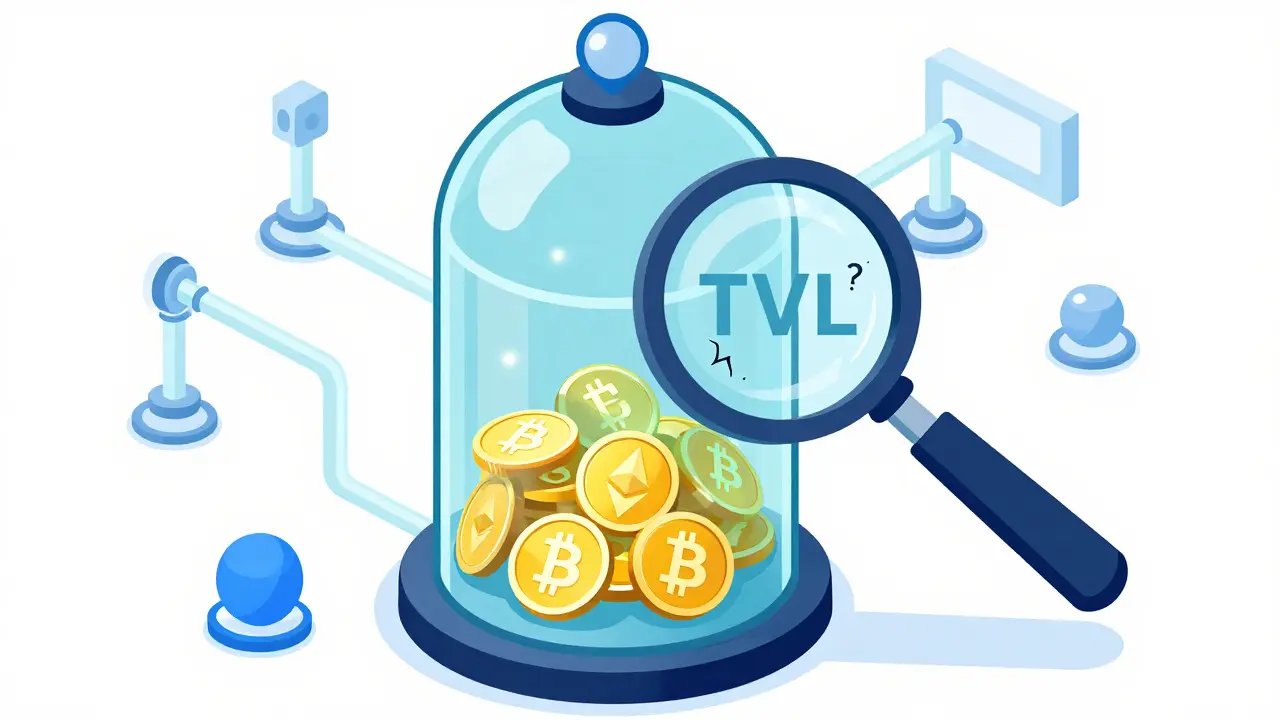
Learn how Total Value Locked (TVL) measures DeFi protocol success, its limitations, and which additional metrics like revenue and active users you should analyze for a complete picture.

Learn how TVL (Total Value Locked) is calculated in DeFi, understand its challenges, and discover best practices for accurate, verifiable measurements.
Categories
 Finance
Archives
Recent-posts

Bored Candy City Crypto Exchange Review: Is It Worth Your Time?
Aug, 22 2026

Blockchain Energy Data Management: How Distributed Ledgers Transform the Power Sector
Sep, 28 2025
RBI Crypto Ban Reversal: How India's Supreme Court Changed the Game
Jul, 18 2026

WorldShards (SHARDS) Airdrop 2025: How It Worked and What Happened After
Jan, 29 2026

AstroSwap (ASTRO) Big Bang IDO: Airdrop Details, Tokenomics & How to Participate
Jun, 2 2026