
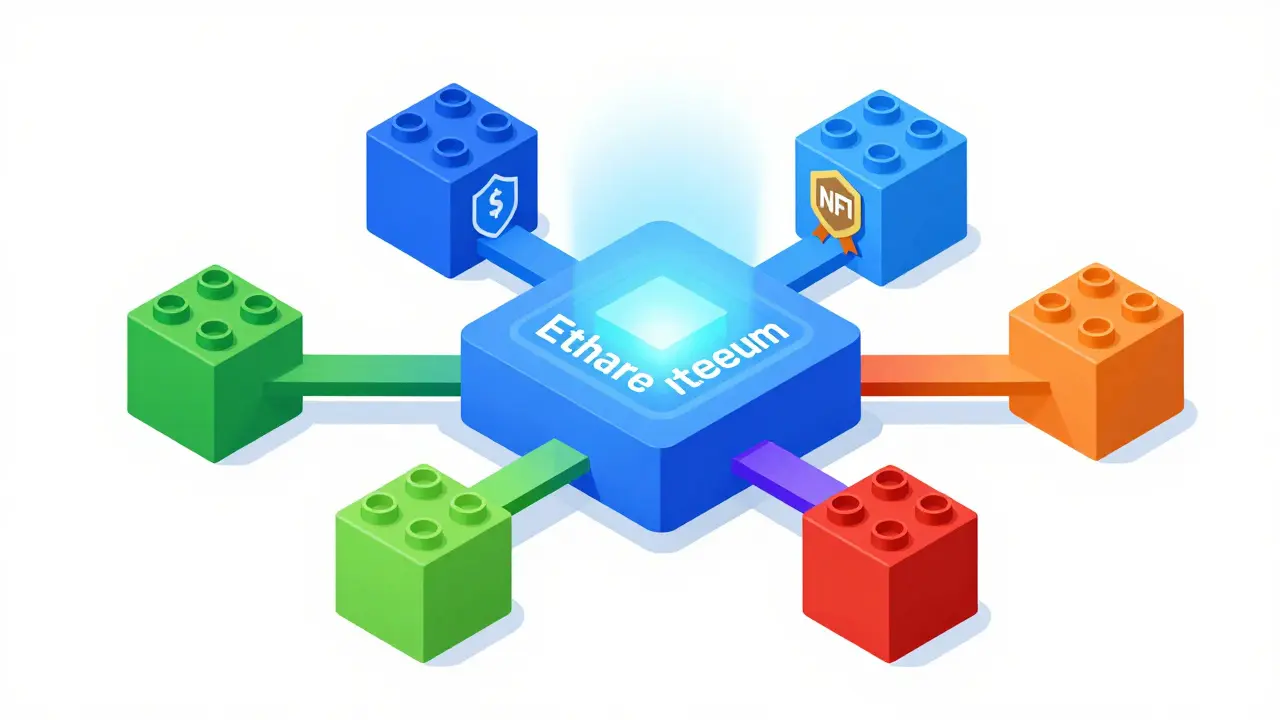
Imagine building a house. You could dig up clay, bake your own bricks, and mix concrete from scratch every time you want to add a room. Or, you could buy pre-made bricks that fit perfectly with everyone else’s construction materials. That second option is what Smart Contract Composability is for the blockchain world.
In traditional software development, if you wanted to use a payment processor or a user database, you often had to negotiate access, deal with closed APIs, or rewrite code because the original creators didn’t design it for sharing. In the blockchain ecosystem, specifically on networks like Ethereum, smart contracts are public by default. They act as open-source building blocks. This means any developer can look at the code, understand how it works, and build new applications on top of it without asking permission.
This isn't just a nice-to-have feature; it is the engine driving the explosion of Decentralized Finance (DeFi) and Web3 applications. By adhering to specific composability standards, developers create an ecosystem where one protocol’s output becomes another protocol’s input, creating complex financial instruments from simple, reusable parts.
The Three Pillars of Composable Standards
To make this "LEGO" analogy work in practice, smart contracts must follow three core principles. Without these, you don't have composability; you just have a pile of disconnected code.
- Modularity: Each contract should do one thing well. Instead of one massive contract handling trading, lending, and governance separately, modular design splits these into distinct components. A token contract handles ownership. A swap contract handles exchange rates. This focus makes each piece easier to audit and reuse.
- Autonomy: A composable contract must function independently. It shouldn't crash because a third-party service went offline. Since smart contracts run on decentralized networks, they are always available. This reliability allows other contracts to trust them as foundational layers.
- Discoverability: Because the code is public, anyone can read it. Standards ensure that when you see a contract implementing a specific interface (like ERC-20), you know exactly how to interact with it. You don't need to reverse-engineer the logic; you just call the standard functions.
These principles transform smart contracts from isolated scripts into public APIs. Unlike traditional web APIs, which can be shut down or changed by a company at any moment, blockchain-based APIs are immutable and permanent once deployed. This permanence gives developers the confidence to build long-term infrastructure on top of existing protocols.
Key Technical Standards Enabling Interoperability
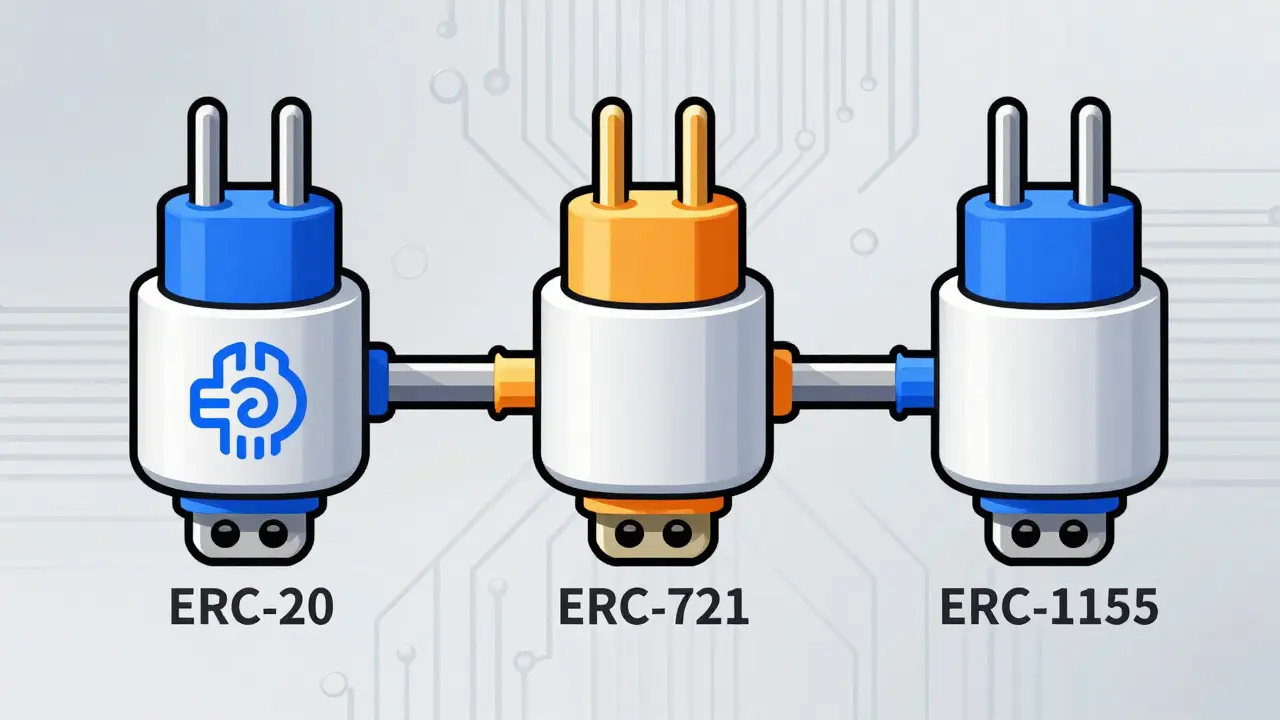
Composability doesn't happen by magic. It requires strict adherence to technical standards. These standards define the "shape" of the data and the "buttons" available on the interface. Here are the most critical ones you need to know:
| Standard Name | Primary Function | Role in Composability |
|---|---|---|
| ERC-20 | Fungible Tokens | The universal standard for tokens. Allows wallets, exchanges, and DeFi protocols to handle any ERC-20 token identically. |
| ERC-721 | Non-Fungible Tokens (NFTs) | Defines unique digital assets. Enables marketplaces like OpenSea to display and trade any NFT without custom integration for each collection. |
| ERC-1155 | Multi-Token Standard | Allows a single contract to manage multiple types of tokens (fungible and non-fungible). Reduces gas costs and simplifies game asset management. |
| EIP-712 | Typed Data Signing | Improves security by allowing users to see exactly what they are signing before approving a transaction, crucial for safe cross-contract interactions. |
For example, when Uniswap launched, it didn't need to ask Bitcoin holders to move their funds into a special Uniswap wallet. It simply supported ERC-20 tokens. Any project that created an ERC-20 token automatically became compatible with Uniswap. This seamless integration is the power of standardized composability.
Why Composability Beats Traditional Software Development
You might wonder why we can't just do this in regular software. The answer lies in control and accessibility. In traditional tech, companies hoard data and functionality. If you want to integrate Facebook's login system, you must comply with their terms, which can change overnight. If they block your app, your product breaks.
In blockchain, the rules are encoded in the contract. Once a standard is adopted, it cannot be arbitrarily changed by a central authority. This creates a level playing field. A small startup can build a lending platform using the same underlying liquidity pools as a giant institution, provided they follow the same standards.
This approach drastically reduces development time. Instead of writing a secure random number generator or a complex fee distribution algorithm from scratch, developers import proven libraries. This "copy-paste" culture, when done correctly with audited code, accelerates innovation. It allows teams to focus on their unique value proposition rather than reinventing the wheel.
Real-World Examples of Composable Innovation
The true test of any standard is its application. Look at the DeFi sector. Protocols like Compound and Aave didn't invent money; they invented ways to lend and borrow existing tokens. They rely entirely on the composability of ERC-20 tokens. Users deposit ETH, and the protocol lends it out to others, all automated by smart contracts interacting seamlessly.
Another prime example is the rise of "Yield Farming" strategies. Developers created aggregators that automatically move funds between different lending protocols to find the best interest rates. These aggregators compose multiple protocols together. One protocol provides liquidity, another offers insurance, and a third manages governance. None of these existed initially to work together, but because they followed common standards, they clicked into place instantly.
In the NFT space, projects like Bored Ape Yacht Club used their ERC-721 tokens not just as images, but as keys to other experiences. Other developers built metaverses and games where owning an Ape granted access. This was possible because the ownership verification was handled by the standard contract, trusted by the entire ecosystem.
Security Challenges and Risks
With great power comes great responsibility. Composability introduces unique security risks. When contracts interact deeply, a bug in one component can cascade through the entire system. This is known as "contagion risk."
If Protocol A relies on Protocol B for price feeds, and Protocol B gets hacked, Protocol A loses its accurate pricing mechanism. This interconnectedness means that audits are no longer enough for individual contracts; developers must assess the security of the entire stack they are composing.
Furthermore, upgradeable contracts introduce complexity. While they allow for fixes, they also create a central point of failure if the admin keys are compromised. Best practices now include using timelocks for upgrades and employing formal verification methods to ensure that composed systems behave as expected under all conditions.
The Future: Cross-Chain Composability
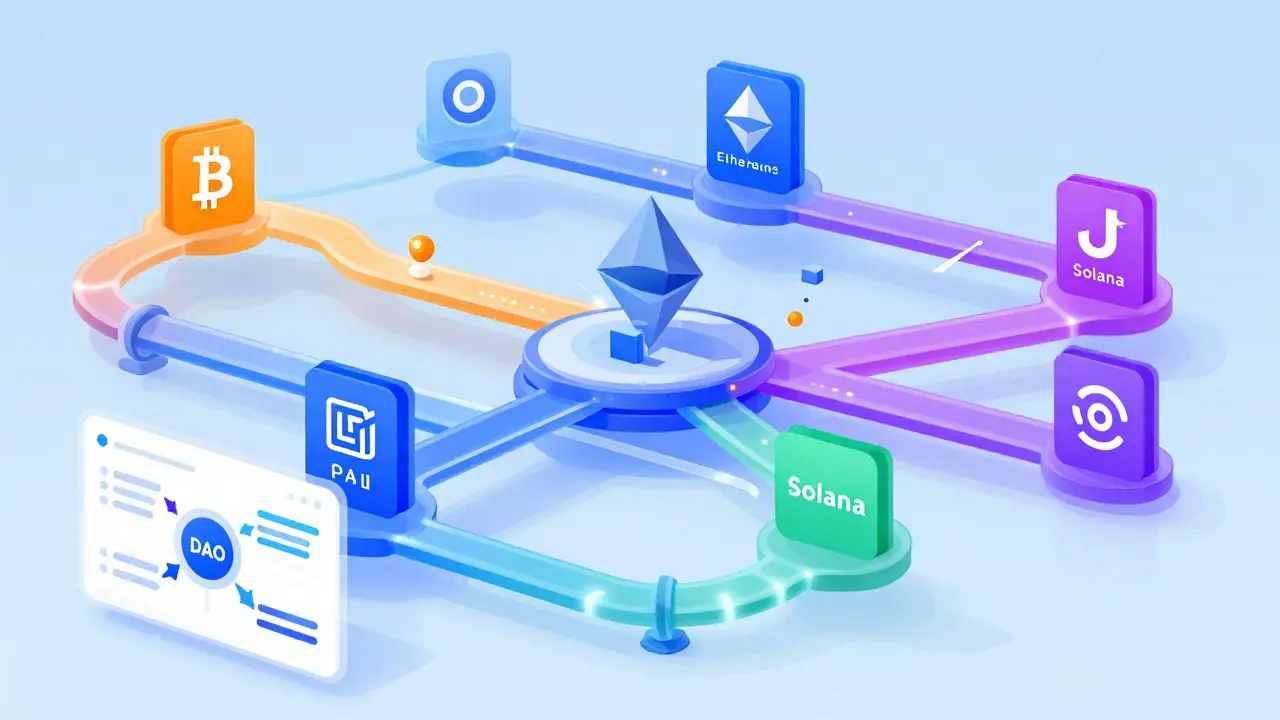
Currently, most composability happens within a single blockchain, primarily Ethereum. However, the industry is moving toward cross-chain interoperability. Imagine a DeFi strategy that uses Bitcoin for collateral, Ethereum for execution, and Solana for high-speed trading.
Standards like IBC (Inter-Blockchain Communication) and various bridge protocols are attempting to solve this. The goal is to create a universal composability layer that transcends individual chains. This will require new standards for verifying state across different consensus mechanisms, ensuring that a token locked on Chain A truly represents value on Chain B.
As these technologies mature, we will likely see more sophisticated governance models integrated into composable stacks. Imagine a DAO (Decentralized Autonomous Organization) that can vote on parameters for multiple underlying protocols simultaneously, adjusting risk levels across an entire portfolio of composed assets in real-time.
What is the difference between composability and interoperability?
Interoperability refers to the ability of different systems to communicate and exchange data. Composability goes a step further; it implies that these systems can be combined to create new, functional applications. Think of interoperability as two people speaking the same language, while composability is them collaborating to write a book together.
Are all smart contracts composable?
Technically, yes, because the code is public. However, practically, only those designed with modular interfaces and standard functions are easily composable. Contracts that are tightly coupled, lack documentation, or violate common standards (like ERC-20) are difficult to integrate safely and efficiently.
How does composability impact DeFi security?
It increases both transparency and risk. Transparency improves because everyone can audit the underlying code. Risk increases due to contagion; a vulnerability in a widely used library can affect hundreds of dependent protocols. Therefore, security auditing must extend to the entire dependency tree, not just the final application.
What role do ERC standards play in composability?
ERC standards act as the universal plug. They define the exact functions and events a contract must implement. When a wallet sees an ERC-20 token, it knows exactly how to display the balance and send funds. This predictability is essential for developers to build tools that work with any compliant contract without custom coding.
Can traditional businesses use composable smart contracts?
Yes, increasingly so. Businesses can issue stablecoins or loyalty tokens using ERC-20 standards, allowing them to integrate with existing crypto wallets and exchanges. They can also use composable DeFi protocols for treasury management, earning yield on corporate cash reserves in a transparent, automated manner.
 Finance