

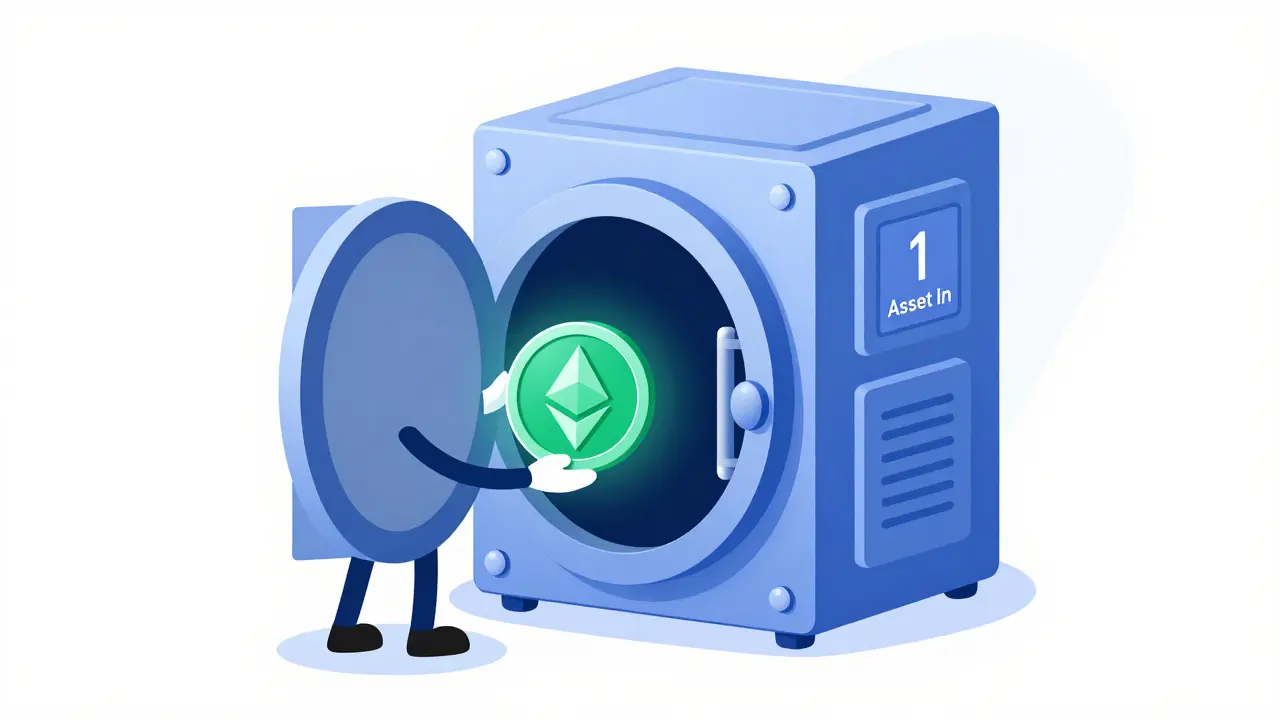
Imagine you have $1,000 worth of Ethereum. You want to earn passive income by lending it out or providing liquidity on a decentralized exchange. In the old days of DeFi, you had a problem: you needed another $1,000 in USDC to create a balanced pool. If you didn't have that stablecoin, you had to sell half your ETH just to participate. That meant missing out on potential price gains if ETH skyrocketed.
That’s where single-sided liquidity changes the game. It allows you to deposit only one asset-your ETH-and let the protocol handle the rest. But is it actually better than the traditional dual-sided liquidity model? Or does it come with hidden traps that could drain your profits? Let’s break down exactly how these two models work, who they are for, and which one makes sense for your portfolio in 2026.
What Is Single-Sided Liquidity?
Single-sided liquidity is a mechanism where a user deposits only one type of token into a liquidity pool. Instead of buying a pair of tokens (like ETH and USDC) and depositing them equally, you just deposit the token you already hold. The smart contract then automatically manages the conversion between assets as trades happen.
This concept isn’t brand new. Bancor pioneered true single-sided pools back in 2017. However, it became mainstream after Uniswap Labs launched Uniswap v3 in May 2021. Uniswap introduced "concentrated liquidity," which lets you specify a price range for your position. While technically still part of a pair, this feature effectively allows users to take positions that behave like single-sided bets because they can allocate nearly 100% of their capital to the asset they expect to rise or stay stable within that range.
Here is how it works in practice:
- You deposit 10 ETH.
- You set a price range, say $3,000 to $4,000 per ETH.
- If the price stays in that range, your ETH is converted to USDC (or vice versa) to facilitate swaps.
- If the price moves outside that range, your position becomes entirely one asset again (either all ETH or all USDC).
The beauty here is simplicity and control. You don’t need to go buy a second token. You keep exposure to your preferred asset while earning trading fees.
How Traditional Dual-Sided Liquidity Works
Dual-sided liquidity, also known as double-sided liquidity, requires you to deposit two assets in equal value. This was the standard model for early AMMs (Automated Market Makers) like Uniswap v2 and SushiSwap.
To provide $2,000 in liquidity to an ETH/USDC pool, you must deposit $1,000 worth of ETH and $1,000 worth of USDC. The smart contract maintains a constant product formula ($x \times y = k$), ensuring that as people trade ETH for USDC, the ratio of assets in the pool shifts automatically.
This model has a major drawback: impermanent loss. If the price of ETH doubles, the value of your LP position will be lower than if you had simply held the ETH and USDC in your wallet. Why? Because the automated market maker sells ETH as its price goes up (to maintain balance) and buys it back as the price goes down. You are essentially forced to "buy high and sell low" by the algorithm.
Dual-sided liquidity spreads your risk across two assets, but it also dilutes your upside. If ETH pumps 50%, you only benefit from half that gain because half your capital is in stable USDC.

Key Differences: Capital Efficiency and Risk
When comparing these two models, three factors matter most: capital efficiency, impermanent loss, and ease of entry.
| Feature | Single-Sided (Concentrated) | Dual-Sided (Traditional) |
|---|---|---|
| Assets Required | One (e.g., ETH only) | Two (e.g., ETH + USDC) |
| Capital Efficiency | High (up to 4,000x in tight ranges) | Low (spread across full curve) |
| Impermanent Loss Risk | Reduced (if range is chosen well) | High (exposed to full price divergence) |
| Fee Earnings | Zero if price exits range | Continuous (but lower per dollar) |
| Management Effort | High (requires rebalancing) | Low (set and forget) |
Capital Efficiency: Single-sided concentrated liquidity is vastly more efficient. According to data from Uniswap v3, providers can achieve up to 4,000 times higher capital efficiency compared to traditional pools when they narrow their price range. This means you earn more fees on the same amount of capital because your money is working harder in the active trading zone.
Impermanent Loss: Single-sided strategies can mitigate impermanent loss significantly. Research by Vitalik Buterin showed that single-sided models reduce average impermanent loss by nearly 59% compared to traditional pools. However, this protection is conditional. If you set a wide range, you still face IL. If you set a narrow range and the price breaks out, you stop earning fees entirely until you rebalance.
Entry Barrier: For beginners, single-sided is much easier. A survey by MEXC found that 73% of new liquidity providers found single-sided entry easier because they didn’t have to acquire a second token. With dual-sided, you often have to sell part of your crypto holdings to buy the pairing asset, which triggers tax events and transaction costs.
Who Should Use Which Model?
There is no single "best" option. The right choice depends on your market view, technical skill, and time commitment.
Choose Single-Sided Liquidity If:
- You are bullish on one asset: You believe ETH will stay within a specific range (e.g., $3k-$4k). You want to earn fees without selling your conviction.
- You hold stablecoins: Providing single-sided USDC or USDT liquidity in stablecoin pairs is low-risk. Since the price doesn’t move much, you rarely exit the range, and impermanent loss is negligible.
- You want to avoid selling assets: You don’t want to trigger a taxable sale by swapping half your portfolio to get the paired token.
Choose Dual-Sided Liquidity If:
- You are neutral on price: You think ETH and BTC will move together, or you don’t care about short-term volatility.
- You want "set and forget": You don’t want to monitor charts daily. Dual-sided pools require less active management.
- You prefer deeper liquidity: Large traders often prefer dual-sided pools (like Uniswap v2) because they offer deeper book depth for massive orders, resulting in less slippage for big trades.
Real-World Performance and Risks
Let’s look at real numbers. In Q3 2023, analysis by SnapX showed that single-sided models typically generated 2-5% APY from trading fees alone in volatile markets, whereas dual-sided pools offered 10-25% APY but with much higher risk of impermanent loss erasing those gains.
Consider this scenario from a Reddit user in September 2023: They provided single-sided USDC liquidity in a tight range ($0.999-$1.001). Over three months, they earned a 6.2% monthly return with zero impermanent loss. However, they had to manually rebalance twice when USDC briefly depegged during the banking crisis. If they hadn’t acted, their position would have stopped earning fees.
Contrast this with a dual-sided ETH/USDC provider who lost 12.7% of their principal during a 30% ETH swing in July 2023. Their 18% APY in fees wasn’t enough to cover the impermanent loss. This highlights the core trade-off: single-sided offers control but demands attention; dual-sided offers passivity but exposes you to market swings.
The Future: Hybrid Models and Automation
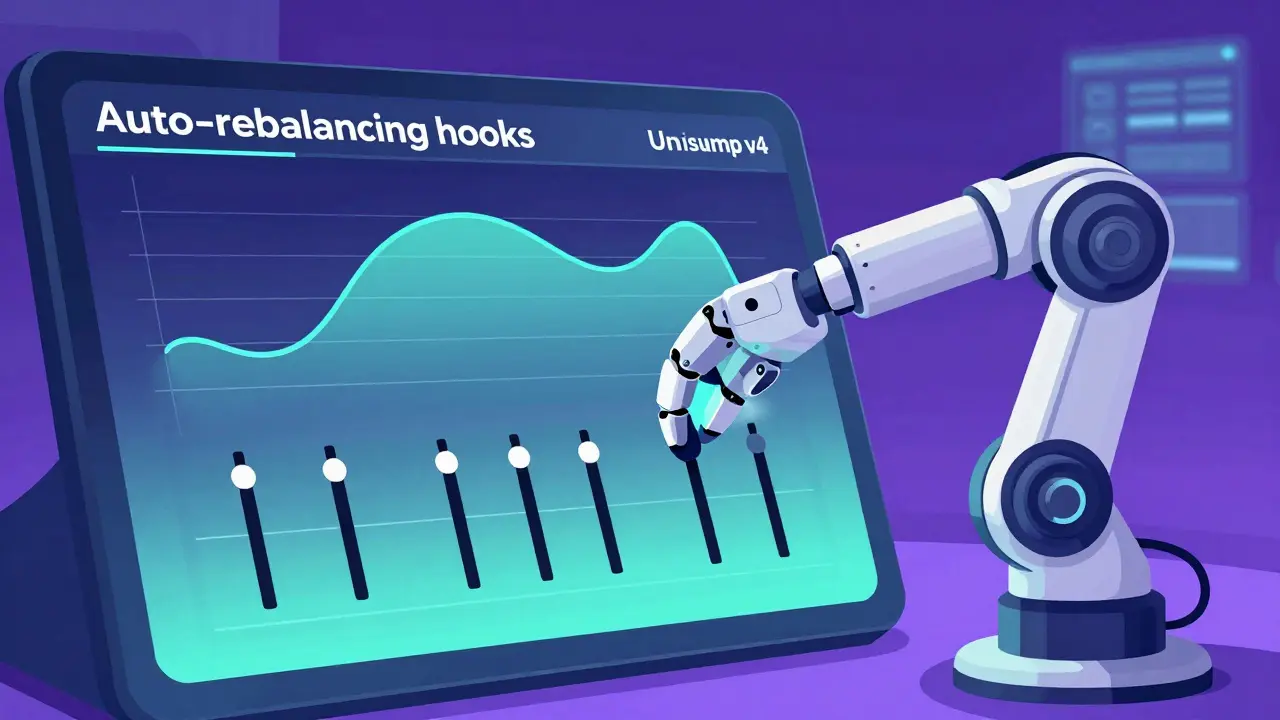
The industry is moving toward hybrid solutions. Uniswap v4, launched in July 2023, introduced "hooks"-smart contracts that allow developers to build custom logic into liquidity pools. This enables automatic rebalancing of single-sided positions, solving the biggest pain point of manual management.
Protocols like GammaXYZ and Pendle are building tools that automate range selection and yield tokenization. By 2026, we expect most retail investors to use these automated vaults rather than interacting directly with raw pools. This blends the efficiency of single-sided liquidity with the convenience of dual-sided passivity.
Regulatory clarity is also improving. While the SEC has hinted at different classifications for single-sided provision, no definitive rulings have blocked these models. As institutional adoption grows-with 23% of institutions now using single-sided strategies-the infrastructure will become more robust and safer for everyday users.
Is single-sided liquidity safer than dual-sided?
It can be, but only if you manage the price range correctly. Single-sided liquidity reduces impermanent loss risk for the deposited asset, but if the price moves outside your set range, you stop earning fees. Dual-sided liquidity always earns fees but exposes you to full impermanent loss. For stablecoin pairs, single-sided is generally safer due to minimal price movement.
Do I need to buy two tokens for single-sided liquidity?
No. The main advantage of single-sided liquidity is that you only deposit one asset. The protocol’s smart contract handles the necessary conversions internally as trades occur. This saves you from having to swap half your portfolio, which can trigger taxes and gas fees.
Which protocols support single-sided liquidity?
Major protocols include Bancor (the pioneer), Uniswap v3 and v4 (via concentrated liquidity), PancakeSwap v3, and Curve Finance (for stablecoins). Newer platforms like Pendle and GammaXYZ offer automated versions of these strategies.
What happens if the price exits my single-sided range?
If the price moves above your upper limit, your position converts entirely to the quote asset (e.g., USDC). If it drops below your lower limit, it converts to the base asset (e.g., ETH). In either case, you stop earning trading fees until the price returns to your range or you manually rebalance your position.
Is impermanent loss permanent?
No, impermanent loss is only "impermanent" as long as you hold the assets. If the price recovers to your entry point, the loss disappears. However, if you withdraw your liquidity while the price is divergent, the loss becomes realized. Single-sided strategies aim to minimize this risk through careful range selection.
 Finance


Emma Rémond
June 24, 2026 AT 11:42It is frankly tedious to watch retail participants struggle with the basic mechanics of concentrated liquidity as if it were some novel revelation. The concept of single-sided entry via Bancor was established nearly a decade ago, yet here we are in 2026 pretending that Uniswap v3's implementation is the pinnacle of innovation. One must possess a certain intellectual rigor to understand that 'capital efficiency' is merely a euphemism for increased exposure to impermanent loss vectors when the price action deviates from your arbitrarily selected range.
The notion that this is 'simpler' for the average user is a dangerous fallacy propagated by protocols seeking to onboard unsophisticated capital into their smart contracts. You are not avoiding complexity; you are simply offloading the execution risk to the protocol while retaining the market risk. If you cannot comprehend the delta-neutral implications of your position, you are essentially donating to the MEV bots who front-run your rebalancing transactions. It is pathetic.
ELNORA JEFFERSON
June 26, 2026 AT 02:41I just lost money again because I didn't read the fine print and now my portfolio looks like garbage
Carol @minaszilda
June 26, 2026 AT 12:08Let us breathe together for a moment.
Financial stress is real.
It is okay to feel overwhelmed by these complex systems.
Perhaps we can find a simpler path forward.
Your worth is not defined by your APY.
Take a step back.
Observe the market without judgment.
Peace is possible even in volatility.
John Curry
June 27, 2026 AT 12:18Oh, the tragedy of it all! To think that we have built such intricate financial instruments only to see them fail the human spirit. It is a dramatic irony worthy of Shakespeare. We chase yields while our souls wither away in the digital void. How poignant. How utterly devastating. The market does not care about your feelings, yet we persist in our hopeful delusion that we can outsmart the algorithm. It is a beautiful disaster.
Trent Erman1
June 28, 2026 AT 02:15Hey there! Let’s flip that script! 🚀
Losses are just tuition fees for the DeFi university! 💸
You’re learning valuable lessons about risk management every single day! 📈
Single-sided liquidity is actually a fantastic tool if you treat it like a leveraged bet rather than a savings account! 💪
Focus on the wins! Celebrate the small gains! Keep pushing forward! 🌟
The future is bright for those who adapt! Stay bullish! 🚀
Fiona Ellis
June 28, 2026 AT 11:47I noticed you mentioned losing money. Did you check your wallet permissions recently? 😱
It is quite alarming how many people leave their keys exposed to malicious contracts. 🤔
Have you considered using a hardware wallet for better security? 🔐
Also, why are you using that specific DEX? It seems risky. ⚠️
I am just concerned for your safety out there in the wild west of crypto. 🙏
Please be careful with your private keys! 🗝️
Nicole Woessner
June 30, 2026 AT 10:26in my culture we save money under the mattress but here everyone wants high yield which is exciting yet terrifying at the same time i guess its just different ways of thinking about value and trust in systems
Jon Milton
July 1, 2026 AT 15:45You are missing the point entirely. This is not about culture; it is about mathematical certainty versus probabilistic outcomes. The American model of aggressive yield chasing is fundamentally flawed because it ignores the tail risks inherent in smart contract code. We need to stop acting like gamblers and start acting like investors. It is an insult to intelligence to suggest that 'trust' is the primary factor here. Code is law, and if you cannot read the code, you do not deserve the returns. Wake up.
Sajjad Ghorbani Moghaddam
July 3, 2026 AT 10:42hey man chill out a bit dude nobody is perfect and we are all just trying to make ends meet in this crazy economy so let's just help each other out instead of being mean about it
Rebecca Shoniker
July 4, 2026 AT 02:02Oh, please. Spare me the naive optimism. It is absolutely pathetic that you think kindness will protect you from a rug pull or a reentrancy attack. You are dangerously ill-informed. The market is ruthless, and your 'chill' attitude is exactly what gets you exploited. Stop pretending that empathy has any place in algorithmic trading. It is either profit or loss, and you are clearly on the wrong side of that equation. Disgraceful.
Jay Sharma
July 5, 2026 AT 14:27its all a setup man they want you to think you have control but the algorithms are rigged by the central bank to drain your liquidity pools slowly while you sleep wake up sheeple the single sided liquidity is just a trap to harvest your stablecoins before the next crash
Scott Miller
July 7, 2026 AT 07:25GET OUT OF THE WAY! You are blocking the progress of true believers! Single-sided liquidity is the ONLY way to go! If you are not going all-in on ETH ranges, you are a coward! Stop whining about losses and start taking massive risks! Dominate the market or die trying! No excuses! Attack!
Abby Martin
July 7, 2026 AT 21:18I literally explained this in three previous threads and no one listened. It is exhausting. You people are walking around with your eyes wide open but refusing to see the obvious truth. Dual-sided liquidity is for suckers who don't understand opportunity cost. If you are still using v2 pools in 2026, you should probably just stick to stocks. At least there, you have regulators to blame when you lose money. Here, you only have yourself. Pathetic.
Mélanie Boulay
July 9, 2026 AT 10:14I would like to take a moment to respectfully address the tone of this conversation, as it seems to have drifted quite far from the original intent of sharing knowledge about decentralized finance mechanisms, which I believe is important for everyone involved to consider carefully before making any hasty judgments or accusations regarding someone else's financial strategies or personal choices, because ultimately we are all navigating a complex and ever-changing landscape together.
Maurice Flynn
July 10, 2026 AT 14:38Just watching the chaos unfold. It is funny how people get so worked up over numbers on a screen. I just set my ranges and forget about them. Life is too short to stress over basis points. Chill out, everyone. The moon is still there whether you are profitable or not. Just vibe.
nancy jarecki
July 11, 2026 AT 09:10This entire discussion is beneath me. The sheer lack of sophistication displayed here is appalling. I suppose I should not expect much from the general public, but really? Discussing 'feelings' in a thread about automated market makers? It is nauseating. I will continue to quietly accumulate wealth while you lot argue about semantics. Do not contact me.
Robert Hundley
July 12, 2026 AT 05:03Yo! What's up guys! :D
Love the energy here! Even the angry stuff! Fire! 🔥
Let's keep the party going! Who else is running tight ranges today? 🚀
Drop your setups below! Let's share the love! ❤️
Stay hyped! Stay liquid! 💧
Melissa L
July 13, 2026 AT 05:42i dont get why ppl complicate things so much just put ur eth in and wait i guess maybe the bot thing is cool but sounds scary lol
Rob Morton
July 13, 2026 AT 14:40Have you considered the philosophical implications of delegation? When you use an auto-rebalancer, you are surrendering agency to an algorithm. Is this freedom or enslavement? Perhaps the answer lies in the balance between control and convenience. I am curious to hear your thoughts on where you draw the line. It is a fascinating dilemma.
Routh Middaugh
July 14, 2026 AT 03:06I think both sides have valid points!! It really depends on what you want!!! If you want control, go single-sided!!! If you want ease, go dual-sided!!! There is no right answer!!! Just choose wisely!!!
Ryan Peters
July 15, 2026 AT 17:49Typical foreign nonsense. Why can't we just stick to traditional banking? These crypto scams are ruining the economy. Single-sided liquidity? Sounds like a made-up term to trick patriots into losing their savings. Stick to dollars and cents, folks. Don't let the globalists fool you with their fancy charts and jargon. America first, always.
ross harris
July 16, 2026 AT 21:30The liquidity pool is a metaphor for the human soul, isn't it? We pour ourselves into the void, hoping for a return, but the market always takes a cut. It is a bloody, beautiful dance of greed and fear. You think you are the trader, but you are just the fuel. Burn bright, then fade into the gas fees. Poetic, really. Tragic. Delicious.