
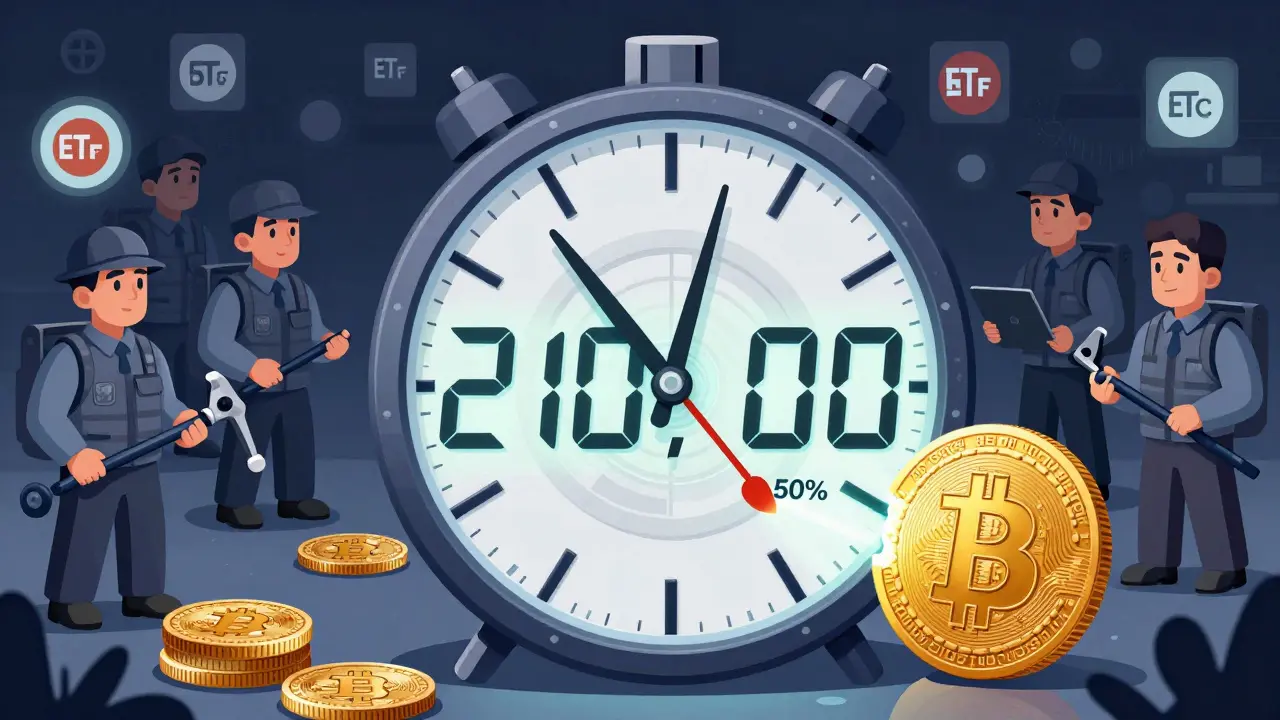
Bitcoin doesn’t work like any other asset. While stocks, gold, or even fiat currencies can be printed or mined at varying rates, Bitcoin has one rule baked into its code: every 210,000 blocks, the reward for mining new coins is cut in half. This is the halving. And the theory behind it - the Halving Supply Shock Theory - says that when the supply of new Bitcoin suddenly drops by 50%, and demand stays the same or grows, the price has to rise. It’s simple economics: less supply, same demand = higher price.
How the Halving Actually Works
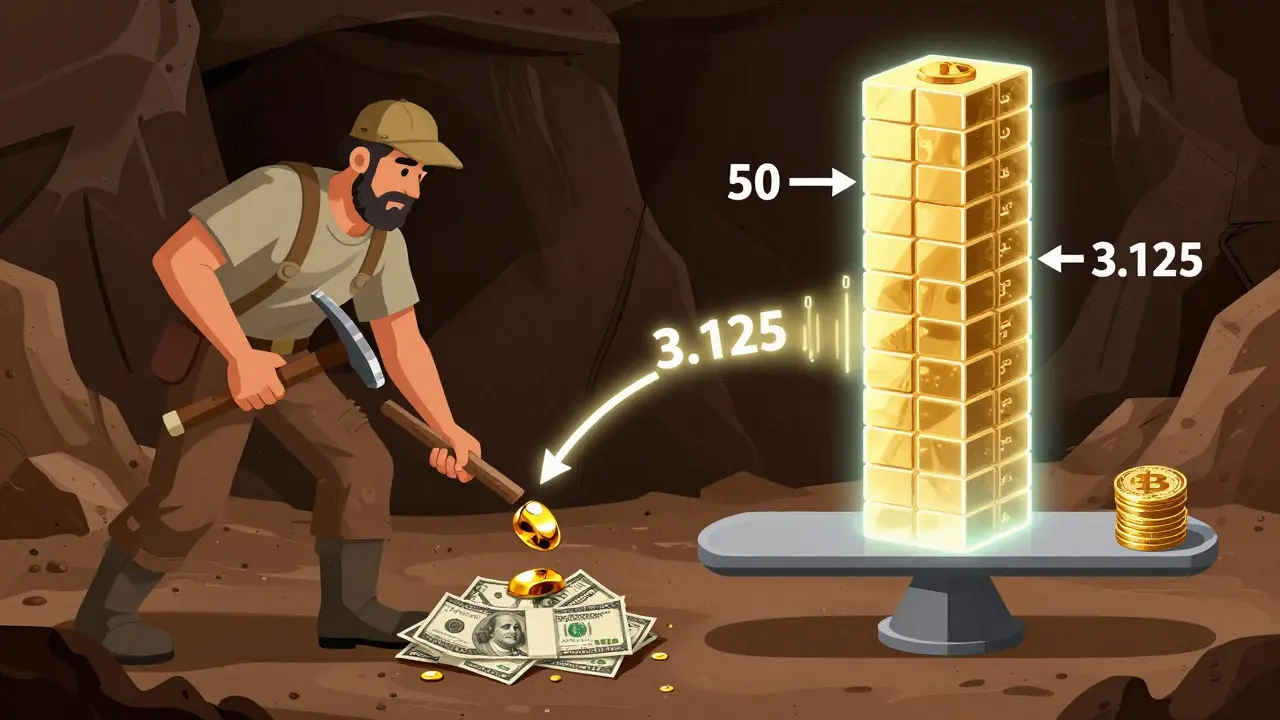
Bitcoin was designed to mimic the scarcity of gold. Gold isn’t easy to dig up - the deeper you go, the harder and more expensive it gets. Bitcoin does something similar, but with math. Every time a miner solves a block, they get rewarded with new Bitcoin. When Bitcoin launched in 2009, that reward was 50 BTC per block. That number didn’t stay fixed. After roughly four years - or 210,000 blocks - it dropped to 25 BTC. Then 12.5. Then 6.25. And on April 19, 2024, it dropped again to 3.125 BTC per block.
This isn’t a guess. It’s not a policy change. It’s not subject to politics or central bank meetings. It’s hardcoded. The Bitcoin protocol checks the block number, and when it hits 210,000, 420,000, 630,000, and so on, it automatically cuts the reward. No one can override it. That’s why this is called a programmed supply shock.
By the time the last Bitcoin is mined around 2140, only 21 million will ever exist. As of March 2026, about 19.8 million are already in circulation. That means less than 1.2 million are left to be mined - and each new coin becomes harder and harder to produce. The inflation rate? It’s now under 1.7% per year. Compare that to the U.S. dollar, which saw over 40% growth in the money supply between 2020 and 2022. Bitcoin isn’t just digital money. It’s digital scarcity.
Why This Should Raise the Price
Think of it like a factory that suddenly cuts production in half. If people still want the product - and they do - prices go up. That’s basic supply and demand.
Before each halving, miners are paid mostly in new Bitcoin. In 2023, over 90% of miner income came from block rewards. After the 2024 halving, that dropped to roughly 50%. The rest comes from transaction fees - and those are still tiny. In Q1 2024, fees made up only 1.3% of miner revenue. That means miners are suddenly earning half as much in Bitcoin, but their electricity, hardware, and overhead costs didn’t change.
So what happens? Less efficient miners get pushed out. Some shut down. Others upgrade their rigs - spending thousands on new ASIC chips to stay profitable. This reduces the overall supply of Bitcoin entering the market. Meanwhile, demand doesn’t vanish. Institutions like BlackRock, Fidelity, and Grayscale are buying Bitcoin through spot ETFs. Retail investors still rush in around halving time, hoping for the next big run. The result? A squeeze.
Historically, this has worked. After the 2012 halving, Bitcoin went from $12 to over $1,100 in 12 months. In 2016, it went from $650 to $20,000. In 2020, it went from $8,800 to $65,000. Those aren’t coincidences. They’re patterns tied to supply cuts.
But It’s Not Always That Simple
Here’s the catch: the halving isn’t magic. It doesn’t guarantee a price spike. In 2022, Bitcoin dropped 65% after the 2020 halving - even though supply was still being cut. Why? Because macro forces overwhelmed it. The Federal Reserve raised interest rates. TerraUSD collapsed. Crypto lending firms went bankrupt. People sold Bitcoin to cover losses elsewhere. The halving didn’t disappear - but it got drowned out.
And as Bitcoin grows, the impact of each halving shrinks. In 2012, the block reward was 50 BTC. At $12, that was $600 in new supply per block. Today, with 3.125 BTC per block and a price around $70,000, that’s $218,750 in new supply per block. Sounds huge? It is - but Bitcoin’s market cap is now over $1.2 trillion. So the halving removes about $1.7 billion in annual new supply. That’s real. But compared to the $34 billion in ETF inflows in 2024? It’s a ripple, not a wave.
Some experts argue the theory is losing steam. Geertjan Cap from Swan Bitcoin showed that post-halving price gains have slowed: 8,700% after 2012, 290% after 2016, 130% after 2020. Why? Because Bitcoin’s market is now dominated by institutions, not retail FOMO. When a hedge fund buys $500 million in Bitcoin, it doesn’t care about halvings. It cares about macro trends, regulation, and liquidity.
What Miners Face After the Halving
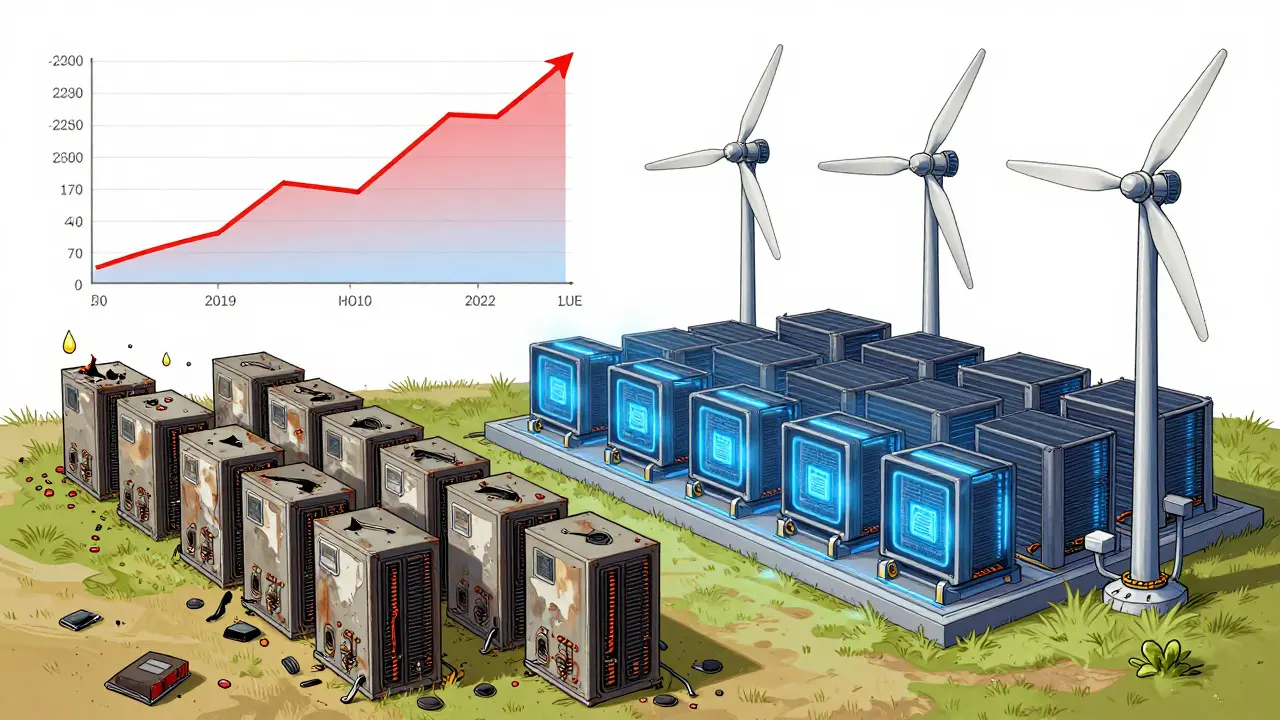
Miners are the backbone of Bitcoin’s security. But they’re also the first to feel the pain of a halving. In early 2024, many U.S. miners were operating at break-even when Bitcoin was at $40,000. After the halving, their revenue dropped by half. To survive, they had to either cut costs or upgrade.
That meant:
- Switching to cheaper power - like stranded natural gas or hydroelectric plants
- Replacing older ASIC miners with newer, more efficient models costing $10,000-$15,000 each
- Consolidating operations - small farms shut down, leaving only large players with access to low-cost energy
The Bitcoin network didn’t break. The difficulty adjustment algorithm kicked in. Every 2,016 blocks (about two weeks), the network checks how fast blocks are being solved. If hash rate drops, it lowers the difficulty. After the 2024 halving, difficulty fell by 24% - enough to keep mining alive. But the cost of entry got higher. The era of backyard miners with cheap rigs is over. Bitcoin’s security now relies on industrial-scale operations.
How the Market Has Changed Since 2020
Before 2020, Bitcoin was mostly traded by retail investors. Halvings were hype events. People bought in early. They sold after the run-up. The halving was the main driver.
Now? The story’s different. Spot Bitcoin ETFs launched in January 2024. In three months, over $34 billion flowed into them. That’s more than the total value of Bitcoin in 2016. BlackRock, Fidelity, and ARK are now the biggest buyers. They don’t trade based on halving calendars. They trade based on inflation data, Fed policy, and global risk sentiment.
Even Ethereum’s shift to proof-of-stake in 2022 - which eliminated mining rewards entirely - created a new narrative: scarcity through burning. Ethereum burns fees, effectively reducing supply. Bitcoin’s halving is still unique - it’s a predictable, scheduled, and irreversible reduction. But now, it’s one of many scarcity mechanisms in crypto.
And then there’s the psychology. The “halving is coming” narrative still drives retail behavior. Reddit threads, Twitter trends, and exchange promotions all push the idea: “Buy before the halving.” But as market cap grows, that effect weakens. A 50% supply cut means less when you’re already trading at $1 trillion than when you’re at $10 billion.
What Investors Should Watch
If you’re trying to use the halving theory to time your Bitcoin buys, here’s what actually matters:
- Miner reserve trends - When miners sell less BTC after a halving, it means they’re holding, not dumping. That’s bullish. In Q1 2024, miner reserves dropped to 1.82 million BTC - the lowest since 2010.
- MVRV Z-Score - This metric compares market value to realized value. A score below -1.5 means Bitcoin is undervalued. It hit -1.8 in February 2024 - a rare signal.
- ETF inflows - If institutional demand is strong, it can override supply shocks. Look at daily inflow numbers from Grayscale, Bitwise, and BlackRock.
- Hash rate recovery - If the network’s hash rate rebounds quickly after a halving, it means miners are confident. Slow recovery? That’s a red flag.
Don’t just buy because “halving is coming.” Buy when the market is weak, miner selling is low, and institutions are accumulating. The halving might help, but it’s not the whole story.
The Future of the Theory
Will halvings still matter in 2030? Probably. But differently. By then, block rewards will be under 1 BTC per block. Transaction fees will need to cover over 80% of miner income. Bitcoin will have fully transitioned from a subsidy-driven system to a fee-driven one - exactly as Satoshi Nakamoto imagined in the original whitepaper.
Some say the halving theory is dead. Others say it’s evolving. The truth? It’s not about whether the price doubles after each halving. It’s about whether Bitcoin continues to prove that a fixed, predictable, and finite supply can hold value over time - even as the world prints trillions.
That’s the real test. And so far, Bitcoin is passing it.
Is the Bitcoin halving guaranteed to make the price go up?
No. While historical data shows price increases after each halving, the effect isn’t guaranteed. External factors like macroeconomic conditions, regulatory changes, or loss of investor confidence can override the supply shock. For example, Bitcoin dropped 65% in 2022 despite the 2020 halving. The halving creates upward pressure, but it doesn’t guarantee a price rise.
Why do miners keep mining after a halving if their rewards are cut in half?
Miners keep mining because they adapt. They upgrade to more efficient hardware, move to regions with cheaper electricity, or consolidate operations to cut costs. The Bitcoin network automatically adjusts mining difficulty every two weeks to ensure blocks are still found every 10 minutes. If too many miners quit, difficulty drops - making it easier and cheaper to mine again. Profitability isn’t fixed - it’s dynamic.
Does the halving affect Bitcoin’s security?
Not directly. Bitcoin’s security comes from its hash rate - the total computing power securing the network. After a halving, some miners shut down, causing a temporary dip in hash rate. But the difficulty adjustment algorithm lowers mining difficulty within weeks, restoring balance. As long as enough miners remain profitable, the network stays secure. In fact, Bitcoin’s hash rate hit 650 exahashes per second in early 2026 - over 13 times higher than in 2020 - proving the network grows stronger despite lower rewards.
How does the halving compare to gold mining?
Gold mining becomes harder and more expensive over time - new deposits are rarer, and extraction costs rise. Bitcoin’s halving mimics this by reducing new supply at fixed intervals. But unlike gold, Bitcoin’s supply schedule is mathematically predictable. Gold’s annual supply can vary by 1-3% depending on discoveries or political instability. Bitcoin’s supply drop is exact: 50% every 210,000 blocks. That predictability is what makes Bitcoin’s scarcity unique.
Can Bitcoin’s supply cap be changed?
No. The 21 million Bitcoin cap is enforced by the protocol’s code. Changing it would require a consensus upgrade - meaning over 90% of miners and nodes would have to agree. Given Bitcoin’s decentralized nature and the fact that the cap is its core value proposition, such a change is virtually impossible. Even attempts to modify it have failed in the past. The supply limit is as immutable as the laws of mathematics.
What happens after all 21 million Bitcoins are mined?
After the last Bitcoin is mined around 2140, miners will rely entirely on transaction fees for income. This was always part of Satoshi’s design. As Bitcoin usage grows, so will transaction volume. If fees rise enough - say, above $5 per transaction - miners will still have strong incentives to secure the network. The halving mechanism ends, but Bitcoin’s security model evolves into a fee-based system. The scarcity doesn’t change - it just stops being replenished.
 Finance