


Back in 2018, if you were deep into the EOS blockchain community, you probably heard about EOSex. It wasn’t just another crypto exchange. It promised something no one else did: 100% of its profits go straight to EXP token holders. No shareholders. No corporate greed. Just you, holding tokens, and getting paid every time someone traded on the platform. Sounds too good to be true? It turned out it was.
What Was EOSex Supposed to Be?
EOSex launched in late 2018 as a hybrid exchange built on the EOS blockchain. That meant it wasn’t fully centralized like Binance, and it wasn’t fully decentralized like Uniswap. It tried to have the best of both worlds: fast transactions from a centralized system, with the transparency and profit-sharing of a decentralized one. Its main selling point? The EXP token. Every dollar the exchange made - from trading fees, listing fees, you name it - was distributed evenly among everyone who held EXP tokens.
This wasn’t a marketing gimmick. It was the core of their business model. While Binance kept its profits to reinvest or pay investors, EOSex claimed to give everything back to users. That’s why early adopters, especially those already invested in EOS, jumped on board. The idea was simple: if you believed in the platform, hold EXP. The more you held, the more you earned.
Cross-Chain Trading? Yes. But Only for a While
EOSex bragged about being the first cross-chain hybrid exchange. It supported trading between EOS, TRON, and Ethereum. That was a big deal back then. Most exchanges stuck to one blockchain. EOSex said it could connect them all. You could swap EOS for ETH without leaving the platform. No need for bridges or third-party wallets. It sounded like a game-changer.
But here’s the catch: there’s no proof it ever worked well. No screenshots. No transaction records. No user reports of successful cross-chain swaps. The only mentions of this feature come from promotional blog posts on Steemit and Ecency - both of which were tied directly to the EOSex team. Independent verification? None.
Why Did It Fail?
Let’s cut to the chase: EOSex died because it had no real users, no liquidity, and no transparency.
- No trading volume: There’s no data anywhere showing how much was actually traded on EOSex. Not on CoinGecko. Not on CoinMarketCap. Not even on obscure blockchain explorers. If no one was trading, the profit-sharing model had nothing to distribute.
- No user reviews: Try Googling “EOSex review Reddit” or “EOSex Trustpilot.” You’ll get nothing. Zero. Not even a single complaint or praise from a real user. That’s not normal. Even failed exchanges have at least a few angry users leaving comments.
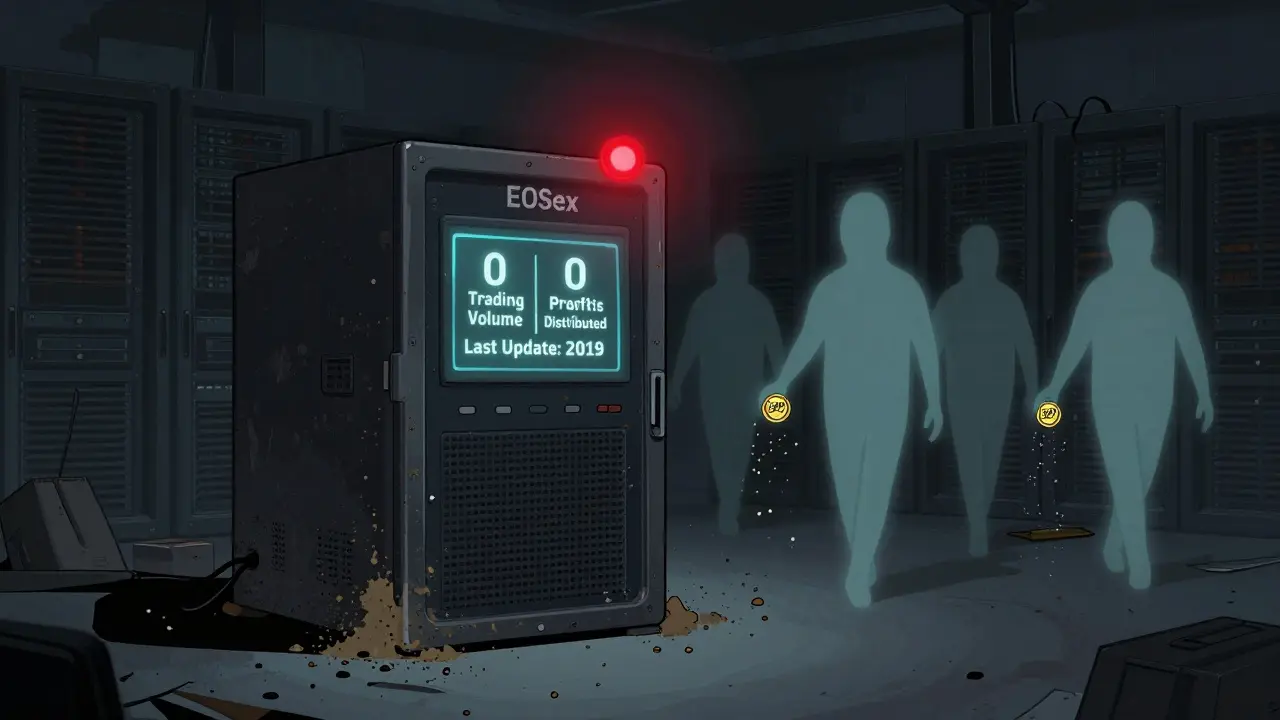
- No updates since 2019: The last real update from the team was in late 2018 or early 2019. No blog posts. No Twitter updates. No GitHub commits. No mobile app releases. The website? It’s gone. The domain now redirects to a parked page. The EXP token? It has no price on any exchange today.
And here’s the kicker: the profit-sharing model itself was legally risky. If you’re giving users a share of profits based on holding a token, regulators like the SEC might see that as an unregistered security. No one ever addressed this. No whitepaper explained how they planned to comply with securities laws. That’s a red flag bigger than the whole project.
Who Was It Really For?
EOSex didn’t try to compete with Binance or Coinbase. It targeted one group: EOS token holders. Back in 2018, EOS was the second most active blockchain after Ethereum. It had hype, a passionate community, and a lot of early investors. EOSex was built to serve them - and them alone.
But that was its downfall. Instead of building a broad user base, it stayed niche. When the EOS hype faded in 2019, so did EOSex. No one else cared. No new traders came in. The community that supported it moved on to better platforms. And without users, the profit-sharing engine had no fuel.
What About the EXP Token?
The EXP token was supposed to be the lifeblood of EOSex. Holders got paid. The more you held, the more you earned. Simple. Clean. Fair.
Today, the EXP token doesn’t exist on any major exchange. Its price is listed as $0 on CoinCodex. There’s no wallet integration. No staking. No liquidity pools. No DeFi use cases. The token’s smart contract hasn’t been touched in over five years. If you bought EXP back then, you’re holding a digital ghost.
And yes - there were bounty campaigns. The team offered rewards for social media posts, translations, and forum participation. But that’s not a real user base. That’s a marketing tactic. It’s like paying people to clap at a play. Doesn’t mean the show was good.

What Could Have Saved It?
EOSex had a great idea. But great ideas don’t win in crypto - execution does.
If they had:
- Published real trading volumes every week,
- Allowed users to withdraw EXP earnings in ETH or USDT,
- Added a mobile app with real-time notifications,
- Partnered with a reputable wallet like Trust Wallet or Phantom,
- Released quarterly financial reports audited by a third party,
- then maybe it could have worked.
But they didn’t. They stayed quiet. They didn’t update. They didn’t respond to questions. And in crypto, silence is death.
The Bigger Lesson
EOSex isn’t just a failed exchange. It’s a case study in how not to build a crypto project.
It promised transparency but delivered silence. It claimed decentralization but never opened its code. It said it was user-owned but never gave users real control. And it relied on hype, not infrastructure.
Today, there are dozens of exchanges that do what EOSex wanted to do - but better. Platforms like KuCoin, Gate.io, and even decentralized ones like dYdX offer real liquidity, clear fee structures, and active development teams.
EOSex is gone. The EXP token is dead. The website is gone. The team? Vanished.
If you’re looking for a crypto exchange today, don’t waste time on relics. Look for ones that are active, transparent, and growing - not ones stuck in 2018.
Is EOSex still operational in 2026?
No, EOSex is not operational. All signs point to the platform being abandoned since late 2019. The official website no longer exists, the EXP token has no trading activity, and there have been zero updates from the team in over five years. It is effectively defunct.
Can I still trade or withdraw EXP tokens?
No. There are no exchanges listing EXP tokens today. No wallets support it. No liquidity pools exist. Even if you still hold EXP tokens from 2018 or 2019, they have no value and cannot be traded, transferred, or withdrawn. The token is non-functional.
Did EOSex ever pay profits to EXP holders?
There is no verifiable evidence that EOSex ever distributed profits to EXP token holders. While the platform claimed 100% profit-sharing, no transaction records, blockchain logs, or user testimonials confirm payments were ever made. The lack of public data suggests the model was never implemented.
Was EOSex a scam?
It’s not proven to be a scam in the legal sense - but it’s also not proven to have functioned as advertised. It raised expectations with bold claims, delivered no verifiable results, and disappeared without explanation. Most users who got involved lost time, energy, and potentially funds. In crypto terms, it’s considered a failed project with high-risk signaling.
Why did EOSex fail when other exchanges survived?
EOSex failed because it had no real users, no liquidity, no transparency, and no ongoing development. While exchanges like Binance and KuCoin invested in security, customer support, and global expansion, EOSex stayed isolated, silent, and self-promotional. It relied on hype during the 2018 bull market and collapsed when the market turned. It never adapted.
Should I still hold EXP tokens?
No. EXP tokens have no value, no utility, and no market. Holding them serves no purpose. If you still have them in a wallet, it’s safe to delete or ignore them. There is no chance of recovery, airdrop, or revival. Treat them as lost.
 Finance



Elijah Young
February 13, 2026 AT 11:13Been around since the early EOS days. Saw this whole thing unfold and honestly? I didn’t even bother signing up. Too many red flags from day one - no whitepaper, no dev team, just vibes and a website that looked like it was built in 2015. Guess I’m just not a hype guy.
Crystal McCoun
February 13, 2026 AT 14:22I remember reading about EOSex back then. I was so excited - finally, an exchange that actually cared about users! But then... nothing. No updates. No payouts. No transparency. I held EXP for months, waiting for my first distribution. It never came. I still have the wallet. It’s like a tombstone.
It’s not just about the money - it’s about trust. And when a project vanishes like that, it makes you question every other ‘user-first’ claim out there.
I’ve since learned to look for active GitHub commits, real community engagement, and third-party audits. Not just pretty promises.
Rest in peace, EOSex. You were a beautiful idea… but a terrible execution.
Michelle Cochran
February 14, 2026 AT 22:18Let’s be real - this was never about profit-sharing. It was a Ponzi dressed up as blockchain innovation. They didn’t need liquidity - they needed suckers with EOS tokens to buy EXP and inflate the perceived value. The moment the hype died, they ghosted. Classic.
And don’t even get me started on how they used Steemit and Ecency as their only ‘proof.’ Those are their own platforms! That’s not transparency - that’s a hall of mirrors.
People still talk about this like it was a ‘failed experiment.’ No. It was a calculated exit scam with a cute slogan.
monique mannino
February 16, 2026 AT 12:45Ugh I remember this 😩 I had EXP tokens. I thought I was winning. Then... crickets. No emails. No updates. Just silence. I deleted the wallet months ago. RIP EXP. You were a dream that never woke up 💔
Peggi shabaaz
February 18, 2026 AT 03:24kinda sad when you think about it. people really believed in this. i mean, who wouldn’t want to get paid just for holding a token? but then again… if it sounds too good to be true, it usually is. i guess we all just wanted to believe
Robbi Hess
February 18, 2026 AT 08:21The tragicomic nature of EOSex is not lost on me. A platform that promised decentralization, yet operated with the opacity of a black-box corporation. The irony is thick enough to spread on toast. Their entire model hinged on the assumption that users would remain passive beneficiaries - not participants. A fatal flaw in an ecosystem built on active engagement.
Moreover, the legal implications of distributing profits via a token without registration - that’s not naivety. That’s negligence masquerading as idealism.
EOSex didn’t fail because of market conditions. It failed because it was structurally unsound from inception.
SAKTHIVEL A
February 19, 2026 AT 01:13The EOSex phenomenon exemplifies the ontological collapse of decentralized governance when divorced from operational rigor. The EXP token was not a utility - it was a metaphysical construct, an ideological artifact predicated upon performative transparency. The absence of verifiable transactional data renders the entire paradigm epistemologically vacuous.
One cannot distribute profits that do not manifest. The blockchain does not lie - but the narrative did. And in crypto, narrative is capital. EOSex capitalized on narrative, then evaporated.
Thus, the true failure was not technical - it was semiotic.
krista muzer
February 19, 2026 AT 07:37i was so into this back then like omg imagine getting paid just for holding a token?? i even did their bounty stuff for like 3 months posting on reddit and translating stuff. i thought i was part of something big. then one day the site just went down and we all just… stopped talking. no one even said goodbye. kinda hurt man
Tammy Chew
February 20, 2026 AT 00:19EOSex? That’s the equivalent of handing out gold-plated paperweights labeled ‘future wealth’ while the team sips champagne in a penthouse they never disclosed. The arrogance of claiming decentralization while operating a closed ecosystem is breathtaking. You don’t get to be ‘user-owned’ and then vanish without a trace. That’s not innovation. That’s theft dressed as a movement.
Lindsey Elliott
February 21, 2026 AT 19:16LOL I still have EXP in my wallet. I keep it as a reminder of how dumb I was. I thought ‘100% profit sharing’ meant they were saints. Turns out it just meant they were lazy. No one was ever gonna pay out. Why bother? The whole thing was a glorified meme.
Still laugh when I see newbies asking about it. ‘Is EOSex still alive?’ Nah baby. It’s a ghost.
Santosh kumar
February 23, 2026 AT 16:35It’s okay to dream big. But dreams need roots. EOSex had wings but no feet. Still, I’m glad someone tried. Maybe next time they’ll build better. Keep going, community. We learn from failures like this.
Claire Sannen
February 25, 2026 AT 15:09I still remember the excitement around EOS in 2018. It felt like the future. Then EOSex came along - and for a moment, I thought we’d found a real alternative to centralized exchanges. But silence speaks louder than promises. The lack of communication, updates, or even a simple ‘we’re pausing’ message… that’s what killed it. Not the tech. Not the model. Just the absence of humanity.
Christopher Wardle
February 27, 2026 AT 07:33The real tragedy of EOSex isn’t the lost profits. It’s the erosion of trust. Projects like this make it harder for legitimate decentralized platforms to gain credibility. One bad actor can poison the well for everyone. We need accountability - not just in code, but in character.
blake blackner
February 28, 2026 AT 12:22bro i had 20k EXP tokens and i thought i was gonna retire. then the site went down and i was like… wait wtf. i checked the blockchain. nothing. no payouts. no logs. just a ghost contract. i still check it every now and then. like a haunted house. i’m not over it 😭
Andrea Atzori
March 1, 2026 AT 18:07As someone who studied alternative economic models, I find EOSex fascinating as a sociological case. The belief in profit-sharing as a social contract - without legal scaffolding, technical infrastructure, or governance mechanisms - reveals a dangerous romanticism in crypto culture. We romanticize ‘decentralization’ while ignoring the institutional frameworks that make systems sustainable. EOSex didn’t fail because of greed. It failed because it mistook idealism for infrastructure.
Jeremy Lim
March 3, 2026 AT 08:03Why does this keep popping up? It’s been dead for five years. EXP is worth $0. The website is gone. The team vanished. Can we please stop reviving dead projects like they’re ghosts at a séance? We’re not summoning spirits - we’re just wasting bandwidth.
John Doyle
March 4, 2026 AT 13:50man i still think about eosex sometimes. it felt like family. we all held EXP like it was our future. no one was rich, but we all felt like we were in it together. then poof. gone. i miss that feeling. even if it was fake, it felt real. and that’s kinda beautiful in its own messed up way
kelvin joseph-kanyin
March 5, 2026 AT 09:40EXP token? still in my wallet 😎✨ never deleted it. just in case. you never know… maybe the devs woke up one day and said ‘oops’ 🤷♂️🚀
Elizabeth Choe
March 5, 2026 AT 18:58yo i still have EXP in my MetaMask. it’s like my crypto shrine. every time i open it i laugh and cry a little. we all got played - but we got played together. that’s kinda the story of crypto, huh? 💫
Grace Mugambi
March 7, 2026 AT 08:15It’s easy to call EOSex a scam, but maybe it’s more accurate to call it a mirror. It reflected what we wanted to believe - that crypto could be fair, transparent, and community-driven. We didn’t fail because the project was flawed. We failed because we refused to ask hard questions. We wanted the dream so badly we didn’t check the foundation.
Maybe the real lesson isn’t about EOSex… it’s about how we choose to believe.
Donna Patters
March 7, 2026 AT 19:19Anyone still clinging to EXP tokens is either delusional or emotionally attached to a fantasy. This wasn’t a project - it was a cult with a smart contract. The fact that people still ask if it’s ‘still alive’ proves how dangerously naive crypto culture has become. Delete the wallet. Move on. There are better places to put your faith.
Will Lum
March 9, 2026 AT 05:38the whole thing was kinda poetic. a beautiful idea that never left the drawing board. no one got rich. no one got hurt. just a bunch of people who believed in something that never happened. kinda like a poem no one ever published. still… i’m glad it existed. even if only for a second