

You might have heard the buzz around Aperture Finance, but here is the reality check you need right now: the main airdrop distribution happened on May 31, 2024. If you are looking for a button to click today to get free tokens, that specific window has closed. However, understanding what Aperture Finance did, how the APTR token works, and where the project is heading in 2026 is still critical for anyone involved in decentralized finance (DeFi). This isn't just about missed opportunities; it's about understanding a new model of interacting with blockchain technology.
Aperture Finance isn't your standard yield farming protocol. It positions itself as a revolutionary DeFi platform built on an "Intents" infrastructure. Instead of manually executing complex trades or managing liquidity ranges on interfaces filled with charts and sliders, users declare their goals in natural language. Think of it like talking to a smart assistant that knows exactly how to move your money across different protocols to get the best price. For many, this represents the next step in making crypto usable for everyone, not just developers.
How the Aperture Finance Airdrop Worked
To understand the current state of the APTR token, we first need to look back at how the community was rewarded. The airdrop was a significant event, distributing 7% of the total token supply to eligible participants. This wasn't random; it was based on engagement. Users had to accumulate qualifying points by interacting with the platform, connecting wallets, and completing social media tasks during the campaign period.
The claiming process required specific technical steps. Eligible users visited the official claim page, connected their cryptocurrency wallet, and authenticated by clicking "Sign." Crucially, users had to switch their wallet network to Arbitrum. Arbitrum is a Layer 2 scaling solution for Ethereum, chosen for its speed and low transaction costs. Once on the correct network, clicking "Claim" initiated the distribution. The system automatically verified eligibility and displayed the exact number of tokens available. There were no vesting restrictions for these airdrop recipients-tokens were 100% unlocked immediately, providing full liquidity and trading flexibility from day one.
Understanding APTR Tokenomics and Valuation
The structure of the APTR token reveals a carefully planned approach to funding and community building. Before the public could even touch the token, several private rounds took place. These rounds set the baseline valuation and ensured the team had resources to build the Intents infrastructure.
| Round Type | Price per Token | Valuation | Funds Raised | Vesting Schedule |
|---|---|---|---|---|
| Seed Round | $0.015 | $15 Million | $1.8 Million | 5% at TGE, 6-month cliff, 24-month vesting |
| Strategic Round | $0.035 | $35 Million | $3.5 Million | 5% at TGE, 3-month cliff, 18-month vesting |
| Public Round | $0.045 | $45 Million | $585,000 | 100% unlocked immediately |
| Airdrop Allocation | N/A (Free) | N/A | N/A | 100% unlocked immediately |
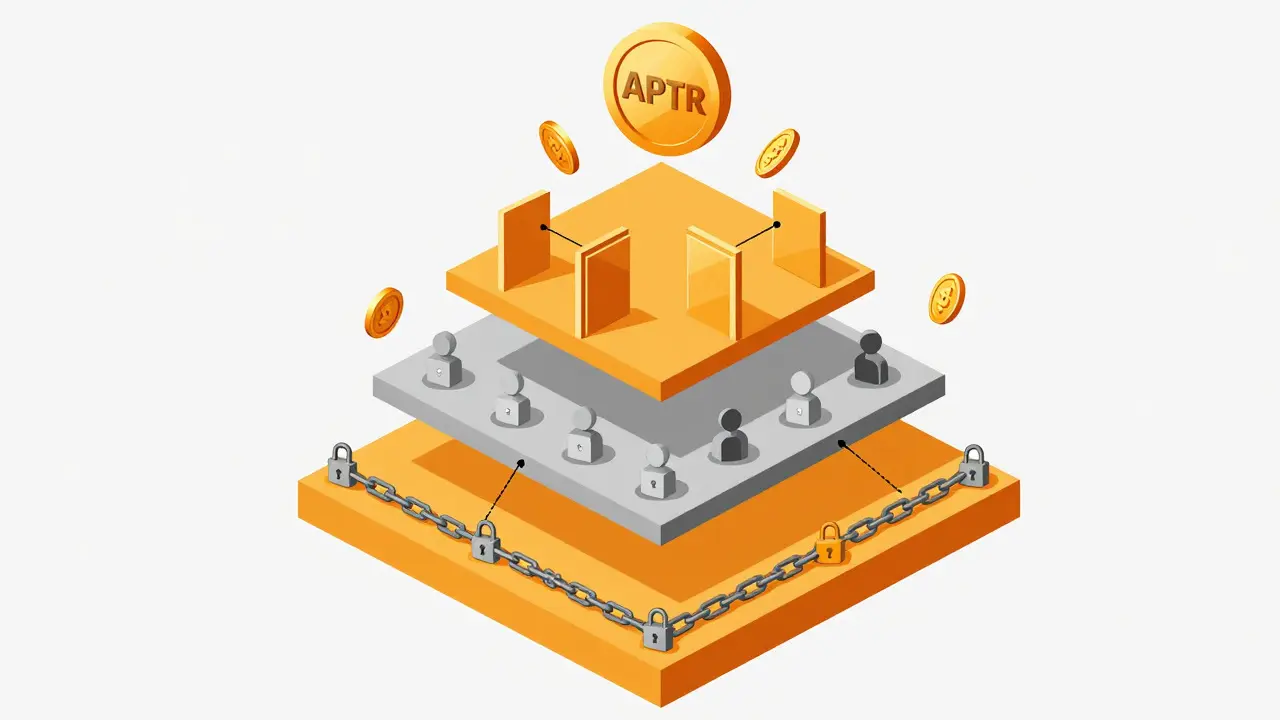
Notice the difference in vesting. Early investors faced long lock-up periods, meaning they couldn't dump their tokens immediately after launch. In contrast, airdrop recipients and public round buyers got immediate access. This creates a dynamic market where early adopters can trade freely, while institutional holders are incentivized to support the project's long-term success.
Beyond the Airdrop: Earning APTR in 2026
Just because the initial airdrop is over doesn't mean the earning potential has vanished. Aperture Finance continues to offer ways to earn APTR through active participation in its ecosystem, particularly for those comfortable with advanced DeFi strategies.
The platform launched a specialized program for Uniswap V3 liquidity providers. Uniswap V3 is known for its capital efficiency but also its complexity. Managing concentrated liquidity requires constant monitoring and rebalancing. Aperture’s UniV3 Private Beta program simplifies this by offering automated tools. Participants gain access to features like automated rebalancing, prescheduled position closures, auto-compounding, and revenue-earning limit orders.
Active engagement in this beta program allows users to earn up to 66,666 APTR tokens, which held a value of approximately $10,000 at peak projections. Additionally, the referral system remains active. By referring new users, you can earn 25% of their airdrop allocations, capped at 16,666 APTR tokens. Content creators also have a path to earnings, receiving 3,333 APTR tokens for producing high-quality educational content about liquidity provider strategies and platform experiences.
Price Predictions and Market Outlook
Market sentiment around APTR has been driven by ambitious predictions. Analytical platforms like CoinLore have projected significant growth, though it is vital to treat these numbers with caution. Crypto markets are volatile, and past performance does not guarantee future results.
Predictions for 2025 suggested prices ranging from $0.0469 in September to $0.0784 in October. Long-term forecasts extended to 2030 with a potential target of $0.1762. While these figures represent massive percentage increases from early pricing levels, they depend heavily on the successful adoption of the Intents infrastructure and the broader acceptance of AI-driven DeFi interfaces. As we stand in August 2026, the real value lies in whether Aperture Finance has successfully reduced the barrier to entry for mainstream users. If the natural language interface truly simplifies complex financial operations, the demand for the governance and utility token APTR could sustain higher valuations.
The Competitive Edge: Intents Infrastructure
What sets Aperture Finance apart from other DeFi protocols? It is the shift from "transactional" to "intentional" interactions. Traditional DeFi apps require you to know exactly which contract to interact with, what gas fees to pay, and how to approve tokens. It is a maze of technical hurdles.
Aperture’s Intents infrastructure changes this. You state your goal-for example, "Swap ETH for USDC with the best rate possible within the next hour." The network of solvers then competes to fulfill this intent. This solver network searches across multiple decentralized exchanges (DEXs) and liquidity pools to find the optimal execution. This not only improves pricing for the user but also reduces slippage and failed transactions. By integrating with existing infrastructure like Uniswap V3, Aperture acts as a value-added layer rather than a competing protocol, leveraging established liquidity while enhancing the user experience.
Risks and Considerations for Users
Despite the innovative technology, risks remain. First, the complexity of underlying operations hasn't disappeared; it has just been abstracted. Understanding concepts like impermanent loss, range orders, and automated rebalancing is still necessary for those participating in liquidity programs. Second, smart contract risk is inherent in all DeFi projects. While Aperture aims for high security standards, any bug in the Intents infrastructure or solver network could lead to losses.
Furthermore, the reliance on the Arbitrum network means users must manage their bridge funds and ensure they have enough ETH on Arbitrum to pay for gas fees. The platform provides educational resources via Telegram and Discord, but self-custody always carries responsibility. Always verify contracts, use hardware wallets for significant holdings, and never invest more than you can afford to lose.
Future Roadmap and Development
Looking ahead, Aperture Finance plans to expand its Intents infrastructure beyond Uniswap V3. Integrations with additional DEXs will broaden the solver network’s reach, potentially improving execution quality further. Enhancements to the natural language processing capabilities aim to handle more complex financial operations, such as multi-step lending strategies or cross-chain swaps.
The success of the project hinges on three factors: the development of a robust solver network, continuous refinement of the user interface, and strategic partnerships with major DeFi protocols. If Aperture can maintain innovation in user experience design while ensuring security, it has the potential to become a standard gateway for retail users entering the DeFi space.
Is the Aperture Finance airdrop still active in 2026?
No, the primary airdrop distribution was completed on May 31, 2024. However, users can still earn APTR tokens through the Uniswap V3 Liquidity Provider program, referral bonuses, and content creation initiatives.
Which blockchain network does APTR operate on?
The APTR token operates on the Arbitrum network, a Layer 2 scaling solution for Ethereum. Users must ensure their wallets are connected to Arbitrum to interact with the platform or claim rewards.
What is the minimum requirement to participate in the UniV3 Beta program?
Participation prioritizes users with previous Uniswap V3 liquidity providing experience. You need to provide liquidity to Uniswap V3 pools and connect your wallet to the Aperture Finance dashboard to access automated management tools and earn APTR rewards.
How does the Intents infrastructure differ from traditional DeFi?
Traditional DeFi requires manual execution of trades and approvals. Intents allow users to declare goals in natural language. A network of solvers then competes to execute these intents optimally across various protocols, resulting in better prices and a simpler user experience.
Are there vesting periods for airdropped APTR tokens?
No, tokens distributed via the airdrop were 100% unlocked immediately upon claiming. This contrasts with seed and strategic investor allocations, which had cliffs and vesting periods ranging from 18 to 24 months.
Can I earn APTR by referring friends?
Yes, the referral system allows you to earn 25% of referred users' airdrop allocations. This bonus is capped at 16,666 APTR tokens per referrer.
 Finance