

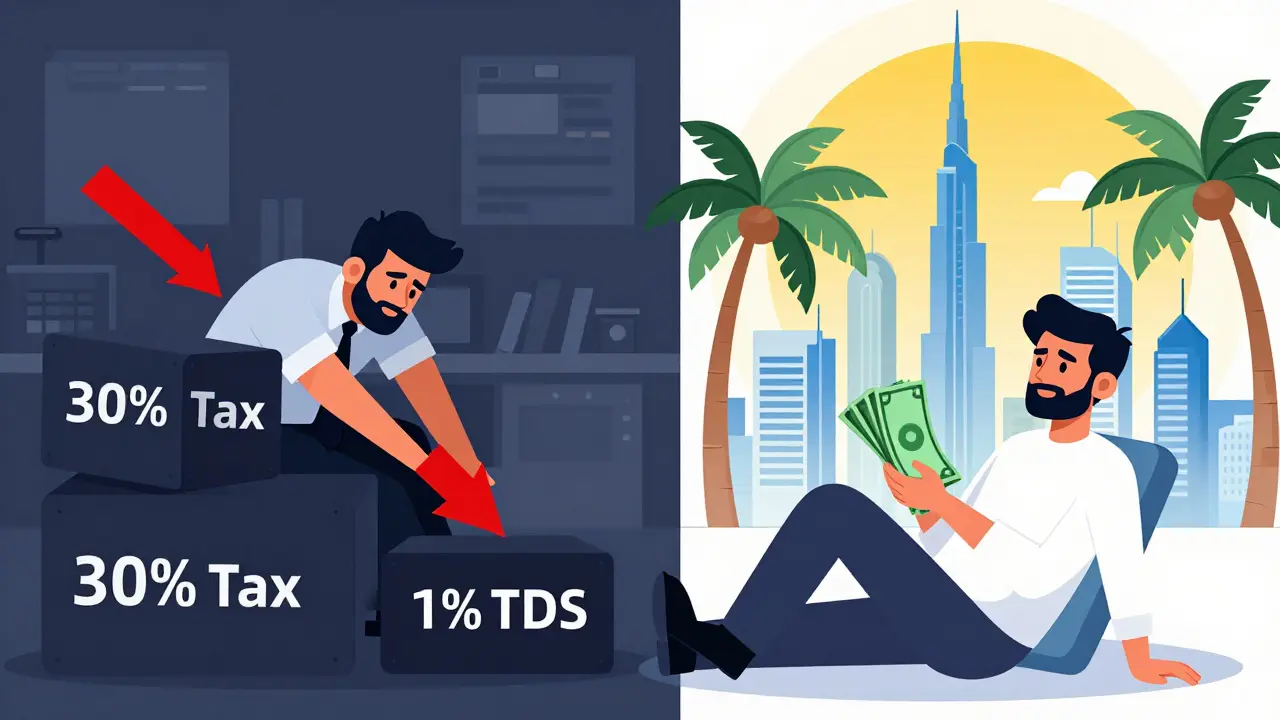
Imagine making $100,000 in profit from Bitcoin trades. In India, you hand over $30,000 to the government immediately, plus another chunk for transaction taxes. In Dubai, you keep every single dollar. This stark contrast is driving a wave of Indian cryptocurrency traders to pack their bags and move to the United Arab Emirates. It isn't just about palm trees and luxury; it is a calculated financial decision based on survival and growth in a volatile market.
The trend has accelerated sharply since 2022. What started as whispers among high-net-worth individuals has become a visible migration pattern. Professional traders, fund managers, and even retail investors with significant portfolios are exploring Dubai not just as a vacation spot, but as a base of operations. But before you book that one-way ticket, you need to understand exactly how this works, what the rules are, and whether the grass is truly greener-or if new regulations are changing the game.
The Indian Crypto Tax Trap
To understand why people are leaving, you first have to look at what they are leaving behind. India’s approach to cryptocurrency taxation is widely considered one of the harshest in the world. When the government introduced these rules, the goal was clear: bring digital assets into the formal economy and generate revenue. For traders, however, the impact was devastating.
Here is the reality of trading in India today:
- Flat 30% Tax on Profits: Every rupee you make from selling or spending crypto is taxed at 30%. There is no distinction between short-term and long-term gains. If you hold Bitcoin for five years, you pay the same rate as if you traded it for five minutes.
- No Deductions Allowed: You cannot offset losses against profits. If you lose ₹50,000 on Ethereum and gain ₹50,000 on Solana, you still pay tax on the full ₹50,000 gain. Trading fees, electricity costs, and hardware expenses? None of them count as deductions.
- 1% TDS (Tax Deducted at Source): This is the cash-flow killer. On every crypto sale above ₹50,000 (approx. $608), 1% is automatically deducted. While this can be claimed back during filing, it ties up your capital. For active traders, this means thousands of dollars are locked in the system until you file returns, creating liquidity nightmares.
This structure effectively penalizes success. The more you trade, the less you keep. For a trader generating millions in volume, the administrative burden combined with the heavy tax bite makes scaling a business nearly impossible within India’s current framework.
Dubai’s Zero-Tax Allure
Cross the border to Dubai, and the landscape shifts dramatically. The United Arab Emirates, particularly Dubai, has positioned itself as a global hub for digital assets. For individual traders, the headline is simple: zero personal income tax on cryptocurrency profits.
Whether you are day-trading Bitcoin, staking Ethereum, or flipping NFTs, the UAE does not impose a personal income tax, capital gains tax, or wealth tax on individuals. If you earn $1 million in Dubai from crypto, you keep $1 million. This is not a loophole; it is the law.
This zero-tax environment applies regardless of your transaction volume. Unlike India, where high volumes trigger stricter scrutiny and TDS issues, Dubai welcomes high-frequency trading. The city’s infrastructure supports this with robust banking services, access to major international exchanges, and a lifestyle that caters to the wealthy. For many Indian traders, moving to Dubai isn't just about saving money-it's about unlocking the ability to reinvest and grow their portfolios without the constant drain of taxation.
Setting Up Shop: Free Zones and Visas
You cannot simply fly to Dubai, open a laptop, and start trading legally as a resident. To benefit from the tax structure and live there, you need a visa. And to get a visa, you typically need a company. This is where Dubai Free Zones come into play.
Free Zones are designated areas in the UAE with specific regulations designed to attract foreign investment. They offer 100% foreign ownership, no corporate tax (under certain conditions), and streamlined visa processes. Popular options for crypto traders include:
- DMCC (Dubai Multi Commodities Centre): Known for its strong presence in commodities and fintech, DMCC offers a reputable license for trading activities.
- IFZA (International Free Zone Authority): Often cited for its cost-effectiveness and ease of setup for freelancers and small businesses.
- Meydan Free Zone: Another option that provides flexibility for remote work and trading setups.
When you register a company in these zones, you can apply for a residence visa. This allows you to legally live in the UAE. Crucially, your trading activities should ideally flow through this entity to maintain compliance. You will need to open a UAE bank account linked to your company. While opening a bank account in the UAE can be challenging due to strict anti-money laundering (AML) checks, having a legitimate free zone license significantly improves your chances.
Corporate Tax: The New Nuance
It is important to note that "zero tax" in Dubai comes with a caveat for businesses. Starting in June 2023, the UAE introduced a federal corporate tax rate of 9%. However, this only applies to taxable income exceeding AED 375,000 (approximately $102,000).
If your trading profits stay below this threshold, you pay zero corporate tax. If you exceed it, you pay 9% on the amount above AED 375,000. Compare this to India’s 30% flat rate plus TDS, and the math still heavily favors Dubai. Even for high earners, paying 9% on marginal gains is a massive improvement over 30% on all gains. Furthermore, proper structuring with professional advisors can help optimize these liabilities further.
VARA and Regulatory Clarity
One of the biggest frustrations for Indian traders is regulatory uncertainty. In India, the Reserve Bank of India (RBI) and other bodies have sent mixed signals for years, leading to a climate of fear. Dubai, by contrast, offers clarity through VARA (Virtual Assets Regulatory Authority).
VARA is the dedicated regulator for virtual assets in Dubai. It provides clear guidelines on what is allowed, how to operate, and what compliance measures are needed. While this sounds like red tape, it is actually a benefit. It means you know the rules. Major exchanges like Binance and Coinbase have established regional headquarters in Dubai because of this regulatory stability. For a trader, operating in a regulated environment reduces the risk of sudden bans or frozen accounts.

The CARF Shadow: Transparency is Coming
However, the era of total anonymity is ending globally. The UAE has announced the implementation of the Crypto-Asset Reporting Framework (CARF). This is an international standard developed by the OECD to increase transparency in crypto transactions.
Here is what you need to know about CARF:
- Timeline: Implementation began in September 2025, with full rollout by January 1, 2027. The first automatic exchange of data between countries is scheduled for 2028.
- What it does: Crypto service providers (exchanges, brokers, custodians) must collect customer data, including identity and residency status, and report transaction details to the UAE authorities.
- The Impact: This data may be shared with other countries, including India, under existing tax information exchange agreements.
Does this mean Dubai is no longer a tax haven? Not necessarily. CARF focuses on reporting, not taxation. You still don't pay income tax in Dubai. But, if you remain a tax resident of India while living in Dubai, the Indian government could theoretically use this data to assess taxes owed. Therefore, simply moving physically is not enough. You must establish genuine tax residency in the UAE to avoid double taxation or legal issues back home.
| Feature | India | Dubai (UAE) |
|---|---|---|
| Personal Income Tax on Crypto | 30% Flat Rate | 0% |
| Capital Gains Tax | 30% (No LT/ST distinction) | 0% |
| TDS on Transactions | 1% on sales > ₹50k | None |
| Loss Offset | Not Allowed | Allowed (for corporate entities) |
| Regulatory Body | Unclear/Multiple Agencies | VARA (Clear Guidelines) |
| Corporate Tax Threshold | N/A (Personal Tax Applies) | 9% on profits > AED 375k |
Is Relocation Right for You?
Moving to Dubai is not a decision to take lightly. It involves significant upfront costs. Setting up a free zone company can cost anywhere from AED 15,000 to AED 50,000 ($4,000 - $13,000) depending on the zone and services included. Visa processing, health insurance, and initial housing deposits add to this. Additionally, the cost of living in Dubai, while lower than London or New York, is higher than most Indian cities.
Who benefits most? Professional traders with consistent annual profits exceeding $50,000-$100,000. For these individuals, the tax savings quickly outweigh the relocation costs. A trader making $200,000 a year saves roughly $60,000 in taxes annually in Dubai compared to India. That is a powerful incentive.
For casual investors with smaller portfolios, the hassle and cost of relocation may not be justified. Instead, they might focus on optimizing their tax strategy within India, such as holding assets long-term (though the tax rate remains the same, the frequency of TDS hits is lower) or diversifying into other asset classes.
Next Steps for Aspiring Migrants
If you are serious about making the move, here is a practical checklist:
- Consult a Cross-Border Tax Advisor: Do not rely on internet forums. Hire a professional who understands both Indian and UAE tax laws. You need to sever your tax residency ties with India properly to avoid being taxed as a Non-Resident Indian (NRI) or Resident but Not Ordinary Resident (RNOR) in complex ways.
- Choose the Right Free Zone: Evaluate DMCC, IFZA, or Meydan based on your budget and long-term business goals. Consider which zone offers the best banking relationships.
- Prepare Your Documentation: Banks in the UAE are cautious. Have a clear business plan, proof of funds, and a clean trading history ready. Avoid mixing personal and business finances.
- Plan for CARF Compliance: Ensure your record-keeping is impeccable. With CARF coming into full effect by 2027, transparency will be mandatory. Keep detailed logs of all transactions, identities, and residency proofs.
- Evaluate Lifestyle Costs: Calculate your monthly burn rate in Dubai. Factor in rent, utilities, schooling (if applicable), and healthcare. Ensure your after-tax income in Dubai comfortably covers these costs while still providing a net gain over staying in India.
The migration of Indian crypto traders to Dubai is a rational response to disparate regulatory environments. It highlights a global shift where capital flows to jurisdictions that offer clarity, fairness, and efficiency. While new frameworks like CARF are increasing transparency, the fundamental advantage of Dubai-zero personal income tax on crypto profits-remains intact for now. For those willing to navigate the setup process and comply with emerging reporting standards, Dubai offers a compelling path to financial freedom in the crypto space.
Can I live in Dubai and still pay tax in India?
Yes, if you do not formally change your tax residency. India taxes residents on their worldwide income. If you spend more than 182 days in India in a financial year, you are likely considered a tax resident. To stop paying Indian tax, you must establish tax residency in the UAE (typically by spending fewer than 182 days in India and obtaining a UAE residence visa) and consult a tax advisor to ensure proper exit procedures are followed.
How much does it cost to set up a crypto trading company in Dubai?
Costs vary by Free Zone. A basic setup in IFZA or Meydan might start around AED 15,000-20,000 ($4,000-$5,500). DMCC licenses are more prestigious and expensive, often starting around AED 30,000-50,000 ($8,000-$13,000). These costs usually include the license fee, visa quota, and initial office space (flexi-desk or physical). Additional costs include visa processing, medical tests, and Emirates ID fees.
Will CARF make Dubai less attractive for crypto traders?
Not necessarily. CARF increases transparency but does not introduce income tax. It ensures that crypto activities are reported to tax authorities. For traders who are genuinely tax-resident in the UAE, this confirms their zero-tax status. The main risk is for those trying to hide income from their home country. For compliant traders, CARF adds a layer of legitimacy to the Dubai ecosystem.
Do I need a local sponsor to own a company in Dubai?
No. In Dubai Free Zones, foreign nationals can own 100% of their company. You do not need a UAE national as a partner or sponsor. This is one of the key advantages of setting up in a Free Zone compared to the mainland, although recent changes have also allowed 100% foreign ownership in many mainland activities.
Is it difficult to open a bank account in Dubai for crypto traders?
It can be challenging. UAE banks are strict about Anti-Money Laundering (AML) compliance. Crypto-related businesses are often flagged as high-risk. To improve your chances, have a solid business plan, proof of source of funds, and a clean track record. Some fintech solutions and digital banks in the UAE are more crypto-friendly than traditional banks like ENBD or FAB.
 Finance