
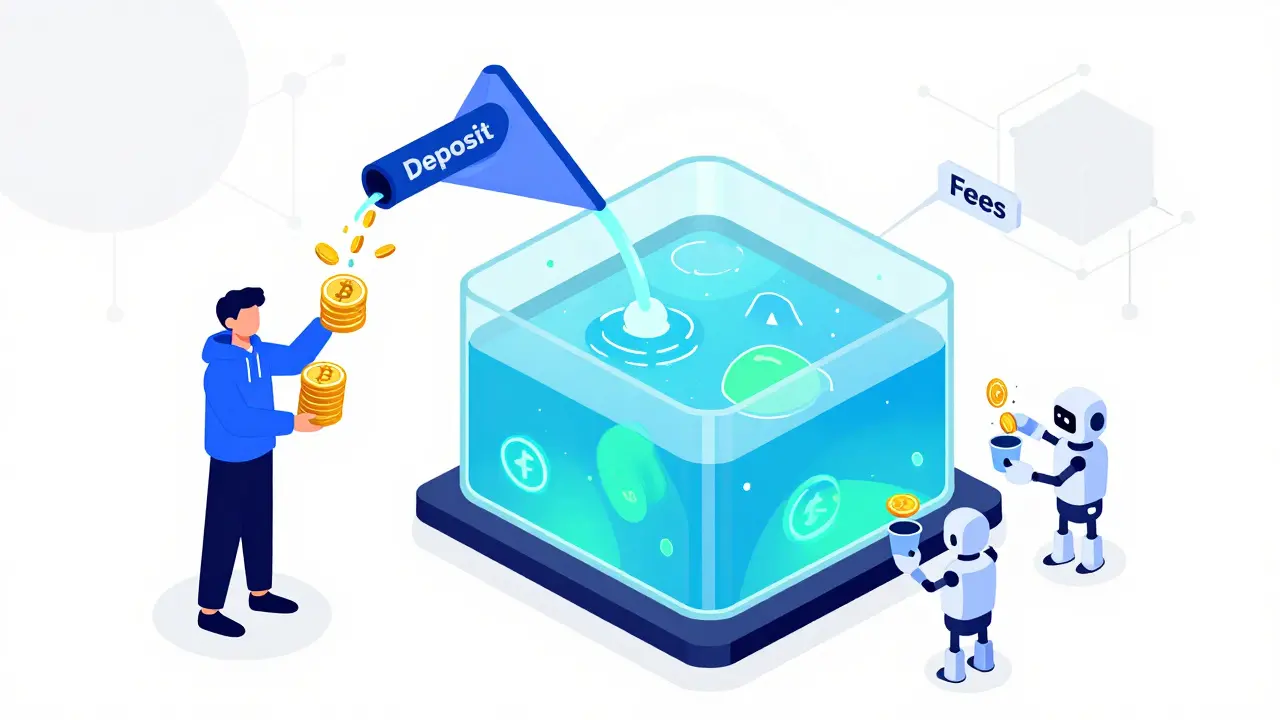
You have a wallet full of crypto. You want it to work for you, not just sit there losing value against inflation. That is where liquidity mining comes in. It sounds technical, but the core idea is simple: you lend your tokens to a decentralized exchange (DEX) so others can trade, and in return, you get paid fees or bonus tokens.
Think of it like being a landlord. Instead of renting out an apartment, you rent out capital. The DEX is the building, traders are the tenants, and the fees they pay are your rent. But unlike a physical apartment, this happens on the blockchain, governed by code, and carries unique risks that can wipe out profits if you aren't careful.
How Liquidity Mining Actually Works
To understand liquidity mining, you first need to understand the problem it solves. Traditional exchanges like Coinbase or Binance have market makers-large firms that ensure there are always buyers and sellers. In Decentralized Finance (DeFi), there is no central company. There is only code.
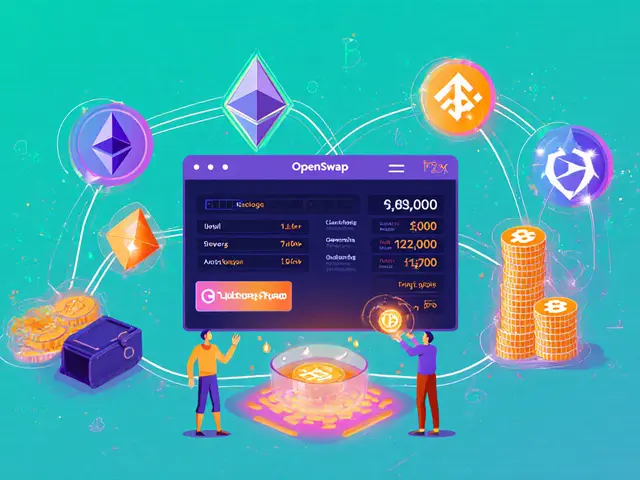
This code uses something called an Automated Market Maker (AMM). An AMM doesn't match buyers with sellers directly. Instead, it relies on Liquidity Pools. These are smart contracts holding pairs of tokens. If you want to buy Ethereum (ETH) using USDC, you don't wait for someone else to sell. You swap against the pool. The price changes automatically based on how much ETH and USDC are left in the pot.
But who puts the money in the pot? You do. This is liquidity mining.
- Choose a Pair: You pick two tokens to provide, such as ETH and USDC.
- Deposit Equal Value: If ETH is $3,000 and USDC is $1, you deposit $1,500 worth of ETH and $1,500 worth of USDC. Total investment: $3,000.
- Get LP Tokens: The protocol gives you Liquidity Provider (LP) tokens. These act as a receipt proving you own a slice of the pool.
- Earn Rewards: Every time someone trades in that pool, they pay a fee (usually 0.3%). Those fees go into the pool, increasing the value of your share. Many protocols also give you extra rewards in their native governance token.
The magic here is automation. No bank manager approves your deposit. No middleman takes a cut. The smart contract handles everything instantly.
Liquidity Mining vs. Staking vs. Yield Farming
New users often confuse these terms because they all promise "yield." But they are mechanically different. Knowing the difference saves you from picking the wrong strategy for your goals.
| Strategy | Primary Action | Risk Level | Reward Source |
|---|---|---|---|
| Staking | Lock tokens to secure a network (e.g., Ethereum, Solana) | Low (mostly slashing risk) | Inflationary block rewards + transaction tips |
| Liquidity Mining | Provide token pairs to a DEX pool | Medium-High (Impermanent Loss) | Trading fees + Protocol incentive tokens |
| Yield Farming | Move assets between multiple protocols to chase highest APY | High (Smart contract risk + Complexity) | Aggregated yields from lending, borrowing, and trading |
Staking is passive. You lock up coins, help the network run, and get paid. Your balance fluctuates with the coin's price, but you don't lose principal due to mechanics.
Liquidity Mining is active participation in a market. You are exposed to price divergence between the two tokens you deposited.
Yield Farming is essentially liquidity mining on steroids. It involves taking your LP tokens and staking them elsewhere, or lending borrowed funds to increase leverage. It’s complex and risky, often reserved for experienced DeFi users.
The Hidden Trap: Impermanent Loss
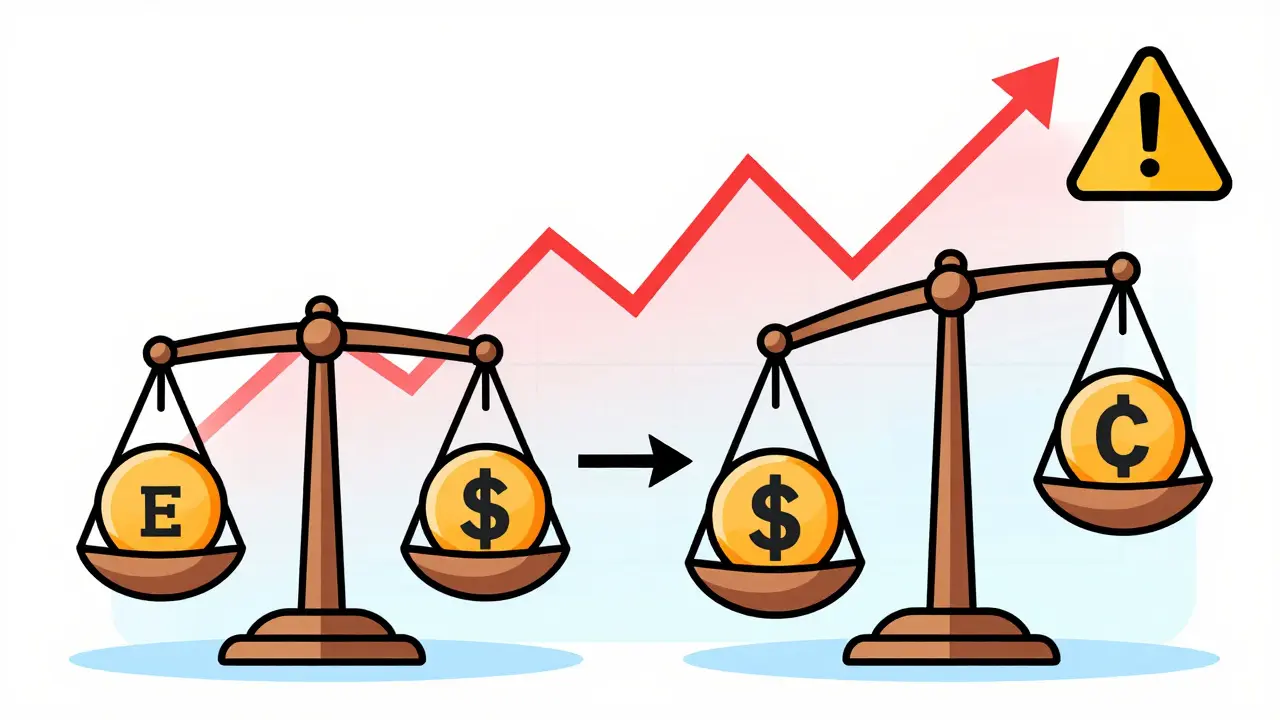
If there is one thing you must master before providing liquidity, it is Impermanent Loss. This is the silent profit killer.
Here is why it happens. When you deposit ETH and USDC, the pool keeps a balanced ratio. If ETH skyrockets in price, arbitrage bots will buy ETH from the pool (because it’s cheaper than the open market) and sell USDC into the pool. The pool ends up with less ETH and more USDC.
You still have the same total dollar value in the pool *at that moment*, but you hold fewer ETH tokens than if you had just held them in your wallet. If ETH continues to rise, you miss out on those gains compared to simply holding. Conversely, if ETH crashes, you end up holding too much worthless ETH.
It is called "impermanent" because if prices return to your entry point, the loss disappears. But if you withdraw during volatility, the loss becomes permanent.
Real-world data shows this impact. According to community reports from mid-2024, users in volatile pairs like ETH/USDT saw impermanent losses ranging from 3% to 7.5% during sharp market swings. However, if the trading fees and reward tokens you earned exceed that loss, you still come out ahead. The key is calculating whether the APY (Annual Percentage Yield) compensates for the risk.
Where to Start: Platforms and Tools
You cannot do liquidity mining on a centralized exchange like Binance. You need a Web3 wallet and a DEX. Here are the industry standards as of 2026.
- Uniswap: The largest DEX by volume. Uniswap V3 introduced "Concentrated Liquidity," allowing you to specify a price range for your funds. This boosts capital efficiency by up to 4,000%, but requires active management. If the price moves out of your range, you stop earning fees.
- Curve Finance: Specializes in stablecoins and wrapped assets (like wBTC/ETH). Because the prices stay close together, impermanent loss is minimal. This is the safest entry point for beginners.
- Balancer: Allows custom pools with three or more tokens. Great for diversification within a single position.
For tracking your positions, tools like Zapper.fi or DeBank are essential. They visualize your cross-chain holdings and calculate your real-time impermanent loss, so you aren't guessing.
Risks Beyond Impermanent Loss
Impermanent loss isn't the only danger. DeFi runs on code, and code has bugs.
Smart Contract Risk: Even audited contracts can have vulnerabilities. In 2023 alone, over $1.2 billion was lost to DeFi hacks. Always use established platforms with long track records. Avoid new, unaudited protocols offering absurdly high APYs-they are often scams or rug pulls.
Token Depreciation: Many protocols reward you in their native governance token (e.g., SUSHI, BAL). If the price of that reward token crashes faster than the fees you earn, your net return turns negative. Always check the historical price stability of the reward token.
Gas Fees: On Ethereum mainnet, transaction fees can spike to $50-$100 during busy periods. If you are mining small amounts, gas fees will eat your profits. This is why many users migrate to Layer 2 solutions like Arbitrum or Optimism, where fees are pennies.
Is Liquidity Mining Still Profitable in 2026?
Yes, but the "easy money" era of 2020 is over. Back then, protocols printed billions in tokens to attract users. Now, yields are more sustainable but lower. Expect realistic APYs of 5-15% for stablecoin pairs and 10-25% for volatile pairs, depending on market conditions.
The landscape has shifted toward efficiency. With Uniswap V3 and similar concentrated liquidity models, you must actively manage your positions. Set alerts. Rebalance when prices drift. Treat it like a part-time job, not a set-and-forget savings account.
Regulatory clarity is also improving. While the SEC remains cautious, jurisdictions like Singapore and Switzerland have provided frameworks that encourage institutional participation. As institutions enter, liquidity deepens, making markets smoother and potentially reducing extreme volatility events.
Step-by-Step: Your First Deposit
Ready to try it? Follow this safe path.
- Set Up a Wallet: Install MetaMask or Rainbow. Secure your seed phrase offline. Never share it.
- Fund Your Wallet: Buy ETH or USDC on a centralized exchange and transfer it to your wallet address. Leave some ETH for gas fees.
- Connect to a DEX: Go to Uniswap.org or Curve.fi. Connect your wallet via the "Connect Wallet" button.
- Select a Pool: Choose a pair. For low risk, pick USDC/USDT. For higher yield, pick ETH/USDC.
- Add Liquidity: Enter the amount of one token. The interface will auto-calculate the other. Review the details carefully.
- Approve and Confirm: You will sign two transactions: one to approve the token spending, and one to add liquidity. Pay the gas fee.
- Monitor: Track your position in Zapper.fi. Watch for impermanent loss alerts.
Start small. Use an amount you are willing to lose while you learn the mechanics. Once you understand how rebalancing works and how to read the charts, you can scale up.
Can I lose my entire principal in liquidity mining?
In standard liquidity mining on reputable platforms, you generally do not lose your entire principal unless one of the tokens in the pair goes to zero (rug pull) or the smart contract is hacked. However, you can lose significant value through impermanent loss combined with a market downturn. If both tokens drop in price and you suffer impermanent loss, your USD value decreases substantially.
What is the best pair for beginners?
Stablecoin pairs like USDC/USDT or DAI/USDC are the best for beginners. Since the prices of these tokens remain pegged to $1, impermanent loss is negligible. You earn primarily from trading fees and any bonus tokens, with minimal risk of price divergence.
Do I need to pay taxes on liquidity mining rewards?
In most jurisdictions, including the UK and US, rewards received from liquidity mining are considered taxable income at the fair market value on the day you receive them. Additionally, when you withdraw your liquidity, any change in value may trigger capital gains tax. Always consult a local tax professional for specific advice.
How does Uniswap V3 differ from V2?
Uniswap V2 spreads your liquidity across the entire price range ($0 to infinity). Uniswap V3 allows you to concentrate your liquidity within a specific price range. This increases your capital efficiency and potential earnings significantly, but requires active management. If the price exits your range, you stop earning fees until you rebalance.
Is liquidity mining safer on Layer 2 networks?
Layer 2 networks like Arbitrum and Optimism reduce gas costs, making frequent rebalancing affordable. However, they introduce bridge risks. Funds must be moved between Layer 1 and Layer 2 via bridges, which have historically been targets for hackers. Stick to well-established L2s and avoid bridging large sums unnecessarily.
 Finance