

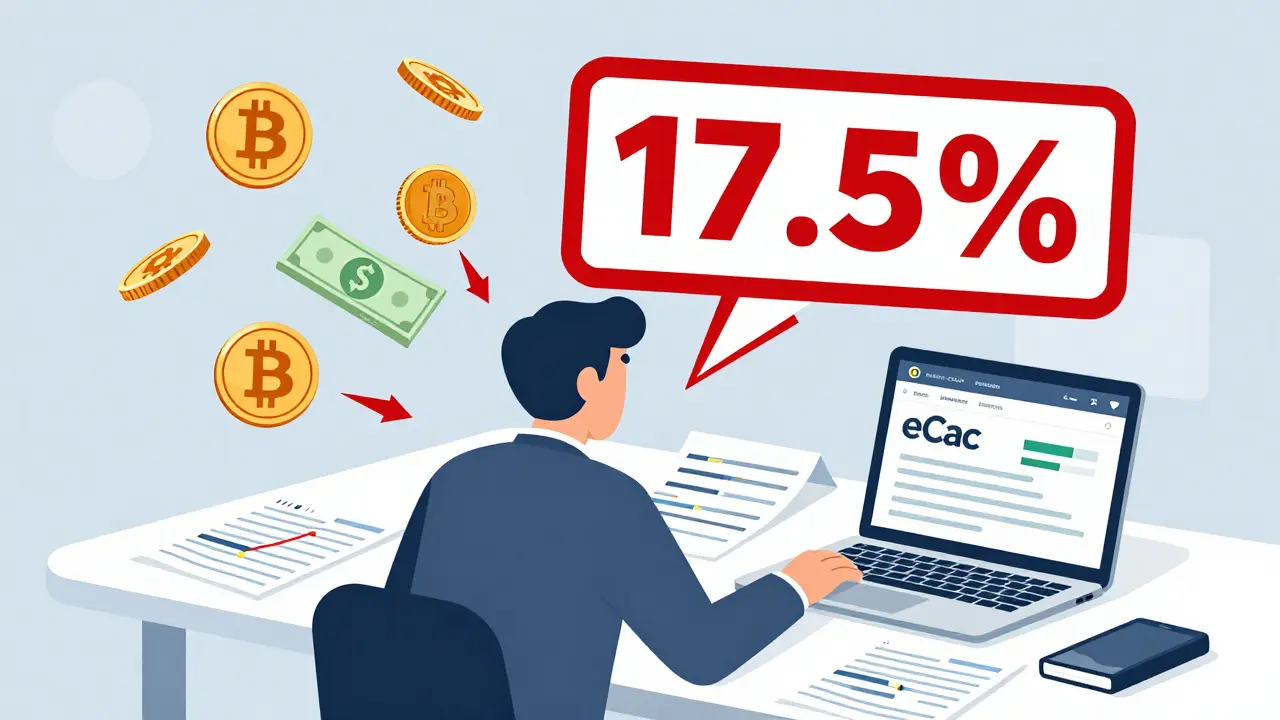
Since June 12, 2025, every crypto trade in Brazil - whether you sold Bitcoin for reais, swapped Ethereum for Solana, or earned staking rewards - is taxed at a flat 17.5%. No more exemptions. No more loopholes. If you made money, the Brazilian tax authority, Receita Federal do Brasil (RFB), wants its cut. This isn’t a suggestion. It’s the law.
What’s Actually Taxed Now?
The 17.5% rate applies to every single profit from cryptocurrency. That includes:- Selling crypto for Brazilian reais (BRL)
- Trading one crypto for another (like BTC to ETH)
- Earning staking rewards or yield from DeFi protocols
- Receiving crypto as payment for goods or services
- Mining income, if you’re running your own node
When Do You Need to Report?
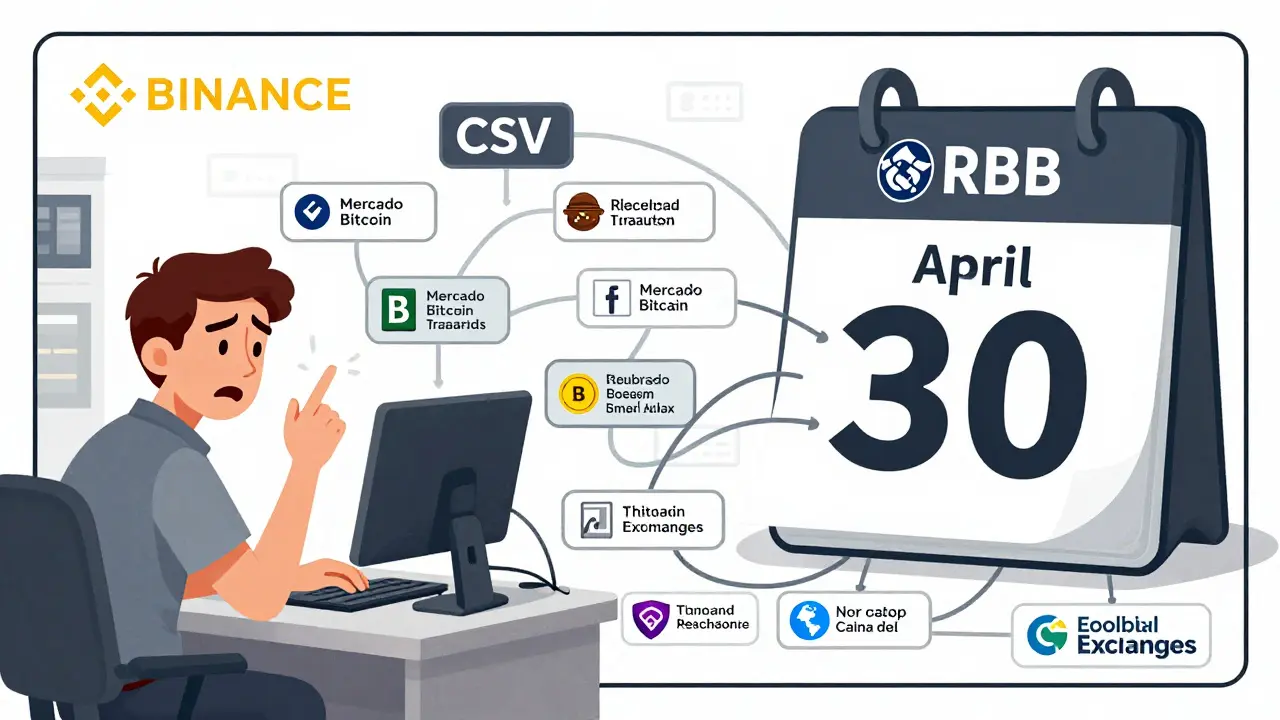
You must report every transaction if your total crypto activity in a calendar month exceeds BRL 5,000. That’s not the profit - it’s the total value of all buys, sells, and trades combined. So if you bought BRL 3,000 worth of Bitcoin and sold BRL 2,500 worth of Ethereum in the same month, you’re over the threshold. You report. The tax year runs January 1 to December 31. All reports are due by the last business day of April the following year. For the 2025 tax year, that deadline was April 30, 2026. Missing it means penalties - and they’re steep. The RFB doesn’t send reminders. They track exchange data, wallet addresses, and bank transfers. If you didn’t report, they’ll find you.How to Report: The eCac Portal
All crypto tax reporting happens through the eCac portal, Brazil’s official online tax system. You need a digital certificate (e-CPF) to log in. If you don’t have one, you can’t file - and that’s a problem for many retail investors who never needed one before. The portal doesn’t have a built-in crypto calculator. You’re expected to track every transaction yourself. That means:- Exporting trade history from every exchange (Binance, Mercado Bitcoin, Kraken, etc.)
- Recording wallet-to-wallet transfers
- Calculating cost basis for each asset
- Tracking fair market value in BRL at the time of each sale or trade
Why 17.5%? The Government’s Logic
Brazil’s crypto market exploded in 2023 and 2024. Between January and September 2024 alone, over $43.5 billion in crypto transactions occurred. That’s billions in untaxed gains. The government saw a revenue opportunity - and decided to treat crypto like stocks or real estate. Finance Minister Fernando Haddad called it “tax equity.” If you make money from stocks, you pay tax. If you make money from crypto, you pay the same. No special treatment. The 17.5% rate was chosen to be simple - no brackets, no deductions, no complexity. It’s easier to enforce. But here’s the catch: it’s also one of the most aggressive flat rates in Latin America. Compare that to Argentina, where crypto gains under $10,000 are tax-free, or Colombia, which taxes crypto at just 10% for individuals. Brazil didn’t just close the door on tax avoidance - it welded it shut.Who’s Getting Hurt? Who’s Getting Help?
Retail investors are feeling the squeeze. A Reddit user in São Paulo posted: “I used to trade $500 worth of crypto every week. Now I have to track every swap, pay a tax accountant, and risk fines if I miss one. Is it worth it?” For small traders, the compliance cost might outweigh the profit. A BRL 1,000 gain becomes BRL 825 after tax. Add BRL 200 in accounting fees? You’re left with BRL 625. Many are stepping back. Institutional traders and high-volume investors are more neutral. The flat rate gives them predictability. No more worrying about whether a 6-month hold gets a lower rate. No more guessing if DeFi rewards are taxable. Everything’s clear - even if it’s expensive.What Happens If You Don’t Report?
The RFB isn’t bluffing. They’ve started cross-referencing data from major exchanges with bank deposits and tax filings. If you sold crypto and deposited BRL 20,000 into your checking account in 2025 - and didn’t report it - you’ll get a letter. First, a notice. Then, a fine of up to 75% of the unpaid tax. Then, interest. Then, legal action. Even if you used a non-Brazilian exchange like Binance or Coinbase, the RFB can still get your data. Brazil signed tax information exchange agreements with over 70 countries. If your exchange reports to the U.S. or EU, they’re legally required to share data with Brazil.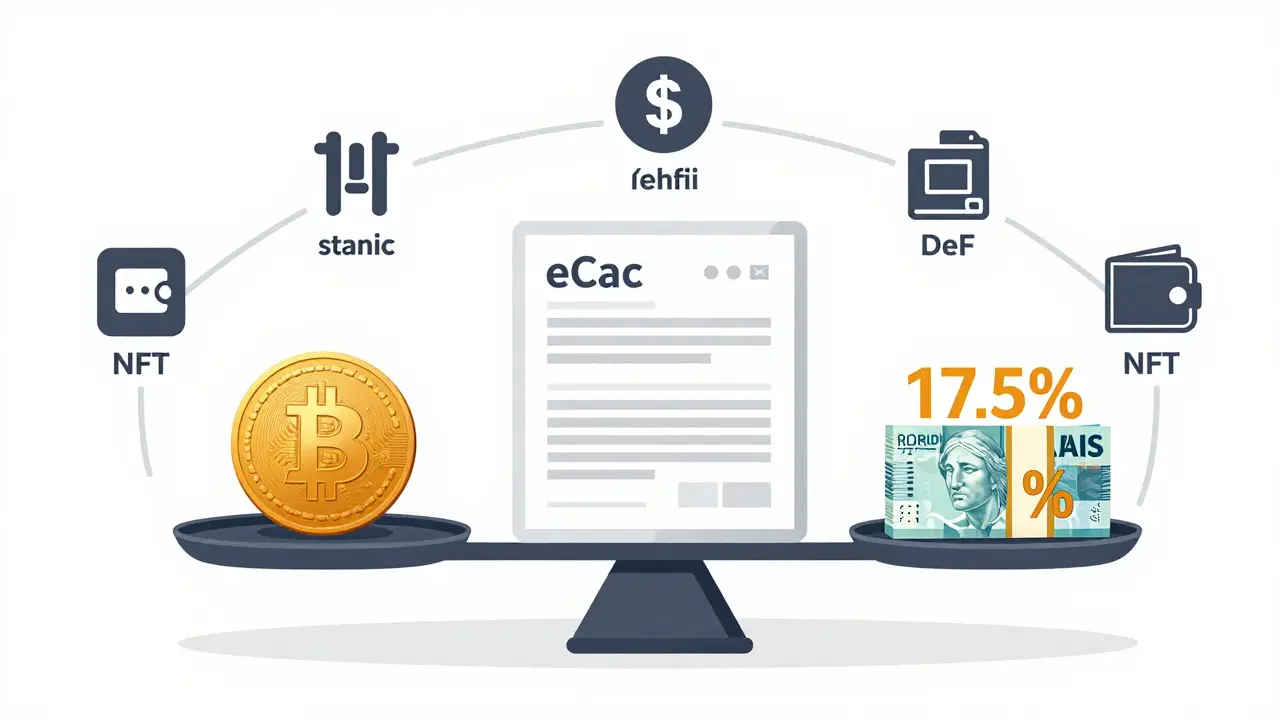
How This Compares to Other Countries
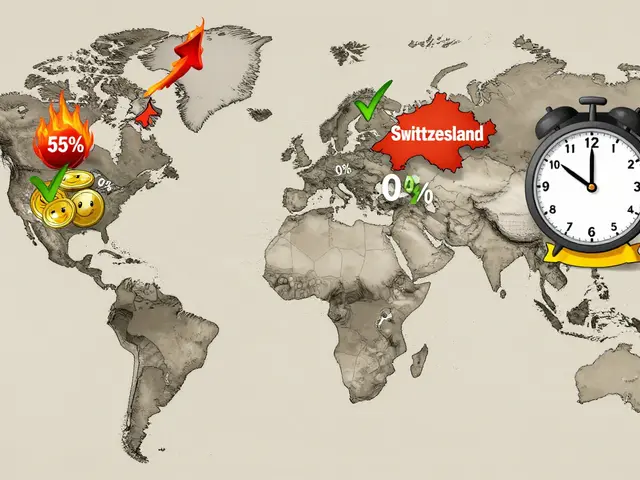
Brazil’s 17.5% rate sits in the middle globally:| Country | Tax Rate | Exemptions | Holding Period Benefit |
|---|---|---|---|
| Brazil | 17.5% | None (BRL 5,000/month reporting threshold) | No |
| Germany | 0% (after 1 year) | €600 annual tax-free allowance | Yes |
| Portugal | 28% (under 1 year) | None for residents | No |
| United Kingdom | 10-20% | £3,000 annual allowance | Yes |
| United States | 10-37% | $0 for individuals | Yes (long-term rates) |
What’s Next for Brazil’s Crypto Scene?
While the tax law tightened, the government also launched pilot programs for Drex - its own central bank digital currency. That’s no accident. Brazil isn’t trying to kill crypto. It’s trying to control it. Expect more clarity soon. The RFB is working with exchanges to automate reporting. Some platforms now offer tax reports in Portuguese. The Central Bank is also drafting rules for DeFi lending and NFT trading - both still gray areas under current law. The message is clear: if you want to trade crypto in Brazil, you play by the government’s rules. No exceptions. No grace period. No more hiding.What Should You Do Right Now?
If you traded crypto in Brazil in 2025:- Export all transaction history from every exchange and wallet you used.
- Use a crypto tax tool (Koinly, CoinTracker, or TaxBit) to calculate your gains in BRL.
- Log into eCac with your e-CPF certificate.
- Manually enter your totals under “Rendimentos de Capital” (Capital Income).
- Pay the tax by April 30, 2026, or risk penalties.
- Track every trade from day one.
- Use a single exchange if possible - fewer records to manage.
- Never ignore a BRL 5,000 monthly threshold. Even small traders get caught.
Is crypto taxed in Brazil even if I don’t cash out to reais?
Yes. Trading one cryptocurrency for another - like Bitcoin for Ethereum - is considered a taxable event. The profit is calculated based on the value in Brazilian reais at the time of the trade. You don’t need to convert to cash to owe tax.
What if I lost money on crypto trades?
Losses can offset gains in the same tax year. If you lost BRL 10,000 and made BRL 6,000, you only pay tax on the net BRL 4,000 gain. But losses can’t be carried forward to future years. You lose them if you don’t use them in the same calendar year.
Do I need to report crypto I bought before June 2025?
Yes. The tax applies to all gains realized after June 12, 2025, regardless of when you bought the crypto. If you bought Bitcoin in 2021 and sold it in 2025 for a profit, you pay tax on that gain. Your original purchase price is your cost basis - keep those records.
Can I use a tax accountant to file for me?
Yes, and many investors do. Look for accountants who specialize in cryptocurrency or digital assets. They’ll help you calculate gains, prepare eCac filings, and avoid penalties. Fees range from BRL 500 to BRL 3,000 depending on complexity.
Are NFTs and DeFi rewards taxed the same way?
Yes. NFT sales are treated as capital gains. DeFi staking rewards, liquidity mining, and yield farming are treated as income at the time you receive them - valued in BRL. You pay 17.5% on the gain when you later sell them. Keep records of every reward received.
 Finance



Caitlin Colwell
January 13, 2026 AT 06:38Jennah Grant
January 14, 2026 AT 16:30Dave Lite
January 14, 2026 AT 21:29Becky Chenier
January 15, 2026 AT 20:54Denise Paiva
January 16, 2026 AT 17:36Jon Martín
January 17, 2026 AT 07:30Mujibur Rahman
January 18, 2026 AT 07:47Dennis Mbuthia
January 18, 2026 AT 09:05Staci Armezzani
January 19, 2026 AT 13:47Tracey Grammer-Porter
January 19, 2026 AT 22:34jim carry
January 21, 2026 AT 05:12Don Grissett
January 23, 2026 AT 00:30Katrina Recto
January 23, 2026 AT 09:01Veronica Mead
January 24, 2026 AT 10:25Mollie Williams
January 26, 2026 AT 04:30Tre Smith
January 27, 2026 AT 15:00Ritu Singh
January 27, 2026 AT 23:47kris serafin
January 29, 2026 AT 16:40Jordan Leon
January 30, 2026 AT 17:21Rahul Sharma
January 30, 2026 AT 22:43