

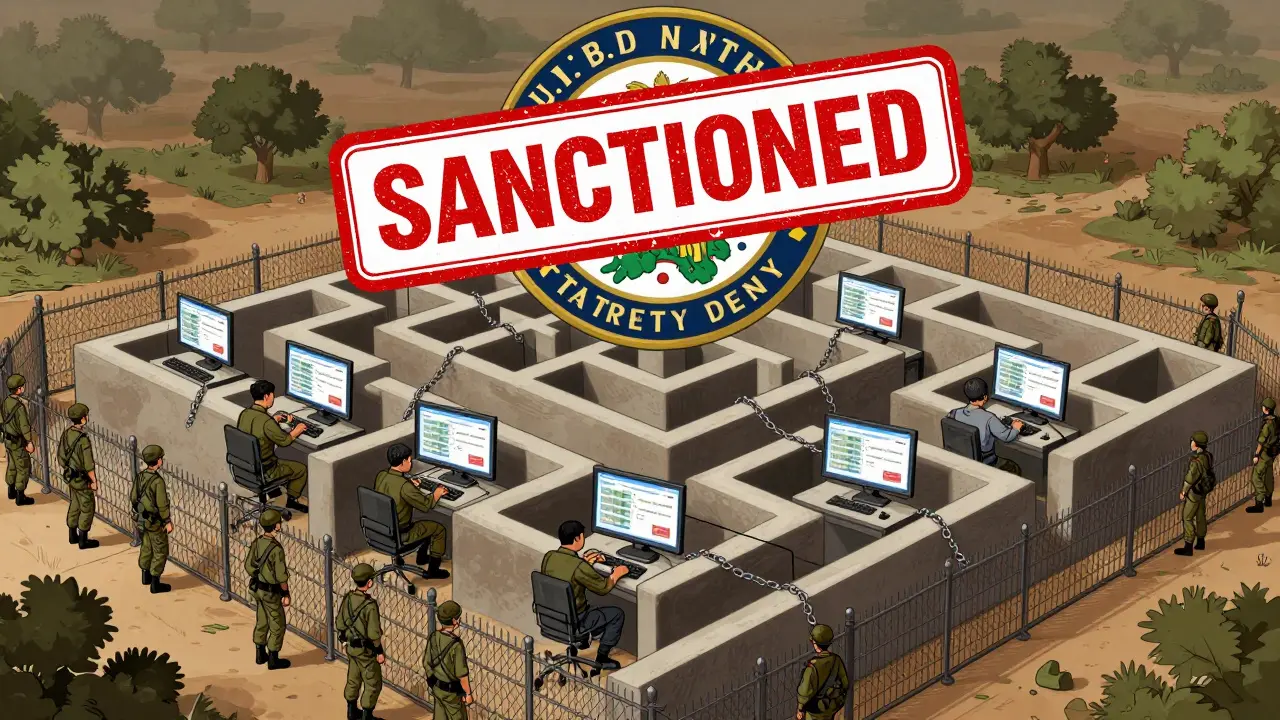
The United States has taken one of its most aggressive financial actions against cybercrime in recent history, targeting nine cryptocurrency-related entities operating out of Shwe Kokko, Myanmar. These sanctions, announced on September 8, 2025, by the Treasury Department’s Office of Foreign Assets Control (OFAC), are not just about freezing assets-they’re about dismantling an entire criminal ecosystem built on forced labor, fraud, and the anonymity of digital currencies.
At the heart of this operation is the Karen National Army (KNA) a militia group controlling parts of the Thai-Burmese border that has turned Shwe Kokko into a hub for digital asset scams. The KNA doesn’t just tolerate these scams-it protects them. In exchange for a cut of the profits, the KNA provides armed security, blocks law enforcement, and ensures the scam centers run uninterrupted. These aren’t small-time operations. They’re large, organized compounds where victims-often lured with fake job offers-are held against their will and forced to run cryptocurrency fraud schemes targeting Americans.
According to official U.S. government estimates, Americans lost over $10 billion to these scams in 2024 alone. That’s not a typo. Ten billion dollars. The Treasury Department says this represents the highest annual loss ever recorded from Southeast Asian cyber scams, with the majority of the damage traced back to operations in Myanmar. The scams themselves are chillingly simple: victims receive messages on social media or dating apps promising high returns on crypto investments. They’re directed to fake platforms that look real, with fake charts, fake customer service, and fake testimonials. Once money is sent, it’s gone. And the people running these platforms? Many of them are victims too-trapped in these compounds, threatened with violence if they don’t meet daily fraud quotas.
How the Sanctions Work
OFAC didn’t just slap a name on a list. They froze all assets these entities hold in U.S. banks or controlled by U.S. companies. They also banned any American from doing business with them-whether it’s sending money, using their services, or even interacting with their websites. This includes wallets, exchanges, and platforms that might have unknowingly processed transactions linked to these sanctioned groups.
The sanctions hit nine specific entities tied to Shwe Kokko and ten more based in Cambodia. Each one is linked to the KNA’s leadership: Saw Chit Thu, his two sons Saw Htoo Eh Moo and Saw Chit Chit, and the networks they control. The Treasury used multiple executive orders to make sure nothing was left out:
- E.O. 13851 targets transnational criminal organizations
- E.O. 13694 goes after malicious cyber activity
- E.O. 13818 addresses human rights abuses
- E.O. 14014 focuses on threats to Burma’s stability
This multi-layered approach means the U.S. isn’t just punishing fraud-it’s also calling out slavery, coercion, and political complicity. The KNA’s ties to Burma’s military regime are no longer ignored. Officials openly stated the KNA “benefits from its connection to Burma’s military,” making it clear this isn’t just a criminal issue-it’s a geopolitical one.
The Human Cost
Beneath the numbers is a brutal reality. People are being kidnapped, trafficked, and forced to scam strangers online. Many of these workers come from poor regions in Southeast Asia, tricked into believing they’re getting legitimate jobs abroad. Once they arrive, their passports are taken, they’re locked inside compounds, and forced to work 18-hour days. Refuse? Beaten. Try to escape? Shot. The U.S. government has called this modern slavery a system of forced labor and psychological torture used to sustain cryptocurrency fraud networks.
And the victims aren’t just the workers. The people being scammed-Americans, Canadians, Europeans-are left with nothing. Savings wiped out. Trust shattered. Some have lost retirement funds. Others lost money meant for medical care or education. The emotional toll is rarely discussed, but Treasury officials say these scams don’t just steal money-they steal security.
Why Crypto? Why Myanmar?
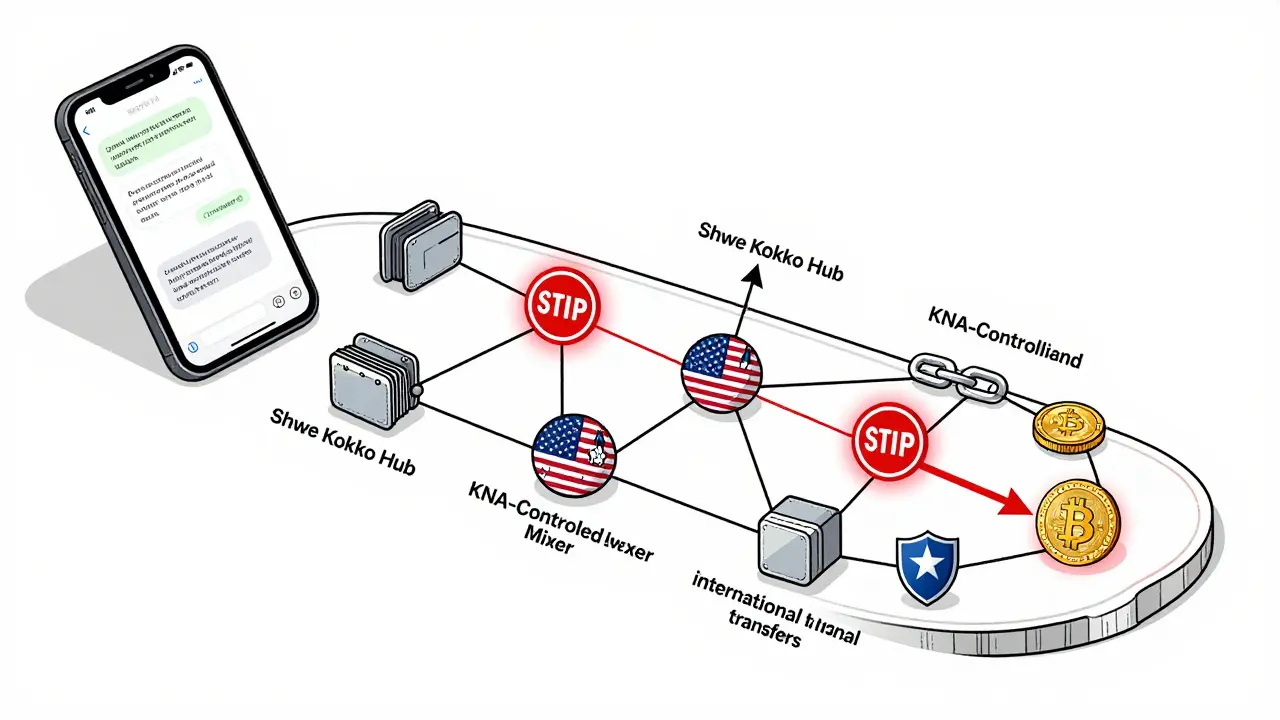
Cryptocurrency is the perfect tool for these criminals. It moves fast. It’s hard to trace. It doesn’t need banks. Once funds are sent to a wallet controlled by one of these groups, they’re often laundered through mixers, converted into stablecoins, or moved across borders before anyone can react.
Myanmar, specifically Shwe Kokko, became the ideal location because of its lawless environment. After the 2021 military coup, the central government lost control of border regions. The KNA stepped in, filled the power vacuum, and turned the area into a criminal free zone. No police. No oversight. No accountability. It’s a haven for fraud, drugs, and human trafficking-all operating in plain sight.
Cambodia, where ten other sanctioned entities operate, serves a similar role. These are not random locations. They’re chosen because they’re outside the reach of international law enforcement and inside zones where corruption is the norm.

What This Means for Crypto Users
For everyday crypto users, this doesn’t mean you can’t trade Bitcoin or Ethereum. But it does mean you need to be extra careful about where you send your money.
Some wallets, exchanges, or DeFi platforms might unknowingly interact with sanctioned addresses. That’s why major platforms like Coinbase and Kraken have started blocking transactions linked to these entities. If you’re using a wallet or service that hasn’t updated its compliance filters since 2025, you could be at risk of accidentally sending funds to a sanctioned address-even if you didn’t know it.
Experts recommend checking wallet addresses against OFAC’s sanctions list before sending large transfers. While most retail users won’t touch these addresses directly, the risk comes from third-party services that don’t screen properly. The Treasury is now requiring all U.S.-based financial institutions to monitor for these links, and many international firms are following suit.
What’s Next?
This isn’t the end. It’s the beginning. The U.S. government has signaled this is part of a broader campaign. Treasury officials said they’re “building on a series of actions taken in the last several months,” meaning more names will likely be added. There are already reports of increased cooperation between the FBI, Secret Service, and Thai and Cambodian authorities to shut down compounds.
One major shift is happening behind the scenes: intelligence agencies are now mapping out the entire financial chain-from the scammer’s phone to the final wallet that receives the money. This means future sanctions won’t just target the operators. They could hit the developers who build the fake apps, the cloud providers hosting the servers, or even the payment processors that help move the money.
There’s also talk of expanding sanctions to include officials in Burma’s military regime who directly support the KNA. If that happens, it could isolate the regime further and cut off funding streams that keep these operations alive.
For now, the message is clear: the U.S. is no longer treating these scams as a technical problem. They’re treating them as a national security threat-and they’re using every tool they have to stop them.
Are U.S. citizens allowed to send crypto to Myanmar-based entities?
No. U.S. citizens and companies are legally prohibited from engaging in any transactions with entities sanctioned by OFAC, including those linked to Myanmar’s cyber scam networks. This includes sending cryptocurrency, using services from these entities, or even interacting with their websites. Violating these sanctions can result in civil penalties or criminal charges.
How do these crypto scams actually work?
Victims are typically contacted through social media, dating apps, or fake investment forums. Scammers pose as financial advisors or traders, promising high returns on crypto investments. They create convincing fake platforms with live charts and fake customer support. Once victims send money, the funds are quickly moved through multiple wallets and converted into stablecoins or other assets to avoid detection. The people running these scams are often themselves victims-forced to work under threat of violence.
Why hasn’t Myanmar shut down these scam centers?
The Myanmar military government lost control of border regions like Shwe Kokko after the 2021 coup. These areas are now controlled by armed groups like the Karen National Army (KNA), which profit directly from the scams. The KNA provides protection, security, and infrastructure in exchange for a share of the profits. Without central authority, there’s no one with the power-or willingness-to shut them down.
Can I check if a crypto wallet is sanctioned?
Yes. The U.S. Treasury’s OFAC website provides a searchable sanctions list. While it doesn’t list every individual wallet address, it does list the entities, companies, and individuals tied to the scams. Many crypto exchanges now automatically block transactions to known sanctioned addresses. If you’re unsure, use a blockchain explorer to trace the transaction history of a wallet and look for links to known scam hubs like Shwe Kokko.
Have these sanctions been effective so far?
It’s too early to measure full impact, but there are signs of disruption. Some scam compounds have reportedly reduced operations due to difficulty moving money through U.S.-linked channels. Major exchanges have blocked known addresses. However, the criminals are adapting-using non-U.S. exchanges, decentralized platforms, and peer-to-peer transfers. The long-term goal is to make these operations financially unsustainable, not to shut them down overnight.
The U.S. sanctions on Myanmar crypto entities are not just about money. They’re about justice-for the Americans who lost everything, and for the people trapped in those compounds, forced to scam others just to survive. This is a new kind of war-one fought with financial tools, not weapons. And for the first time, the world is seeing the full cost of letting chaos go unchecked.
 Finance



bella gonzales
February 27, 2026 AT 22:36Paul Reinhart
February 28, 2026 AT 12:47Samantha Stultz
March 2, 2026 AT 02:20Robert Conmy
March 2, 2026 AT 11:16Amita Pandey
March 3, 2026 AT 07:25Jan Czuchaj
March 3, 2026 AT 21:27Patrick Streeb
March 5, 2026 AT 18:56Kenneth Genodiala
March 7, 2026 AT 00:53Michael Rozputniy
March 8, 2026 AT 01:09Shannon Black
March 9, 2026 AT 09:18Brian Lemke
March 10, 2026 AT 19:09Cheryl Fenner Brown
March 10, 2026 AT 22:20Michael Teague
March 12, 2026 AT 18:10kati simpson
March 14, 2026 AT 13:33Colin Lethem
March 16, 2026 AT 05:02lori sims
March 18, 2026 AT 00:39Reggie Fifty
March 19, 2026 AT 09:21Kristi Emens
March 19, 2026 AT 13:35