
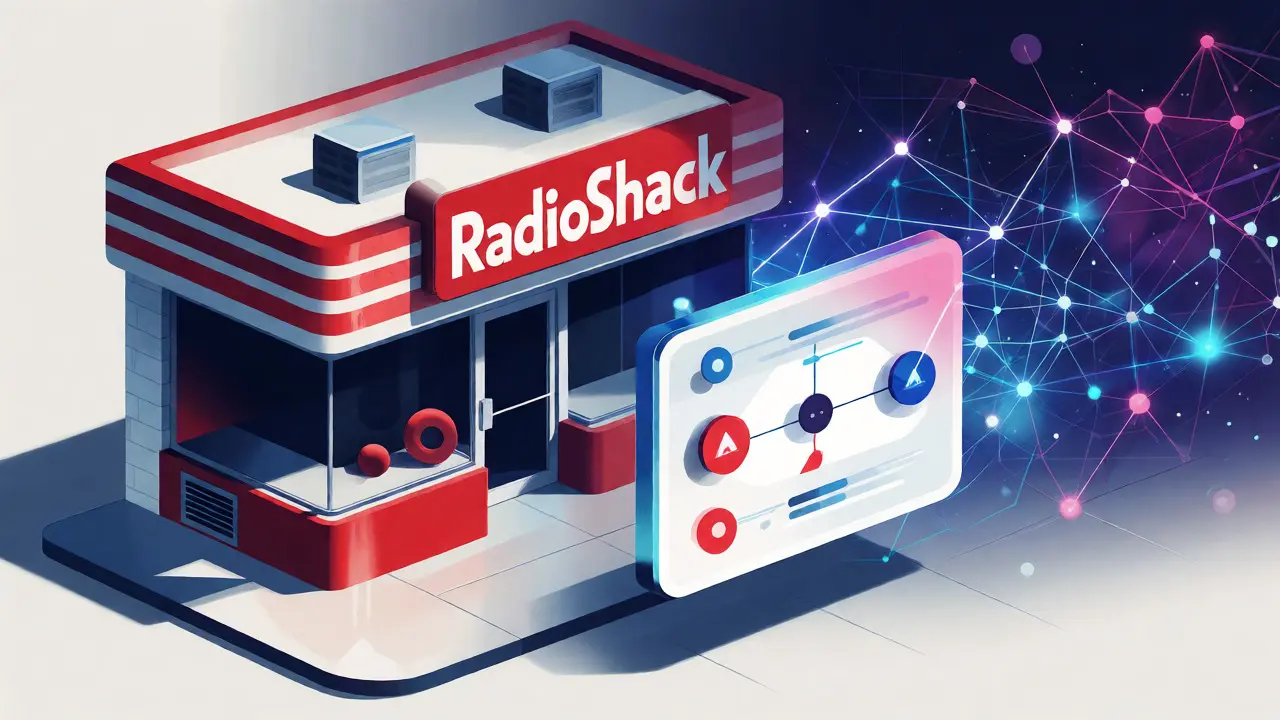
Remember the smell of fresh batteries and plastic packaging in a RadioShack store? For many, it was the gateway to electronics. Now, imagine that same brand powering your cryptocurrency trades on the Avalanche blockchain. That is exactly what RadioShack DeFi promises. But does a century-old retail name translate into trust and utility in the fast-moving world of decentralized finance? If you are considering swapping assets here, you need to know if this is a serious financial tool or just a clever marketing stunt.
The Core Proposition: Bridging Corporate Worlds
RadioShack DeFi isn't trying to compete with Uniswap on volume alone. Instead, it targets a specific gap: corporate executives who find standard DeFi interfaces intimidating. The platform launched its initial swap functionality in Q2 2025, positioning itself as the first protocol designed specifically for mainstream business leaders. Their pitch is bold: they want to be the bridge between CEOs controlling global corporations and the new world of cryptocurrencies.
This approach relies heavily on brand recognition. While newer projects struggle to build trust from scratch, RadioShack leverages roughly 100 years of history. However, trust doesn't pay gas fees. As of late 2025, the native RADIO token traded at approximately $0.0002869. This low valuation raises immediate questions about market confidence, even if the user experience aims for simplicity.
Technical Infrastructure and Swap Mechanics
At its heart, RadioShack operates as a decentralized exchange aggregator on the Avalanche network. It uses what they call "permissionless bridging technology" to connect various blockchains. The goal is true any-to-any swaps, allowing users to move assets without leaving the interface. They claim to leverage years of experience in web widgets to keep things smooth.
But let's look at the reality. Compared to established competitors like Symbiosis Finance or Rubic, RadioShack's technical documentation remains vague. Users have reported inconsistent transaction confirmations, which appeared in nearly 28% of negative reviews. One verified user noted an 8.3% slippage on a small $500 swap, while competitors handled similar trades under 2%. For a platform targeting high-net-worth individuals, such inefficiencies are hard to ignore.

User Experience: Simple but Limited
If you are a beginner, the learning curve is surprisingly shallow. A usability study from early 2026 showed an average onboarding time of just 8.7 minutes for those with basic crypto knowledge. Compare that to over 22 minutes for Symbiosis Finance, and you see why non-technical users prefer RadioShack. The interface strips away complex charts and limit orders, focusing purely on swaps.
However, this simplicity comes at a cost. Advanced traders will feel boxed in. There are no advanced charting tools, no limit orders, and limited blockchain support compared to broader aggregators. The community is also small; their Discord server had fewer than 4,000 members in early 2026, dwarfed by VoltSwap’s 18,500+. Support response times average 14 hours, which can feel like an eternity when your funds are stuck in limbo.
| Feature | RadioShack DeFi | Symbiosis Finance | VoltSwap |
|---|---|---|---|
| Primary Focus | Corporate adoption & simplicity | Cross-chain liquidity | Speed & low fees |
| Network | Avalanche | Multi-chain | Meter L2 |
| Token Price (Est.) | $0.00028 | Higher volatility | Stable utility focus |
| Community Size | ~3,800 members | Large ecosystem | ~18,500 members |
| Best For | Executives/Beginners | Active Traders | High-frequency Swaps |
Market Position and Token Performance
The RADIO token ranks around #1,843 by market capitalization. This places it far behind market leaders like Atlas DEX (#981) and Symbiosis (#427). Why so low? Partly due to skepticism. Analysts warn that brand nostalgia cannot sustain a project in a $150 billion cross-chain swap market. The SEC has even flagged retro-branded DeFi projects for potentially misleading investors if they don't clearly disclaim non-affiliation with the original retail chain.
Adoption rates reflect this hesitation. In December 2025, only 1,842 unique active wallets used the platform. That represents a mere 0.03% of the cross-chain aggregator market. While the partnership with Atlas USV provides some technical legitimacy, the lack of a clear roadmap beyond basic swaps makes long-term viability uncertain. Gartner predicts less than a 5% survival probability for such brand-nostalgia projects by 2027.
Verdict: Who Should Use It?
Should you use RadioShack DeFi? If you are a CFO or executive who wants to dip a toe into crypto without learning Solidity, yes. The simplified interface reduces friction. You get a familiar name and a straightforward swap mechanism. But do not expect institutional-grade features or deep liquidity. For serious traders, the slippage issues and limited features make alternatives like Symbiosis or Rubic better choices. RadioShack is a niche player, serving a specific demographic rather than the masses.
Is RadioShack DeFi affiliated with the original RadioShack retail company?
No, it is not directly operated by the bankrupt retail chain. It leverages the brand name through licensing or strategic partnerships to target corporate users, but it is a separate decentralized finance entity built on the Avalanche blockchain.
What is the current price of the RADIO token?
As of recent data from late 2025 and early 2026, the RADIO token has traded around $0.0002869. Prices fluctuate significantly in the crypto market, so always check live data before trading.
Does RadioShack DeFi require KYC verification?
Generally, decentralized exchanges do not require KYC for basic swaps. RadioShack DeFi focuses on permissionless access, though specific regulatory changes or corporate-focused features might introduce optional verification steps for higher limits.
What are the main risks of using RadioShack DeFi?
Key risks include high slippage on smaller swaps, limited liquidity compared to major aggregators, and potential regulatory scrutiny regarding its use of a legacy brand name. Additionally, the lack of advanced trading features limits its utility for professional traders.
How does RadioShack DeFi compare to Uniswap?
Uniswap is a general-purpose DEX with massive liquidity and advanced features. RadioShack DeFi is an aggregator focused on simplicity and corporate users. Uniswap offers better depth and lower slippage for large trades, while RadioShack offers a simpler onboarding experience for beginners.
 Finance