
Imagine sending a message to your friend, but instead of going straight through, it bounces off ten different people before arriving. Now imagine one of those people is an imposter who changes the message or stops it entirely. This is exactly what happens on the P2P (Peer-to-Peer) network, which is the decentralized communication layer that allows blockchain nodes to share transactions and blocks without a central server. It is the backbone of every major cryptocurrency, from Bitcoin to Ethereum. Without it, the ledger would not exist.
We often focus on smart contract bugs or private key theft when discussing crypto security. Those are real dangers. But there is a quieter, more fundamental threat hiding in plain sight. The network itself-the pipes that carry data-is leaking. As blockchain adoption grows, attackers are shifting their gaze from the application layer down to the infrastructure. They realize that if they can isolate a node or confuse the network, they don't need to break complex cryptography. They just need to control what the node sees.
The Anatomy of a Decentralized Network
To understand the vulnerability, you first have to understand the structure. In a traditional client-server model, like banking apps, your device talks to a central bank server. If that server goes down, everything stops. That is a single point of failure. Blockchain avoids this by using a distributed topology. Every full node connects directly to other nodes.
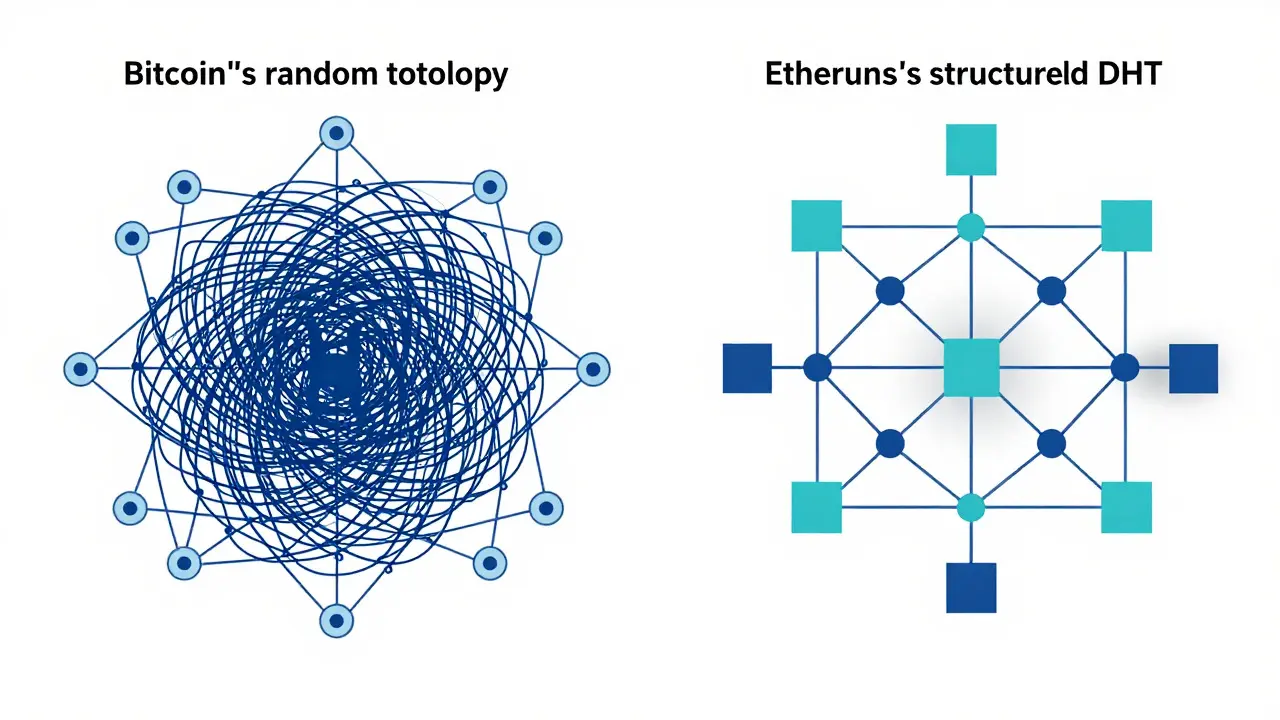
However, "distributed" does not mean "random chaos." Different blockchains organize these connections differently. Bitcoin uses a random graph topology where nodes connect to peers somewhat arbitrarily, creating a mesh-like structure. This makes it hard for an attacker to predict the path of a transaction, but it also means nodes rely heavily on the integrity of their immediate neighbors. On the other hand, Ethereum utilizes a Kademlia-based Distributed Hash Table (DHT) for efficient peer discovery and data routing. This structured approach speeds up finding specific data but introduces new attack vectors related to how nodes map IDs to locations.
The technical specs matter here. Bitcoin nodes typically limit themselves to around 8-125 outbound connections, while Ethereum nodes manage up to 125 slots. These limits are designed to save bandwidth and processing power. But they create a bottleneck. If an attacker can fill those slots with fake connections, the legitimate network is shut out. This is the core tension in P2P design: balancing resource efficiency with connection diversity.
Eclipse Attacks: Isolating the Node
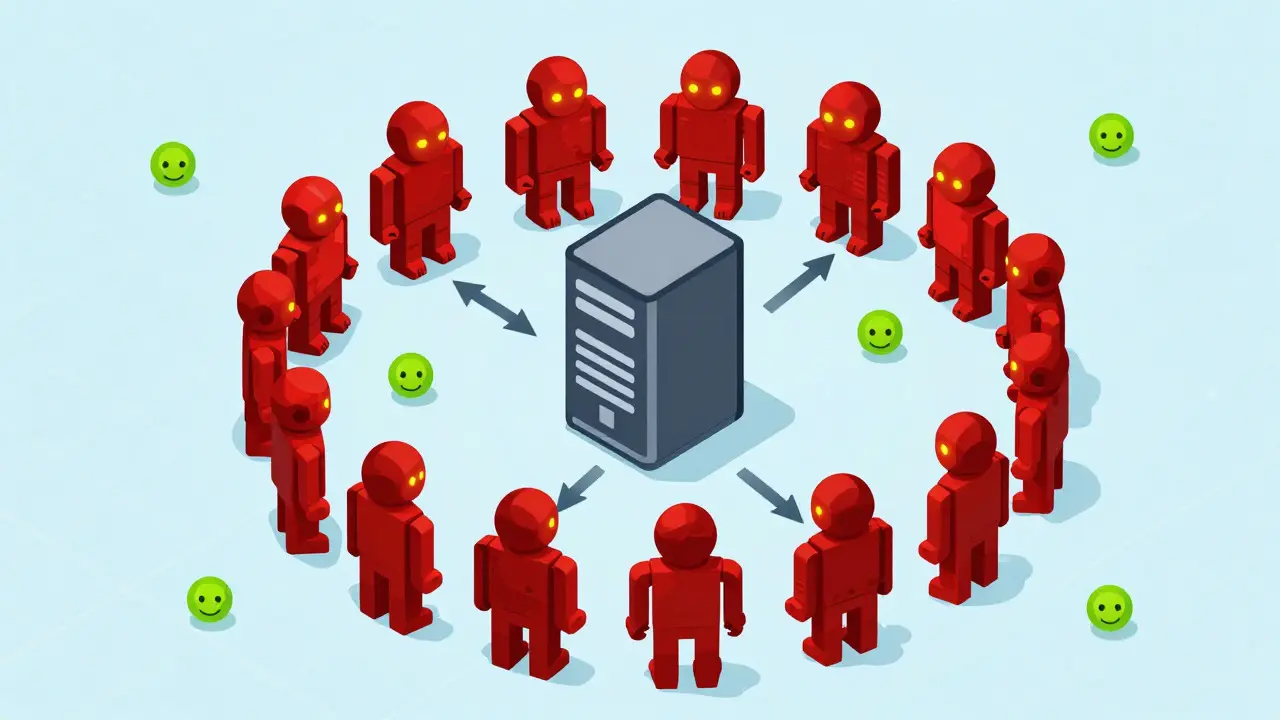
The most famous P2P vulnerability is the Eclipse Attack. The concept was detailed by researchers Heilman et al. at USENIX Security in 2015. The goal is simple: surround a target node with malicious peers until it loses contact with all honest nodes.
Here is how it plays out in practice. An attacker monitors the network for a specific victim node-perhaps a high-value wallet or a mining pool operator. Once identified, the attacker floods the victim’s connection slots with requests from thousands of IP addresses controlled by the attacker. Because the victim has a limited number of open slots, it eventually drops connections to honest peers to make room for the incoming flood. Suddenly, the victim is only talking to the attacker.
This isolation has severe consequences. The attacker can now feed the victim false information about the state of the blockchain. They can hide transactions, delay confirmations, or even convince the victim that a shorter chain is the longest valid one. In January 2019, this wasn't just theory. Monero experienced a documented eclipse attack involving approximately 130 IP addresses. Users reported transaction delays lasting 8 to 12 minutes. For a privacy-focused coin, having your transactions held hostage by network manipulation is a critical failure.
| Feature | Random Graph (e.g., Bitcoin) | Structured DHT (e.g., Ethereum) |
|---|---|---|
| Primary Strength | Resilient against targeted data manipulation | Fast peer discovery and data retrieval |
| Key Weakness | Susceptible to network partitioning and eclipse | Vulnerable to routing anomalies and ID mapping attacks |
| Attack Complexity | Requires significant IP resources to isolate targets | Can exploit structural logic flaws with fewer resources |
| Mitigation Difficulty | High (requires diverse connection sources) | Medium (requires robust hashing and validation) |
Beyond Eclipse: New Threat Vectors
If you think eclipse attacks are the only concern, you are looking at outdated data. The landscape has evolved. A pivotal moment came with the NDSS '23 paper introducing the "Gethlighting Attack." Researchers demonstrated that on Ethereum, you didn't need to completely eclipse a node to cause damage. You could disrupt it with just 1.5% of the total network bandwidth.
This changed the economics of attacking. Previously, defenders assumed that launching a successful P2P attack required massive botnets and huge financial investment. The Gethlighting study proved that sophisticated, low-resource attacks could achieve denial-of-service effects. This led to emergency hotfixes in Geth v1.11.0 in March 2023. Users on Reddit reported swap failures lasting nearly an hour during the initial attack window, highlighting how quickly theoretical risks become user-facing pain points.
Furthermore, structured networks face unique issues. The Georgia Tech DISL project in 2022 showed how malicious nodes could manipulate routing tables in DHTs. By tweaking how nodes map IDs, attackers could isolate specific data items, making them invisible to the rest of the network. This is particularly dangerous for applications relying on fast data lookup, as it effectively creates "blind spots" in the blockchain's memory.
The Human Factor: Configuration Errors
Even if the protocol is sound, the implementation often fails. Dr. Emin Gün Sirer from Cornell University noted in his 2024 IEEE keynote that 78% of consensus failures originate from network layer issues, not cryptographic flaws. Much of this comes down to poor configuration by node operators.
Qualysec’s 2023 pentesting report found that only 63% of analyzed blockchain networks properly implemented certificate pinning for node authentication. Worse, 68% of public nodes had incorrectly configured firewall rules. Why does this matter? If a node doesn't verify the identity of its peers via TLS 1.2+ encryption correctly, it becomes easy for an attacker to spoof a legitimate peer. If firewalls are too open, the node is exposed to scanning and slot-filling attacks.
Consider the average node operator. According to Blockdaemon’s 2024 State of Node Operations Report, they have about 4.7 years of IT experience. While skilled, many are not networking specialists. Setting up a full Bitcoin node requires managing TCP/IP connections, monitoring bandwidth (nodes need ~50GB monthly upload), and handling storage growth. One misstep in the `bitcoin.conf` file or `geth` startup parameters can leave a node wide open.

Defending the Perimeter
So, how do we protect the network? There is no silver bullet, but a layered defense works. First, diversify your connections. Don't rely on a single DNS seed list. Use multiple sources to discover peers. This makes it harder for an attacker to dominate your view of the network.
Second, implement strict peer scoring. Ethereum adopted EIP-5845 to penalize peers that behave badly. If a node sends invalid data or disconnects frequently, its score drops, and eventually, it gets banned. Bitcoin Core introduced connection diversity requirements in July 2024 (PR #27891) to prevent IP-based targeting. These mechanisms ensure that malicious peers are ejected faster than they can cause harm.
Third, enforce encryption and validation. Always use TLS 1.3 for node communication where supported. Validate every packet. Rate-limit incoming connections to prevent slot starvation. Apriorit’s security team recommends HTTPS connections with SSL verification as a baseline for any serious node operation.
Finally, stay updated. The arms race is ongoing. Ethereum’s planned DevP2P 2.0 upgrade in Q2 2026 aims to reduce the attack surface by 70%. Bitcoin continues to refine its gossip protocols. Ignoring updates leaves you vulnerable to exploits that were patched months ago.
The Future of P2P Security
The stakes are rising. The global blockchain security market is projected to hit $12.71 billion by 2028, driven largely by demand for P2P protection. Regulatory frameworks like the EU’s MiCA, effective December 2024, now require robust network layer security assessments for service providers. This means compliance is no longer optional; it’s a legal requirement.
Yet, challenges remain. Dr. Ari Juels warned at Black Hat 2025 that quantum networking advancements could undermine current P2P models within 5-7 years. We may need complete architectural redesigns. Until then, the focus must be on hardening existing protocols. Hybrid architectures, like Polkadot’s parachain setup, offer interesting paths forward by balancing decentralization with centralized relay security.
For the individual user, the lesson is clear. Trust, but verify your connections. Your wallet’s security depends not just on your private key, but on the health of the network nodes broadcasting your transactions. Keep your software updated, monitor your node’s peer list, and assume that someone is always trying to isolate you.
What is an Eclipse Attack in blockchain?
An Eclipse Attack occurs when an attacker monopolizes all of a target node's connections, isolating it from the rest of the honest network. This allows the attacker to feed the victim false information about the blockchain state, potentially delaying transactions or causing double-spends.
How can I protect my node from P2P vulnerabilities?
To protect your node, use multiple DNS seeds for peer discovery, enable TLS encryption for communications, implement strict firewall rules, and keep your node software updated to the latest version. Additionally, monitor your peer list for unusual activity and consider using peer scoring systems if available.
Is Bitcoin more secure than Ethereum regarding P2P attacks?
Both have different strengths and weaknesses. Bitcoin's random graph topology is resilient against data manipulation but vulnerable to network partitioning. Ethereum's structured DHT allows for faster data retrieval but faces risks from routing anomalies. Neither is inherently "more secure"; they face different types of P2P threats.
What is the Gethlighting Attack?
The Gethlighting Attack, described in an NDSS '23 paper, demonstrated that attackers could disrupt Ethereum nodes using only 1.5% of network bandwidth. Unlike traditional eclipse attacks, it did not require complete isolation of the target, proving that low-resource attacks could still cause significant denial-of-service effects.
Why are P2P vulnerabilities considered a major risk?
P2P vulnerabilities bypass cryptographic security. Even if the math behind the blockchain is unbreakable, an attacker can compromise the network layer to hide transactions, delay confirmations, or isolate nodes. Experts estimate that 78% of consensus failures stem from network layer issues rather than cryptographic flaws.
 Finance