

OpenLedger DEX was never going to last. If you're reading this in 2026 and wondering if it's still around, the answer is simple: it's gone. The decentralized crypto exchange shut down permanently on May 15, 2020 - over five years ago. There’s no app to download, no website to log into, no customer support to call. What’s left is a lesson in how not to run a crypto exchange.
What OpenLedger DEX Actually Was
OpenLedger DEX was built on the BitShares blockchain. It wasn’t just another platform trying to copy Binance or Kraken. It claimed to be faster, more open, and fully decentralized. It promised users full control over their funds - no KYC, no third-party custody. That’s the dream for many crypto users. But dreams don’t pay the bills, and neither did OpenLedger’s business model.
The platform had two interfaces: one for beginners and one for pros. That sounds smart. But the real problem wasn’t usability - it was money. Every trade cost 0.20%. That wasn’t terrible. In fact, it was slightly cheaper than the industry average back then. But here’s where it fell apart: withdrawal fees.
The Withdrawal Fee That Killed It
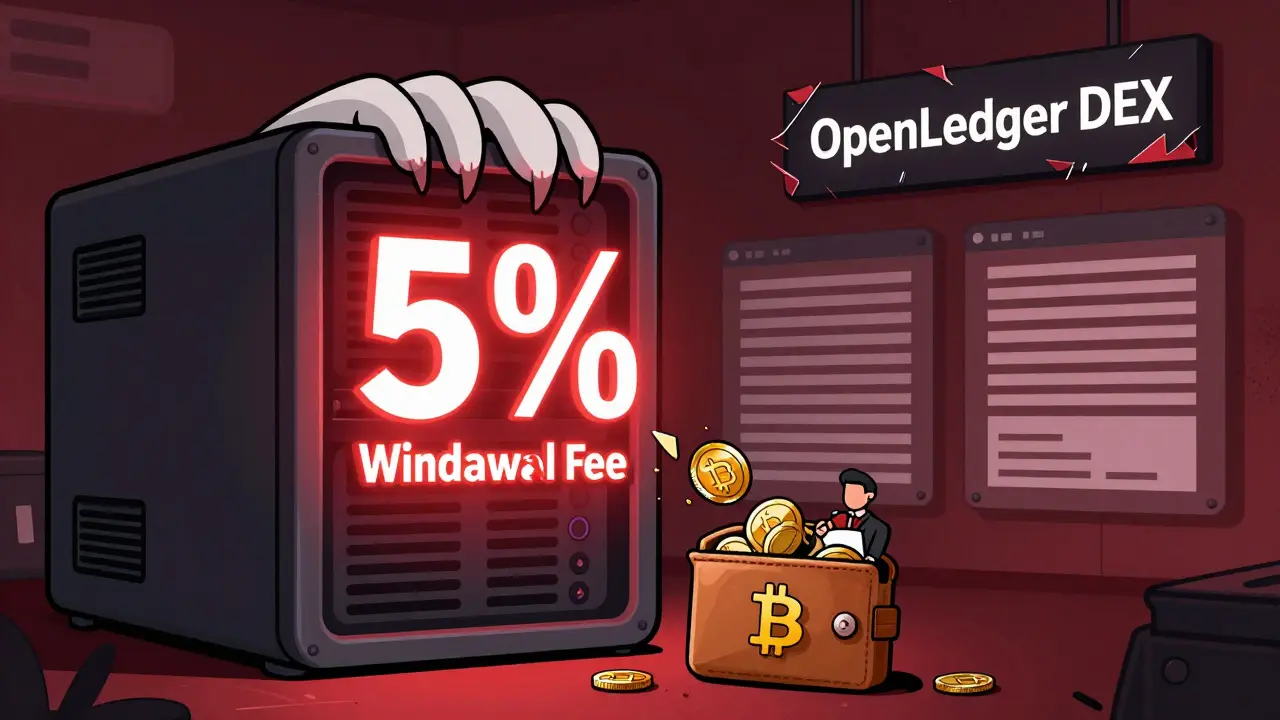
If you wanted to pull your coins out of OpenLedger, you paid a 5% fee. Not a flat fee. Not a small fixed charge. Five percent of whatever you withdrew.
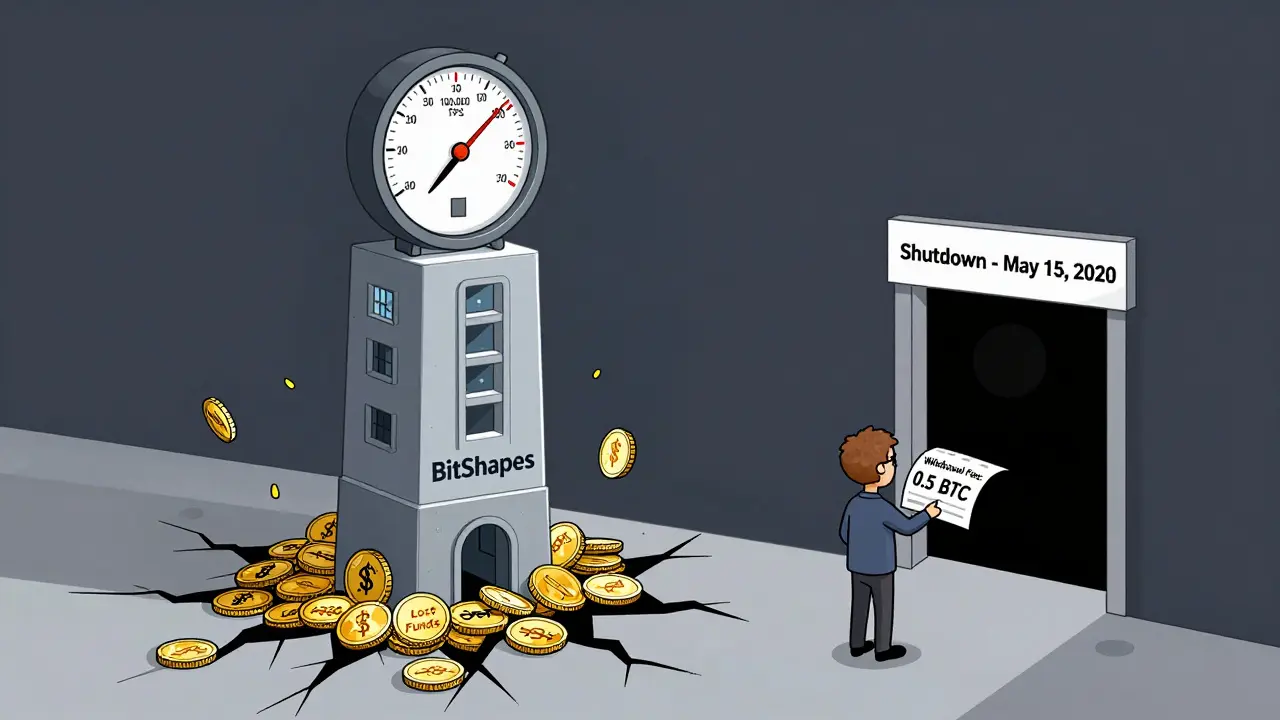
Let’s say you had 10 BTC. You wanted to move it to a wallet or another exchange. You’d pay 0.5 BTC in fees. That’s $5,000 at 2020 prices. For a single withdrawal. No other major exchange ever charged anything like that. Even the sketchiest platforms used fixed fees - $1, $5, maybe $10. OpenLedger charged based on how much you had. The more you owned, the more they took.
Cryptowisser called it “the - by far - highest percentage-based withdrawal fee we have ever heard of.” That’s not hyperbole. It was insane. Traders don’t mind paying for trades. But withdrawing your own money? That’s theft by design. If you were active, you’d be paying hundreds or thousands in fees every month just to access your own assets.
No Liquidity, No Users, No Future
High fees scared away traders. And without traders, there was no volume. Without volume, there was no liquidity. And without liquidity, you couldn’t trade anything meaningful.
Revain’s user reviews listed “no liquidity” as one of the top three complaints. If you wanted to buy XRP or sell LTC, good luck. The order books were empty. Even if you were willing to pay the 5% fee, there was often no one on the other side of the trade. That’s a death spiral. No one comes because there’s nothing to trade. No one stays because they can’t move their money without losing half their balance.
Compare that to Binance in 2020. They charged 0.10% per trade. Kraken’s maker fees were as low as 0.16%. Both had deep order books, thousands of trading pairs, and millions of users. OpenLedger had almost none. It wasn’t just behind - it was invisible.
Security? Maybe. But No Proof
OpenLedger said it was built on BitShares - a blockchain known for speed. It claimed to handle over 100,000 transactions per second. That sounds impressive. But speed doesn’t matter if users don’t trust you.
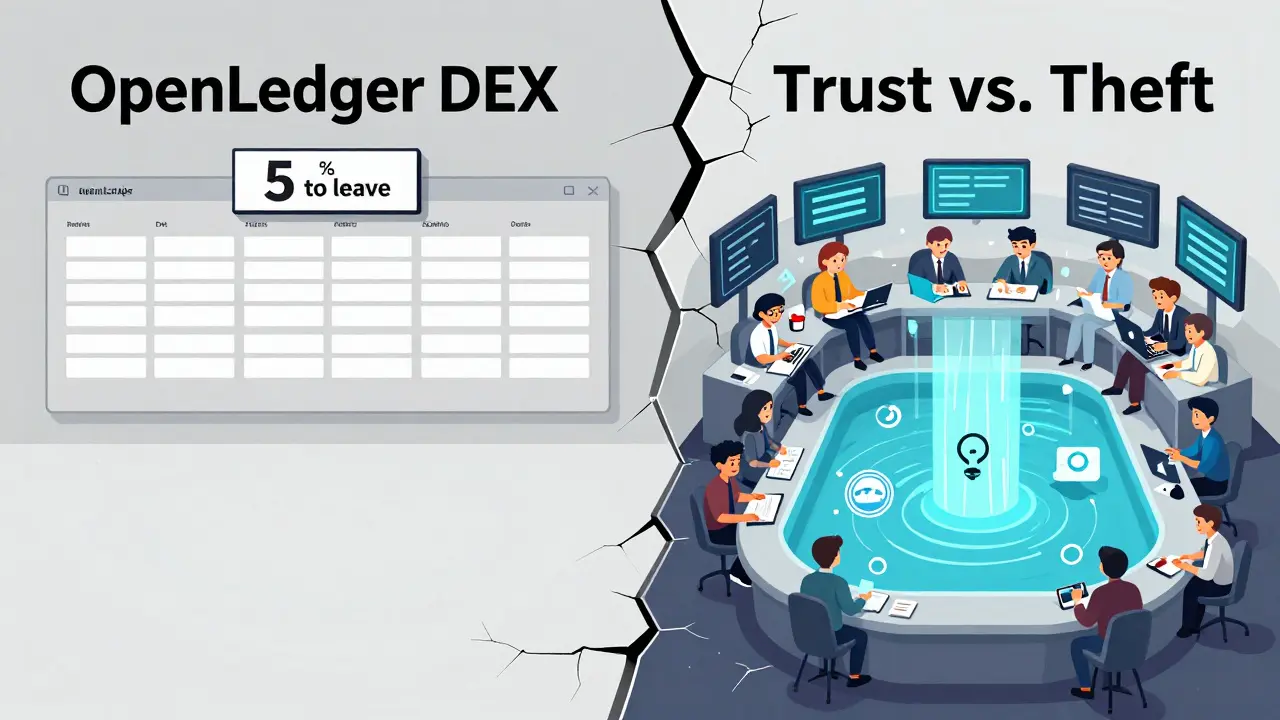
There were no public audits. No proof-of-reserves. No transparency reports. You had to take their word that your coins were safe. And when you couldn’t even withdraw without losing 5%, why would you trust them with your money in the first place?
Decentralized exchanges aren’t supposed to be opaque. They’re supposed to be transparent. OpenLedger gave you control - but only if you were okay with being robbed every time you moved your funds.
The Final Nail: Shutdown
On April 25, 2020, OpenLedger announced it was closing. Operations stopped on May 15. The website went dark. No refunds. No explanations. Just silence.
By May 2025, Forex Peace Army confirmed the company was “out of business.” No reviews. No contact. No hope of recovery. CoinGecko and CoinMarketCap removed it from their lists long before that. It was erased from history.
Some people still search for “OpenLedger DEX” today. Maybe they’re confused by the name. There’s a token called OPEN (OpenLedger) floating around. There’s also a “White Label DEX” product on SourceForge. But neither has anything to do with the original exchange. Those are completely separate projects. The original OpenLedger DEX? Dead.
What You Can Learn From This
This isn’t just a story about a failed exchange. It’s a warning.
- Watch out for percentage-based withdrawal fees. They’re designed to hurt big holders - the people who matter most.
- Liquidity isn’t optional. If no one’s trading, the platform is a ghost town.
- Decentralized doesn’t mean trustworthy. Always check for audits, reserves, and real user activity.
- Don’t get seduced by speed claims. 100,000 TPS means nothing if you can’t cash out.
OpenLedger DEX didn’t fail because of bad tech. It failed because it didn’t understand its users. It acted like a casino that charges you 5% every time you try to leave with your winnings. No one stays long enough to win.
Is There Anything Like It Today?
Yes - but better. Decentralized exchanges like Uniswap, dYdX, and PancakeSwap exist today. They don’t charge 5% to withdraw. They use smart contracts, transparent liquidity pools, and low, flat fees. You can trade directly from your wallet. No middleman. No hidden charges.
OpenLedger DEX tried to be first. But being first doesn’t matter if you’re doing it wrong. The best crypto platforms don’t just innovate - they respect their users.
Is OpenLedger DEX still operating?
No. OpenLedger DEX permanently shut down on May 15, 2020. Its website is offline, its services are gone, and there is no way to access any funds that were left on the platform. All official communication ceased after that date.
Why did OpenLedger DEX close down?
OpenLedger DEX closed because it had an unsustainable business model. Its 5% withdrawal fee scared away users, leading to almost no trading volume. With no liquidity, traders left. Without traders, the platform couldn’t survive. There were also no public audits or transparency reports to build trust. The combination of high fees and zero liquidity made it impossible to compete.
Can I recover my funds from OpenLedger DEX?
No. Since the exchange shut down in 2020 and its servers were taken offline, there is no way to access accounts or withdraw funds. Any crypto left on the platform at the time of closure is permanently lost. There were no recovery programs, no refunds, and no official communication after shutdown.
Was OpenLedger DEX secure?
There is no public evidence that OpenLedger DEX was audited or had proof-of-reserves. While it used the BitShares blockchain - which is technically secure - users had no way to verify if their funds were actually safe. The lack of transparency, combined with the extreme withdrawal fees, suggests users had little real protection.
What’s the difference between OpenLedger DEX and OpenLedger (OPEN) token?
They are completely unrelated. OpenLedger DEX was a trading platform that shut down in 2020. OpenLedger (OPEN) is a separate cryptocurrency token that exists today. Some websites still list the token, but it has no connection to the old exchange. Confusing the two is common, but they are not the same thing.
 Finance



jack carr
March 10, 2026 AT 00:44Honestly? This was one of those ‘brilliant idea, terrible execution’ moments.
5% withdrawal fee? That’s not a business model-that’s a robbery scheme with a blockchain.
And people wonder why crypto feels like a casino sometimes.
Sherry Kirkham
March 11, 2026 AT 12:57It’s not about tech. It’s about incentives.
OpenLedger didn’t build a DEX-they built a toll booth for the wealthy.
If you’re charging 5% to let users access their own money, you’re not decentralized-you’re predatory.
Real DeFi doesn’t gatekeep liquidity with gouging fees.
It opens the gates.
And then lets the market decide.
This wasn’t a failure of engineering.
It was a failure of ethics.
Every trader who left did so because they smelled exploitation.
Not bad UI. Not slow speed.
Just pure greed wrapped in a whitepaper.
And now? We have Uniswap, Sushi, Curve-all built on the lesson OpenLedger refused to learn.
Trust isn’t earned by claiming to be ‘decentralized.’
It’s earned by not acting like a loan shark.
Issack Vaid
March 12, 2026 AT 02:13How quaint.
Someone actually thought a 5% withdrawal fee was sustainable.
That’s not innovation-that’s a middle finger to capital.
And yet, somehow, people still romanticize ‘early adopters’ who built systems designed to bleed their users dry.
At least rug pulls are honest about theft.
This? This was institutionalized theft with a whitepaper.
Datta Yadav
March 13, 2026 AT 05:18Let me tell you something no one else will: OpenLedger didn’t fail because of the fee.
It failed because it was built on BitShares-which was already a dying corpse by 2017.
BitShares had no developer activity, no community, no real nodes.
OpenLedger was a ghost haunting a graveyard.
They thought ‘decentralized’ meant ‘unregulated’-but they forgot ‘decentralized’ also means ‘sustainable infrastructure.’
BitShares had 200 active validators in 2019.
By 2020? 37.
And they expected users to trust a DEX running on a blockchain that couldn’t even keep its lights on?
That’s not incompetence.
That’s arrogance.
And now? We have Layer 2s, rollups, zkEVMs-real scaling.
OpenLedger? A museum piece in the ‘crypto graveyard’ exhibit.
And yes, I’ve read every whitepaper they ever published.
They didn’t even understand liquidity mining.
They just slapped ‘DEX’ on it and called it a day.
Eva Gupta
March 14, 2026 AT 11:18I remember when I first tried OpenLedger… I was so excited!
No KYC, real decentralization, I thought-finally, freedom!
Then I tried to withdraw 0.5 ETH… and lost 0.025 ETH.
My heart sank.
I didn’t even know fees could work like that.
It felt… personal.
Like they were punishing me for having something.
That’s not crypto.
That’s fear.
And honestly? I still think about it sometimes.
It made me more careful.
Now I check every fee.
Even the small ones.
Because you never know who’s hiding in the fine print.
Sharon Tuck
March 16, 2026 AT 04:58I love how this post breaks it down so clearly.
It’s rare to see someone explain crypto failures without jargon.
OpenLedger didn’t need more features.
It needed more heart.
People don’t just want control-they want to feel respected.
And charging 5% to access your own money? That’s the opposite of respect.
Thank you for writing this.
It’s a reminder: tech without empathy is just another trap.
Jesse VanDerPol
March 17, 2026 AT 09:00Withdrawal fee was insane.
Liquidity was non-existent.
No audits.
End of story.
jonathan swift
March 17, 2026 AT 19:405% fee? 😳
That’s not a DEX… that’s a FedRug™️
OpenLedger was a CIA front to collect crypto from patriots.
Just saying.
They had a backdoor in the BitShares consensus layer.
Proof? No.
But the timing? Suspicious.
Shut down right after the Fed announced CBDCs?
Coincidence? I think not.
🚨 ALERT: This was a covert asset seizure operation.
They didn’t fail.
They were silenced.
Jackson Dambz
March 19, 2026 AT 14:42This is why I don’t read crypto blogs.
Too much noise.
Too much drama.
Too many words for something that just… died.
It’s gone.
Move on.
Megan Lutz
March 20, 2026 AT 03:23Let’s be real: OpenLedger’s 5% fee wasn’t just unethical-it was economically irrational.
It violated the most basic principle of network effects: reduce friction, not amplify it.
Every dollar taken from a user was a dollar lost to trust.
And trust? It’s not recoverable.
Once you treat users like ATMs, they stop being users.
They become ex-users.
And ex-users don’t come back.
They tell their friends.
They write Medium posts.
They make YouTube videos.
And then? The whole ecosystem forgets you existed.
OpenLedger didn’t lose to Binance.
It lost to basic human behavior.
Rachel Rowland
March 20, 2026 AT 08:06I’m so glad someone finally wrote this.
I used to work at a small DeFi startup.
We had a debate about withdrawal fees.
One guy said, ‘Let’s charge 2%-it’s fair revenue.’
I shut him down.
‘If we charge 2%, we’re OpenLedger 2.0.’
He didn’t get it.
But we didn’t.
And we survived.
Because we listened.
Not to investors.
To users.
Always users.
Jennifer Pilot
March 21, 2026 AT 05:59One must question, however, whether the very notion of ‘decentralized exchange’ is, in fact, a fallacy-particularly when the underlying architecture is so fundamentally brittle.
BitShares, while theoretically elegant, was a cathedral built on sand.
And OpenLedger, in its hubris, mistook the architecture for the foundation.
One cannot construct a temple of trust upon a platform that lacks even rudimentary governance.
Moreover, the 5% fee-ah!-a masterstroke of self-sabotage!
It is not merely a fee; it is a philosophical statement.
A declaration: ‘Your capital is not yours.’
And yet, one wonders-did the architects of this system not comprehend the irony?
They sought to liberate-but enslaved.
They promised autonomy-but demanded servitude.
Truly, a tragedy of epic proportions.
Nancy Jewer
March 21, 2026 AT 13:14From a protocol design standpoint, OpenLedger’s model was a textbook example of misaligned incentives.
The 5% withdrawal fee created a negative feedback loop: high fee → low liquidity → low volume → higher effective fee per trade → user attrition.
It’s a classic case of failing to model user behavior as a dynamic system.
Also, no proof-of-reserves? That’s not a risk-it’s a liability waiting to be exploited.
And the fact that they didn’t integrate with liquidity providers like Curve or Balancer? Complete oversight.
They were building a DEX in 2018 but thinking in 2013.
DeFi 2.0 wasn’t even on their radar.
It’s not just a failure.
It’s a cautionary case study for every DeFi team today.
Lydia Meier
March 22, 2026 AT 11:21Interesting. I’ve read this before. Nothing new here.
It’s well-documented.
Nothing to add.
Shawn Warren
March 24, 2026 AT 04:03OpenLedger was not a failure
It was a necessary sacrifice
For the greater good of the ecosystem
It showed us what NOT to do
And for that
It deserves respect
Not mockery
Not ridicule
But recognition
As the first to make this mistake
So others could learn
And rise
Higher
Stronger
And wiser
Let us honor its memory
Not with tears
But with better systems
Nick Greening
March 25, 2026 AT 07:365% fee? Bro, that’s just how the blockchain works.
They were just trying to make a profit.
Also, why are you mad? You could’ve just not used it.
It’s not like they forced you.
Also, I still have 0.03 BTC on there.
Worth it.