

Ecuador Crypto Transaction Fee Calculator
When you hear the phrase underground crypto Ecuador, a picture of secret deals on dark web forums might pop up. The reality in Ecuador is a mix of a clear legal framework and a shadowy undercurrent that few can quantify. This article peels back the layers, explains what the law says, how legitimate platforms operate, and why an underground market could still exist despite the regulations.
What the law actually says
Underground cryptocurrency market refers to the illicit buying, selling, or swapping of digital assets outside of regulated channels is not a term you’ll find in Ecuadorian statutes. Instead, the government classifies cryptocurrencies as legal to trade but not legal tender. That means you can own Bitcoin, Ethereum, or USDT, but you can’t use them to pay for a loaf of bread.
The 2018 electronic‑money law introduced AML (anti‑money‑laundering) and KYC (know‑your‑customer) obligations for any exchange that wants to operate openly. Exchanges must verify users’ identity, monitor transactions, and report suspicious activity. Failure to comply can result in hefty fines or suspension of operations.
Where the legal market lives
International exchanges have set up shop for Ecuadorian users. Platforms such as CEX.IO, Bybit, Gemini, and Bit2Me provide a full suite of services - from buying Bitcoin with a credit card to staking USDT for passive income. These services obey the AML/KYC rules, employ two‑factor authentication, and store the majority of assets in cold wallets certified to ISO 27001 and SOC 2 Type 2 standards.
Peer‑to‑peer (P2P) marketplaces also operate legally. Binance P2P and LocalCoinSwap let users meet directly, but the platforms still require registered accounts and enforce transaction limits to curb fraud. A typical Binance P2P trade for 50 USDT costs about $50.80, including a modest $0.80 commission, and the funds first land in a “funding wallet” before the buyer moves them to a spot wallet for further trading.
Why an underground market might still thrive
Even with a regulated environment, several pain points push some users toward the shadows:
- High fees: Some legal exchanges charge up to 2 % on purchases, which can add up for frequent traders.
- Limited payment methods: Not everyone has access to a credit card that works with foreign platforms. Cash‑only users may look for alternative routes.
- Privacy concerns: KYC requirements mean personal data is stored on central servers, a red flag for privacy‑focused individuals.
These gaps create a fertile ground for informal networks - cash‑handed‑over deals, private Telegram groups, or even local meet‑ups where crypto is exchanged without any digital trail. Because the country does not criminalize crypto ownership, law enforcement often focuses on money‑laundering rather than the act of trading itself, making it harder to crack down on “underground” activity.
Typical players in the hidden scene
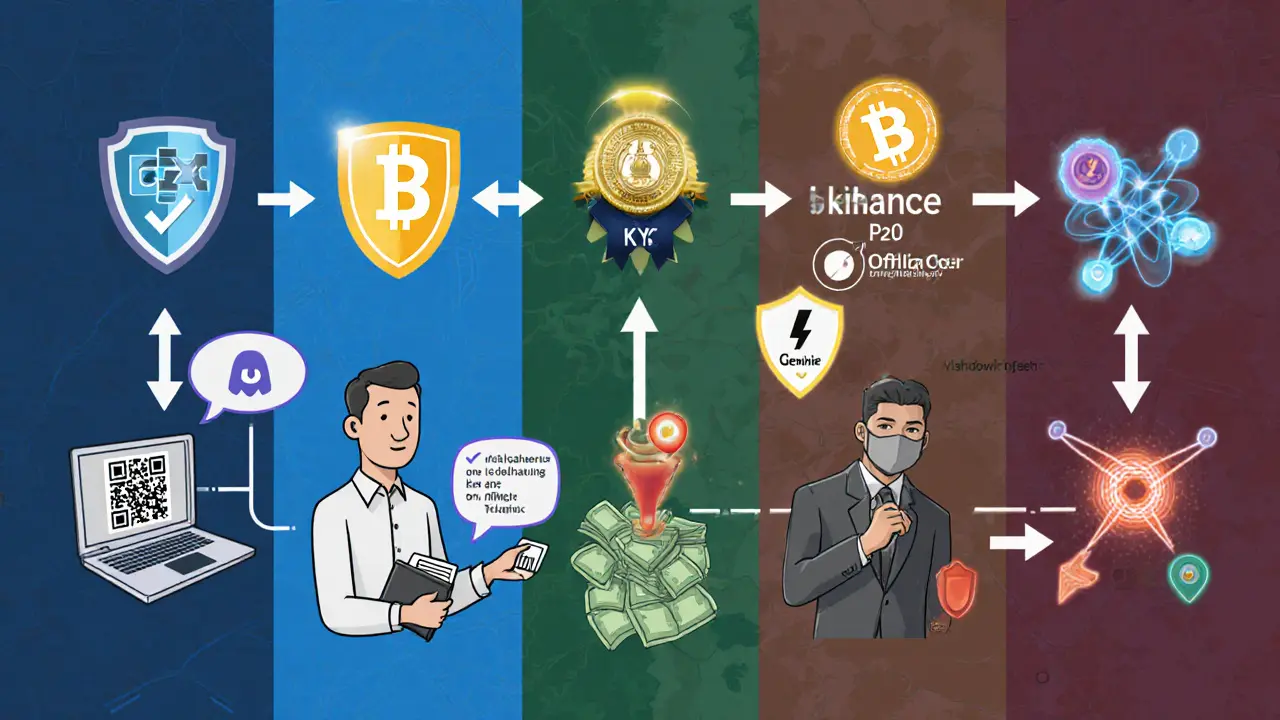
Based on anecdotal reports from Ecuadorian forums and regional news, the underground market consists of three main groups:
- Cash dealers: Individuals who accept local currency in person and hand over a paper wallet or QR code for Bitcoin or USDT.
- Online brokers: Operators who run private Discord or WhatsApp channels, offering “instant” crypto swaps for a premium fee.
- Money‑launderers: Criminal groups that use crypto to move proceeds from illicit activities, often blending legitimate exchange accounts with black‑market trades.
These actors typically avoid any traceable KYC process, meaning the transaction chain can be extremely short - cash → offline wallet → occasional “mixing” service → re‑entry into a legal exchange.
Risks you should know
Participating in an unregulated market carries heavy risks:
- Scams: No escrow or dispute resolution; once you hand over cash, there’s no recourse.
- Legal gray area: While owning crypto isn’t illegal, using the proceeds of an illicit transaction could trigger anti‑money‑laundering investigations.
- Security: Offline wallets are vulnerable to loss or theft, and there’s no customer support if something goes wrong.
For these reasons, most experts advise starting with a regulated exchange, then only moving to private deals if you fully understand the mechanics and accept the potential loss of funds.
Choosing a platform - legal vs. underground
| Platform | Legal Status | Typical Fees | Risk Level |
|---|---|---|---|
| CEX.IO | Legal (AML/KYC) | 0.5‑2 % | Low |
| Binance P2P | Legal (registered accounts) | 0‑0.8 % (platform fee) | Medium |
| Cash dealer (offline) | Unregulated | 5‑15 % premium | High |
| Private Discord broker | Unregulated | 3‑10 % premium | High |
When you compare the numbers, the legal side offers transparency and protection, while the underground side swaps convenience for a steep risk premium.
How to stay safe if you dip into the underground market
- Start small: Trade amounts you can afford to lose.
- Verify reputation: Use community‑vetted escrow services or ask for references.
- Move funds quickly: Transfer to a secure hardware wallet, then to a regulated exchange for conversion.
- Document everything: Keep screenshots of chat logs and transaction IDs; they may help if authorities get involved.
- Know the law: Avoid converting illegal proceeds into fiat without a clear paper trail.
Following these steps doesn’t eliminate risk, but it reduces the chance of getting burned.
Looking ahead - what could change?
Ecuador has flirted with a state‑issued digital currency in the past, but the project never launched. If the government revisits a central‑bank digital currency (CBDC), it could tighten controls over crypto gateways, pushing more users toward covert channels. Conversely, clearer guidance on tax reporting and a push for broader financial inclusion might shrink the underground market by making legal routes more affordable.
For now, the ecosystem remains a hybrid: a regulated core surrounded by a fringe of private trades that fill the gaps left by fees, privacy concerns, and payment‑method limitations.
Quick checklist for Ecuadorian crypto users
- Check exchange compliance: look for AML/KYC, ISO 27001, SOC 2 certification.
- Compare fees across CEX.IO, Binance P2P, and local P2P platforms.
- Assess privacy needs - consider using a hardware wallet for long‑term storage.
- Stay aware of the legal line: owning crypto is fine; using illicit proceeds can invite investigation.
- If you must use an underground channel, keep trade amounts low and document everything.
Is cryptocurrency illegal in Ecuador?
No. Ecuador permits buying, selling, and holding cryptocurrencies, but they are not recognized as legal tender. You cannot use Bitcoin to pay for everyday goods, and exchanges must follow AML/KYC rules.
Can I use a local bank to buy crypto?
Some legal exchanges, like Bit2Me, allow bank transfers. However, many users prefer P2P platforms because banks may charge extra fees or block crypto‑related transactions.
What are the biggest risks of trading on the underground market?
Scams, lack of recourse, possible money‑laundering investigations, and the chance of losing funds due to poor security practices are the main dangers.
Are there any reputable P2P platforms that operate legally?
Yes. Binance P2P and LocalCoinSwap require registered accounts, enforce transaction limits, and cooperate with local regulators, making them safer than completely unregulated private brokers.
How can I protect my privacy while staying within the law?
Use a reputable exchange for the initial buy, then transfer the assets to a hardware wallet. When you need to trade again, move only the required amount back to a regulated exchange, keeping your on‑chain activity minimal.
 Finance


Ryan Comers
October 20, 2025 AT 08:22So the article paints Ecuador’s crypto scene as some secret cabal, but the reality? It’s just regular folks trying to dodge fees. 🙄 The government isn’t hunting Bitcoin lovers, they’re after the money‑launderers. 🇺🇸 Anyway, if you think the “underground” is a myth, you’re living in a bubble. 🚀
Prerna Sahrawat
October 23, 2025 AT 17:31One must first acknowledge that the mere existence of a regulated framework does not, by itself, extinguish the allure of a market that operates beyond the purview of statutory oversight.
While the author has commendably catalogued the statutory provisions, the narrative neglects the sociocultural undercurrents that render the “underground” not merely a reactionary phenomenon but a sophisticated response to systemic inefficiencies.
The predilection for anonymity among certain strata of Ecuadorian technophiles, for instance, is less a matter of sheer illicit intent than an aesthetic choice rooted in a philosophical tradition that venerates privacy as a sacrosanct right.
Moreover, the persistent friction between high exchange fees and the modest incomes of many users cultivates an environment ripe for alternative, peer‑to‑peer mechanisms.
It would be a scholarly oversight to dismiss these mechanisms as merely “shady”, for they often embody the very principles of decentralization that the blockchain ideology espouses.
In addition, the linguistic nuance of the term “underground” itself warrants scrutiny, as it implicitly imposes a binary moral judgment that fails to capture the gradient of legitimacy present in the market.
The author’s focus on “cash dealers” and “online brokers” as discrete categories also obscures the fluidity with which actors migrate between regulated and unregulated spheres.
One must also consider the geopolitical dimension: Ecuador’s historical flirtation with state‑issued digital currency introduces a latent risk that could, paradoxically, amplify the very clandestine activity the state seeks to curtail.
This dialectic between governmental oversight and market innovation is not a novel story, yet its specific manifestation in the Andean context offers fertile ground for comparative analysis.
The omission of empirical data regarding transaction volumes on platforms such as Binance P2P, for example, weakens the article’s evidentiary foundation.
Likewise, the reliance on anecdotal reports, while valuable, should be triangulated with on‑the‑ground ethnographic research to substantiate claims about “private Discord brokers”.
The risk matrix presented, albeit thorough, could benefit from a more granular segmentation that distinguishes between the varied threat vectors inherent to each actor class.
A deeper exploration of anti‑money‑laundering enforcement patterns would illuminate why law enforcement appears more concerned with the proceeds of crime than the act of crypto trading itself.
In sum, the piece offers a commendable overview, yet it stops short of delivering the nuanced, interdisciplinary perspective that such a complex socio‑technical ecosystem demands.
Future scholarship should therefore aspire to integrate legal analysis with cultural anthropology, thereby rendering a more holistic portrait of Ecuador’s crypto landscape.
Until then, the reader is left with an informative yet incomplete mosaic of a market that continues to evolve in the shadows of both regulation and innovation.
Nikhil Chakravarthi Darapu
October 27, 2025 AT 01:40Ecuador’s legal stance treats crypto as a taxable asset, not as legal tender, which aligns with global AML standards. Exchanges operating openly must implement KYC procedures, and any deviation invites regulatory penalties. The underground market persists primarily due to fee differentials and limited payment options for cash‑only users. Participants should therefore assess the trade‑off between privacy and compliance before engaging in off‑exchange transactions.
Tiffany Amspacher
October 30, 2025 AT 10:48In the grand theater of finance, Ecuador plays the role of a reluctant protagonist, bound by law yet yearning for freedom. The article sketches the stage, but the deeper drama lies in the human desire to circumvent invisible shackles. When a user hands over cash for a QR code, it becomes a ritual of rebellion against bureaucratic inertia. Such acts, while risky, echo the timeless quest for autonomous value creation.
Lindsey Bird
November 2, 2025 AT 19:57What a waste of time.
john price
November 6, 2025 AT 05:05I think the article missed the point about how crazy high fees can push people into shady deals. Its not just about law, its about real people with real wallets. If you dont watch out you can lose cash fast. So be smart, dont just follow the hype.
Ty Hoffer Houston
November 9, 2025 AT 14:14The key takeaway for newcomers is to start with a reputable exchange that complies with AML/KYC, then consider moving funds to a hardware wallet for added privacy. P2P platforms like Binance can bridge the gap for those without credit cards, but always verify counterparties. Community forums often share tips on minimizing fees and avoiding scams. Stay informed, and you’ll navigate the ecosystem safely.
Ryan Steck
November 12, 2025 AT 23:22Did you ever notice how every time a new crypto rule drops, they claim it's to protect us but the real agenda is total control? The gov't and big banks are probably using these AML regs to track every single transaction, even the legit ones. There's a reason the underground market stays hidden. Wake up, people, the surveillance state is watching.
James Williams, III
November 16, 2025 AT 08:31From a technical standpoint, leveraging cold storage with ISO‑27001 certification dramatically reduces the attack surface for custodial breaches. Meanwhile, P2P liquidity pools offer arbitrage opportunities that can offset the marginal fee spread on centralized exchanges. However, you must monitor slippage and counterparty risk, especially in low‑volume markets. In practice, a hybrid strategy-centralized onboarding followed by decentralized off‑ramping-optimizes both compliance and efficiency.
Scott McCalman
November 19, 2025 AT 17:40Let’s get this straight: the “underground” isn’t some mythic dragon, it’s simply market participants reacting to fee structures and privacy concerns. 😎 The legal exchanges are fully compliant, and the risk comes from bypassing KYC. 📈 If you’re looking for arbitrage, study the spread between CEX.IO and Binance P2P. 🔥 Knowledge beats fear every time.
PRIYA KUMARI
November 23, 2025 AT 02:48The article glosses over the obvious: most of these “underground” operators are scammers preying on inexperienced users. Their premium fees are nothing more than extortion, and the lack of escrow guarantees a one‑way loss. Anyone who doesn’t vet a broker properly is asking to be ripped off. The market is a cesspool, and the piece fails to call it out.
Jessica Pence
November 26, 2025 AT 11:57Honestly, the best move is to start on a platform like Bit2Me that lets you fund via bank transfer-it's safe and you avoid crazy cash‑dealer premiums. Just double‑check the fee schedule; sometimes they hide extra costs. If you need to move to a P2P site, use Binance’s escrow feature, it adds a layer of protection. And always keep a backup of your wallet seed.
johnny garcia
November 29, 2025 AT 21:05From an epistemological perspective, the dichotomy between regulated and unregulated crypto markets reflects a broader tension between state authority and individual sovereignty. 🧐 While the legislative framework imposes order, it simultaneously engenders incentives for clandestine activity. 📜 Therefore, a prudent participant must cultivate both legal compliance and crypto‑literacy to navigate this duality. 🗝️ In doing so, one reconciles the paradox of freedom within constraint.
Andrew Smith
December 3, 2025 AT 06:14Great stuff! It’s encouraging to see that legal exchanges are stepping up with better security and lower fees. If we keep pushing for wider adoption, the underground market will shrink naturally. Keep the community informed and supportive.
John Lee
December 6, 2025 AT 15:22Wow, this deep dive really paints a vivid picture of the crypto ecosystem in Ecuador. The contrast between shiny, compliant platforms and the gritty street‑level swaps feels like a cyber‑noir novel. I love how the author breaks down the fee structures – it’s like a menu of choices for the savvy trader. The mention of hardware wallets reminds us that security isn’t just a buzzword, it’s a lifeline. And the potential CBDT twist adds a sci‑fi flavor to the whole saga. Overall, a compelling read that balances data and drama.
Jireh Edemeka
December 10, 2025 AT 00:31Oh, sure, because reading a dense legal article is exactly how I spend my weekends. But if you must indulge, note that the “underground” is less a secret society and more a pragmatic response to high fees. The author could have saved us the lecture by simply stating that cash‑only users seek cheaper alternatives. Anyway, good luck navigating that maze.
del allen
December 13, 2025 AT 09:40Hey folks, just wanna say the article is pretty solid but i think it could use more on how to keep ur privacy safe 😊. Using a hardware wallet is key, and maybe some tips on anon mixers would be cool. Also, don’t forget to check the exchange’s KYC policy before you dive in 😂. Stay safe out there!
Jon Miller
December 16, 2025 AT 18:48Seriously, this whole underground crypto thing sounds like a thriller movie. I mean, cash deals in dark alleys? It’s wild! But hey, if you’re into the hype, just make sure you ain’t getting scammed.
Rebecca Kurz
December 20, 2025 AT 03:57Crypto is risky, it’s illegal sometimes, it’s expensive, it’s private, it’s fast, it’s confusing, it’s worth learning, it’s evolving, you need caution, you need knowledge.
Elizabeth Chatwood
December 23, 2025 AT 13:05Look the underground scene can be scary but you can handle it if you stay sharp and keep learning it’s not impossible to stay safe just be smart and use tools like hardware wallets and reputable exchanges
Tom Grimes
December 26, 2025 AT 22:14When evaluating the risks of participating in Ecuador’s covert crypto channels, one must first appreciate the human element that drives such behavior.
The allure of anonymity is not merely a technical preference but a sociopsychological safeguard against perceived overreach.
Many users, especially those in rural areas, lack access to conventional banking, which makes cash‑only transactions an attractive alternative.
The financial literacy gap further compounds the problem, as individuals may not fully understand fee structures on regulated platforms.
Consequently, they gravitate toward “cash dealers” who promise swift, fee‑free exchanges for a premium.
However, these dealers operate without any oversight, leaving participants exposed to fraud, theft, or forced laundering.
The absence of escrow mechanisms means that once cash changes hands, recovery is virtually impossible.
Moreover, the legal gray area surrounding the use of illicit proceeds can trigger anti‑money‑laundering investigations, even if the crypto itself is legally owned.
Law enforcement in Ecuador tends to focus on money‑laundering rather than crypto possession, creating a paradox where the act is benign but the funds’ origin is scrutinized.
This regulatory nuance encourages a cat‑and‑mouse dynamic, where underground actors continuously adapt to evade detection.
Technologically, the use of mixing services adds another layer of opacity, further obscuring transaction trails.
Yet, mixing also introduces additional counter‑party risk, as users must trust unfamiliar services with their assets.
From a risk‑management perspective, the prudent strategy is to limit exposure: trade modest amounts, document every interaction, and swiftly move assets to a hardware wallet.
Ultimately, while the underground market fills a niche left by high fees and limited payment options, it does so at a steep cost to personal security and legal certainty.
Paul Barnes
December 30, 2025 AT 07:22Sure, the regulated exchanges are fine, but they’re also a gatekeeper that stifles true decentralization. If you want real freedom, you have to look beyond the “legal” veneer.