
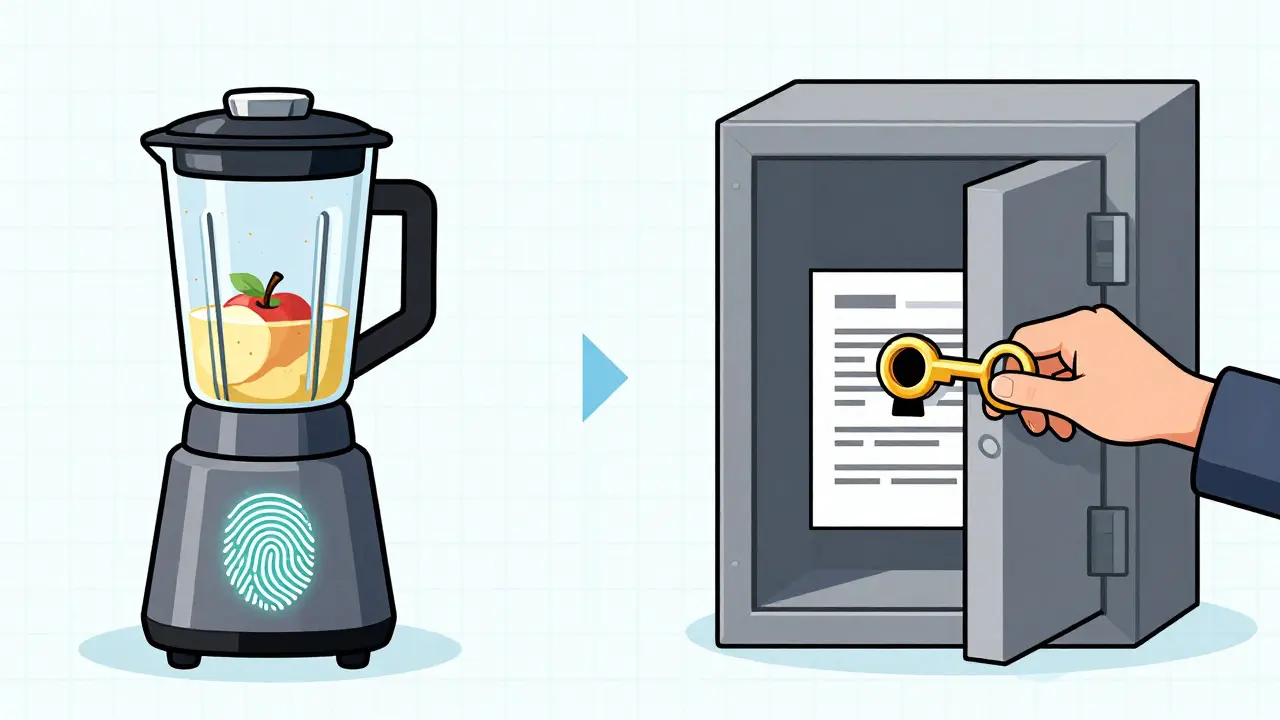
Imagine you are trying to verify that a document hasn't been altered. You could lock it in a safe (encryption) so only the owner can open it, or you could take a unique fingerprint of the document (hashing) to check if it matches the original record. In blockchain technology, both methods work together, but they solve completely different problems. Confusing these two concepts is one of the most common mistakes developers and investors make when evaluating network security. Understanding the distinction between cryptographic hashing and encryption is essential for grasping how Bitcoin, Ethereum, and other distributed ledgers maintain trust without a central authority.
This article breaks down the technical mechanics, performance metrics, and real-world applications of both systems. We will look at why hashing provides the structural backbone of the chain while encryption handles user identity and transaction authorization. By the end, you will know exactly which algorithm protects what part of your wallet and why losing a private key is far more dangerous than finding a hash collision.
The Core Difference: One-Way vs Two-Way
Cryptographic Hashing is a one-way mathematical function that transforms input data of any size into a fixed-length output called a hash value. Think of it like a blender. You can put an apple in, blend it, and get smoothie. But you cannot un-blend the smoothie to get the exact same apple back. The process is irreversible. If you change even a single letter in the input data, the resulting hash changes completely. This property is known as the avalanche effect. In blockchain, this ensures that if someone tampers with a block, its hash changes, breaking the link to the next block and alerting the entire network.
Encryption, on the other hand, is a two-way process that converts plaintext into ciphertext using keys and can be reversed with the appropriate decryption key. It is like a locked box. Anyone can see the box, but only the person with the specific key can open it to read the contents. Once opened, the original information is fully recoverable. In blockchain, encryption is primarily used for asymmetric cryptography, where a public key allows anyone to send funds to you, but only your private key allows you to spend them.
| Feature | Cryptographic Hashing | Encryption |
|---|---|---|
| Reversibility | One-way (Irreversible) | Two-way (Reversible with key) |
| Output Size | Fixed length (e.g., 256 bits for SHA-256) | Variable length (depends on input and algorithm) |
| Primary Purpose | Data integrity and linkage | Confidentiality and authentication |
| Key Requirement | No key required | Requires private/public key pair |
| Speed | Very fast (approx. 3.7x faster than encryption) | Slower (approx. 0.3ms per signature on modern hardware) |
| Main Risk | Collision attacks (theoretically infeasible for SHA-256) | Private key compromise |
How Hashing Builds the Chain
Hashing is the glue that holds the blockchain together. Every block in a chain contains the hash of the previous block. This creates a chronological, immutable ledger. If you try to alter a transaction in Block 100, the hash of Block 100 changes. Consequently, Block 101 no longer points to the correct hash of Block 100, and the chain breaks. To fix it, an attacker would need to re-mine all subsequent blocks, which requires more than 50% of the network's computing power.
The standard algorithm used in Bitcoin is SHA-256, a secure hash algorithm that produces a 256-bit hash. Despite its name, it generates a 64-character hexadecimal string. This deterministic nature means that the same input always produces the same output. For example, the hash of the empty string is always 'e3b0c44298fc1c149afbf4c8996fb92427ae41e4649b934ca495991b7852b855'. Developers rely on this consistency for Merkle trees, which allow users to verify their transactions without downloading the entire blockchain. According to recent benchmarks, SHA-256 achieves throughput of approximately 280 MB/sec, making it efficient for the high volume of transactions processed daily.
The Role of Encryption in Wallets and Signatures
If hashing secures the structure, encryption secures the users. When you send cryptocurrency, you don't actually "encrypt" the message in the traditional sense of hiding it from everyone. Instead, you use a digital signature. This relies on Elliptic Curve Digital Signature Algorithm (ECDSA), an asymmetric cryptographic scheme widely used in Bitcoin and Ethereum for signing transactions.
Here is how it works in practice:
- You generate a random number called a private key.
- Mathematically derive a public key from that private key.
- When sending funds, you sign the transaction with your private key.
- The network uses your public key to verify the signature.
The magic lies in the asymmetry. Deriving the public key from the private key is easy. Deriving the private key from the public key is mathematically impossible with current technology. This is why you can share your public address with the world safely, but must keep your private key secret. If your private key leaks, anyone can sign transactions as you. This vulnerability was highlighted in the 2022 Wormhole hack, where a compromised key led to $320 million in losses.

Performance and Computational Costs
Developers often ask which process is heavier on the CPU. Hashing is significantly lighter. Because it is a simple mathematical transformation, it can be performed millions of times per second. This is crucial for Proof-of-Work mining, where miners guess nonces until they find a hash that meets certain difficulty criteria.
Encryption operations, specifically ECDSA signing, are more computationally intensive. On modern hardware, generating a single signature takes approximately 0.3 milliseconds. While this seems fast, when multiplied by millions of daily transactions, it adds up. However, the bottleneck is rarely the computation itself; it is usually the storage and management of the keys. Hashing requires no state management-you just feed data in and get a hash out. Encryption requires strict entropy generation to ensure private keys are truly random. Poor entropy is listed as a top vulnerability in the OWASP Blockchain Top 10, leading to predictable keys and stolen funds.
Security Risks: Collisions vs Key Compromise
Each system has a distinct failure mode. For hashing, the theoretical risk is a collision-finding two different inputs that produce the same hash. For SHA-256, the probability of this happening naturally is roughly 1 in 2^128. To find a collision intentionally, you would need to perform 2^128 operations, which is physically impossible with current energy resources. Therefore, SHA-256 is considered secure for at least the next 15 years, according to long-term viability assessments.
For encryption, the risk is practical and immediate: key management. Unlike hashes, which are public and harmless, private keys are secrets. If you lose your private key, you lose access to your funds forever. If someone else gets it, they steal your funds. There is no password reset. There is no customer support. The 2021 Cryptoquant report documented $1.9 billion in cryptocurrency losses due to poor private key management alone. This is why hardware wallets exist-to store keys offline and away from malware.

Future-Proofing Against Quantum Computing
Both technologies face a future threat: quantum computers. A sufficiently powerful quantum computer could theoretically reverse SHA-256 hashes or break ECDSA signatures. Experts estimate we have 7-10 years before this becomes a realistic threat. To prepare, the industry is looking at post-quantum cryptography. NIST finalized standards in August 2024, including CRYSTALS-Dilithium for signatures and SPHINCS+ for hashing. Newer chains like Algorand are already experimenting with these algorithms. For now, however, SHA-256 and ECDSA remain the gold standard, powering over 300,000 daily Bitcoin transactions securely.
Frequently Asked Questions
Is hashing the same as encryption?
No. Hashing is a one-way process that creates a fixed-size fingerprint of data and cannot be reversed. Encryption is a two-way process that scrambles data using a key and can be reversed to reveal the original data.
Why does Bitcoin use SHA-256 instead of AES?
Bitcoin uses SHA-256 because it needs to verify data integrity and link blocks, not hide data. AES is a symmetric encryption standard used for confidentiality, whereas SHA-256 is a hash function designed for integrity checks and proof-of-work mining.
What happens if I lose my private key?
You lose access to the funds associated with that key. Since blockchain is decentralized and there is no central authority to reset keys, the funds are effectively lost unless you have a backup of the private key or seed phrase.
Can a hacker change a transaction on the blockchain?
Theoretically yes, but practically no. Changing a transaction changes the block's hash, which breaks the chain. To fix it, a hacker would need to control more than 50% of the network's mining power to re-mine all subsequent blocks, which is prohibitively expensive.
Are quantum computers a threat to blockchain security?
Yes, potentially. Quantum computers could break current elliptic curve cryptography and possibly hash functions. However, experts believe we have about a decade before this becomes a practical risk. The industry is developing post-quantum algorithms like CRYSTALS-Dilithium to mitigate this threat.
 Finance