

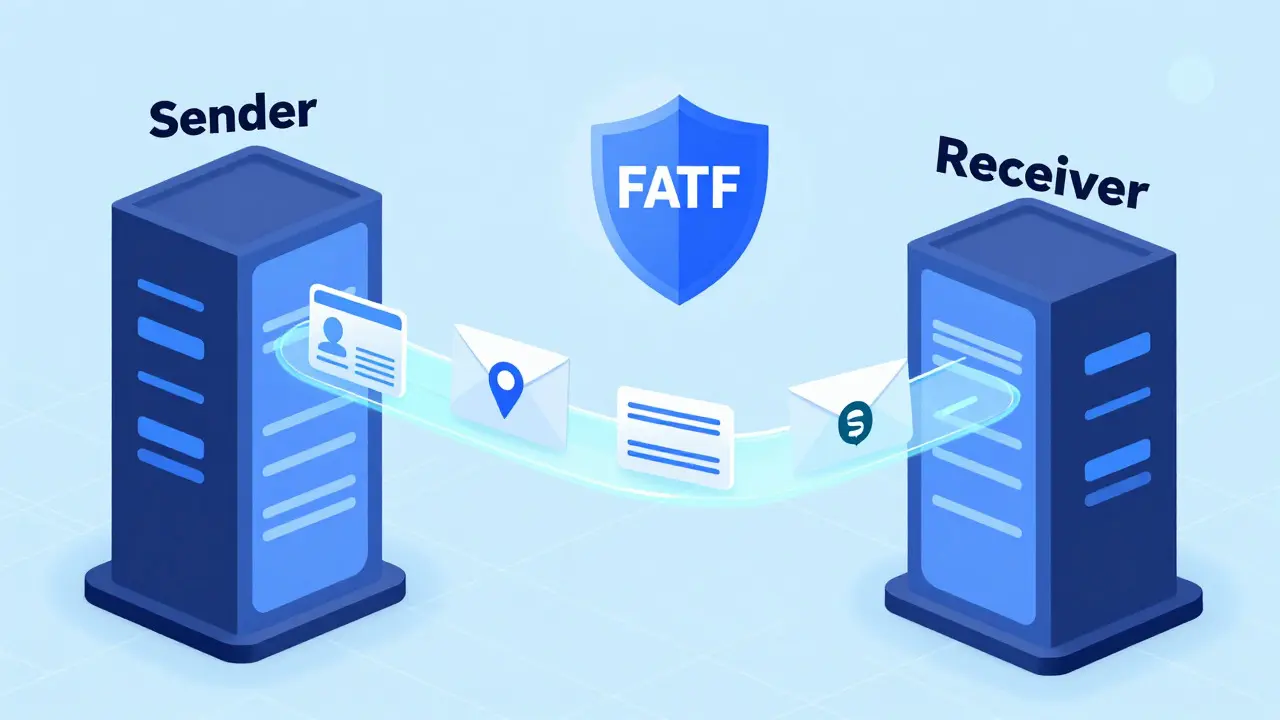
For years, the idea that cryptocurrency was a lawless frontier for anonymous transactions has been crumbling. By 2026, international authorities have closed many of the loopholes that once allowed digital assets to move across borders with little oversight. If you are moving significant amounts of crypto internationally, you are no longer invisible. Governments are using sophisticated data-sharing agreements and strict reporting rules to track every major transaction. This shift isn't just about catching criminals; it is about integrating digital finance into the global banking system.
The Core Mechanism: The Travel Rule
The backbone of modern cross-border crypto monitoring is the Travel Rule, which is a regulatory requirement mandating that financial institutions share originator and beneficiary information for transactions above a specific threshold. Originally designed for traditional wire transfers, this rule has been aggressively applied to virtual assets. Under frameworks established by the Financial Action Task Force (FATF), a global money laundering and terrorist financing watchdog based in Paris, Virtual Asset Service Providers (VASPs) must collect and transmit personally identifiable information (PII) for transactions exceeding $3,000.
This means when you send Bitcoin or Ethereum from an exchange in one country to another, the sending platform must provide your name, address, and account number to the receiving platform. The receiving platform then verifies this information against its own records. It creates a paper trail similar to traditional banking. For most users on centralized exchanges like Coinbase or Binance, this happens automatically behind the scenes. You rarely see it, but the data is flowing between regulated entities in real-time.
- Originator Details: Name, physical address, and unique ID or wallet address.
- Beneficiary Details: Name and account number or wallet address.
- Transaction Data: Amount, date, and time of transfer.
If you try to bypass this by using non-KYC (Know Your Customer) platforms, you run into the next layer of scrutiny: bank integration. Most fiat-to-crypto on-ramps still require identity verification because they are connected to the traditional banking system.
US Regulatory Landscape: FinCEN and the BSA
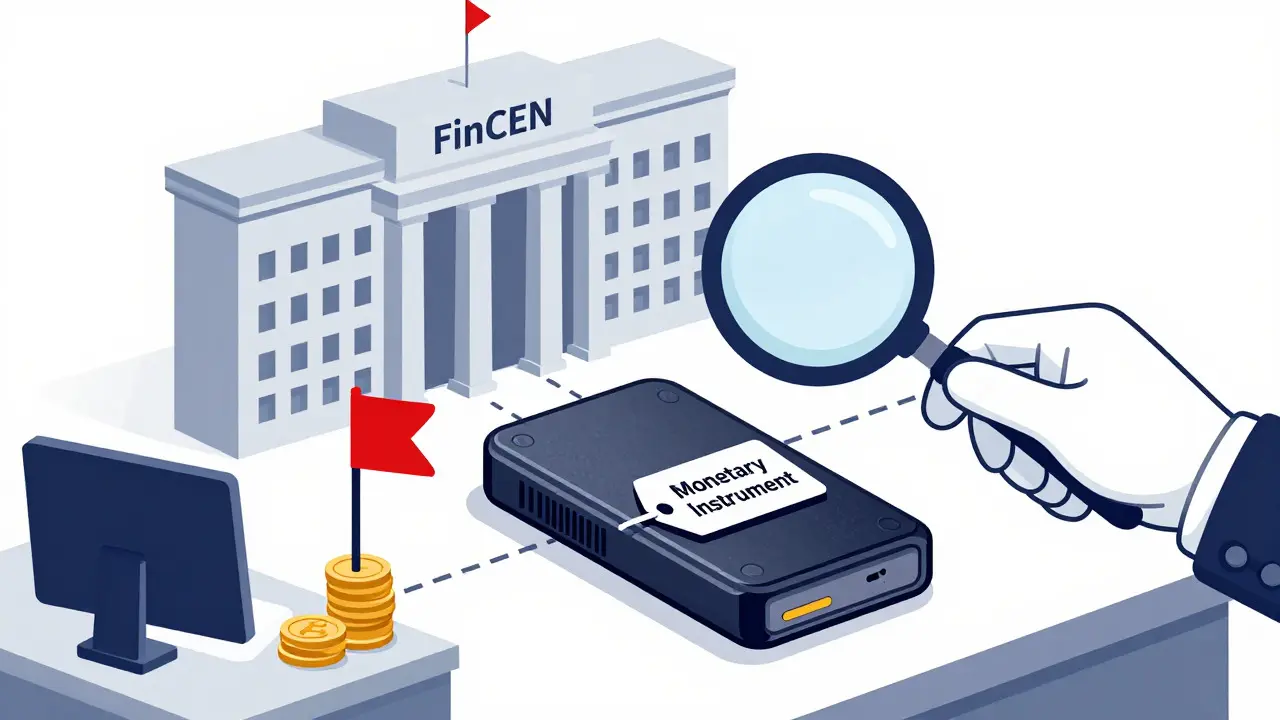
In the United States, the Financial Crimes Enforcement Network (FinCEN), an agency of the U.S. Department of the Treasury responsible for safeguarding the financial system from illicit activity, plays the lead role. They enforce the Bank Secrecy Act (BSA), a U.S. federal law requiring financial institutions to assist government agencies in detecting and preventing money laundering. Recent updates have expanded the definition of who needs to comply. It is no longer just money service businesses. Now, cryptocurrency businesses regulated by the Securities and Exchange Commission (SEC) and the Commodity Futures Trading Commission (CFTC) are also in the crosshairs.
A critical development in 2025 and continuing into 2026 involves how FinCEN treats unhosted wallets-essentially private wallets where you hold your own keys, like a hardware wallet or a software wallet on your phone. Proposed rules suggest treating cryptocurrencies held in these wallets as 'monetary instruments.' This classification triggers stricter recordkeeping requirements. If a bank or money service business processes a transaction involving a convertible virtual currency (CVC) linked to an unhosted wallet, they may need to verify customer identity more rigorously than before.
This creates a bottleneck. While blockchain itself is pseudonymous, the points where crypto touches fiat currency (banks) are heavily monitored. FinCEN requires banks to report suspicious activities involving digital assets. If your transaction patterns look unusual-such as rapid movement of funds through multiple jurisdictions-the bank’s compliance software will flag it.
European Standards: MiCA and Risk Management
Across the Atlantic, the European Union has taken a different approach with the Markets in Crypto-Assets (MiCA), a comprehensive EU regulation governing crypto asset issuers and service providers. MiCA is often described as more risk-averse than the US framework. It establishes a unified license for crypto asset service providers (CASPs) operating within the EU. This means a company licensed in Germany can operate across all 27 member states under the same rules, reducing regulatory arbitrage.
Under MiCA, CASPs must maintain robust financial crime control frameworks. They are required to conduct enhanced due diligence on customers, especially those involved in high-risk jurisdictions. Transaction monitoring is mandatory, and any suspicious activity must be reported to national Financial Intelligence Units (FIUs). The EU’s approach emphasizes consumer protection alongside anti-money laundering (AML) goals. This includes strict rules on stablecoins, ensuring they are backed by high-quality assets and do not threaten monetary sovereignty.
| Feature | United States (FinCEN/BSA) | European Union (MiCA) |
|---|---|---|
| Primary Focus | Enforcement and Reporting | Consumer Protection & Market Integrity |
| Licensing Model | d>Fragmented (State + Federal)Unified Pan-European License | |
| Travel Rule Threshold | $3,000+ | €1,000+ (varies by member state implementation) |
| Stablecoin Regulation | Emerging (CFTC/SEC overlap) | Strict Reserve Requirements |
| Unhosted Wallets | Increased Scrutiny via Banks | Enhanced Due Diligence Required |
UK-US Cooperation: The Transatlantic Task Force
One of the most significant developments in 2025 was the formation of the UK-US Transatlantic Task Force on Digital Assets. This bilateral initiative aims to align regulatory standards between two of the world’s largest financial hubs. By coordinating on licensing, custody, and stablecoin standards, they create a de facto global benchmark. Other countries often look to London and New York for cues on how to regulate emerging technologies.
This cooperation helps close gaps where criminals might previously have exploited differences between jurisdictions. For example, if a sanctioned entity moves funds from a UK-based exchange to a US-based one, both regulators now share intelligence seamlessly. The task force focuses on areas like disclosures and cross-border compliance, ensuring that neither jurisdiction becomes a weak link in the chain. For businesses, this means higher compliance costs but greater legal certainty. For individuals, it means fewer places to hide illicit funds.

Evasion Tactics and Technical Challenges
Despite these advances, bad actors continue to adapt. The UK’s Office of Financial Sanctions Implementation (OFSI) identified several vulnerabilities in their 2025 threat assessment. One common tactic is using Virtual Private Networks (VPNs) to obscure the true location of a user. KYC systems rely on IP addresses and geolocation data. If you mask your location, it complicates the ability of authorities to determine which jurisdiction’s laws apply.
Another challenge is the use of intermediary wallets. Criminals often deposit funds into a clean wallet, then withdraw them to a different address after a short delay. This breaks the direct link between the sender and receiver in basic compliance software. However, advanced blockchain analytics tools used by firms like Chainalysis and Elliptic can trace these paths by analyzing timing patterns, cluster analysis, and historical behavior. These tools map out networks of addresses, identifying even subtle connections to known illicit entities.
Mixers and privacy coins remain a concern. Services that pool funds from multiple users and redistribute them make tracing nearly impossible without additional metadata. As a result, regulators are increasingly targeting the entry and exit points of these services. If a mixer accepts fiat currency or interacts with a regulated exchange, that exchange faces penalties if it fails to report suspicious links. This pressure forces many platforms to blacklist known mixer addresses, effectively squeezing out casual users of privacy tools.
Impact on Businesses and Users
For legitimate businesses accepting crypto payments, the landscape is clearer but more demanding. Working with licensed crypto asset service providers allows companies to leverage stablecoin payment rails without obtaining their own licenses. However, they must perform careful due diligence on their partners’ AML approaches. If your payment processor gets fined for poor compliance, your brand reputation suffers too.
For individual users, the days of total anonymity are over for large transactions. Small peer-to-peer trades may still fly under the radar, but anything approaching institutional scale leaves a digital footprint. The key takeaway is transparency. Keep records of your transactions, understand the source of your funds, and ensure your chosen exchanges comply with local regulations. Non-compliance can lead to frozen accounts, hefty fines, or even criminal charges depending on the severity of the violation.
The integration of blockchain technology with traditional financial oversight is ongoing. Authorities are balancing innovation with security. The goal is not to kill crypto but to tame it. As central banks explore their own digital currencies (CBDCs), the infrastructure for monitoring digital value transfer will only become more sophisticated. Staying informed about these changes is essential for anyone participating in the global digital economy.
What is the Travel Rule in cryptocurrency?
The Travel Rule is a regulatory standard set by the FATF that requires Virtual Asset Service Providers (VASPs) to share originator and beneficiary information for transactions above a certain threshold (usually $3,000 or €1,000). This ensures that crypto transfers have a similar level of transparency as traditional bank wires.
How do authorities track transactions from unhosted wallets?
While unhosted wallets (private wallets) are harder to monitor directly, authorities track them through their interaction with centralized exchanges and banks. When you deposit or withdraw funds from a private wallet to a regulated exchange, the exchange must verify your identity and report the transaction. Advanced blockchain analytics can also trace the flow of funds between addresses on the public ledger.
What is the difference between MiCA and FinCEN regulations?
MiCA is an EU-wide regulation that provides a unified license for crypto service providers and focuses heavily on consumer protection and market integrity. FinCEN is a US agency that enforces the Bank Secrecy Act, focusing on anti-money laundering reporting and enforcement. MiCA offers more regulatory clarity for businesses operating across Europe, while FinCEN’s approach is more fragmented and enforcement-driven.
Can I avoid monitoring by using privacy coins?
Privacy coins like Monero make on-chain tracking difficult, but they are not immune to monitoring. Regulators target the fiat on-ramps and off-ramps. Many centralized exchanges delist privacy coins or impose strict limits on their use. Additionally, heuristic analysis can sometimes identify patterns associated with privacy coin usage, leading to further scrutiny from authorities.
What happens if my crypto exchange fails to comply with AML rules?
Non-compliant exchanges face severe penalties, including massive fines, loss of license, and potential shutdown. In extreme cases, executives can face criminal charges. For users, this might mean frozen assets or difficulty withdrawing funds while investigations take place. It is crucial to choose exchanges that demonstrate strong compliance practices.
 Finance




Don Fizy
August 12, 2026 AT 22:01Hey everyone! 👋 Just wanted to drop a quick note saying that while this all sounds super intense, it's actually pretty great for the long-term health of crypto. It brings legitimacy. Don't stress too much about the small stuff, just keep your records tidy and you'll be golden! 🌟
Dominic Greco
August 13, 2026 AT 10:06The whole Travel Rule is just a Trojan horse for total financial surveillance 🕵️♂️ They don't care about money laundering, they want to track every single satoshi you move. The 'Transatlantic Task Force' is basically a global police state for your wallet. Wake up people! 😡👁️
Eric Zehr
August 13, 2026 AT 16:40I think we should look at the bright side here. Having clear regulations means fewer scams and more institutional investment, which stabilizes prices. It’s a growing pain, but necessary for mass adoption. Let’s embrace the structure!
Candice Cornett
August 14, 2026 AT 15:42everyone is sleeping on the fact that this kills the original ethos of bitcoin. decentralization is dead if every transaction needs KYC. typical government overreach. they say its for safety but its really for control. stop pretending otherwise.
Prudence Flemming
August 16, 2026 AT 03:29the ontological shift in how we perceive value is happening faster than regulatory frameworks can adapt. the epistemological crisis of trust in centralized entities vs decentralized ledgers is the real story here. miCA is just a band-aid on a bullet hole. we need to rethink the very nature of digital sovereignty.
Namrata Mapgaonkar
August 17, 2026 AT 09:04hmm interesting read... i guess its good for security but kinda scary lol. in india we are still figuring out our own rules so this feels far away but maybe not for long :)
Lance Jantz
August 18, 2026 AT 18:56Oh, the sweet, sweet taste of bureaucratic shackles! 🎭 How delightful that our beloved digital frontier has been tamed by the grey suits of Paris and Washington. I suppose we must bow before the altar of compliance now, lest we be cast into the outer darkness of unhosted wallets. A tragic comedy indeed!
Sean Rowland
August 20, 2026 AT 09:01Let us examine the jurisprudential implications of the FATF guidelines with rigorous academic scrutiny. The conflation of pseudonymity with illicit intent is a logical fallacy of the highest order. Furthermore, the intrusion into private wallet management constitutes a violation of property rights as defined by classical liberal theory. One must question the efficacy of such measures when blockchain analytics are inherently probabilistic rather than deterministic.
Sus Sawyer
August 21, 2026 AT 19:41Look man, its easy to complain but if you play by the rules you got nothing to worry about. Its like learning to drive, you gotta follow the traffic laws or you gonna crash. Keep it simple and stay safe out there! 🚗💨
Aryan MISHRA
August 23, 2026 AT 12:10The regulatory arbitrage is diminishing rapidly!!! This is a critical juncture for global finance!!! Compliance is no longer optional!!! Adapt or perish!!!
Ryan Robinson
August 24, 2026 AT 23:22i mean its whatever right? as long as my money goes up who cares if they track it? seems like a lot of drama for something that just makes things easier for banks honestly.
Earl Kott65
August 26, 2026 AT 23:10Oh wow, another day, another way for the big bad government to peek into your pocket! 🙄 But hey, at least they're trying to 'protect' us from ourselves, right? 🤡 Classic move. Let's see how well that works out when the next bubble bursts! 📉😂
Ethan Yuwono
August 28, 2026 AT 19:00it is interesting to consider the balance between privacy and security. perhaps the solution lies not in resistance but in better technology. zero knowledge proofs could offer a middle ground where verification happens without exposing data. worth thinking about.
Jack Delasquez
August 30, 2026 AT 10:50just ignore the noise and hodl. regualtions come and go but the tech stays. dont let the fear get u down guys.
Matthew Smith
September 1, 2026 AT 07:21morality dictates that transparency is virtue. yet privacy is also a human right. this paradox is the crux of the modern dilemma. we are sacrificing liberty for convenience. a Faustian bargain indeed. the soul of crypto is being sold piece by piece to the highest bidder.
Phil Babb
September 2, 2026 AT 00:27Folks!! Listen up!! This is HUGE news!! You NEED to pay attention to these changes!! If you are doing business across borders you MUST comply!! Do not sleep on this!! Get your paperwork in order NOW!! Stay sharp!! 🔥🔥🔥