

Imagine setting up a crypto business where you don't need millions in capital, don't have to hire local directors, and face almost zero bureaucratic red tape. That is exactly what Costa Rica is known for in the digital asset world. For years, this Central American nation has been the go-to spot for decentralized exchanges, GameFi platforms, and NFT marketplaces looking for a cheap and fast entry point. But here is the catch: there is no specific "crypto law." You are operating in a legal gray area that feels like freedom until you realize you might be standing on thin ice.
If you are planning to launch or move your virtual asset service provider (VASP) to Costa Rica in 2026, you need to understand the rules of this unregulated playground. The landscape shifted significantly in mid-2025 with new legislative moves, but the core reality remains: cryptocurrencies are not money here, but they are tolerated if you play by certain anti-money laundering rules. Let’s break down how this works, what the recent changes mean for you, and how to stay out of trouble.
The Core Reality: No Legal Tender Status
To understand the gray area, you first have to accept one hard fact from the Central Bank of Costa Rica (BCCR): Bitcoin and other cryptocurrencies are not legal tender. This wasn't a recent discovery; the BCCR made this clear back in October 2017. They stated explicitly that these assets are not backed by law and do not constitute official currency.
So, why isn't it illegal? Because the bank also said private transactions using these assets are permissible. This creates a unique split. You cannot pay your taxes in Bitcoin. A shop cannot legally refuse to accept Colones (the local fiat currency) if you try to pay with crypto instead. However, two private parties can agree to exchange value using digital tokens without breaking any laws. This distinction is crucial. It means you can operate a business, but you cannot claim your product is a financial instrument recognized by the state.
This lack of recognition is both a blessing and a curse. On one hand, you aren't subject to strict banking regulations that would crush your margins. On the other hand, you have no consumer protection framework. If your platform gets hacked or goes rogue, users have very little recourse under traditional financial laws because the activity exists outside the formal financial system.
The 2025 Shift: Bill 22.837 and VASP Registration
For a long time, the "gray area" meant zero oversight. That changed with the passage of the first debate of Bill 22.837 in July 2025. Originally proposed by former President Carlos Alvarado Quesada's administration, this landmark legislation aims to plug loopholes in the country's Anti-Money Laundering and Combating the Financing of Terrorism (AML/CFT) laws.
Here is what you need to know about this bill:
- New Definitions: The bill formally defines "Virtual Asset" as any digital representation of value traded online that isn't legal tender. It also defines Virtual Asset Service Providers (VASPs), which includes anyone exchanging crypto for fiat, transferring assets, or providing custody services.
- Mandatory Registration: All VASPs must now register with the Superintendencia General de Entidades Financieras (SUGEF). This is the financial regulator responsible for supervision.
- Risk-Based Approach: SUGEF will supervise these entities based on risk levels, focusing heavily on AML compliance rather than operational viability.
Crucially, officials have stressed that this registration is not a license to operate. It does not mean the government authorizes your business model. It simply means you are acknowledging your existence and agreeing to follow AML protocols. This maintains the gray area status while imposing necessary compliance obligations. If you ignore this registration requirement, you risk severe penalties under existing money laundering statutes.
Why Businesses Still Flock to Costa Rica
If the regulation is tightening, why are startups still choosing Costa Rica? The answer lies in cost and speed. Compared to jurisdictions like Switzerland, Singapore, or even neighboring Panama, Costa Rica offers an exceptionally low barrier to entry.
| Feature | Costa Rica | Strict Jurisdictions (e.g., EU/Swiss) |
|---|---|---|
| Minimum Share Capital | None required | Often €100k - €500k+ |
| Local Directors | Not required | Frequently required |
| Physical Office | Not strictly required for registration | Mandatory |
| Licensing Speed | Fast (registration-based) | Months to years |
| Tax on Foreign Income | Territorial (often 0% if earned abroad) | Global income taxation |
The absence of deposited share capital requirements is a game-changer for early-stage projects. You don't need to lock up hundreds of thousands of dollars just to get your paperwork in order. Furthermore, there is no obligation to maintain local offices or hire local directors, which keeps overheads incredibly low.
This environment is particularly attractive for specific sectors:
- GameFi Platforms: Developers can integrate token economies without navigating complex securities laws immediately.
- Crypto Casinos: The synergy between gaming licenses and VASP registrations allows for faster market entry.
- Decentralized Exchanges (DEXes): Since DEXs often argue they are software providers rather than financial intermediaries, the flexible definition of VASP helps them find a foothold.
How to Set Up Legally: Step-by-Step
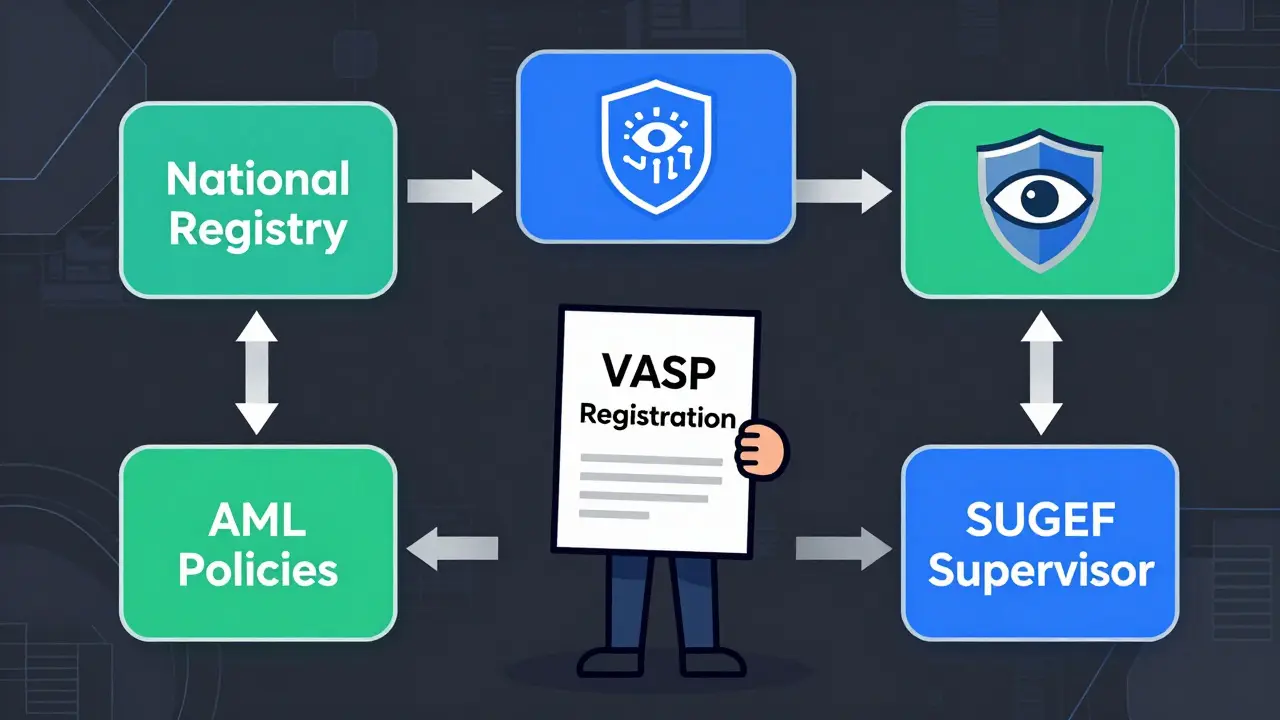
Even though it's a gray area, you cannot just show up and start trading. You need to navigate three primary institutions: the National Registry (Registro Nacional), SUGEF, and potentially the Central Bank depending on your activities. Here is the practical path to compliance in 2026:
- Company Incorporation: Start by registering your entity at the National Registry. Prepare your incorporation documents and secure a legal address in Costa Rica. While you don't need a physical office for operations, you need a registered agent or address for legal correspondence.
- Bank Account Opening: Open a corporate bank account. This can be tricky because traditional banks are wary of crypto businesses. Be prepared to present your AML policies upfront to convince them you are a low-risk client.
- Develop AML/CFT Policies: Before you apply for VASP registration, you must have robust internal controls. This includes procedures for identifying clients (KYC), verifying final beneficiaries, and monitoring transactions for suspicious activity.
- VASP Registration with SUGEF: Submit your registration application to SUGEF. Include your risk assessment, internal control mechanisms, and information-sharing protocols. Remember, this is for AML compliance, not operational approval.
- Ongoing Compliance: Maintain detailed transaction records. Perform regular risk assessments, especially regarding politically exposed persons (PEPs) and high-risk jurisdictions identified by international bodies like the FATF.
Skipping step 3 is the most common mistake. Many founders think they can register first and figure out compliance later. In the eyes of SUGEF, lacking proper AML frameworks from day one is a major red flag that can lead to immediate rejection or future sanctions.
Risks and Pitfalls to Avoid
The freedom of the gray area comes with inherent risks. Since there is no comprehensive regulatory clarity, you operate without explicit legal protection. If a dispute arises between you and a user, courts may struggle to apply traditional financial laws to your case.
One major pitfall is assuming that VASP registration equals a "license." Some entrepreneurs mistakenly believe that once they are registered with SUGEF, they have government backing. This is false. The legislation explicitly states that registration ensures adherence to AML protocols, not authorization to operate. If your business model violates other laws (such as securities laws if you are issuing tokens that function as investments), you are still liable.
Another risk is the evolving nature of the law. Bill 22.837 passed its first debate in 2025, but legislative processes can take time. Further amendments could tighten definitions or increase capital requirements. Businesses that build their entire infrastructure on the current loose interpretation may find themselves scrambling to adapt if stricter rules are implemented in the coming years.
Finally, consider reputational risk. Operating in a jurisdiction known for its gray areas can make partnerships with global payment processors or institutional investors difficult. They may view Costa Rican entities as higher risk due to the lack of stringent regulatory oversight compared to Tier-1 jurisdictions.
Tax Implications for Crypto Businesses
One of the biggest draws for Costa Rica is its tax system. The country operates on a territorial tax principle. This means that income generated outside of Costa Rica is generally not taxed locally. For many crypto businesses that serve a global customer base, this translates to a 0% corporate income tax rate on foreign earnings.
However, this benefit comes with conditions. You must prove that the income was indeed generated abroad. Proper documentation and transfer pricing policies are essential. If you have significant operations within Costa Rica, such as local employees or servers, some portion of your income may be considered locally sourced and thus taxable.
Additionally, while there is no specific crypto capital gains tax, general income tax laws apply. If you earn income from staking, lending, or trading within the country, it may be subject to standard corporate tax rates. Always consult with a local tax advisor to structure your entity correctly and avoid unexpected liabilities.
Future Outlook: From Gray to Clear?
Where is this all heading? Industry experts suggest that Costa Rica is moving toward more structured regulation while trying to preserve its business-friendly reputation. The risk-based supervisory approach aligns with international standards set by the Financial Action Task Force (FATF). This suggests that the gray area will gradually shrink, replaced by clearer, albeit still flexible, regulatory frameworks.
For businesses already established in Costa Rica, this transition should be manageable if you have been compliant with AML/CFT requirements. For new entrants, it means waiting for further legislative details before making long-term commitments. The key takeaway is that the era of total anonymity and zero oversight is ending. The future of crypto in Costa Rica lies in regulated flexibility, not wild west freedom.
Is cryptocurrency legal in Costa Rica?
Yes, private transactions using cryptocurrency are permissible. However, cryptocurrencies are not considered legal tender and are not backed by law. Businesses operating in this space must comply with Anti-Money Laundering (AML) regulations and register as Virtual Asset Service Providers (VASPs) with SUGEF.
Do I need a license to run a crypto exchange in Costa Rica?
You do not need a traditional financial license, but you must register as a VASP with SUGEF. This registration confirms your adherence to AML/CFT protocols. It is important to note that this registration is not an authorization to operate but a compliance requirement.
What are the tax implications for crypto businesses in Costa Rica?
Costa Rica uses a territorial tax system. Income generated outside the country is generally not taxed locally, offering a potential 0% corporate tax rate on foreign earnings. However, income sourced within Costa Rica is subject to standard corporate tax rates. Proper documentation is required to prove foreign sourcing.
What is Bill 22.837 and how does it affect crypto?
Bill 22.837 is legislation passed in its first debate in July 2025 that brings Virtual Asset Service Providers (VASPs) under Costa Rica's AML/CFT framework. It mandates registration with SUGEF and requires strict KYC and transaction monitoring procedures, reducing the previous regulatory ambiguity.
Can I use Bitcoin to pay for goods and services in Costa Rica?
No, Bitcoin is not legal tender. Merchants are not obligated to accept it, and it cannot be used for official payments like taxes. While private parties can agree to trade using crypto, it does not have the same legal standing as the Costa Rican Colón.
Are there minimum capital requirements for crypto companies in Costa Rica?
Currently, there are no deposited share capital requirements for registering a company or obtaining VASP registration. This makes Costa Rica an attractive option for startups compared to jurisdictions that require significant upfront capital.
 Finance