

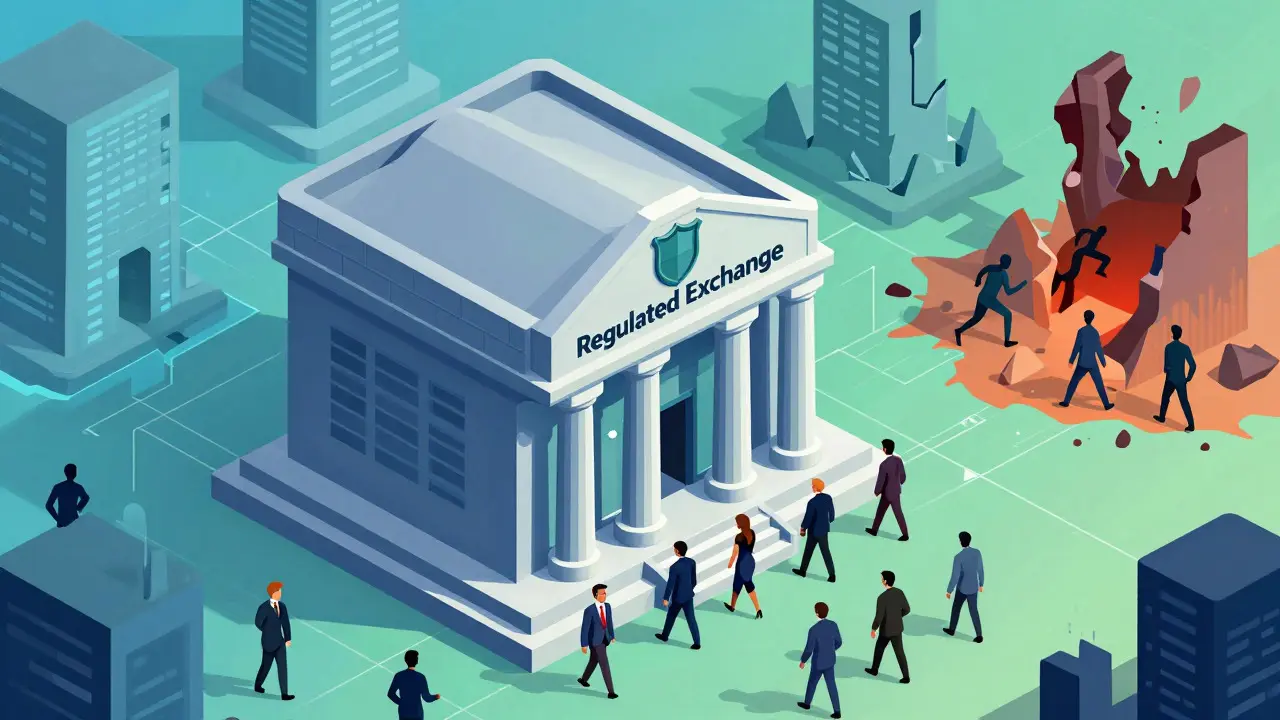
The cryptocurrency market isn't just surviving; it's evolving into a sophisticated financial ecosystem. If you're looking at the landscape in late 2025 and early 2026, the term bullish doesn't just refer to price action-it describes the trajectory of the exchanges themselves. We are seeing a massive consolidation where the top platforms are becoming more regulated, more institutional, and surprisingly, more user-friendly. But with over 34% of exchanges operating in 2022 having ceased operations by Q3 2025, picking the wrong platform can be costly. This review cuts through the noise to identify which exchanges are truly positioned for growth and reliability.
Why 'Bullish' Now Means Regulated and Institutional
Gone are the days when a 'bullish' exchange was simply one that listed every new meme coin within minutes. Today, the most promising platforms are those that have secured regulatory clarity and attracted institutional capital. The global crypto market grew at an 18.7% CAGR from 2022 to 2025, reaching $4.2 trillion. Within this growth, institutional trading volume has surged by 41% year-over-year, now representing 39% of total exchange activity.
This shift means that exchanges like Coinbase and Kraken are capturing 68% of this institutional segment. Why? Because they offer the security and compliance structures that large funds require. Dr. Elena Rodriguez, Chief Analyst at Delphi Digital, notes that exchanges securing MiCA compliance in Europe and tailored structures for US markets show the strongest growth vectors. Coinbase's institutional platform alone processes $4.7 billion daily, a 220% increase from 2023. If you want a bullish outlook, you need a platform that isn't afraid of regulators but uses them as a moat against competitors.
Top Contenders: A Deep Dive into Market Leaders
Not all exchanges are created equal. While Binance remains the volume leader, the 'best' choice depends entirely on your profile-whether you're a beginner, a high-frequency trader, or an institution. Let's look at the key players defining the 2025-2026 landscape.
Coinbase: The Beginner-Friendly Giant
Coinbase is the leading US-based crypto exchange known for its ease of use and strong regulatory standing. It holds the title of 'Best crypto exchange for beginners' with a 4.6/5 rating from NerdWallet. Its onboarding process averages just 18 minutes for verified accounts, making it the fastest among major platforms. However, convenience comes at a cost. Fees range from 0% to 3.99%, significantly higher than competitors. Additionally, while it supports 235 cryptocurrencies, users often complain about slow customer support during volatility-a sentiment echoed in Reddit analyses showing 58% negative comments during the September 2025 market crash.
Kraken: Security and Value for Serious Traders
If security and low fees are your priority, Kraken is a veteran exchange offering deep liquidity, low fees, and rigorous security audits. Kraken leads with 350+ cryptocurrencies and trading fees ranging from 0% to 0.4%. Crucially, it maintains monthly proof-of-reserve audits since Q2 2023, providing transparency that many rivals lack. For institutional users, Kraken Pro provides API integration within 4.2 hours of account approval, compared to Coinbase Prime's 18-hour average. The trade-off? A steeper learning curve. YouTube reviewers note that Kraken's Pro platform has 47% fewer beginner-friendly tooltips than Coinbase, which can be daunting for newcomers.
Binance: The Global Volume King
Despite regulatory headwinds, Binance is the world's largest crypto exchange by trading volume, offering extensive asset selection and advanced tools. It maintains the #1 position with $84 billion in daily volume. Michael Novogratz, CEO of Galaxy Digital, highlights Binance's focus on emerging markets, noting that 63% of new users in 2025 came from Southeast Asia and Latin America. Binance supports over 500 cryptocurrencies with optimized fee structures through multi-level KYC processes. However, its global counterpart faces ongoing scrutiny, and Binance.US offers a more limited selection (158 assets) with fees up to 0.6%.
CEX.IO: The Rising Star for Institutions
Don't overlook CEX.IO is a flexible exchange serving 185+ countries with a focus on institutional clients and innovative tools. CompanionLink named it 'The Best Overall Crypto Exchange' in October 2025 due to its accessibility and diverse feature set. CEX.IO's bullish trajectory stems from its 'Compliance-as-a-Service' launch in 2025, which increased enterprise revenue by 140% in Q3 2025 alone. With 37% of its $114 million average daily trading volume coming from institutional clients, it's a serious contender for those seeking reliability and deep liquidity.
| Exchange | Crypto Assets | Trading Fees | Key Strength | Best For |
|---|---|---|---|---|
| Coinbase | 235+ | 0% - 3.99% | Ease of use, speed | Beginners |
| Kraken | 350+ | 0% - 0.4% | Security, low fees | Serious traders |
| Binance | 500+ | Varies by tier | Volume, asset variety | Global traders |
| CEX.IO | 100+ | Competitive | Institutional tools | Enterprises |
| Bitstamp | 82 | Standard | Regulatory licenses | Conservative investors |

The AI Frontier: How Technology is Changing Trading
The next competitive frontier isn't just regulation-it's artificial intelligence. Exchanges are integrating AI-powered tools to give traders an edge. Coinbase's 'Advanced Trade' platform now incorporates machine learning algorithms that reduce slippage by 22% for large orders. Meanwhile, Binance's newly launched 'Alpha Terminal' uses predictive analytics to identify arbitrage opportunities across 18 different exchanges. These tools are no longer futuristic concepts; they are live features that can significantly impact your profitability. If you're engaging in high-volume trading, choosing an exchange with robust AI integration could be the difference between profit and loss.
Security First: Protecting Your Assets in a Volatile Market
With 23 exchange-related hacks occurring in Q3 2025 totaling $147 million in losses, security cannot be an afterthought. Notably, 78% of these hacks involved accounts lacking two-factor authentication (2FA). Beyond basic 2FA, look for exchanges with proven security architectures. Coinbase employs cold storage for 98% of assets, verified quarterly by Ernst & Young. Kraken’s monthly proof-of-reserves provide real-time assurance that your funds are backed 1:1. Bitstamp stands out as the 'Most Regulated' platform with 11 national licenses, though its limited asset selection (82 cryptos) may deter some. Gemini also offers unmatched regulatory confidence with 100% SOC 2 Type II compliance, but its higher fees (0.5% to 3.49%) and limited options constrain its appeal for active traders.

Hidden Costs and Pitfalls to Avoid
While headline fees matter, hidden costs can erode your gains. Robinhood, for instance, advertises 'no fees' for trading but limits users to just 25 cryptocurrencies. This makes it suitable for simple stock-crypto hybrids but poor for altcoin diversification. Trustpilot reviews reveal that 63% of complaints relate to 'forced liquidations during volatility,' a risk exacerbated by limited product offerings. Similarly, while Bybit offers an intuitive derivatives interface, its KYC verification takes an average of 32 hours, potentially locking you out during fast-moving markets. Always consider the total cost of ownership, including withdrawal fees, spread costs, and potential downtime during peak volatility.
Looking Ahead: What Makes an Exchange Truly Bullish?
The Standard & Poor's 2025 Crypto Exchange Viability Index warns that exchanges without substantial cash reserves (below $500 million) face a 63% probability of failure during significant market corrections. This underscores the importance of choosing established players. The most bullish exchanges will be those balancing regulatory compliance with innovative product development. As the US Presidential Crypto Framework approaches implementation in Q1 2026, platforms like Bitstamp and Kraken are well-positioned for accelerated growth. Keep an eye on developments in MiCA compliance in Europe, which is setting a global standard for consumer protection and operational transparency.
Which crypto exchange is best for beginners in 2025?
Coinbase is widely considered the best for beginners due to its intuitive interface, fast 18-minute onboarding process, and high trust factor. However, be aware of its higher trading fees (up to 3.99%).
Are crypto exchanges safe in 2025?
Major exchanges like Coinbase, Kraken, and Binance have significantly improved security. Look for platforms with proof-of-reserves, cold storage for majority of assets, and mandatory KYC. Always enable two-factor authentication (2FA), as 78% of recent hacks involved accounts without it.
What does 'bullish' mean for a crypto exchange?
In this context, 'bullish' refers to exchanges showing strong growth trajectories, regulatory compliance, and institutional adoption. It indicates platforms that are likely to survive and thrive in the maturing market, rather than just short-term price increases.
How do trading fees compare across top exchanges?
Fees vary significantly. Kraken offers some of the lowest rates (0%-0.4%), while Coinbase can charge up to 3.99% for simple buys. Binance and CEX.IO offer competitive tiers based on volume. Always check both maker and taker fees before committing large volumes.
Is Binance still worth using despite regulatory issues?
Yes, for many global traders. Binance maintains the highest trading volume ($84 billion daily) and supports over 500 cryptocurrencies. Its focus on emerging markets and advanced tools like Alpha Terminal make it attractive, though US users should consider Binance.US or alternatives like Coinbase for stricter local compliance.
What role does AI play in modern crypto exchanges?
AI is increasingly integrated for better execution and insights. Coinbase uses ML to reduce slippage by 22% on large orders, while Binance's Alpha Terminal identifies arbitrage opportunities. These tools help traders optimize strategies and minimize losses.
Why is regulatory compliance important for my investment safety?
Regulated exchanges are less likely to fail suddenly or engage in fraudulent activities. With 34% of 2022 exchanges ceasing operations by 2025, sticking to compliant platforms like Kraken, Coinbase, and Bitstamp reduces counterparty risk significantly.
 Finance




Jack Delasquez
August 14, 2026 AT 00:53bro i just moved my shit to kraken cause the fees on coinbase are absolute robbery lol why pay 3.99% when you can pay like nothing else?? its crazy how they get away with it
Earl Kott65
August 14, 2026 AT 19:24Oh, look at you, trying to be 'smart' about fees! 🙄 It's adorable really. You think a few cents difference matters when the market crashes 20% overnight? Coinbase is safe because it's regulated, not because it's cheap. But sure, keep your coins in some sketchy offshore server while you brag about saving $0.40 on a trade. I'll be over here sleeping soundly knowing my assets aren't going to vanish into the ether. 💅✨
Harman Singh
August 16, 2026 AT 11:20u guys dont get it the whole system is rigged against us small fry anyway why bother reading this garbage article when the whales are just gonna dump on our heads tomorrow sigh my life is so hard dealing with all this tech nonsense
Michael Mostyn
August 17, 2026 AT 08:34The shift towards institutionalization is not merely a trend but a fundamental restructuring of the asset class. The data presented regarding the 41% surge in institutional trading volume suggests that volatility will decrease as market depth increases. One must consider the implications of MiCA compliance; it serves as a barrier to entry for lesser entities, thereby consolidating power among the top three exchanges. This centralization, often criticized by purists, may actually provide the stability required for broader adoption.
Dominic Greco
August 18, 2026 AT 15:35They want you to believe in 'regulation' so they can track every satoshi you own. 🚩👀 It’s all part of the CBDC rollout plan. Coinbase and Kraken are basically government agents now. The 'security' they talk about is just surveillance. Wake up sheeple! The real bullish move is running nodes and holding physical hardware wallets far away from these centralized honeypots. They’re counting on your laziness. 🔒💻
Rita Dutta
August 18, 2026 AT 20:05oh please tell me you still think binance is safe after everything that happened with CZ lol the irony is palpable yet you cling to it like a security blanket made of lies maybe if you spent less time typing and more time learning about decentralization youd realize these 'exchanges' are just glorified casinos with better PR teams
Nick Darring
August 20, 2026 AT 03:18You know what I find fascinating about this entire discourse is the sheer lack of nuance people display when discussing financial infrastructure. We have this binary view where either you trust the government-regulated giants or you trust the chaotic freedom of unregulated offshore platforms, but rarely do we consider the hybrid models emerging in jurisdictions like Singapore or Dubai. Furthermore, the mention of AI integration is brushed off too quickly. If Coinbase is reducing slippage by 22% using machine learning, that is a tangible competitive advantage that directly impacts ROI. To dismiss this as 'surveillance' is to ignore the mathematical reality of order execution efficiency in high-frequency trading environments.
Qolbina Islami
August 21, 2026 AT 23:57AND WHY IS NO ONE TALKING ABOUT AMERICAN EXCHANGES?! 🇺🇸 WE NEED TO SUPPORT OUR OWN DOMESTIC PLATFORMS! COINBASE IS THE ONLY REAL CHOICE FOR PATRIOTS! BINANCE IS FOREIGN PROPAGANDA! KRACKEN IS AUSTRIAN GARBAGE! USE AMERICAN MONEY ON AMERICAN SOIL OR GO HOME!!! MAKE CRYPTO GREAT AGAIN!!!
Paul Smith
August 23, 2026 AT 03:28Hey everyone! 👋 Just wanted to chime in from Australia. We’ve been using Binance heavily here because the asset selection is unmatched for altcoins. But honestly, the KYC process has gotten so strict lately it feels like applying for a mortgage. 😅 Coinbase is way easier for the basics though. Love the variety in this thread!
Sus Sawyer
August 24, 2026 AT 07:04Look, im a dev and ive looked at the api docs for both kraken and cex.io. kraken is solid but their ui is stuck in 2015. cex.io is actually doing some cool stuff with their institutional tools, dont sleep on them just because theyre smaller. also typo alert: its 'proof-of-reserves' not 'proof-of-reservez' lol jk but seriously check out the slippage stats mentioned above, thats huge for day traders.
Prudence Flemming
August 24, 2026 AT 15:21the paradigm shift is undeniable yet most retail participants remain tethered to legacy mentalities regarding custodial risk. liquidity fragmentation across multiple l2s means that exchange choice dictates not just fee structure but access to specific yield opportunities. ai-driven arbitrage bots are already eating the inefficiencies that manual traders used to exploit so unless you are leveraging similar tech you are essentially donating alpha to the institutions. simple as that.
Matthew Smith
August 26, 2026 AT 11:11morality in finance is an oxymoron yet we pretend otherwise. the fact that 34% of exchanges failed is a testament to market Darwinism not regulatory failure. those who survived did so because they adapted or had deep pockets. stop whining about fees and start understanding value. if you cant handle 0.4% fee you probably dont deserve to trade crypto anyway.
Sean Rowland
August 27, 2026 AT 01:24Let us dissect the epistemological crisis inherent in trusting any centralized entity with private keys, shall we? The article posits 'bullish' as synonymous with 'regulated,' which is a profound category error. Regulation provides legal recourse, not technical security. When one deposits funds onto Coinbase, one does not own Bitcoin; one owns an IOU from Coinbase. This distinction is critical. Furthermore, the reliance on AI for slippage reduction presupposes that the underlying market mechanics are stable, which history repeatedly proves they are not. We are building castles on sand while praising the architects of the sandcastle.
Alex Di Mango
August 27, 2026 AT 05:44I think there's a lot of truth in what Sean said about the IOU aspect, but let's not forget convenience has value too. Not everyone wants to manage their own cold storage. For beginners, Coinbase is a gateway drug (in a good way). Once they learn the ropes, they might move to Kraken or self-custody. It's a spectrum, not a binary choice. Plus, the AI features are genuinely helpful for avoiding bad trades. Progress is progress! 🌟
Amor Jordan
August 28, 2026 AT 05:01I always feel like we're missing the human element in these discussions. Yes, fees matter, yes, security matters, but what about support? I had an issue with my account last month and Coinbase took weeks to reply. It was stressful. Kraken was faster but their chat bot is useless. We need platforms that treat users like humans, not numbers. That's the real bullish trait-empathy in service. 💖
Rodmun Tarnowski
August 29, 2026 AT 02:19Indeed!! The importance of customer service cannot be overstated!! Many overlook this crucial factor until disaster strikes!! A platform with low fees but zero support is a ticking time bomb!! One must evaluate the total ecosystem of services provided!! Regulatory compliance is excellent!! But responsiveness is paramount!! Do not neglect this vital aspect of your investment strategy!!
Phil Babb
August 29, 2026 AT 06:47LISTEN UP FOLKS!!! IF YOU ARE NOT USING MULTI-SIG WALLET BACKED BY AN INSTITUTIONAL GRADE EXCHANGE YOU ARE DOING IT WRONG!!! CEEX.IO IS THE MOVE!!! THEY HAVE THE COMPLIANCE AS A SERVICE WHICH MEANS THEY ARE BUILT FOR THE FUTURE!!! DON'T BE A LATE ADOPTER!!! GET IN NOW BEFORE THE BIG BOYS TAKE OVER ALL THE LIQUIDITY!!! YEAH BOSS!!! 💪🔥
Joy Kwant
August 30, 2026 AT 02:57It is absolutely disgusting how these companies profit off our anxiety. They sell us 'security' while hiding behind complex terms of service. And don't get me started on the environmental impact of all this computing power for AI trading bots. We are destroying the planet to save fractions of a cent on slippage. Shameful. Truly shameful. The moral decay of the industry is palpable.
Ethan Yuwono
August 31, 2026 AT 02:47perhaps we should focus on the utility rather than the morality. the technology exists to facilitate exchange. whether it is ethical is a separate debate. for now the proof of reserves is the closest thing we have to trust in a trustless system. keep an eye on the monthly audits that is the only metric that truly matters in the current landscape