
You might have seen vUSDC on a dashboard or heard it mentioned in DeFi circles and wondered why a "stablecoin" seems to be trading for pennies instead of one dollar. If you are looking at the price charts right now, the numbers look confusing. You see a token called Venus USDC, but it isn't worth $1.00. In fact, recent data from mid-2026 shows it hovering around $0.025. So, what is going on? Is it broken? Is it a scam? Or is there a specific financial mechanism at play that most casual observers miss?
To understand Venus USDC (vUSDC), you first need to separate the underlying asset from the protocol wrapper. This article breaks down exactly what vUSDC is, how it fits into the Venus Protocol ecosystem, why its market price deviates from the dollar peg, and whether it still holds value for traders on the BNB Smart Chain.
The Core Concept: What Actually Is vUSDC?
Venus USDC is not a standalone currency you buy at a grocery store. It is a synthetic representation of USD Coin (USDC) within the Venus Protocol. To put it simply, when you deposit real USDC into the Venus lending platform, the protocol issues you vUSDC tokens in return. These tokens represent your claim on the underlying USDC plus any interest accrued.
This distinction is crucial. Real USDC is fully collateralized by fiat reserves held in bank accounts. Synthetic assets like vUSDC are derivative tokens. They exist primarily on the blockchain to allow users to earn yield or use their capital elsewhere without withdrawing their funds from the lending pool. Theoretically, 1 vUSDC should always equal 1 USDC. However, as we will see, market dynamics often tell a different story.
Why Does vUSDC Trade Below $1.00?
If you check major aggregators like CoinMarketCap or Coinbase in July 2026, you will likely see vUSDC trading between $0.02 and $0.03. This massive discount raises eyebrows. Why would anyone hold a token worth only two cents if it represents a dollar?
The answer lies in liquidity and redemption mechanics. For vUSDC to trade at $1.00, there must be a seamless, automated way to swap it back into real USDC instantly. In many DeFi protocols, this process involves burning the vToken to reclaim the underlying asset. If the trading volume is low, or if the liquidity pools connecting vUSDC to other pairs are shallow, arbitrageurs cannot easily correct the price.
Additionally, during periods of high volatility or protocol stress, investors may panic-sell their vTokens rather than go through the formal withdrawal process. This selling pressure drives the secondary market price down. The current price discrepancy suggests that vUSDC is currently more of a speculative trading pair than a functional stable medium of exchange for everyday users.
Technical Specifications and Blockchain Infrastructure
Understanding where vUSDC lives is just as important as understanding what it is. Here are the hard facts regarding its technical implementation:
- Blockchain: BNB Smart Chain (formerly Binance Smart Chain).
- Token Standard: BEP20.
- Contract Address: 0xecA88125a5ADbe82614ffC12D0DB554E2e2867C8.
- Total Supply: Approximately 3.37 billion vUSDC (varies by source due to minting/burning activity).
- Market Cap: Ranging from $65 million to $86 million depending on the aggregator used.
The choice of the BNB Smart Chain is strategic. Ethereum gas fees can eat up small profits, making micro-transactions or frequent rebalancing expensive. By operating on BSC, Venus Protocol ensures that moving vUSDC remains cheap and fast. This infrastructure supports the high-frequency trading required for algorithmic money markets to function efficiently.
| Feature | vUSDC (Venus Protocol) | Native USDC |
|---|---|---|
| Primary Function | Lending receipt / Yield-bearing token | Store of value / Medium of exchange |
| Peg Stability | Variable (often discounted) | Stable ($1.00) |
| Blockchain | BNB Smart Chain (BEP20) | Ethereum, Polygon, Solana, etc. |
| Yield Generation | Built-in via lending protocol | Requires external DeFi action |
| Risk Profile | Smart contract risk + Liquidity risk | Custodial risk (Circle) |
How Users Interact With vUSDC
Most retail users do not actively seek out vUSDC to hold in their wallets. Instead, they encounter it as a byproduct of using the Venus Protocol. Here is the typical user journey:
- Deposit: A user connects their wallet (like MetaMask or Trust Wallet) to the Venus app.
- Mint: They deposit native USDC into the lending pool. The protocol burns the USDC and mints an equivalent amount of vUSDC in their wallet.
- Earn: As borrowers take out loans against that pool, interest accrues. The value of the user's vUSDC position grows relative to the debtors.
- Redeem: When the user wants their money back, they send the vUSDC back to the protocol, which burns the vUSDC and releases the original USDC plus interest.
However, some advanced traders choose to keep the vUSDC. They might use it as collateral for another loan or sell it on a decentralized exchange (DEX) like PancakeSwap. Selling on a DEX is where the price disconnect happens. If the buyer believes the redemption process is risky or slow, they will bid lower than $1.00, creating the discount we see in market data.
Wallet Support and Accessibility
Managing vUSDC requires compatible infrastructure. Since it is a BEP20 token, you need a wallet that supports the BNB Smart Chain. Popular options include:
- MetaMask: The industry standard for interacting with DeFi apps. You must manually add the BSC network RPC details.
- Trust Wallet: Offers built-in support for BSC tokens, making viewing balances easier.
- Atomic Wallet: Supports over 1,000 coins and includes vUSDC, catering to users who prefer a non-custodial desktop/mobile solution.
- Binance Web3 Wallet: Integrated directly into the Binance ecosystem, allowing seamless bridging between centralized exchanges and DeFi protocols.
Ensure you always double-check the contract address before adding any custom token to your wallet. Scammers often create fake tokens with similar names to trick users into approving malicious transactions.
Risks and Considerations for 2026
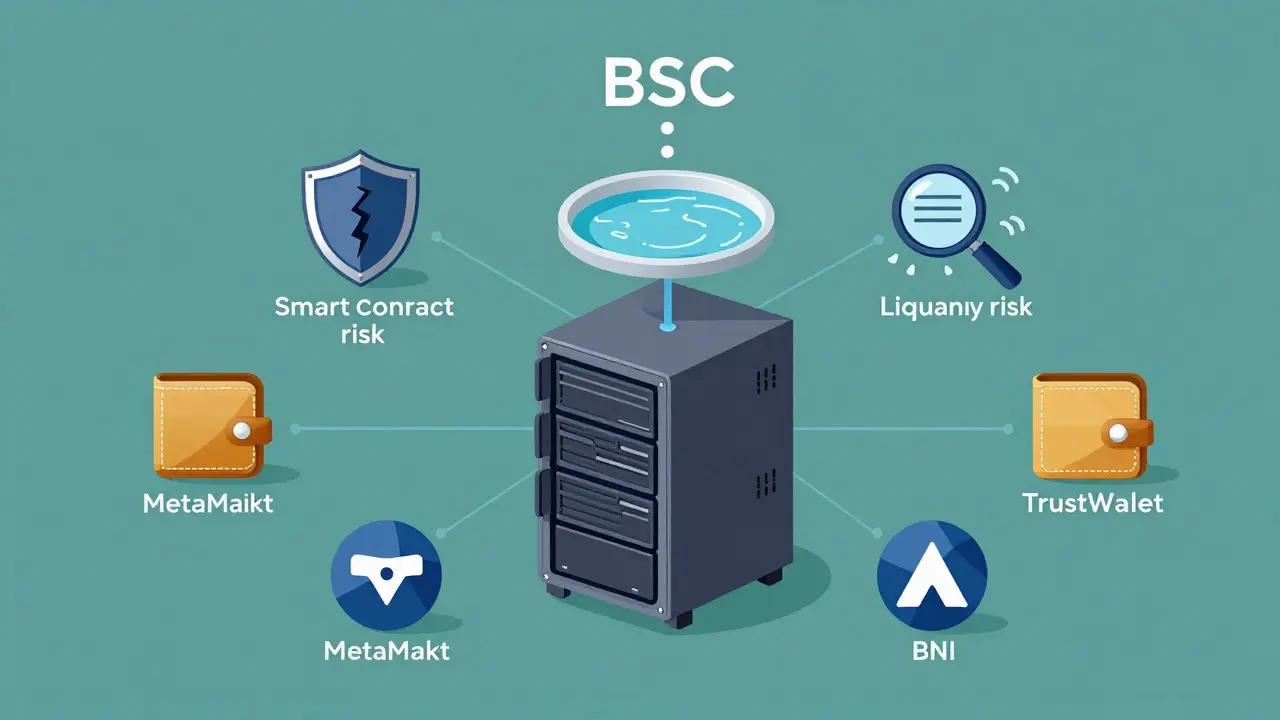
Entering the world of synthetic assets carries distinct risks compared to holding native stablecoins. First, there is smart contract risk. If the Venus Protocol code has a bug or is exploited, the underlying USDC could be locked or stolen. Second, there is liquidity risk. As noted by the current trading volume of roughly $34 million daily, the market is active but not deep. Large withdrawals could slip the price significantly.
Furthermore, regulatory scrutiny on DeFi lending platforms continues to evolve globally. While the BNB Smart Chain offers speed and low costs, it also operates in a jurisdictionally complex environment. Users should stay informed about updates from the Venus governance team regarding compliance and security audits.
Is vUSDC Still Relevant?
Despite the price discrepancies, vUSDC remains a core component of the Venus Protocol's liquidity engine. For power users who understand the mechanics, it offers a way to optimize capital efficiency-using their stablecoin exposure to generate yield while potentially leveraging it further. For the average investor, however, the complexity and price volatility make native USDC or other established stablecoins a safer bet for simple storage of value.
The key takeaway is this: vUSDC is a tool, not a currency. Treat it accordingly. Use it within the Venus ecosystem to maximize yield, but be cautious about holding it as a long-term investment outside of the protocol unless you are comfortable with the associated smart contract and liquidity risks.
Why is vUSDC trading at $0.02 instead of $1.00?
The price discrepancy occurs because vUSDC is a synthetic token representing a deposit in the Venus Protocol. On secondary markets, its price is determined by supply and demand rather than direct redemption. Low liquidity, fear of smart contract risk, or difficulty in redeeming the underlying USDC can cause the market price to drop significantly below the $1.00 peg.
Can I convert vUSDC back to regular USDC?
Yes, technically. You can redeem vUSDC for the underlying USDC through the Venus Protocol interface. However, doing so on a decentralized exchange (DEX) will result in receiving the market price (e.g., $0.02), not the full $1.00 value. Always use the official protocol redemption feature to get the full principal plus accrued interest.
Which blockchain does vUSDC operate on?
Venus USDC operates exclusively on the BNB Smart Chain (BSC) using the BEP20 token standard. This allows for low transaction fees and fast processing times compared to Ethereum-based alternatives.
Is vUSDC a safe investment?
Like all DeFi assets, vUSDC carries risks including smart contract vulnerabilities, liquidity shortages, and regulatory changes. It is not insured by government bodies like FDIC. It is best suited for experienced users who understand the mechanics of algorithmic money markets and are willing to monitor their positions actively.
What wallets support vUSDC?
Any wallet that supports the BNB Smart Chain and BEP20 tokens can hold vUSDC. Popular choices include MetaMask, Trust Wallet, Atomic Wallet, and the Binance Web3 Wallet. Ensure you have added the BSC network to your wallet settings to view the balance correctly.
 Finance