
![What is Quickswap [New] (QUICK) Crypto Coin? A Guide to the Polygon DEX Token](/uploads/2026/09/what-is-quickswap-new-quick-crypto-coin-a-guide-to-the-polygon-dex-token.webp)
Imagine holding a ticket that says you own $100, but the ticket itself has no value until you trade it for cash. That’s essentially what happened with the original QuickSwap token. If you’re looking at charts and wondering why there are two versions of QUICK floating around, or if you’re confused by the sudden drop in unit price after a "token split," you aren’t alone. The confusion stems from a major technical upgrade in 2022 that fundamentally changed how the token works on the blockchain.
At its core, Quickswap [New] (QUICK) is the native governance and utility token for the QuickSwap decentralized exchange (DEX). It powers the DragonFi ecosystem on the Polygon network. But here is the catch: the "New" label isn't just marketing fluff. It represents a redenominated version of the original token, created to fix supply issues and improve accessibility. Understanding the difference between Old QUICK and New QUICK is critical because only the New version holds actual power-giving you voting rights and staking rewards. If you buy the wrong one today, you might end up holding a digital receipt instead of an asset.
The Big Switch: Why Old QUICK Became Obsolete
To understand New QUICK, you have to look back at March 2022. The QuickSwap community voted to perform a massive token split, similar to a stock split in traditional finance. They decided to break each original QUICK token into 1,000 new tokens. This wasn't done to dilute value; it was done to make the token more accessible to retail investors who found the high unit price of the original token intimidating.
Before this change, the maximum supply of QUICK was capped at 1 million units. After the split, the max supply jumped to 1 billion units. Mathematically, nothing changed about your portfolio's total value. If you held 1 Old QUICK worth $100, you ended up with 1,000 New QUICK tokens still worth $100 total. However, the market dynamics shifted. The "New" token became the active currency for all protocol functions, while the "Old" token was left behind as a legacy artifact.
| Feature | Old QUICK | New QUICK |
|---|---|---|
| Status | Legacy / Non-functional | Active / Canonical |
| Max Supply | 1,000,000 | 1,000,000,000 |
| Governance Rights | None | Full Voting Power |
| Staking Utility | None | Dragon’s Lair Rewards |
| Conversion Ratio | N/A | 1 Old = 1,000 New (until Nov 2026) |
How to Convert Your Tokens Before It’s Too Late
If you bought QUICK before mid-2022 and haven't touched your wallet since, you likely hold Old QUICK. While centralized exchanges like Binance automatically converted balances during the migration, users holding tokens in self-custody wallets (like MetaMask) need to act. There is an official converter contract that swaps Old for New, but it comes with a ticking clock.
The conversion ratio is not static forever. As of September 2026, you can still convert at the full 1:1,000 rate. But starting November 4, 2026, the terms get worse. The ratio will drop to 1:750, then 1:500 in December, and finally 1:250 in January 2027. By February 5, 2027, the migration window closes completely. If you wait too long, you effectively lose 75% of your claimable value. This stepwise reduction is designed to incentivize holders to migrate early rather than leaving dust on the chain.
- Check your balance: Ensure you know which version you hold. On-chain data distinguishes them by contract address.
- Use the official converter: Access the QuickSwap docs to find the secure link to the conversion tool.
- Avoid scams: Never share your private key. The conversion happens via smart contract interaction, not by sending tokens to a random person.
Utility: What Can You Actually Do With New QUICK?
Owning New QUICK isn't just about speculating on price movements. The token serves three primary functions within the DragonFi ecosystem. First, it grants you governance rights. As a holder, you can propose changes to the protocol and vote on critical parameters like trading fees and treasury allocations. This decentralized autonomous organization (DAO) structure means the community, not a central company, steers the ship.
Second, you can stake your tokens in the "Dragon’s Lair." This is a staking pool where you lock up your QUICK to earn additional rewards. These rewards often come from trading fees generated by the platform. It’s a passive income stream for those willing to lock up their capital. Third, QUICK acts as an incentive layer. Liquidity providers who add funds to trading pairs on QuickSwap often receive QUICK rewards, helping to bootstrap liquidity across the network.
It’s important to note that these features are exclusive to New QUICK. Holding Old QUICK gives you zero voting power and zero staking rewards. It is strictly a claim ticket. If you try to use Old QUICK in a DeFi application, it will likely fail or require an extra swap step, costing you gas fees and time.
Where Does QUICK Live? Multi-Chain Expansion
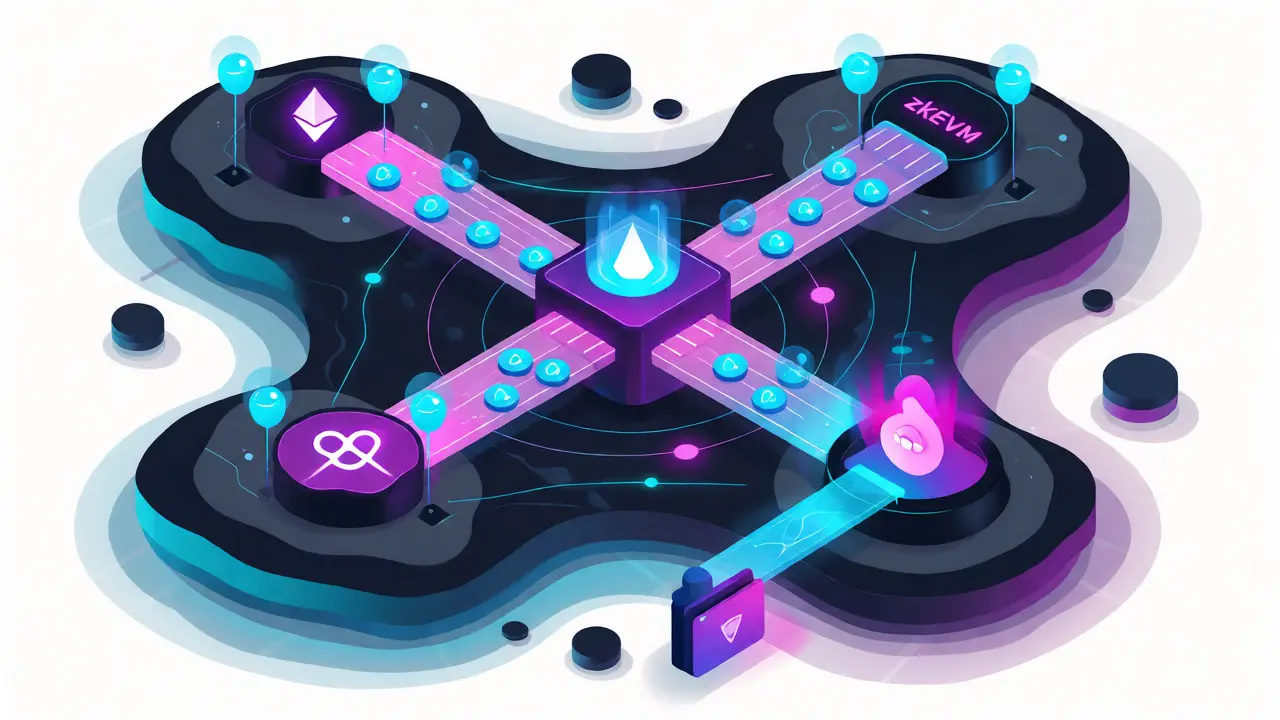
While QuickSwap started as a fork of Uniswap on the Polygon PoS network, it has expanded significantly. As of 2026, the protocol operates on multiple chains, including Polygon zkEVM, X Layer, and Immutable zkEVM. This multi-chain strategy allows users to access QuickSwap without being tied to a single network.
New QUICK exists on both Ethereum and Polygon. If you are interacting with the contract directly, you need the right address. On Polygon, the contract is 0xb5c064f955d8e7f38fe0460c556a72987494ee17. On Ethereum, it is 0xd2ba23de8a19316a638dc1e7a9adda1d74233368. Using the wrong address can lead to lost funds or failed transactions. Always double-check the network settings in your wallet before sending tokens.
The expansion beyond Polygon is significant because it increases the potential user base. However, it also fragments liquidity. When evaluating the health of the project, look at the total value locked (TVL) across all supported chains, not just the main Polygon instance. A healthy DEX maintains balanced liquidity across its deployments.
Market Performance and Risks
Let’s talk numbers. In late 2026, QUICK trades around $0.009 to $0.010 per token. This is a far cry from the inflated prices seen during the bull runs of previous years. For context, in early 2023, the token traded near $0.02. This decline reflects broader trends in the Decentralized Finance (DeFi) sector, where many governance tokens have struggled to maintain value despite growing usage.
Why did the price drop? Several factors play a role. First, the token split increased the circulating supply by a factor of 1,000. While the economic weight remained the same, psychological barriers were removed, potentially leading to higher sell pressure from smaller holders. Second, inflationary emissions continue to mint new tokens over a four-year schedule. As of recent documentation, roughly 70-75% of the max supply is circulating. The remaining tokens are gradually released, which can dilute existing holders if demand doesn't keep pace.
Investors should be wary of "cheap" unit prices. A token priced at $0.01 isn't necessarily cheaper than one priced at $10 if the latter has a much lower supply. Always calculate the Market Cap (Price × Circulating Supply) to compare valuation accurately. QUICK’s market cap places it as a small-to-mid-cap asset, meaning it carries higher volatility and risk compared to established giants like UNI or SUSHI.
Getting Started: How to Buy and Store QUICK
If you want to participate in the QuickSwap ecosystem, you need to acquire New QUICK. The easiest route for most people is through centralized exchanges. Binance lists QUICK/USDT, QUICK/TUSD, and QUICK/BTC pairs. Other platforms like Coinbase and Kraken may offer different pairings depending on regional regulations.
For those preferring decentralization, you can swap for QUICK directly on QuickSwap using stablecoins like USDC or DAI. This keeps your assets in your own wallet, giving you full control. Just remember to bridge your funds to the appropriate network (usually Polygon PoS for the best experience).
Storage options include hardware wallets like Ledger or Trezor for long-term holding, or software wallets like MetaMask for active trading and staking. Since QUICK is an ERC-20 compatible token, it works seamlessly with any standard Ethereum-compatible wallet. No special software is required.
Frequently Asked Questions
Is Old QUICK worthless now?
Not exactly worthless, but it has no functional utility. It serves only as a claim ticket to convert to New QUICK. If you do not convert before the deadline, you risk losing significant value due to the decreasing conversion ratios.
When does the Old QUICK conversion deadline end?
The final deadline is February 5, 2027. However, the favorable 1:1,000 conversion rate ends on November 4, 2026. After that, the ratio drops progressively, making early action highly recommended.
Can I stake Old QUICK in the Dragon’s Lair?
No. Only New QUICK holders can participate in staking rewards and governance voting. You must convert your Old QUICK to New QUICK first.
Which blockchain networks support QUICK?
QUICK is primarily deployed on Polygon PoS and Ethereum. The broader QuickSwap protocol also supports Polygon zkEVM, X Layer, and Immutable zkEVM, though token availability may vary by specific deployment.
Why did QuickSwap increase the supply to 1 billion?
The community voted to increase supply to lower the unit price, making the token more accessible to retail investors. This was a cosmetic change to market perception, not a fundamental change in economic value.
Next Steps for Investors
If you currently hold QUICK, check your wallet immediately. Determine if you are holding Old or New tokens. If you hold Old, prioritize the conversion before the November 2026 deadline to preserve your value. If you are new to the space, research the current TVL and volume metrics on Dune Analytics or DefiLlama to gauge the protocol's health. Don't just look at the price chart; look at the activity levels. A quiet chain is a risky investment, regardless of how low the token price looks.
 Finance